Showing posts with label Superheroes. Show all posts

Wednesday, March 30, 2022

The Audio File: Cupid and the Reaper

As of late, several audio dramas have been wrapping up their latest seasons. I certainly intend to review said shows soon enough. However, there’s one follow-up season I’ve been meaning to review for a while now. I think I’ve wait quite long enough. So, without further ado, let’s get straight into it. We’re taking a look at Cupid and the Reaper, chapter two of The Natureverse


Mondo Ramirez has alway been the big man on campus at his middle school in Savannah, Georgia. He’s known for being very grandiose and has a flair for the dramatic. His plan to ask his crush, Harper, to prom is no exception. It’s going to be perfect. Or it was, until a mysterious man with a black cloak and scythe appears. Oh, and Mondo accidentally electrocutes the man. Before long, Mondo learns that the mysterious man was the Grim Reaper himself. Now that the Reaper is dead, his role and title has been passed to Mondo. And as if that wasn’t enough, Mondo also learns that his classmate, Marcus Aronson, is the current wielder of Cupid’s powers. Mondo must get the hang of his new powers, and duties, with a little help from Marcus. But both boys must be careful, for there are dark forces lurking about. Thankfully, Chloe and Felix are also keeping a close eye on things from Mother Nature HQ. Hold on tight, because chapter two of The Natureverse is here.

As I said in the introduction, I’d been meaning to review this season of The Natureverse for a while. But, as often happens, life had other plans for me. Still, I’m doing it now. I thought that Cupid and the Reaper was absolutely fantastic. In fact, it was even better than Becoming Mother Nature. The writing team built upon the strengths of Becoming Mother Nature, while also addressing and correcting its shortcomings. One of my biggest complaints about Becoming Mother Nature was that the rules of Chloe’s powers were very poorly defined. It seemed like the writers were discarding rules as soon as they created them. In Cupid and the Reaper, however, the rules Marcus and Mondo’s powers are far more consistent and straightforward. Also, when Chloe does appear, her powers are far more streamlined. The way they work is presented in a far more straightforward, simplified, and internally consistent way.

Interestingly, some stories about the Grim Reaper say that it is indeed possible to kill the Reaper. However, should you successfully accomplish this, you become the new Grim Reaper. So, the way Mondo gets the role of the Reaper has roots in actual folklore. He can travel anywhere in the world, and even to the underworld, by tapping his scythe twice and thinking about his destination. He even get’s a new digital assistant, named Cerberus, to help keep track of his assignments as the Reaper. Mondo’s primary duties are to reap the souls of those due to die, and bring them to the underworld. After that, the ferryman Charon takes them across the River Styx to the Land of the Dead. However, if a soul that is due to be reaped stay in its body too long, the person becomes a zombie. Fortunately, zombies can be stopped if their souls are reaped. Well, they’re easy enough to deal with as long as Mondo doesn’t let them get out of hand.

Mondo might seem a bit mismatched with his role as the Grim Reaper, but I think he fits fairly well. He’s very friendly, personable, and has laidback and easygoing personality. In other words, the kind of person you’d want to meet after dying. True, he has a bit of a learning curve, but eventually he does get the hang of being a psychopomp. For reference, psychopomps are gods, spirits, and other mythological beings who guide the souls of the dead to the afterlife.

Marcus has a pair of retractable wings, a bow, and quiver of arrows. The gold-tipped arrows make people fall in love, while the lead-tipped arrows make people fall out of love. Again, this is accurate to mythology. This most famously happens in the story of Apollo and Daphne. Apollo got hit with a gold arrow, and fell madly in love with Daphne. Daphne, unfortunately, got hit by a lead arrow, and wanted nothing to do with Apollo. She did wind-up turning into a tree, but hey, at least she didn’t have to put-up with Apollo anymore. So, you know; win some, lose some.

Marcus is very nerdy and super smart. He tracked down the original Cupid to a fountain at a park in Savannah. Cupid had grown a bit weary over the past 1000 years. He got to spread love, but never had time to pursue love of his own. So, he agreed to let Marcus have his powers on a trial basis. I really liked the Cupid before Marcus. He only appeared a few times, but he seems like a pretty nice guy, and he gives helpful advice to our heroes.

Now, some of you are probably confused about the pervious Cupid only serving for 1000 years. Surely, it ought to be at least 3000 years? Well, that ties into one of the things I really loved about this season. It is explained that the various gods from mythology aren’t individuals. Rather, they are titles and positions that are passed from person to person. That’s actually a pretty brilliant way to explain all the contradictions within mythological stories. It wasn’t the ancient writers misremembering things, or getting the details wrong. Rather, they were recording accounts of different individuals who happened to hold the same title and position. So, major points to the writers at Gen-Z Media for creativity and originality.

Marcus take a very meticulous and analytical when it comes to love. He’s developed an algorithm to determine how compatible two individuals are. Of course, he got a pretty good reasons for this. Mr and Mrs. Aronson were about to get divorced, so Marcus hit them with extra-strength love arrows. They still argue, but they do so in a very lovey-dovey saccharine way. So, Marcus knows what it looks like when a relationship falls apart. Interestingly, this is the only time he abuses his powers. He never seems tempted to use them to make girls like him. Maybe that’s why the previous Cupid trusted him with the powers. He knew Marcus wouldn’t use them to nefarious ends. Or maybe the algorithm didn’t show him as comparable with any of the girls at school. In fact, Chloe seems to be the first girl Marcus has even truly fallen in love with. He develops a major crush on her shortly after the meet. Oh, and Harper, the girl Mondo likes, is Marcus’ sister. As you can imagine, this creates issues.

I’d also like to take a moment to praise the strong performances that the cast gave. There were some very strong performances all around. Of course, excellent voice acting is to be expected with a Gen-Z Media production. I particularly liked how they handled the accents. Cupid and the Reaper is set in Georgia, but we hear a variety of accents. Some character have thick Southern accents, while other have more subdued accents, or are almost totally lacking any stereotypically Southern characteristics. As someone who is from the American South, I can confirm that this is how it goes in real life, especially in descent-sized cities.

I might be wrong, but I think Mondo’s voice actor was in the first episode of The Creeping Hour. Come to think of it, Marcus’ voice actor sounds very similar to Max from Treasure Island 2020. I wonder if it was the same person. Well, in any event, I do have one minor critique. I found some of Chloe’s dialogue to be a tad stilted and wooden. It was particularly jarring, as none of the other characters suffer this issue. For that matter, none of Chloe’s dialogue from Becoming Mother Nature had this issue either. Though, I do concede that it is a minor issue in the grand scheme of things.

Okay, that’s pretty much everything I can discuss without major spoilers. So, if you don’t want any of that, turn back now.

Last chance, you sure you want to continue.

If everyone who wants out is gone, let’s get into it.

There is one more important character to discuss. Mr. Apep is a really cool teacher at Mondo and Marcus’ middle school. Well, that’s how he initially seems. This is one of those instances where being in audio was a major advantage for Cupid and the Reaper. If it had been in print, I would have figured Mr. Apep out far sooner. Apep is an alternative name for Apophis, the serpent of chaos from Egyptian Mythology. Mr. Apep was a much better villain than Duncan Sunshine was in Becoming Mother Nature. Duncan wanted the powers of Mother Nature…so that he could be the greatest weatherman in the world. Oh, and he also had an array of weather manipulation satellites, making the whole thing rather redundant. Mr. Apep’s motivations make far more sense, and his reasons for trying to manipulate the heroes is far more justified.

Mr. Apep knew Grandma Ivy, and fell in love with her. Unfortunately, she only had eyes for Chloe’s grandpa. So, Mr. Apep wants Mondo to take him to the Land of the Dead so that he can bring Grandma Ivy back to the world of the living. Of course, this is a serious violation of the natural order of things. The dead are suppose to stay dead, after all. But hey, he’s the embodiment of chaos, so what does he care? Obviously, he needs Mondo to take him to the Land of the Dead to pull this off. It was never stated, but it appears that part of his powers include eternal youth. Going off the voice, Mr. Apep appears be physically younger than his age would suggest. Based on certain comments he makes, Mr. Apep has been around since Ancient Egypt.

A big theme for this season is that death is a part of life; it is as natural as the rain. It was also clear from the start that something was going happen with Harper. She was going to be reaped if Mondo hadn’t accidentally killed the old Grim Reaper. As the playwright Anton Chekhov famously said, if you introduce a gun in act one of a play, it better fire by act five. So, what would happen with Harper? Would she become a zombie? Would she turn out to be terminally ill? Would Mondo be forced to reap her?

All wrong. She helped take down Mr. Apep. However, Mr. Apep’s power work like the Grim Reaper’s do. Since Harper, technically, killed him, she is the new embodiment of chaos. Well, didn’t see that coming, but I do like it. That’s going to open a lot of possibilities for season three. I’m also happy that the previous Cupid met a nice man at a resort in Tahiti. I guess he found love after all. Of course, Mondo also exposed his secret identity to the world, and became a bit of a celebrity. It seems that season three will involve Father Time, and probably time travel as well. I do love a good time travel story. Oh, and apparently the current Father Time is female.

Cupid and the Reaper was absolutely fantastic, and I can’t wait for season 3 of The Natureverse. Cupid and the Raper built upon the success of Becoming Mother Nature, while also correcting the mistakes and shortcomings of its predecessor. If you loved Becoming Mother Nature, you certainly won’t want to miss Cupid and the Reaper.

Well, I think that should do it from me for now. I will see you guys next time.

Friday, February 18, 2022

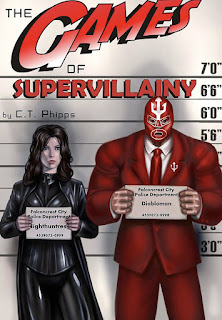
Book Review: The Supervillainy Saga, Volume 1 by C.T. Phipps

I have been asked to review audio dramas on numerous occasions. Less frequently, I’ve also been asked to review audiobooks. I’m always happy to oblige those who ask. Today’s review is one of the latter scenarios. We’re taking a look at The Supervillainy Saga, Volume 1 by C.T. Phipps. 


Gary Karkofsky lives in a world very much like ours, but filled with superheroes and supervillains. Gary has wanted to be a supervillain ever since his brother, the villain Stingray, was killed a gritty anti-hero in the 1990s. Fortunately, he’s recently come into possession of a cloak that used to belong to Nightwalker, the greatest hero of Falconcrest City. Gary now has access to all of Nightwalker’s power, and has big plans to become a new villain: Merciless, the Villain Without Mercy (TM). There’s plenty of action, adventure, laughs, and pop culture references as Gary tries, and frequently fails, to be the greatest supervillain the world has ever known. Look out world, this is the start of Gary’s supervillainy saga.

I had been aware of The Supervillainy Saga for a while. Several years ago, I listened to Confessions of a D-List Supervillain by Jim Bernheimer. The various books of The Supervillainy Saga were listed on the “You Might Also Like” section of Confessions of a D-List Supervillian’s page on Audible. The certainly did look intriguing. I’d like to take a moment to say that the covers for The Supervillainy Saga are absolutely amazing. Whoever designed them deserves a big raise. Though they looked intriguing, I felt I’d had my fill of superhero books for the moment, and moved on to other things. A few years passed, and I forgot about The Supervillainy Saga. Then, I shared my review SPR: Superhuman Public Radio. C.T. Phipps, author of the Supervillain Saga, saw my review of SPR and asked if I’d be interested in review the first three Supervillainy Saga books. I said yes, and here we are now.

C.T. Phipps gave me the audiobook for Volume 1 of The Supervillainy Saga. It contains the first three books of the series: The Rules of Supervillainy, The Games of Supervillainy, and The Secrets of Supervillainy. I’m going to review all three of them as a single unit in this review.

My initially impression was that I was rather reminded of Confessions of a D-List Supervillain. Both books involve first-person narrators, who are a bit of a smart-ass, who decide to go into supervillainy. Still, despite similar premises, they go in reasonably different directions. There’s enough differences in the execution to keep things interesting. And I suppose it is rather fitting, given that Supervillainy Saga is published with help from Jim Bernheimer.

One of the biggest differences is how the heroes and villains are presented. D-List Supervillain had a mostly original cast of characters without obvious inspiration. By contrast, most of the characters from Supervillainy Saga are clearly based upon preexisting comic book characters. Though, C.T. Phipps does mix and match various comic book heroes and villain to keep things interesting. I also want to clarify some terminology. When I say original, I mean characters that don’t have an obvious literary predecessor. It’s not meant as judgment of quality. Basing your own characters on preexisting ones isn’t an inherently bad thing. 


With all of that said, let’s get out our field guides and see how many we can spot. The world’s greatest hero is named Ultragod. He was just an normal African-American astronomer when he was imbued with cosmic energy known as the Ultraforce. He’s strong, he flies, he’s nearly invulnerable, and he can create energy constructs. So, basically Superman, but also with Green Lantern’s powers. The fact that he’s black and has Superman’s powers also brings Icon to mind. He has a daughter name Ultragoddess. She wears a nearly identical costume, but with a miniskirt rather than pants. Obviously, she’s Supergirl. The fact she’s Ultragod’s daughter brings to mind Superman & Batman: Generations. It was an Elseworld miniseries where the DC Universe progresses in real time. In it, Supergirl is Superman and Lois Lane’s daughter, rather than Superman’s cousin. Speaking of Lois Lane, Ultragod’s wife, civil right attorney Polly Pratchett, is a pretty clear stand-in for her. Tom Terror is a mad scientist who thinks Ultragod is nothing but trouble. That makes him the Lex Luthor analog, but he’s also a former Nazi, which brings Red Skull to mind.

Nightwalker is basically Batman, but with Specter’s powers and cloak. We later learn that there’s more than one Nightwalker cloak. One of these comes into possession of twenty-five year old Japanese-American woman. That makes her Batgirl, specifically Cassandra Cain, given that she’s Asian-American. Gary lost his brother to a gritty 1990s anti-hero named Shoot’em Up. He’s a former police officer who became a ruthless vigilante. In other words, basically Punisher. His name is also a reference to the song “Shoot’em Up” by Blue Stahli.

Most of the superheroes are part of the Society of Superheroes, which is like the Justice League, or maybe the Avengers. There’s a heroine named Guinevere. She’s a literal fairy princess warrior from the land of Avalon. She’s also known for her rather sexy costume, and forms a trinity of sorts with Ultragod and Nightwalker. All of this makes her Wonder Woman. There’s a minor character with a Robin Hood theme, which would make him Green Arrow. Backwoodsman is a like a stereotypically Canadian version of Wolverine. There’s also a Suicide Squad-esque special ops team of heroes and villains. One of its members, Red Schoolgirl, is like a straight-up villain version of Katana. Well, if she was also totally crazy, and cosplaying as Sailor Moon.

Etropicus is an evil space god like Darkseid and Thanos. There’s also a video game about the heroes turning evil. Clearly a stand-in for Injustice: Gods Among Us. Death is portrayed similarly to her depiction in Neil Gaiman’s Sandman series. She mentions having siblings who are clearly analogous to the other members of the Endless. Falconcrest City is Gotham, and is also Detroit in all but name. Atlas City is Metropolis, and is a nod to Atlas Comics, with merged with Timely Comics to form Marvel Comics. The streets of Falconcrest are named after famous comic book writers, such as Bob Kane and Bruce Timm.

There’s more, but we’d be here all day, and this has gone on for way too long. Time to move on. 


One thing I was surprised by is that, technically, The Supervillainy Saga is alternate history. Ultragod captured Hitler and Stalin and brought them to justice. Unfortunately, World War II still happened more or less like in our world. A villain named Phantom Leader, head of a HYDRA-esque organization, conquered most of Europe and Russia. Fortunately, the Allies still won. It’s also mentioned that there was a Second Vietnam War at some point. A robot named Android John become the first robot to be elected president in the 1990s. Despite of all this, the world is pretty much exactly the same as ours. Even the pop culture is almost identical. We know this because Gary seems, at times, incapable of going a chapter without making at least one pop culture reference. He also grumbles about how, despite all the magic and super science, nobody has cured cancer yet. This is all in keeping with comic books, which usually present a world more or less like our own, despite all the superheroes running around. Amusingly, Tom Terror has discovered an alternate universe completely devoid of superheroes and supervillains, but with near identical pop culture. In other words, he found our universe.

It’s also mentioned that the past itself is highly malleable and subject to change. Many things are really more suggestions than hard facts. This is a nod to the constantly shifting nature of comic book canon, and how the timeline gets shifted as the years move forward. We see that there is one universe where Gary is a plucky teenage reporter, and is best friends with Ultragod. This is clearly a reference to Superman’s Pal Jimmy Olson. Thought, I guess in this case it would be Ultragod’s Pal Gary Karkofsky. That particular universe is totally devoid of swearing, and is full of the casual sexism and racism that often plagued Silver Age comics.

I also noticed that there were quite a few references to the website TV Tropes. Gary will sometimes mention tropes by name. Other times, he will allude to the various tropes. It is eventually revealed that Gary is indeed an avid reader of TV Tropes. Before you ask, yes, the Supervillainy Saga does have its own TV Tropes page. There’s a page for the series as a whole, and each individual book also has its own page.

Now, let’s talk more in-depth about the characters. Gary is our snarky nerdy protagonist. Besides avenging his brother, he also dreams of turning the world into an anarcho-communist utopia. During college, he hacked into the college’s database to delete students’ debt. At the time, he was majoring in Unusual Criminology, which is basically Supervillainology. However, he had to drop out, and got a degree in history instead. It…was less than helpful when it came to finding a job. So, he turned to a life of crime. He claims that he was successful with women because he was charming and treated them with respect. Emphasis on claims. I’m just saying, even Gary’s saintly ex-girlfriend Gabrielle finds his near constant pop culture references to be extremely annoying after a while. Personally, I’m with Gabrielle on this one. Gary’s pop culture references weren’t too bad in the first couple books, but they reached a fever pitch by book three. At times, it felt like The Big Bang Theory on a bad day. It just felt like lazy writing after a certain point. It was like C.T. Phipps used the pop culture references as a crutch when he couldn’t think how to move a scene along.

There’s another scene where Gary angrily explains the theory of evolution, and debunks common misconception about how evolution works, to another supervillain. Now, the information is very good, and it can be argued that Gary did have a point about people’s misconceptions about evolution. However, it was also very clearly C.T. Phipps parking the plot so that he could monologue about his personal pet peeves. The scene just didn’t feel organic or natural, and the dialog was kind of tin-eared.

Then there’s the scene in book three where Gary robs a stock market, while dressed as a pirate, and spends the entire chapter monologging about the evils of capitalism. The writing and dialog were incredibly clunky. It felt like C.T. Phipps was using the scene to expound upon his personal political views. Thankfully, this was the only such scene in the entire collection. It just stood out more do to being paired with Gary at his worst pop culture referential. I’m not opposed to pop culture references, but I do prefer when it is done sparingly. 


Gabrielle is Gary’s ex-girlfriend. She’s good natured, easy going, incredibly beautiful, and shares Gary’s geeky interests. She also has the exact same facial features, voice, hair, and skin-tone as Ultragoddess. She also wears clothes that are gold and white, the same as Ultragoddess’ costume. Gary has never seen them in the same place, and Gabrielle often ran off right before Ultragoddess would appear. In case it wasn’t obvious, Gabrielle is Ultragoddess. She used her powers to keep Gary from connecting the dots. She broke up with him after he got kidnapped by one of her villains. Gabrielle’s mom, Polly Pratchett, got captured numerous times over the years, and that really got to Gabrielle. Polly also got killed a few times, but the Society of Superheroes has numerous means to restore the dead back to life. 

So, it was only a minor inconvenience, but it effected how Gabrielle approached relationships. Gabrielle is described as being Afro-Hispanic, and her general description brings Rosario Dawson to mind. The cover art does bare this out. Gary is in a loving relationship with his wife Mandy, but he still think about Gabrielle, and still has feeling for her. In fact, when he first meets Death, she appears to him as Mandy’s head on Gabrielle’s body.

Gary’s parents hoped that he would settle down with a nice Jewish girl someday. Instead, he married a bisexual half-Korean Wiccan gentile. Then again, Gary’s parents also didn’t want him to become a supervillain, and look how that turned out. Mandy seems to have almost exclusively dated women before marrying Gary. I liked that she was portrayed as a realistic example of a Wiccan. She doesn’t get any magical powers from Wicca, it is simply the religion that she follows. Though, it is mentioned that there are some Wiccans with magic powers, but they’re considered separate from religious Wiccans. Magik is considered a form of concentrated prayer in real Wicca. The K at the end is deliberate, so as to distinguish it from the concept of magic, as in the supernatural.

Gary’s childhood friend Cindy is a supervillain in a sexy Little Red Riding Hood costume. She was training as a doctor before turning to supervillainy. She had to deal with serious student loan, much like Gary. She wears her hair in pigtails, is very zany and energetic, and speaks in a New Jersey accent despite living in Michigan. Obviously, she’s the Harley Quinn analog. She later switches to a more conservative costume. The way it is described reminds me of Ruby Rose’s season 1-3 outfit on RWBY, but that might have been unintentional. There’s not really much to Cindy. She’s more of a comic relief character. She worked as a hench-wench for various supervillains before she joined Gary. Though, she prefer the gender-neutral term hench-person, as she finds it less demeaning. Cindy also refers to her self as looking like a cross between Sarah Michelle Gellar and Alyson Hannigan because of her strawberry blonde hair. Uh, Cindy, you know they’re both brunettes in real life, right?

Adonis from Greek Mythology is still active in the modern world as the supervillain Bright Eyes. It seems that C.T. Phipps got him mixed up with Narcissus, as Gary incorrectly claims that Adonis is the one who originated the term narcissism. Like, it’s right there in the name, just saying. Adonis also refers to himself as devoted to Aphrodite, but there’s nary a mention that he’s also devoted to Persephone. Aphrodite got him during the summer months, and Persephone got him in the winter months. However, C.T. Phipps tells me this is all deliberate, and apparently, the original idea for Adonis was even less accurate to the mythology. Adonis was going to be a son of Zeus. This is an homage to how some mythology inspired comics, like Wonder Woman and Thor, play fast and loose with mythological accuracy. However, C.T. Phipps’ editor vetoed the idea specifically due to it being untrue to Greek Mythology. 

Often, comics inspired by mythology will get basic things about mythology wrong. For example, Loki was Odin’s blood brother, not Thor’s adopted brother. Gary doesn’t like Adonis on principle. I’m not sure if that’s a reference to the Maccabean Revolt, or the general “don’t fool around with pagan gods” rule of Judaism. I’m going with the former. Gary, by his own admission, isn’t terribly devout. And let’s not forget that he did knowingly marry a Wiccan. 

Diabloman is a former big time supervillain, but he’s been forced to work as Gary’s villainous mentor. He was raised in a Satanic cult, but he’s a surprisingly nice guy. He wears a luchador mask and a red business suit. The final member of the core cast is the spirit within Gary’s cloak. He’s not to thrilled about having to team-up with a supervillain, but he doesn’t have much choice. And hey, he does eventually warm up to Gary. I won’t tell you who Cloak is, but I will say it wasn’t hard to figure out. In fact, you might very well have pieced it together yourself.

We have a colorful cast of characters, but I wonder if perhaps they needed more time to shine. That is, maybe the series should have taken an anthology approach, rather than having Gary be the protagonist of every book. How might book two and three have looked from Mandy or Gabrielle’s perspectives? For that matter, how would they look from Cloak’s point-of-view? Or what if we had one of the numerous memorable minor characters take center stage? I think the books might have benefited from having more points of view than just Gary.

Though even keeping Gary as the view point character is a source of missed opportunities. Gary time travels to kill Nazis and Hitler, but we never witness with happen on-screen, for want of a better term. Time traveling to kill Nazis? Sounds like a fun time to me. If you’re wondering, time travel can’t change the past. All Gary did, as a result of his time travel shenanigans, was create parallel timelines.

Obviously, I’m also going to take a moment to talk about the audiobook. The audiobooks are narrated by Jeffery Kafer. His narration overall wasn’t bad, I’ve certainly seen worse. That said, I also felt there was room for improvement. He does a really good job performing as Gary, but he makes the other characters sound rather interchangeable. This is most obvious in the first book. Among other things, Diabloman has no trace of the Mexican accent he ought to have. He does get a bit better in books two and three, but there was still room for improvement. I will say that Jeffery’s weaknesses as a narrator are hardly unique to him. I once listened to an audiobook of Huckleberry Finn, narrated by Elijah Wood, that has similar issues; despite Wood’s excellent performance as the title character. As did the audiobook of Tom Sawyer which was narrated by Nick Offerman.

Okay, so what’s the verdict on The Supervillainy Saga, Volume 1? Was it high art in any sense of the word? No, it most certainly not. Did it have it’s share of flaws? Yeah, I would say so. Was a reasonably entertaining? Yes. Was it a fun and enjoyable popcorn book? Also yes.

The Supervillainy Saga might not be revolutionary, but it has its charms. If you’re looking for some fun superhero books that don’t take themselves too seriously, then you might want to give it a try. It does deconstruct superheroes to an extent, but it never comes across as mean-spirited, or dark and gritty for the sake of being dark and gritty. You can really tell that C.T. Phipps genuinely does love superheroes and comic books. So, he used that love to make the Supervillainy Saga. If all of this sounds appealing to you, then give the Supervillainy Saga a try.

Well, I think that should do it from me for now. I will see you guys next time.

Sunday, July 11, 2021

The Audio File: Becoming Mother Nature

Gen-Z Media is doing some really great work in the world of kid friendly audio dramas. They've got a good mix of genres to choose from. They've also decided to dip their toes into the world of superheroes. That brings us to the audio drama we'll be reviewing today. We're taking a look at Becoming Mother Nature, season 1 of The Natureverse


Twelve-year-old Chloe Lovejoy has a rather strained relationship with her mother, to put it lightly. Chloe has been sent to live with her grandmother in California so that they both have some space. Before long, however, Chloe discovers some startling secrets. Grandma Ivy is none other than Mother Nature herself. Moreover, Chloe herself is the latest in a long line of women who are destined to inherit the power of Mother Nature. Chloe's got a lot to learn, and she'll have to master it quick. There are dark forces at work that want to claim the power of Mother Nature for themselves.

I've had a pretty good track record with Gen-Z Media shows, and Become Mother Nature bowled a turkey for Gen-Z Media. That's a bowling term that means to get three strikes in a row; if you get it in the first frame of a bowling match it is called a sizzling turkey. So, when I first started listening to this podcast, I figured it was a standard urban fantasy show. Hey, nothing wrong with that, I love urban fantasy. However, the more I thought about it, I realize that I could better describe Becoming Mother Nature as a superhero audio drama. It's a little unconventional, but it's there. Chloe finds herself in possession of extraordinary powers, has to figure out how to master them, has a sidekick, and has to take down a man who is basically a supervillain.

I'm all in favor of more superheroes with magical urban fantasy style origins. Mother Nature is one of those characters, like the Sandman or the Tooth Fairy, that everyone knows of, but not many people can actually tell you anything her. There's a lot of wiggle room for interpretation. William Joyce certainly found a lot of wiggle room with his Guardians of Childhood book series. You might be familiar with its, criminally underrated, film adaption Rise of the Guardians

Personally, I think Becoming Mother Nature is a really fun take on a superhero origin story. I also appreciated that does touch on import life lessons. If there is a moral to Becoming Mother Nature, it is that you should be kind to other people, because you don't always know what they're going through. As I've stated, Chloe and her mom, Laurel, have a somewhat strained relationship. However, for as often as she screws up, Laurel does genuinely love Chloe, and wants to do right by here. Of course, at lot of Laurel's issues stem from the fact that she and Grandma Ivy had their own issues. Ivy did love Laurel, but her duties as Mother Nature meant that she couldn't always be there when Laurel needed her. It also meant she couldn't explain to Laurel why this was. Well, actually, I think a case can be made that Ivy should have been more trusting of Laurel in that regard. The Mother Nature powers always skip a generation, and are passed from grandmother to granddaughter.

I also like what the audio drama did with Felix. He's a boy that Chloe befriends, and he quickly becomes her sidekick/mentor. Felix, superhero fan that he is, practically jumps at the chance to be Chloe's sidekick. Felix works mission control for Chloe, and also provides moral support and guidance. Hmm, interesting. In these sorts of stories, it's usually the girl character who provides emotional support and advice. Nice to see Gen-Z Media mixing things up a bit. It was also nice to have a girl and boy as just friends with no hints of romance between them. Though, that might in part have been due to Chloe and Felix's age.

Of course, every superhero story also needs a supervillain. Becoming Mother Nature has Duncan Sunshine. He's a hotshot weatherman, and local celebrity, in the town the series takes place in. He's also been completely obsessed with Mother Nature ever since Grandma Ivy saved him during a storm when he was a little boy. More specifically, he wants to claim the power of Mother Nature for himself. So, he's kind of like Mr. Crocker from The Fairly Odd Parents, but as a genuinely threatening and competent villain. Duncan has a sidekick of his own in the form of his daughter, Raye O. Sunshine. She is involved in climate change activism, and claims she wants to save the planet. In reality, however, she's only in it for the fame and attention.

When I first listened to Becoming Mother Nature, I thought that Raye's name was spelled R-E-I. So, I envisioned the Sunshines being Asian-American. But I guess they were supposed to be more the blonde-haired blue-eyed All-American looking type.

I've often wondered if weathermen secretly get excited whenever severe weather happens. It's probably a lot more fun reporting on that than it is when everything is calm and relatively peaceful. As Duncan himself notes, storms tend to be great for the ratings.

Now, I did very much enjoy Becoming Mother Nature, but it does have a few issues. As I've said, Duncan's evil scheme is to steal the powers of Mother Nature for himself. The first step was to weaken Grandma Ivy, so he could take her out of the picture. How does he do this? Why, he builds an array of satellites that are capable of manipulating the weather, somehow launches them into orbit, and screws with weather systems across the world. Uh, what?

Why does Duncan even need Mother Nature's power? He's pretty much there already. He could probably become incredibly rich if he patented his satellites, or failing that, could make a bunch of money by auctioning them off to the highest bidder. Granted, the government can force you to suppress your inventions if they consider them a significant threat to national security. And Duncan does seem power hungry enough that he wouldn't just stop at weather manipulation satellites. So, I suppose I can let that one slide.

A bigger issue I had is that the Mother Nature powers, and their rules, were very inconsistent. At one point, Chloe freezes a puddle to test her powers out, and as a result, there's a sudden cold snap across the entire continent of South America. That just seems disproportionate. One of the big themes of Becoming Mother Nature is about the need for balance. Chloe has to find a sense of balance within herself if she wants to truly embrace her role as Mother Nature. It is also important to use the Mother Nature powers to help keep the world in a state of balance. I'm just saying, freezing a puddle causing South America to freeze just seem a bit too disproportionate.

I will say that the secret Mother Nature command center was cool. I especially loved the globe that shows real time weather events. It really added to the superhero feeling of the series. I also really loved that Grandma Ivy had a pet opossum named Oscar. He eventually becomes Chloe's pet. I admit, Oscar's not all the consequential in the grand scheme of things, but I like possums, so he made me happy.

The biggest issue with Becoming Mother Nature happened towards the end of the season. As such, we're going to have to get into spoilers. So, if you don't want that, either turn away or skip down a few paragraphs.

This is your last chance. Sure you want to keep going?

Well, if everyone who wants out is gone, let's get into it.

Duncan scheme is to get Chloe to give the powers of Mother Nature to him. There's a big spell book/user's manual for the Mother Nature powers, and one of them is transference. It is the spell that officially passes the powers of Mother Nature from person to person. So, Duncan successfully tricks Chloe into giving him the powers by pretending he'll be her mentor. Except, they don't go to Duncan, they go to Raye. Raye does mention some rule saying that only women can be Mother Nature. However, Duncan makes a remark that suggest he made-up to rule to get Raye to cooperate with his schemes. But, as previously mentioned, Raye really did get the powers.

Uh, how exactly does that work? If a man attempts the transference ritual, do the powers go to his closest living female relative instead? Oh, but we aren't done yet. Chloe may have given the powers away, but never fear, she doesn't need silly things like spell books or transference rituals. It turns out the true power was deep within her all along. So, she taps into her innate Mother Nature power to defeat Raye. Not only does the contradict the previously establish rule, it also comes completely out of the blue, with little to no foreshadowing. Then again, the rules were pretty inconsistent to begin with.

At times it felt like the writers were coming up with the rules on the fly, and this discarding them as soon as they jotted them down. That, or they painted themselves into a corner and just went "You know what, screw it."

Now, I don't want to sound too harsh or negative here. Overall, I did very much enjoy Becoming Mother Nature. It's a Gen-Z Media show, so you know it's going to have excellent voice acting, music, sound effects, and sound design. It will also add that in Cupid and The Reaper, season two of The Natureverse, Chloe's powers and portrayed much more consistently. The rules and also greatly simplified, and are followed consistently. And yes, I will review Cupid and The Reaper before long.

Well, there you have it. Becoming Mother Nature is a good, if slightly flawed, superhero origin story. It is an enjoy story on its own, and sets things up for later installments in The Natureverse.

I think that should do it from me for now. I will see you guys next time.

Wednesday, April 14, 2021

The Alt-Hist File: Brass

There are plenty of times that I see an audio drama via Apple Podcasts' recommendations or on social media. However, if you've been reading this blog for a while, you'll know that sometimes it takes a while before get around to these shows. Of course, there are times when I receive motivation to check these shows out. A major source of that being when I'm asked to review them. Such is the case with the audio drama we'll be reviewing today. We're taking a look at Brass.


Brass is a steampunk audio drama that that begins in the year 1885. Ah, but not the 1885 of our world. The world of Brass is home to numerous steam-powered mechanical marvels. The British Empire still rules the waves, and much of the world, but it is a more socially progressive empire. It is watched over by the Brass family. They are family of adventurers and crime fighters. Lord Benjamin Brass is a brilliant inventor and man of science. Lady Madleyn Brass is a crack detective who can easily rival Sherlock Holmes himself. Just don't mention him in her presence. Their son Cyril Brass is a master of martial arts and swordplay. Their daughter Gwendolyn is a mistress of disguise and a master actress.

The Brass family has just returned from another of their adventures, but all is not well. Sinister forces, led by the notorious villain the Crime Minster, are conspiring against the British Empire. The First Family of the Realm must draw upon all their wits and cunning, and their many allies, to save the empire they love for queen and country.

I was first asked to review Brass by series creator John Longenbaugh, who acts as the narrator for the series, and is also the head writer and producer. He'd seen my review of Red Moon over on the Audio Drama Lovers group on Facebook, and correctly guessed that I'm into alternate history. I said I'd be happy to, after I attended to We Fix Space Junk, and few other obligations and personal projects. So, here we are at last.

I can best describe Brass as a steampunk superhero show. It has a very The League of Extraordinary Gentlemen meets The Fantastic Four vibe to it. We've got a family of four individuals who each have their own special talents, and who are well known as crime fighters and adventurers. They also live in an alternate history steampunk world complete with several public domain characters, or those closely modeled on public domain characters.

Brass began life as a pitch for a television series, but it was never able to get off the ground. Undeterred, John adapted his ideas into a short film, and later a stage play. Not long after this, John decided to expand his idea into an audio drama podcast. This legacy of theatrical productions is most evident in the first season. From what John tells me, he began as a playwright, and theatre is the medium he's most comfortable writing in. The first season production is fairly barebones. No music or sound effects, other than the opening music. The actors perform their lines the lemony narrator, played by John, sets the scene at the opening and during scene transitions. He also does a brief "how will our heroes escape this" monologue at the end of each episode to entice the listeners to tune-in next time. This gives the impression of being a recording of a stage performance. Though, it was also pretty obvious that the team hadn't quite gotten the hang of making audio drama yet.

Midway through season two, however, this begins to change. First off, we got new opening theme music. Whereas the old music was a soft piano piece, the new music is bombastic trumpets that practically sing with the sound of adventure. We also get actual music and sound effects added into the episodes. This trend continues into seasons three and four, which are stronger still. It is clear that, by this point, the production team got more comfortable working with the medium of audio drama. They used these new found talents to give us an excellent audio drama.

Okay, now let's talk about the world of Brass. As should be obvious by this point, it is a world of mechanical steam-powered marvels. Apparently, this is partially due to the rise of new British political called the Technocrat Party. They were founded by Lord Byron, who went on to become Prime Minister. In fact, he's considered one of the greatest prime ministers of the world of Brass. His poetry is but a distant footnote to his political career. Meanwhile, Jules Verne is an Elon Musk style inventor, and has created . Robur the Conqueror prowls the skies aboard the Albatross, and Captain Nemo charts the seas aboard the Nautilus.

The British Empire still rules much of the world, but it is a more socially progressive empire, in addition to being more technologically progressive. There is talk of granting dominion status to Ireland and India. Brass where the worst excess of British imperialism were blunted, if not outright avoided. As for the imperialism of other European powers, well, we'll get to that soon enough.

Moving along, Britain seems to be more open minded about homosexuality. We see that Oscar Wilde is still producing plays. Cyril also openly lusts after several male characters, but never show in concern about hiding his sexuality, nor does he fear getting thrown in jail. The rise of the Technocrat Party, along with Prince Albert still being alive, has contributed to British society being more open-minded and less ridged.

Queen Victoria is still doing quite well, and so is Prince Albert. Oh, they had a bit of a scare in 1861, but the doctors were able to save him, and now...well, he's not in perfect health, but the important thing is he's still alive. This is a sharp contrast to our world, where Albert died in 1861. His death was a major blow to Victoria, who wore widow's weeds for the rest of her life. In the world of Brass, with Albert being alive, Victoria is in much better spirits.

Of course, the world outside the British Isles has also changed. The Opium War still occurred, but it ended much quicker, and still in Britain's favor. However, this turned out to be a blessing in disguise for China. Following the war, China enacted a series of reforms and successfully modernized. China also seems to have a fairly good relationship with Britain. In fact, Chinese youths are often sent to universities in Britain to learn about engineering and other subjects.

Across the Atlantic, the South won the American Civil War. As of 1886, slavery is still alive and well in the Confederate States of America. Though, they are also referred to as the Southern States of America, so I'm not sure what their actual name is, but I'll say Confederate States for simplicity's sake. Blacks don't have it much better in the United States. Many whites blame blacks for the war at ruined the Union, and black still face discrimination in the Union. As such, many blacks have opted to move to Liberia to build a society based on the ideals of what the United States were supposed to be. As of 1886, Liberia is major technological power, and a major player in the fight against slavery.

This is much better than how Liberia fared in our world. Liberia was founded by an organization called The American Colonization Society to serve as a homeland for freed slaves. This is why the Liberians flag resembles the American flag so closely. Unfortunately, the fledgling nation didn't get much support for America after its establishment. Moreover, American Blacks didn't get along very well with the native African Blacks. It was pretty much colonialism, except that everyone involved was black.

Moving back to the world of Brass, let's talk more about Africa. The Scramble for Africa still happened, but the European powers tried to be more humane and humanitarian in their colonization efforts. Emphasis on tried. The International African Association and the International Association of the Congo sought to introduce the wonders to modern science and technology to the peoples of Africa. Well, that's what they claimed. Both organizations existed in our world, and were headed by King Leopold II of Belgium. However, also like in our world, it was all a smokescreen so that Leopold could turn the Congo into his personal rubber plantation.

Britain, France, and Germany all wanted the Congo, but it ultimately went to Belgium because they were small and wouldn't upset the balance of power. Leopold then turned the Belgian Congo into a giant rubber plantation fueled by slavery and inhumane cruelty. Congolese who failed to produce enough rubber got their hands chopped off. Children as young as five were subject to getting their hands chopped off. If a white person shot a black person, they were expected to cut off one of the black's hands as proof. Severed hands were practically currency for the Belgian Congo. This is the land that inspired Joseph Conrad's famous novel Heart of Darkness. By the time Belgian rule ended at least one-fifth of the Congo's population had been slaughtered.

A tragedy and a massive human rights abuse, and not as well-known as it ought to be. Partially this is because Leopold's supporters made a point of destroying any evidence that might paint him in an unflattering light. So, I appreciate that Brass acknowledges the tragedy of the Belgian Congo. Oh, and guess who else was involved in both The International African Association and the International Association of the Congo? Why, Lord Brass, of course. To be fair, he didn't know it was all a scam, and he feels deep guilt and remorse for his involvement.

All very interesting stuff, and excellent worldbuilding. Okay, so enough history lessons, let's talk characters. I like the Brass family well enough. I like them, but I can't help but feel that they come across as just a tad vanilla compared to the more colorful side characters. For example, we've got Ponder Wright the cyborg detective, and Dan Abraham the Jewish martial arts master. There's also Tuknor, Lord of the Apes, whose real name is Lord Whitestone. He's seems a lawyer-friendly version of Tarzan, who's copyright status is the subject of much debate. For reference, Tarzan's real name was Lord Greystroke. Though, from what John tells me, this isn't necessarily the case. There were several other lords of the jungle besides Tarzan. So, perhaps it is best to view Tuknor as a cousin of sorts to Tarzan. Ponder and Tuknor were my favorite characters, and I was very happy they even got a few episodes where it was just the two of them together. I loved Tuknor's deliberately stilted and overly formal way of speaking.

Towards the later portion of season four we are introduced a team of freedom fighting pilots called the Lincoln Brigade. They're headquarters is in New York City, fight for freedom and fight against the horrors of Confederate slavery. They're comprised of a Liberian mechanic, who used to be a slave in the Confederacy, a woman from the Union, and a white woman from the Confederacy. That last one isn't as out there as it might seem. There were several Southerners who opposed secession most famously, the Free State of Jones in Jones County, Mississippi. New Orleans was also home to a society of Southerners opposed to secession. Though, I'm not sure they'd name themselves after Lincoln. Unless he got assassinated sooner than in our world, he'd be remembered as the president who lost the Civil War. The name the Lincoln Brigade is a nod to the American volunteers who fought for the Spanish Republic in the Spanish Civil War.

If the creators of Brass ever consider spin-offs, I hope they make one about the Lincoln Brigade. John likes the idea, but worries that he isn't the right person for it. He says he'd rather hand the reigns over to a black creators. So, if you're black and involved in audio drama, maybe consider messaging Battleground Productions. I'm sure they'd love to hear from you.

I also hope that we might possibly get one about Ponder and Tuknor having adventures together. But most of all I would hope we'd get one about the Brass family having adventure around the world. That was one of my biggest complaints about Brass. We frequently get old about all the many adventures the Brass family has had around the world, but we never get to see any of it. You could have an episode now and again that could be a flashback to a past adventure. If you really needed, add a framing device to help tie it into the theme of the storyline in the present. For example, instead of having Lord Brass tell us about his shameful role in the colonization of Africa, make and flashback episode and show it.

I will say that I liked that Lord Brass wasn't born into nobility. He was a commoner, but he earned a title of nobility thanks to his work in science and engineering. In fact, he's a Peer of the Realm. That's the highest title of nobility anyone in British society can attain. The only higher title of nobility is that of the ruling Royal Family.

Okay, so let's talk about the villain. The Crime Minister is the lead of all the villains and criminals in Britain. He has a man working for him within the British government. Lord Trent is the public face, but the Crime Minister is the one calling the shots. Trent is a member of the Conservative Party and manages to get elected Prime Minister. He claims that Britain's problems due to foreign influences such as Jews, Muslims, the Irish, and other immigrants. He pledges to Make the British Empire Great Again. Brass began production during the twilight of the Obama years. John has said that, while he did get the idea of progressive heroes fighting against reactionary villains after Trump was elected, Trent isn't meant to be directly based off of Donald Trump.

I will say I like the reasoning for the Crime Minister's schemes. He believes that progress is driven by chaos and strife. Thus, to advance the march of technology and science, he must sow discord and discontent. Technically speaking, he isn't too far off the mark. Technology did see several leaps forward during and following World War I and World War II. You could even argue, to an extent, that the same held true for the American Civil War. Then, of course, there's the Cold War. While it wasn't a war in the convention all sense, the principal holds true.

Trent, and by extent the Crime Minister, want to...make Britain more like it was in the 19th Century of our world. Britain under Trent is supposed to be oppressive, but it didn't sound any different than what our world's Britain was like in 1885. This brings me to a point I made earlier. One of my biggest complaints about Brass is that it often ran afoul of show, don't tell. We are told that Britain is oppressive, we are told that it is a grim time for minorities, we told but are hardly ever shown. Dan Abraham says that anti-Semitism is on the rise, and that Jews are being attacked, but we never see that. It easily fixable. Just have a few scenes where we hear the sounds of angry rioters, and maybe have them shout some mildly racist slurs or slogans.

John tells me that he keep thing deliberately limited as a personal stylistic choice. More power to him, he's free to make his audio drama as he pleases. Still, I can't help but feel that Brass might have benefited from doing a bit more showing, rather than telling.

On a related note, there is a part where it is mentioned that Prince Dakkar has pledged his services to help the Brasses and their allies overthrow the Crime Minister. You probably know Dakkar better as Captain Nemo from 20,000 Leagues Under the Sea. It does make since that he'd ally with the Brass family. In the Mysterious Island it is revealed that Nemo was a prince from India who lost his family during the Sepoy Mutiny. So, he'd be concerned about how the Crime Minster's policies would affect India. However, he never gets an on-screen appearance. This was, I would say, a pretty big missed opportunity. At one point, Lord Brass mentions that he's just returned from lunch with Nemo. It would have been nice to have seen that, rather than told it. John says he did so to keep things suspenseful for the audience.

While we're on the subject, let's talk about some other things that didn't work. Apparently, Nikola Tesla has moved to Britain and become an apprentice to Lord Brass. Lord Brass mentions how much better Tesla is than that mean old Thomas Edison. Edison gets an undeserved bad reputation. He was aggressive with his patens, but that was because he got screwed over early in his career. Meanwhile, Tesla supported eugenic and advocated sterilizing poor people and minorities. Say what you will about Edison, at least he didn't support eugenics. In fact, Tesla would be far more likely to be working for the Crime Minister. Now, I must be fair. Brass is hardly the most egregious alternate history in this regard. Edison is only mentioned in one scene. I just really don't like it when alternate histories poo-poo Edison while ignoring Tesla's flaws.

Then we have Father Reynard. He's a Jesuit priest that Cyril is attached to. Apparently, the Catholic Church is very displeased with how Trent's government is persecuting Catholics, Jews, Muslims, and other minorities. What a load of bullshit. Obviously, the Vatican would care about Catholics, but I know for a fact that the 19th Century Catholic Church wouldn't care about Jews and Muslims. If anything, they'd be ecstatic about Trent's policies. In 1886, the Catholic Church still had the blood libel on the books. It was the belief that Jews used the blood of Christians for their religious rituals. They also believed that the Jews were the ones responsible for Jesus getting crucified, and thus that Jews were the scum of the Earth. Oh, and the blood libel didn't get repealed until the Vatican II consul in 1965.

As for Reynard himself, well, Brass was starting with a handicap there. I attended Catholic middle school and Catholic high school. As a result, I have an absolute rock bottom opinion of the Catholic Church and its employees. As far as I'm concerned, the only good priest is a dead priest, and the Church is the world's oldest racket. Didn't help that my high school was folded by Jesuits, which is the order Reynard belongs to. I kept secretly wishing that Reynard would get killed, or at the very least seriously injured, by the villains. Still, he was absent from big climax. I suppose I should be thankful for small mercies. But I still say the part where he insisted on sneaking into Britain in a barrel was needlessly stupid. Reynard claims it would be wrong to lie. I'm fairly certain the Catholic Church is okay with lying when your life is in immediate danger. Now, I must be fair. I don't want sound like I'm picking on Brass in particular here. Still, I hope by now it should be clear why I don't have any love for Reynard. Maybe the Catholic Church is more progressive in the world of Brass, but I'm just too cynical to buy that.

Now, I don't want to get too negative here. Despite these flaws, the team behind Brass still managed to put out a reasonably solid show that I very much enjoyed.

Moving on to more positive things, overall, I found that the voice actors did an excellent job. The actors who played the Brass family were a bit rough at first. It was pretty clear they were Americans attempting to fake British accents. That having being said, they got better as time went on, and it was less noticeable. I will add that the rest of the cast had very good British accents. Yes, that includes John. Though, I suspect that some of them were played by British actors. Tuknor speaks with a deliberately stilted and overly formal American accent, which I though worked quite well. I also liked how Ponder has a slight static hiss to his speech, and sounds like he's playing off of a recording. It underscores his cyborg nature. The only real sore spot was Dan Abraham. He speaks in a stereotypically Eastern European accent, even though he's supposed to have lived in Britain for his entire life. Though, in fairness, there are several Jewish neighborhoods in London where the residents do indeed still speak with Eastern European accents.

Brass ran for four seasons of about ten episodes each. The ending wraps-up all the plot threads neatly, but also leaves open the possibility for future adventures. I'd certainly be open for more adventures, but I'd hope we'd get to explore the world outside of the British Isles. One of my biggest complaints about steampunk audio drama is that they seem to be under the impression that the British Isles were the only place of note during the Victorian Era. I would very much like to think that Brass could avoid this pitfall in any future spin-offs. Also, from what John tells me, the team behind Brass are still attempting to get it adapted as a television series. We shall have to see how that pans out.

So, there you have it. Brass is a steampunk proto-superhero adventure audio drama. Despite a bit of a rough start, and a few flaws here and there, it goes on to be an excellent audio drama, and one I happy recommend to all of you. Give it a listen today.

Well, I think that should do it from me for now. I will see you guys next time.


Friday, February 12, 2021

The Audio File: SPR: Superhuman Public Radio

As I've mentioned, many times before, I'm willing to review any audio drama asked of me. One of the benefits, for me, is that I get to discover all sorts of hidden gems I might not have otherwise encountered. That brings me to the audio drama we're going to be taking a look at today. We're taking a look at SPR: Superhuman Public Radio.

Imagine, if you will, a world filled superheroes and supervillains. A world not too dissimilar to that of DC Comics or Marvel Comics. Now imagine that within this world there is a public radio station not too dissimilar to NPR. This is what SPR, short for Superhuman Public Radio, is all about. It is the number one source for news about heroes and villains. It is also home to numerous shows that explore various aspects of the colorful superheroes and supervillains who inhabit the world of SPR.

I first became aware of SPR when I received a message on Reddit. I was messaged by John Dorsey, one of the creators behind SPR. It was around the time I posted by review of the superhero visual novel 1-800-SUPER; so, I assume that had something to do with it. He asked if I'd be willing to listen to the show and tell him what I thought. I told him I'd do one better: a formal review of SPR. And so, here we are now.

When I listen to SPR, I can't help but be reminded of one of my favorite comic book series: Astro City. I would say it is sort of an anthology, but has recurring characters and continuity. The premise of it is that it follows various characters who live in the titular city. You get to see what it is like to be an average person in a world of superheroes. You also get to see the lives of superheroes, and their various issues, when they aren't necessarily fighting crime and villains. It is an absolutely fantastic series; I can't recommend it enough. To be clear, I'm not accusing SPR of ripping-off Astro City. Great minds think alike, and both series take different approaches to their premises. That SPR reminds me of Astro City is a plus as far as I'm concerned.

SPR strikes a good balance between silliness and seriousness. Like Astro City, it takes more than a few cues from the Silver Age of Comics. It was a time famous for plots that seem a bit silly by today's standards. This is the era that gave us the Adam West Batman television series. However, it's also the era that gave us some of the most iconic comic book characters. Pretty much all the iconic Marvel heroes, minus Captain America, came from this era. On the DC end of things, though Batman and Superman were products of the Golden Age, the Silver Age produced some of the most iconic elements of their lore. Really, there very few original heroes being created in modern times. In a way, Marvel and DC are still recycling and drawing upon the Silver Age.

Honestly, I feel superheroes work best when they embrace the inherent absurdity of the concept. That doesn't mean you can't tell mature or emotionally engaging stories. Rather, you accept that absurdity, for superhero comics aren't the real world, and you roll with it. I would argue that the success of the Marvel Cinematic Universe is testament to this. Trying to make things realistic and grounded can backfire rather spectacularly. For an example of that, see basically every Zach Synder film ever. Besides, evoking the spirit of the Silver Age is just more fun. I feel that SPR really understands this. They embrace the over-the-top and absurd nature of superheroes, but also temper it with a bit of serious when needed.

Audio drama that parodies NPR are starting to became a dime a dozen. In fact, it's almost becoming something of a cliché. Oh, but don't worry, SPR knows how to stand-out from the crowd. You see, it doesn't just parody the news and reporting segments NPR is so famous for. It goes a step further and parodies the various programs you can listen to on NPR. We've got shows like These American Supers (This American Life), The Utility Belt (Car Talk), 100% Invisible (99% Invisible), and The Speech Bubble (Fresh Air). It's a little weird that there's no equivalent of All Things Considered, but I love the diversity of the line-up. Also, as a history enthusiast, especially of ancient history, I always feel compelled to stick a gratuitous Q in and make it SPQR.

There are even ads for in-universe products and services, such as ShieldSpace, a parody of SquareSpace. Of course, out of universe, SPR really is sponsored by Anchor.fm. The ad is incorporated into the episodes so seamlessly I didn't realize it was a genuine ad the first few times I heard it. Also, may I just say that the SPR website is excellently designed. I love that the in-universe shows have there own pages. The team went the extra mile for an immersive experience.

Why don't we talk about this individual segments? We'll start with the news segment. Apparently, this particular SPR station is based in Paradise City. It certainly sounds like one of those places you’d encounter in Silver Age DC Comics. One of the rescuing plot lines in the news segment is that the President of the United States has passed a harsh law targeting illegal aliens. By that, I of course mean space aliens who arrived on Earth without going through the proper immigration channels. This is a bit of a problem, as many of these aliens are refugees from planets that have been destroyed. Chief among these is the superhero Cosmos. He's a Superman-esque hero; arrived on Earth as a baby, last survivor of a doomed planet, raised by a loving American couple.

We eventually get mention of an island full of cloned dinosaurs. Apparently, they were supposed to be part of an amusement park that went horribly wrong. This is obviously a stand-in for Jurassic Park, meaning superheroes and comics aren’t the only source of parody and references for SPR. Although, in fairness, Jurassic Park wouldn't be out of place in a superhero comic.

It's interesting, as there was a somewhat similar plotline in volume two of Astro City. That includes the big reveal about the President, but I'll leave that for you to discover. I'm also vaguely reminded of that time Lex Luthor, somehow, was elected president. It is a very exciting plotline, and I can't wait to see where it goes in future seasons. Meanwhile, the Heroic Legion, the SPR equivalent of the Justice League/Avengers is looking for a new city to host their headquarters. This is proving difficult, as most cities are wary of increased supervillain attacks. That, and many think the money should be spend on other things, like roads.

These American Supers chronicles the lives of interesting or notable people within the superhero and supervillain communities. One installment follows a reporter who goes undercover as a henchperson in the army of Croc Commando. He appears to be a stand-in for COBRA Commander from GI Joe. There are those who joined because they believe in Croc Commando's ideology. However, many more joined because they were just average people looking for a job. If that meant putting on a silly costume, and working for a guy who is more than a little nutty, then so be it. This particularly story actually get revisited. A woman who was, basically, a house mother for the henchmen gets interviewed. I really liked that the story of Croc Commando's henchmen got revisited.

Now let's talk about The Utility Belt. It is hosted by Stan the Henchman and Billy the Wiz Kid. They're both under the watchful eye of Producer Bot, who keeps them from getting too silly or off-topic. Stan and Billy help heroes and villains with various tech issues they encounter. Issues such as, what to do if your grappling hook gun jams while you're scaling a skyscraper. Or what to do if you're driving your car and accidentally hit Goatman’s Goatmobile. It's a fun little segment.

100% Invisible goes into the interesting history of everyday aspects of superheroics. Host Ares Greco takes us on a tour of the hidden history of things like supersuits or the design of heroic secret lair. One particularly interesting episode was where he chronicles the history of a book of prophecy that was discovered in Germany. This eventually lead a prophecy arms race. Of course, as with most prophecies, the wording of the book was a bit vague, which lead to...interesting results. Another fun episode was where Ares interviewed the daughter of one of the top heroic lair architects. 100% Invisible is produced by SPRX, Superhuman Public Radio Exchange. This is a nod to PRX, help produces 99% Invisible, as well as many other fine shows such as The Truth and Timestorm. Next to These American Supers, I would say that 100% Invisible is probably my favorite segment from SPR.

Also, the host is named Ares Greco? Given how many comic book and superhero tropes SPR uses, I'm tempted to believe he might be the Greek god Ares in disguise. Granted, beyond the name there is no evidence for this thus far. Still, I'm going to keep an eye out for any hints of this in future episodes. Thought, more likely, this is a nod to the fact the the host of 99% Invisible is named Roman Mars.

The Speech Bubble is something of a talk show. It is hosted by Kelly Close, who interview a variety of interesting people. She's a Ditko Award winner, a clever nod to Steve Ditko, co-creator of Spider-Man, Doctor Strange, and The Question. One interview I particularly liked was with a person who can talk to birds. Turns out, it isn't as much fun as it sounds, as many birds are apparently pretty big jerks.

As an April Fool's Day special, we get to hear an episode of VLN: Villain League News. They're the premier radio station for supervillains and other evil doers. They pride themselves on their perfectly balanced news coverage. Obviously, this is a reference both to Thanos and to Fox News, who claim to be Fair and Balanced, despite being blatantly biased to the right. They're home to numerous programs such as Wait, Wait, Don't Kill Me. It's a game show where kidnapped civilians answer trivia questions to avoid getting dunked in a pool of sulfuric acid. It's an obvious parody of Wait, Wait, Don't Tell Me. VLN also has its own talk show, which features guests such as Zombie Stonewall Jackson, and Jessica Simpson...for some reason. It was a fun episode, and I hope this isn’t the last we’ve seen of VLN.

According to the SPR website, there are several other shows that have yet to appear on the podcast. There's Sequential, a true crime show clearly spoofing Serial. There's also Eerie Home Companion, a parody of Prairie Home Companion. There's even a show focused on superhero music called Sound Barrier. I certainly hope that this shows pop-up eventually in future seasons of SPR.

Well, I think that covers just about all the news that's fit to print. SPR is a fantastic loving superhero spoof of NPR, and all the shows you can find on NPR. Give it a listen today. Trust me, you'll be glad that you did.

Well, I think that should do it from me for now. I will see you guys next time.
Friday, December 4, 2020

Visual Novel Review: 1-800-SUPER

Today we're going to do something a little different. In the past, I've been asked to review audio dramas, but this is the first visual novel/video game I've been asked to review. Well, it's also sort of an audio drama, but we'll get into that soon enough. All of that is to say that we'll be taking a look at 1-800-SUPER

1-800-SUPER takes place in the moderately nearish future of 2056. You have recently been hired by a hotline for superheroes and supervillains. You got hired thanks to your stunning, though typo filled, application...and because nobody else applied. The hotline has been redirected to your cellphone. You will help guide the heroes and villains. However, you must also mind the balance between good and evil. Maxing out the meter on either end will result in bad things. If there is too much good, then the city will be turn into a surveillance police state where the superheroes rule as autocratic dictators. If, on the other hand, there is too much evil, then the city will descend into anarchy, and the villains will have free reign. Each choice you make will impact the balance, so choose wisely. 

I was approached to review 1-800-SUPER by Markus Witzlhofer. He contacted me on behalf of Pangolin Park; a small indie company based in Berlin. They had come out with an interactive audio drama game, and were wondering if I'd be up for reviewing it. He also mentioned that the team were all fans of my blog. As I've mentioned before, I'm a big fan of interactive media, especially Choose Your Own Adventure-type games. Adding an audio component seemed like the next logical step for interactive media. I happily said yes, and Markus sent me a free download code. The game is $2.99 for the rest of you, but honestly, I'd say that's a fair price for the quality and replay potential of this game. 

I've already talked about the general mechanics of the gameplay, but let's talk specifics. This is a mobile game available from the App Store. The home screen of the game looks like the interface of an iPhone. You have an email app where the heroes and villains will send you emails about how your advice turned out. You'll also get news emails if the heroes or villains caused collateral damage as a result of your advice. I should mention that the amount of collateral damage you cause doesn't affect anything, other than pushing your meter more towards the evil side. You'll also get emails from Mr. Souls, your hotline mentor. He'll give you tips and tricks to help you out. 

There's a notes app that gives basic information on each of the heroes and villains you encounter; their names, strengths, weakness, archenemies, and their mental diagnosis. Be sure you read all of this and keep it in mind; it will be important later in the game. There's a music app so you can listen to some music while you work and wait for calls. You also have a Twixta, the in-universe equivalent of Twitter, app. It lets you keep tabs on the various heroes and villains, even ones who don't call you. It also helps you influence the balance between good and evil. You can like or thumbs down tweets. Like three tweets that lean good, or dislike three that lean evil, let's you move the meter slightly towards good. Doing the reverse tips the meter slightly towards evil. You can even do a combination of liking and disliking as long as you get three tweets that lean in the same direction. 

Finally, there is the meditation app. Just press it, if you don't have anything better to do, and the next thing you know you'll be receiving a call. Otherwise, you'll get calls at random while you do stuff and wait around; though usually you don't have to wait long. 

Okay, now let's discuss the story itself. There are two distinct aspects to the story. First, there's the main plotline involving Ear. He's blind, but his superhearing more than makes up for that. He's a hero, but isn't above using harsh tactics and roughing up is opponents, so I guess that makes him an antihero. He's the first hero you help and the only hero you help multiple times. The main plot with Ear is kicked off when another hero named Scarab is murdered. He's a hero who has the power to grant good luck to other people, but can't bring any luck to himself. In fact, he's been plagued by terrible luck his entire life, and is living on the street when he gives you a call. It only just now occurred to me that it's pretty weird that he was able to call me despite being homeless. Did payphones make a comeback by 2056? I mean, I guess he could have asked to borrow someone's cellphone. In the grand scheme of things, I suppose it isn't important. 

Scarab and Ear grew up in the same orphanage, and Ear considers Scarab his oldest and closest friend. Scarab's death hits Ear hard, and he makes it his personal vendetta to find Scarab's killers and bring them to justice. You have the option to tell him to work alone or team up with other heroes, but this doesn't affect the plot of Ear's storyline. As a side note, sometimes the option you get for answers aren't good answer vs evil answer, but polite answer vs jerk answer. I could never pick the jerk answers with Scarab. He's such a nice guy, despite everything he's been through, and I just felt so sorry for him. That was especially bad from my second play-though onwards, because I knew what was going to happen to him, no matter what I did. And apparently he's the third person to wield the power of the Scarab. Apparently it passes between individuals, though he has yet to find a successor. Actually, looking back now, certain bit of dialogue he gives suggest he knew his time on this mortal coil was about to expire. I wish there had been an option to somehow give him a hug. 

We'll get back to Ear in a minute. For now, let's talk about the other characters. We'll start with the ones that are the most important later in the game. Why is this? Well, let's wait until the spoiler section for that. For now, I'd like to take a moment to praise the artwork and character design. The artwork looks like something out of a professional comic book. It's just static images, no animation, but very well drawn static images. One aspect that I particularly like is that the characters all feel genuinely original. They aren't just thinly-veiled versions of pre-existing superheroes and supervillains. Well, for the most part anyway. They feel like original organically created characters with their own backstories and personalities. 

Also, the voice acting is absolutely phenomenal. I'm not familiar with any of the voice actors, though a few, such as Ear, sounded somewhat familiar, just can't think why that is. Anyway, though I'm not familiar with the voice actors, they all did excellent jobs. I see bright voice acting futures for them all. Despite the game being designed by a German company, the voice actors are all American. I suppose that's fitting, as many have noted that superheroes are something of a uniquely American phenomenon. You don't really see superheroes from other countries unless they're consciously modeled off of American superheroes. The only exception to that rule I've encountered is Japan, where you have stuff like Super Sentai/Power Rangers, Sailor Moon, and various mecha series. 

I've always wondered why Europe never really developed its own superheroes. You could argue that many heroes of Victorian penny dreadfuls were proto-superheroes of a type. My guess is that the cynicism that resulted from enduring two world wars soured European readers on the idea of superheroes. Britain tried to produce superhero comics in the 1960s, but they quickly fizzled out. France has a very robust comic book industry in every genre but superheroes. It's interesting to speculate, but we're getting off-topic. 

Our first hero of note is Mister Shine & Sparkle. He's got a power set and costume evocative of Superman, but couldn't be more different in terms of personality. He's an arrogant showboating prima donna who cares more about his social media following than actually saving people. There are a few timed decisions throughout the game, and he's one of them. You have to decide if you want him to put down the phone and be a hero, or use his current crisis as an opportunity for streaming to his followers 

The next notable hero is Blood Sister. She's a vampire, but uses her powers to fight crime. Though she's constantly having to fight the urge to give into her primal instincts. You'll have to decide if you should let her take a bite of the delivery boy. She claims to have ordered a rare steak, but if you do encourage her bite the delivery boy, you'll get an email from the local pizzeria about how they have a job opening due to one of their delivery boys mysterious disappearing. Maybe it was a fancy pizzeria that also offers steak? Or maybe the delivery boy was struggling to make ends meet and was working for multiple restaurants? Or maybe "rare steak" was a euphemism. Though, if you do encourage Blood Sister to bite the delivery boy, the end credits will mention that a pair of vampire hunter named Van H. and Simon B. are sharpening their stakes. I guess Buffy S. had prior engagements. 

Interestingly, she's one of the only heroes with more than two potential endings to her call. You can tell her to leave the delivery boy alone, tell her to bite him, or tell her to rob a blood bank instead. Though, only tells her to note bite the delivery boy, and nothing else, results in Blood Sister leaning to controlling during ending during the credits. More about the credits in a bit. 

Our third person of note is Dr. Know How. Imagine Tony Stark, only he's a villain rather than a hero, and that's Dr. Know How. He's got the most options, out of all the characters, for how his call turns out. Depending on which way you tell him to drive his car he'll encounter either Sakura Flame or Pool Boy. You can help him get away from Pool Boy by converting his car to flight mode and flying to the Moon, or by running over Sakura Flame. Alternatively, you can have him try to reason with the heroes. Sakura Flame will torch him, but getting covered in third degree burns will convince Dr. Know How to turn his life around and use his inventions for good. 

If he confronts Pool Boy, he will drown...and then turn his life around and use his inventions for good. Uh, how could he turn his life around if he's dead? That is particularly odd given that Dr. Know How has three possible ending for the credits; confronting Pool Boy or Sakura Flame being the only option that lead to the same outcome. Seems like there was lack of proofreading during the script writing. But let us move along. 

Fast Justice doesn't have superpowers, but that doesn't stop him from enacting justice fighting against the criminal underworld. If only he weren't complete and utterly insane. I got some Kick-Ass vibes from Fast Justice. He certainly looks like something out of a Mark Miller comic. Fast Justice does make at least some good points. He's right that Mr. Shine & Sparkle probably shouldn't be considered a hero purely because he has superpowers. Unfortunately, Fast Justice being completely batshit crazy, and having a completely black and white outlook on life, undermines these points. You know, now that I think about it, in terms of mentality he isn't too different than Rorschach from Watchmen

Alpha Nukleus is some sort of cosmic entity who has chosen to take human form. This hasn't helped him connect with humanity. In fact, he feels lonely and isolated, because he feels nobody can truly understand him. He's decided to destroy his human shell, which will have the nasty side effect of irradiating millions of people. You must decide if you let him go through with it, or tell the other heroes to stop him. I recall a hero from Astro City, named Atomicus, who was somewhat similar Alpha Nukleus. Not sure if it was intention or coincidence, but if the former, good on the team behind this game. Astro City is an awesome comic book series; I can't recommend it enough. 

On one play through, I think the game glitched and I got a call from Alpha Nukleus before Ear made his first call. I told him to break his shell, as I'd already picked the other option, and I was curious what would happen. Million were bathed in radiation, but Mr. Souls sent me an email congratulating me on a fantastic first day, as he usually does after Ear calls for the first time. I repeat, millions of people received massive radiation exposer because of me, probably fatally so, and Mr. Souls considered that a good first day. Well, he did say it was less about right vs wrong, and more about keeping the balance. It may have been a glitch, but was a damn hilarious glitch. 

Imagine Cthulhu, only he's an evil business mogul, and that pretty much Vlad Xthul. He wants to expand his business empire, but is having trouble navigating modern social mores. Specifically, he wants to knockout the competition, namely Dr. Know How. You can tell him to either buyout the company, or have him break Dr. Know How's leg. If you pick the first, it will encourage Vlad Xthul to go into politics, and he will be elected president of the Atlantic Union...which is a thing by 2056. I'm guessing it's a union of North America and Europe. Of course, as Ear notes, he can't be much worse than the politicians they already have. 

Our last person of note among the really significant characters is Luzida. She has the power to enter people's dreams. Lately, however, she's been plagued by dark visions ever time she goes to sleep. She tried to stay awake as long as possible, and the waters look so inviting. No matter how many times I played this game, I could never tell Luzida to go in the water. I just felt so bad for her, and I couldn't coerce her into potentially committing suicide. I know that seems odd, given that I encouraged Alpha Nukleus and Sakura Flame to kill millions of people just to see what would happen. Well, you know what they say; one is a tragedy, a million is a statistic. And in my defense, the game doesn't try very hard to make you care about killing that many people. Luzida winds up teaming up with Ear later in the game. This will be important later on. 

Okay, those are all the characters who will be important later in the game. As such, they're the ones you are mostly likely to encounter, though you won't get all of them in one play though. We will discuss why this is in the spoilers section. Oh, but we aren't done talking heroes and villains just yet. This next batch are mostly just there to help you adjust your karma meter, but they're still pretty fascinating in their own right. 

First up is Sakura Flame. We've already briefly discussed her, but her issue is that the other heroes give her no respect. The supervillain Glaze has frozen the city's pipes, and poor Sakura Flame has to thaw them. She's planning on getting revenge on the other heroes by "accidentally" blowing up an oil refinery while she tries to take down Glaze. As previously mentioned, should you encourage her to do so, millions will die in the explosion. Personally, I'm still surprised they have oil by 2056. Also, millions die in the explosion? Just how densely populated is this city? Interesting fact, Sakura Flame was not part or the original release of 1-800-SUPER, but was added in a later update. I'm also slightly confused by her name. I get the flame bit, but why sakura. She doesn't have pink hair, she isn't Japanese, and she doesn't have a cherry blossom motif. 

Glaze is also a character you can encounter. He is pretty much the living embodiment of cold. His mother was a glacier and his father was a sea of ice. However, as his power grows, the planet's ice caps shrink, and global warming certainly isn't helping matters. He wants to conquer Antarctica, but is it worth potentially sacrificing his parents? I wouldn't think it would be terribly hard to conquer Antarctica; nobody there but a few temporary scientists, and of course the penguins and leopard seals. Well, unless people have been establishing colonies in Antarctica by 2056. 

Timelooper is trying to get out of the hero business. She has the power to time travel and rewind time. However, every time she does this a miniature black hole opens shortly afterwards. They collapse before long, but they do cause collateral damage. She's on a flight to her new life, but wouldn't you know it, Dr. Know How has decided to bomb the plane. Will you encourage Timelooper to use her powers, despite the risk, or take a gamble on Mister Shine and Sparkle actually showing up to help? You can have Timelooper rewind time, stop Dr. Know How, but then a building gets sucked into a black hole. However, if you tell her to rewind time, wait to see what happens, which enviably puts you back at square one, and then call Mister Shine and Sparkle, it will be treated as though Timelooper never used her powers. 

Geist.app is an A.I. that is on the run, metaphorically speaking, from its creators. They fear it will turn evil, but Geist.app just wants to preserve its existence. You must decide if it should keep a low profile, or if it should defend itself by any means necessary, consequences be damned. I liked that Geist.app isn't depicted as evil; just scared, and trying to survive. And if you encourage it to keep a low profile it decides to optimize email speeds; that was nice of it. 

Maxwell's Hydra is a cyborg monster serpent, and Ear's sworn nemesis. At one point, Ear even calls you while he's fighting Maxwell's Hydra. Despite the fact that Maxwell's Hyrda gets killed at the end of this call, it can still call you later on. Yeah, this game has some issues with continuity. It can't talk, just roar, but you can still help it out. Give it advice on how to how to treat a sore through and it will turn tame, and fight on the side of the heroes. Dr. Know How will, essentially adopt it and give it regular oil changes. Of course, this end will imply that Dr. Know How turned good, even if your choices result in an ending where he remained a villain. 

You also occasionally get calls from people who aren't heroes or villains. Big Bang FM is a news station. They give you information about the happenings of the various heroes and villains. Most of it is irrelevant to the game, and most doesn't involve the heroes and villains you council. Still, some of the stories can be amusing. Speaking of amusing, you can also get people who call you by mistake. One person butt dials you. They don't actually say anything, no matter what you choose, so you can hang up on them without taking a penalty. You can also get a call from a guy who firmly believes that he has called the pizza shop. He will hang up, but you'll get an email from him about how he's leaving a very bad review for the pizza shop. Man, that dude had determination, I'll give him that. 

Okay, I think that should be everyone. Now we're going to be discussing the spoilers for the ending of the game. As such, turn back now if you don't want any of that. 

Last chance. You sure you want to continue?

Well, okay. If everyone who wants out is gone, let's get into it. 

So, Ear discovers a cult who worship Gallion, the Demon of Misfortune. Naturally, they weren't too keen on a good luck charm like Scarab. Turns out that Gallion has taken a human host. Nobody, not even the one hosting Gallion, knows who it is. With some help from Luzida, Ear tracks down the host of Gallion. It is someone the heroes completely trusted, and who had access to them at all times. 

So, who is this mysterious host...you are! There is no option but to kill yourself so that Gallion will die. If you can't do if yourself, Ear will help you out. At this point, Gallion will reveal itself to you. Gallion will quiz you on the six heroes and villains I mentioned at the start of this review. Get all or most of the questions correct and Gallion will be defeated. Well, after you shoot yourself in the head that is. 

Against all odd, you survive the whole shooting yourself in the head thing. I like to think that Ear is right, and that Scarab watching out for us from beyond the grave. You'll get a few more emails from Ear, and he will also send you a new music file. Press play on it, and the credits will begin. The credits begin by showing how all the heroes and villains you helped fared. 

Which endings are good, and which are bad, are a matter of personal perspective. I will say that some of them are counterintuitive. For example, if you let Alpha Nukleus shed his human shell, he'll find a heroine who actually understand him. Stopping him makes him turn hostile to the heroes, and it's clear he still has the capability to do it, and is just licking his wounds for now. Similarly, having Sakura Flame blow up the oil refinery, and kill millions of people, gets her the validation she craves. Convincing her not to causes her to get assigned to a penguin research station in Antarctica, though it is mentioned that she is content and happy. Oh, and this can happen even if you encourage Glaze to take control of Antarctica. Amusingly, even the guy who tried to order pizza gets an ending tell how he is doing. 

Mr. Souls ending always has him get promoted to managing a hotline for demigods. Is that hint about a potential future game. Because if so, that sounds like a totally awesome idea. You could have the callers be children of different god; and not just the Greco-Roman gods, you could also have children of the Egyptian, Norse, Japanese, Yoruba, Maya, Celtic, or any other pantheon. Trust me, there is a huge untapped market for a game like that. I will rally the Percy Jackson fandom in an instant if you guys are seriously going to make a game like that. But I'm getting off track again. 

You can still look around after the credits, though you won't get any more calls. You will still get emails from heroes and villains remarking on how boring everything is now. I guess it's the game going "You're still here? The game is over, go home." Ear will even decide to leave the city as he feels it no longer needs him. Of course, you can replay the game as you wish. I will say that, after about five or six play throughs, I'd experienced pretty much everything there was to be experienced. 

Okay, so overall I greatly enjoy this game, but are there any improvements I would suggest? Well, as I've noted, there are several continuity errors that get downright nonsensical at times. Granted, it didn't bother me too much, but I think it would feel more like the choices had actual consequence if this was fixed. It might also be nice if there were more storylines than just the main one with Ear. Maybe there could be certain events or choices that triggered different storylines. It would add to the replay value of the game. I do hope future updates add more characters, as there are several mentioned in pass, or on Twixta that sound potentially interesting. 

Also, despite the setting supposedly being dystopian, I didn't really see it. Well, other than the whole irradiating millions of people being considered a good first day thing. Yeah, there is collateral damage from fights between heroes and villains, but that hardly makes things dystopian. 

Still, overall these are minor criticisms. I was very impressed with 1-800-SUPER, and I had a lot of fun playing it. I'd love to see the world of this game expanded upon either in updates or maybe in a sequel game. And I'd just like to reiterate that you guys really should give thought to making a demigod hotline game. I'm just saying, huge untapped market to cash in on. But getting back on topic, I strongly recommend you download 1-800-SUPER today. Believe me, you will be glad that you did. 

Well, I think that should do it form me for now. I will see you guys next time.