Friday, September 7, 2018

Comic Review: Three

I love to explore the potential of comic books and graphic novels as a medium. Yes, note that I said medium, not genre. Comics are medium in the same way that television, movies and books are a medium. If I hear another person refer to comics as a genre I will be very tempted to scream my head off. Nine times out of ten, when people refer to comics as a genre what they're really talking about are superhero comics. I love superhero comics as much as the next guy, and I do plan on reviewing some here, but comics can be about more than just superheroes. They can tell a story in any genre you can imagine. Such as, for example, historical fiction. 

Case in point, the comic we're going to be taking a look at today. We're reviewing the comic Three by Kieron Gillen and Ryan Kelly. 


Three takes place in Ancient Sparta in the year 364 BC. It follows three helots names Klaros, Damar and Trepander. They manage to survive as well as three helots can; each day's being its own small blessing. One night, their master, Eurytos, forces them and their fellow helots to get drunk and dance for his amusement. The trio kill Eurytos and his Spartiates in revenge for massacring their fellow helots. Now the three helots are on the run. Danger lurks around every corner as they are pursued by their master's son, Nestos, and a band of 300 Spartan warriors.

So yeah, this comic is, in many ways, intended to be the antithesis to Frank Miller's (in)famous comic-turned-movie 300. Kieron Gillen said that he was inspired to write this comic because he found 300 to be hypocritical, with how the Spartans bragged about fighting for freedom, and yet kept slaves. From the very first pages we get a sense of this. We begin with some helots picking olives, but then they're massacred by Spartans as part of the Krypteia. Krypteia was an annual festival where Spartans were allowed to kill helots just for fun. The Spartans did this to cull the helots, and prevent and slave revolts or other uprisings. It also did a lovely job of keeping the helots in constant fear.

I suppose I ought to explain what helots are. Helots were slaves who did all of the agricultural work, and other undesirable jobs, in Sparta. To say that it sucked to be a helot would be a massive understatement. Besides the Krypteia, there were several other ways to be killed. For example, when young Spartans trained to be warriors they had a final exam to take. However, if they successfully murdered a helot they automatically passed the final exam. We'll talk more about the helots in just a minute, but for now, let's talk about the comics as a whole.

You don't really see many historical fiction comics, at least in America; it's a different story in France and Japan. So, this comic was quite a treat, and there's a very strong commitment to historical accuracy. At the end of the comic there are several pages devoted to explaining the reasoning behind different panels of the comic, and the historical research behind them. There's also an extended conversation with a professor of Classical Antiquity who specializes in the study of Sparta.

Even without all of that you can just feel that there was a lot of time, love and research put into this comic. For example, at one point our trio of helots stop by a statue of Aphrodite, who is carrying a spear, and Trepander remarks that even the gods follow the insane way of life in Sparta. The Spartans did indeed worship Aphrodite. Ares was, unsurprisingly, Sparta's favorite god, but they did worship other gods. Aphrodite is often depicted as Ares' lover, and you could make an argument that love and war spring from the same sorts of passions and emotions. Also, all of the statues are depicted as fully painted in full color, just as they would have been in Ancient Greece.

Another point of note is when we met Nestos' mother Gyrtias. She's shown to clearly be the one in charge of the family plantation, especially after Eurytos is killed. Women in Sparta enjoyed quite a bit more freedom than most of the other city-states of Ancient Greece. They managed the farms and estates while the men were off fighting wars and waging battles.

Then there's the armor the Spartans wear. Nine times out of ten, when you see Ancient Greek helmets they tend to be Corinthian helmets. Corinthian helmets were the ones that covered almost all of the face, and often had plumes on the top. Those appear here, but they're always shown to be older, more antiqued armor inherited from previous generations. The overwhelming majority of the Spartan warriors wear opened-face conical pilos helmets; which is what most Spartans wore at the time of the story.

Overall, the way that Sparta feels in this comic is a nation past its prime. It's been almost 100 years since the famous Battle of Thermopylae. Sparta's glory days are behind it, and everyone in positions of power are keenly aware of this. That's why 300 warriors are sent after the three helots. Even a rebellion that small could have major ramifications for Sparta's waning way of life.

The artwork is absolutely gorgeous; I could start at the drawings all days. It is exactly the kind of quality you would expect from something created by Image Comics. Three clocks in at a total of five issues, and that's one of the few criticisms I have with this comic. It's so good, and I wish there had been more. Now, don't get me wrong, those five issues tell are complete story, and a pretty much perfect just the way they are. Still, I would maybe have liked to spend slightly longer with these characters. Kieron Gillen really should write mor historical fiction comics. If this is what he can do with the history of Sparta, imagine what he could do with other eras of history.

Now, let's talk about the characters themselves. I should warn you that there will be a few spoilers as we continue on past this point. I may wish to turn away if you'd rather avoid those.

Klaros is stoical and reserved. He keeps his head down and does his best to be average in everything he does, at least at the start of the comic. He does this a survival tactic to avoid being killed during the Krypteia. The strongest helots are always killed during the Krypteia. He also pretends to be crippled as part of this, but it turns out there's another, darker reason he does this.

To talk about what that is, we have to discuss the Messenian Wars. Messene was a rival city-state to Sparta, and they got into a war in 743 BC. Sparta won the war, and the Messenians were forced to became helots. In 685 BC the helots attempted a revolt, but they were crushed by the Spartans. In 371 Sparta got into a war with the city-state of Thebes, and the helots of Messene revolted again. This time, however, Sparta was defeated and Thebes emerged victorious. Thebes liberated Messene from Spartan rule, and re-established it as a free city once more. As you can imagine, Messene became a very popular destination for runaway helots.

Alright, so what's this got to do with Klaros? Well, during the war with Thebes some Messenians took refuge in a sacred grove. The Spartans were afraid they'd anger the gods if they went in, so they had their helots burn it down. Klaros was one of the helots who set the grove on fire. Also, turns out Klaros isn't his real name. The grove was in Stenyklaros, so he took the name Klaros so that he would never forget what he did that day. Klaros feels deep shame for what he did, and he's spent his life looking for a way to atone for his actions.

Damar is somewhat similar to Klaros in terms of personality. She lost her husband to the Krypteia a few years before the comic begins. In fact, he's one of the helots we see get killed in the opening pages of the comic. The biggest difference between Damar and Klaros is that, where Klaros has resigned himself to death's eventual embrace, Damar is determined to live and survive. She shows Klaros that, despite the tragedy of his past, he still has things to live for in the present.

Trepander, unlike his comrades, is known for his wit and has a flair for the dramatic. Of course, his tongue is what kicks off the plot. Eurytos didn't like what Trepander had to say while drunk, and that led to the slaughterer of the helots. Still, he is shown to be a loyal friend, and sticks by Klaros and Damar even in the darkest of times. It's implied that his constant joking and sharp remarks is the way he copes with the harsh realities of life as a helot.

I think it's clear by now that I absolutely love Three. Not just one of the best historical comics, but one of the best comics out there in general. Do yourself a favor and pick up a copy today.

That should do it for now. I will see you guys next time.

Wednesday, September 5, 2018

Book Review: The Peshawar Lancers by S.M. Stirling

There are plenty of books I want to listen to, but they just aren't available in audio form.  It frustrating, but it is what it is.  Sometimes, however, my patience is rewarded in a big way.  Case in point, the book we're reviewing today.  We're reviewing the alternate history novel The Peshawar Lancers by S.M. Stirling. 


The Peshawar Lancers takes place in a world where, in 1878, the Earth was bombarded by a series of asteroids.  This event would later become known as The Fall.  In addition to the chaos of the impacts, there were massive tsunamis and five years of endless of winter.  The European powers fled south to their colonies in warmer climates.  The novel takes place in the year 2025.  The climate has long since stabilized, but the world has been forever changed.  The British Empire, now known as The Angrezi Raj, is centered India and has its capital in Delhi.  They've rather thoroughly gone native and the extended exile has produced a unique Anglo-Indian hybrid culture. 

The novel follows several characters from across the Angrezi Raj, and their plots do intertwine and intersect.  First, we have Athelstan King, and his right-hand man Narayan Singh, of the Peshawar Lancers; an elite military team who guard the frontier of the Viceroyalty of India.  We also follow Athelstan's twin sister Cassandra, a highly respected astronomer who is reaching a way to prevent a second Fall.  We also follow Prince Charles and Princess Sita of the British Royal Family.  Finally, there is Yasmini, a psychic girl on the run from the sworn enemy of the Angrezi Raj, the Russian Empire.  Oh, did I mention that Russia is ruled by satanic cannibals?  

I can say without a shadow of a doubt that this novel was worth the wait.  This is one of the best alternate history novels I've read in quite some time.  S.M. Stirling has long been hailed as a master of worldbuilding, and those skills are on full display here.  The world of The Peshawar Lancers is rich, vibrant and detailed.  I could practically smell the spices on the streets of Delhi, feel the rush the wind on a soaring airship, and overall just really felt like I was going on a swashbuckling alternate history British-Indian adventure.  

Let's delve into the specifics of the worldbuilding.  The Angrezi Raj is divided into three primary parts: the viceroyalties of India, Australia and the Cape.  The Viceroyalty of India comprises India, Pakistan, Bangladesh, Sri Lanka, Myanmar, Malaysia and a bit of Thailand.  It is the one we get to see the most of, and it appears to be where the Anglo-Indian hybrid culture is strongest.  It is the cultural and political heart of the empire.  Each of the viceroyalties operates its own colonies across the globe, and India is in-charge of managing the British home isles.  Oh, how the tables have turned indeed.  For extra irony, the British of the home isles closely follow Indian standards of fashion and the India's spin on English.

I suppose I should elaborate on that bit.  English has gone through a few changes since The Fall.  Several lone-words from a smattering of Indian languages have crept in.  Thus, the Angrezi are prone to say things such as "The Kunwar must fulfill his rajadharma for the good of the Angrezi Raj".  Also, the "Th" sound has been replaced by "Dee" and W has been supplanted by V.  Despite all of this, the Angrezi insist that they are speaking the exact same English as Queen Victoria I. 

The Church of England has pretty much become Hinduism in all but name; though it is mentioned a more conservative version, closer to the original thing, exists as well.  Characters frequently swear in the name of various Hindu deities.  Though it was also mentioned that Benjamin Disraeli, who lead the evacuation efforts during The Fall, has become a saint.  Perhaps in the biggest bit of irony, the Angrezi consider beef-eating to be extremely taboo, and Angrezi cuisine has fully embraced Indian ingredients.  Charles and Sita shudder at the thought that their ancestors ate cows.  There's a particularly amusing scene where Henri de Vascogne, a visiting French diplomat, is amazed at how flavorful and tasty Angrezi cuisine is; noting the old stories about British cuisine being bland must have false.  In fact, he finds Angrezi breakfast foods to be a bit over spiced for his taste. 

Most of Britain's colonies in Southern Africa, plus a few Portuguese and would-have-been German colonies, have become the Viceroyalty of the Cape.   They're pretty much Apartheid Era South Africa, but bigger and with a steampunk-lite level of technology.  There's talk of them breaking away from the Raj, but they're still loyal...for the moment.  Afrikaans has become a dead language, but it, along with Bantu, still managed to contribute several words to the Kapenaar dialect.  

Australia and New Zealand form the Viceroyalty of Australia.  Out of all of the viceroyalties it is probably closest to the version from our world.  Fiercely loyal to the Raj, but culturally more conservative, meaning closer to what we'd recognize as Victorian culture.  Their English is the closest to our own, to the point that Athelstan can't understand an Australian member of the Peshawar Lancers.  Australia has a colony in the Pacific Northwest of North America. 

Speaking of which, what happened to America?  It got hit hard by The Fall, and the resulting tsunamis.  The less effected region couldn't handle the influx of refugees, and America collapsed into Neo-Barbarism and tribalism.  There are a few civilized places; Texas has a semi-civilized tribal confederation, California is home to a series of theocratic city-states, and the Mormons are doing pretty well in Utah.  The Angrezi have a few outposts at the major rivers, but no serious settlements.  

Now let's talk about the rest of the world.  France, which is now known as France-outre-mer, evacuated to its North African colonies.  They've held onto Marseilles and a few other places in Southern France, and have retained most of their original culture.  They've also begun resettling Italy and the Iberian Peninsula, though that's being slightly complicated by the Caliphate of Damascus, the successor to the Ottoman Empire.  Egypt has managed to become independent, and acts as a buffer state between France and the Caliphate.  It's also mentioned that Brazil is doing fairly well for itself, albeit they also happen to be members of the caudillo of the month club.  The Dutch evacuated to Indonesia and exist as a client state of the Raj as the Republic of Batavia.  They've got a hybrid culture with Indonesia like the British do with India.  

The Raj's main rival for power is Dai-Nippon.  They're a union of China and Japan, and by that I mean Japan invaded China during The Fall.  They control the Japanese home isles, China, a good chunk of Eastern Asia and they have a colony on the west coast of North America.  They are ruled by a Mikado who, these days, spends just as much time, if not more, in Peking as he does in Edo.  And yeah, Beijing and Tokyo are still called Peking and Edo.  From what we glimpse it appears the Westernization has slightly reversed, with the Nippiness favoring traditional clothing, and samurai still play a role in society. 

By far the most notable resident of the post-Fall world, other than the Angrezi themselves, is the Russian Empire.  The Fall has a massive impact on the Russian psyche.  As a result, they turned their backs on Christianity and embraced Satanism.  Nobody know how exactly this happened, but it is speculated that it might be a very corrupted version the Yazidi belief in Melek Taus, the peacock angel.  Indeed, the Russians often refer to Satan as Melek Taus; though they also associate him with the Slavic god Chernobog.  

Russia retreated to their Central Asian territories, and their capital is Samarkand.  Russia makes a point of keeping its Kazakh and Uzbek subjects terrified and in-line by, among other things, eating them.  At one point Count Ignatieff, the main villain of the book, looks forward to getting home to Samarkand to enjoy a delicious suckling Uzbek.  So yeah, the Russians literally eat babies. 

The one of the most notable features of the Russian Empire are the Sisters of the True Dreamer.  They're descended from a nun who had psychic powers, which they all inherited.  Boys go mad around puberty, but girls keep for several years before their madness sets in.  The madness can be averted with sex, but that also removes their powers, so the Russians make a point of ensuring that doesn't happen.  You might wonder why they never try to run away, but there could be several reason for this.  If the girls never see themselves getting away in their dream, they won't try, and thus you get a self-fulfilling prophecy.  Alternatively, they do try, but their sisters rat them out.  The Sisters are the one true fantasy element in an otherwise mostly steampunk-lite sort of novel.  There is one particularly amusing scene where Yasmini gets a glimpse of several alternate worlds, including our world. 

So, how is this story for realism?  Well, perhaps not the most realistic, but that's not necessarily a bad thing.  The asteroid that killed the dinosaurs was about the size of Mount Everest, so I'm not sure if humanity could have realistically survived The Fall.  Of course, that depends on how much total mass those asteroids amounted to.  Stirling has said that he wrote The Peshawar Lancers because he want to write something that like the adventures stories of Rudyard Kipling, which you can't really do in the modern explored world; but he also wanted to avoid the disappointment of historical fiction. 

He knew what he wanted to happen, built the story around that, and the book is all the better for that.  As you may have guess, I adore the worldbuilding Sterling put into this book.  This book is often described as being steampunk, but I'm not sure if I entirely sure if I agree with that label.  It is certainly true that the book includes several things often found in steampunk works, such as airships and Babbage Engines, but for the most part the technology is typical Victorian and Edwardian stuff. Of course, in the grand scheme of things, the exact labeling is fairly inconsequential.  At the end of the book there is a very large appendix that really fleshes out the details of the history of this alternate world.  

It was kind of amazing to think that Athelstan and Cassandra, both in their mid-twenties, were about the same age as me when I was reading this book.  I felt the same way about Jazz Bashara when I read Artemis, which I will get around to reviewing at some point.  Prince Charles was, I would say, probably different from the Prince Charles of our world.  He certainly sounds younger and more handsome than the Prince Charles of our world.  Well, that and he's the son of King-Emperor John II, who has no analogue in our world that I can think of.  One touch I liked is that the British Royal Family is still called Saxe-Coburg Gotha.  Germany was destroyed during The Fall, and thus World War I never happened, so they never changed their name to Windsor.  

Cassandra's romantic struggles give us insight into the society of the Raj.  It's mentioned that women have made considerable strides and advances, but they still lack the vote.  Cassandra is attracted to Charles, but if she marries him, she'll have to give up her hard-won position at the university.  So it seems that, beneath the adventure and exoticism, the Raj still has its share of issues to sort out.  Of course, for me personally, the lack of air conditioning would be a real killer.   

I haven't really been talking about the characters.  That not because I thought they were bad, or that I didn't enjoy them.  I did, very much so, but when I think of The Peshawar Lancers I always think first and foremost about the amazing worldbuilding.  Hey, if nothing else, it gives you something to discover when you read this book. 


I would also like to take a moment to plug the awesome audiobook version.  The audiobook version is, of course, the whole reason we're having this review.  It is narrated by Shaun Grindell, who perfectly captures the story.  I'm very happy that this amazing work of alternate history is available in audiobook form at long last.  

Well, there you have it.  I've been waiting for The Peshawar Lancers to come out in audio for quite some time, and it was well worth the wait.  Easily one of the best alternate history novels I've read in a while.  Well, I think that should do it for now.  I will see you guys next time. 

Saturday, September 1, 2018

Riordan Retrospective: The Demigod Diaries


Welcome once again to the Riordan Retrospective.  For those of you just joining the fun, this is my look back at the works of Rick Riordan.  That means we're taking a look at Percy Jackson, its sequel series and its spin-off series. This is less of a formal review, and more of a look back, along with my thoughts and observations.  Last time we took a look back at The Son of Neptune.  This time we're taking a look at the short stories collection The Demigod Diaries. 


As per usual there will be spoilers, so turn back now if you don't like that sort of thing.  Everyone who wants out gone?  Good, then let's begin.

The first story is called "The Diary of Luke Castellan".  It takes place several years before The Lightning Thief and follows Luke, Thalia and Annabeth before they came to Camp Half-Blood.  In fact, it takes place not too long before Luke and Thalia met Annabeth for the first time.  Before that, however, they must meet with a son of Apollo named Halcyon Green.  He has the power to see into the future, but what will he say about Luke and Thalia's futures?

A lot of people had been asking Rick to write a story about Luke, Thalia and Annabeth's adventures before they arrived at Camp Half-Blood.  As such, I'm sure this story made many people very happy.  Can't say I was exactly one of those people, but overall I enjoyed this story.  One of the first things that stuck out to me about this story was the tone.  Even at its darkest moments, the Riordanverse always had an undercurrent of wonder and awe at all of the mythical things going on.  That feeling is completely absent here.  There's a much more ominous and sinister tone.  This story almost feels more like a horror story than a fantasy story. 
  
We see the seeds that would lead Luke down his path to try to overthrow the gods.  We also get to find out just where the knife Luke gave to Annabeth came from.  I get the feeling that this isn't the last we'll see of Halcyon Green.  He's just too good of a character for Rick to not being back in some capacity in The Trials of Apollo.  This story was a great way to provide a sympathetic look of one of the Riordanverse's most tragic villains.  All in all, "The Diary of Luke Castellan" was a great way to start off the collection.   

Our next story is "Percy Jackson and the Staff of Hermes".  This story takes place between The Last Olympian and The Lost Hero.  In fact, it takes place about a month after the end of The Last Olympian.  Percy and Annabeth are celebrating their one month anniversary when the god Hermes ask for their help.  His caduceus has been stolen by the giant Cacus, and it's up to Percy and Annabeth to get it back. 

This one was probably my favorite story of the bunch.  It's another story that shows that Percy and the gang are having adventures even when it isn't the summer.  Cacus serves as some great foreshadowing about how Roman Mythology is going to start playing a bigger role in Percy and Annabeth's lives.  At one point he brags about the time he stole all the cattle in Rome.  Well, he serves as foreshadowing to Percy and Annabeth, at any rate.  By this point, we already knew about the Roman demigods and their corner of the world.  My only really criticism is that it seemed like Percy forgot about his Curse of Achilles.  For that matter, Rick Riordan also seems to have forgotten, given that Percy gets minor injuries even though he shouldn't have. 

Hermes rewards our heroes with a romantic dinner in Paris.  That was awfully nice of him.  Of course, going back to The Sea of Monsters, Hermes has always been one of the nicest and friendliest gods Percy and the gang have encountered.  The scene where Percy turns on the caduceus' laser function was fun, and George and Martha, are always fun.  "Staff of Hermes" is a really great story that helps to expand the Riordanverse.

 Our third story is "Leo Valdez and Quest for Buford".  It takes place between The Lost Hero/The Son of Neptune and The Mark of Athena.  Jason, Piper and Leo are scrambling to find a mechanical table Leo made before the chemicals it contains blows the woods up.  Also, said chemicals are vital for the construction of the Argo II.  If they want to get to Buford they're going to have to put up with some very crazy Maenads.

This was probably my least favorite story of the bunch.  The first problem it had is that it stars Jason, Piper and Leo.  I think I've already made it quite clear that I don't find them to be compelling characters in the slightest.  The second, and by far the greater issue, is that it didn't develop them as characters.  Leo is the same annoying Leo, and Jason and Piper are just as bland and uninteresting as ever.  It would have been better if the story had been set at Camp Jupiter before the events of The Lost Hero.  It would have been a great opportunity to get insight into Jason's character, and to develop him as a character.  Also, the Camp Jupiter characters are much more fun to read about than Piper and Leo; just saying.

For the life of me, I just don't understand why Riordan seems to love Jason, Piper and Leo so much.  Well, I suppose I ought to throw this story at least one bone or two.  I did enjoy the Maenads; I had been wondering when they were going to show up.  They claimed they were drinking kid-friendly non-alcoholic eggnog, but they sure did seem awfully buzzed.  While we're on the subject, same goes for Dakota, a son of Bacchus from Camp Jupiter.  He claims that he only drinks kool-aid, but I've got my suspicions about that.  Also, this story claims Camp Half-Blood doesn't celebrate Christmas, but this is contradicted by what we saw in The Titan's Curse.  Well, anyway, let's move on to the last story.
  
Our final story is "Son of Magic".  It follows Dr. Howard Claymore, a leading researcher into the study of death.  During one of his talks he is approached by a boy named Alabaster C. Torrington.  Alabaster wants to know if there is a way to stop death.  Dr. Claymore is hesitant at first, but agrees to follow up with Alabaster.  Before long, Dr. Claymore finds himself drawn into a world of gods, monsters and things he can't even begin to fathom. 

This story is unique compared to the other three because it is not written by Rick Riordan.  Instead, it is written by Rick's son, Haley Riordan.  The first thing that stuck me about this story is the tone.  It's dark, ominous and there is a strong sense of foreboding.  That goes hand-in-hand with the second way this story sticks out: the protagonist is both an adult and a bog-standard mortal.  This is a first on both of those counts.  Dr. Claymore' reaction to discovering the world of demigods and monsters is, I would say, pretty realistic.  We all might fantasize about visiting the Riordanverse, but without magic powers or special training, it would probably be a downright terrifying place to live in.  At times this felt very much like a horror story.

Now let's talk about Alabaster, son of Hecate.  He was one of the demigods who fought for Kronos.  Even after the war ended, he wanted to keep fighting, and refused to accept the armistice.  The gods worried that he might cause an uprising, but Hecate convinced them to spare Alabaster, in exchange for him being exiled from Camp Half-Blood.  He is the first, and thus far only, demigod this has ever happened to.  Chalk another one up for how dark this story is.  I actually had wondered if there were demigods who wanted to keep fighting after the war was officially over, and now I have my answer. 

We also finally get an answer for why monsters can smell demigods so easily. Lamia, the mother of monsters, did it after Hera killed her children in retaliation for Zeus trying to court Lamia.  This was back before Lamia was turned into a monster.  Anyway, due to being a daughter of Hecate, Lamia cast a spell so that monsters could find demigods easily.  She did this so that Hera would know what it's like to lose a child.  Unfortunately, Hera's feelings for demigods ranges from indifferent to downright antagonistic...unless they're Jason Grace, for some reason.  So yeah, thanks a lot Hera. 

Though, I suppose she did throw them one bone.  Well, besides the whole bringing the camps together to fight Gaea the giants thing.  Argus, the hundred-eyed giant, was Hera's faithful body guard.  She loaned him out to Camp Half-Blood as the head of security.  I always thought it was kind of a shame that Argus didn't play a bigger role in the stories, but I digress.

Hecate overall was reasonably well written, though this depiction seems at bit at odds with how Hecate appears in The House of Hades.  However, my biggest issue with this story also involves Hecate.  There are several times that Dr. Claymore has visions/conversations with Hecate where she is sitting in a church and praying.  The implication being that the Judeo-Christian god is real, and all of the polytheistic gods are subservient to him.  The biggest problem I have with this is that it just doesn't fit with the established universe. 

We've seen multiple times that the afterlife is radically different than what Christians say.  Back in The Lightning Thief we even saw a corrupt televangelist burning in Tartarus.  Why would the Judeo-Christian god let people go to pagan afterlives?  It just makes no sense.  Rick has hinted that maybe the Judeo-Christian god does exists somewhere out there, but given the afterlife problem, it feels like red herrings more than anything else.
  
Still, despite these hiccups, overall this story was quite well written.  I'm still partial to "Staff of Hermes" but "Son of Magic" can certainly give it a run for its money.  I see a bright future for Haley Riordan and his writing career.  A very bright future indeed. 

I'll also take a moment to plug the audiobook version of this short story collection.  Each story is narrated by a different narrator.  "Diary of Luke Castellan" is narrated by Nick Chamian, "Staff of Hermes" is narrated by Jesse Bernstein, "Quest for Burford" is narrated by Joshua Swanson, and "Son of Magic" is narrated by Aaron Groben. 

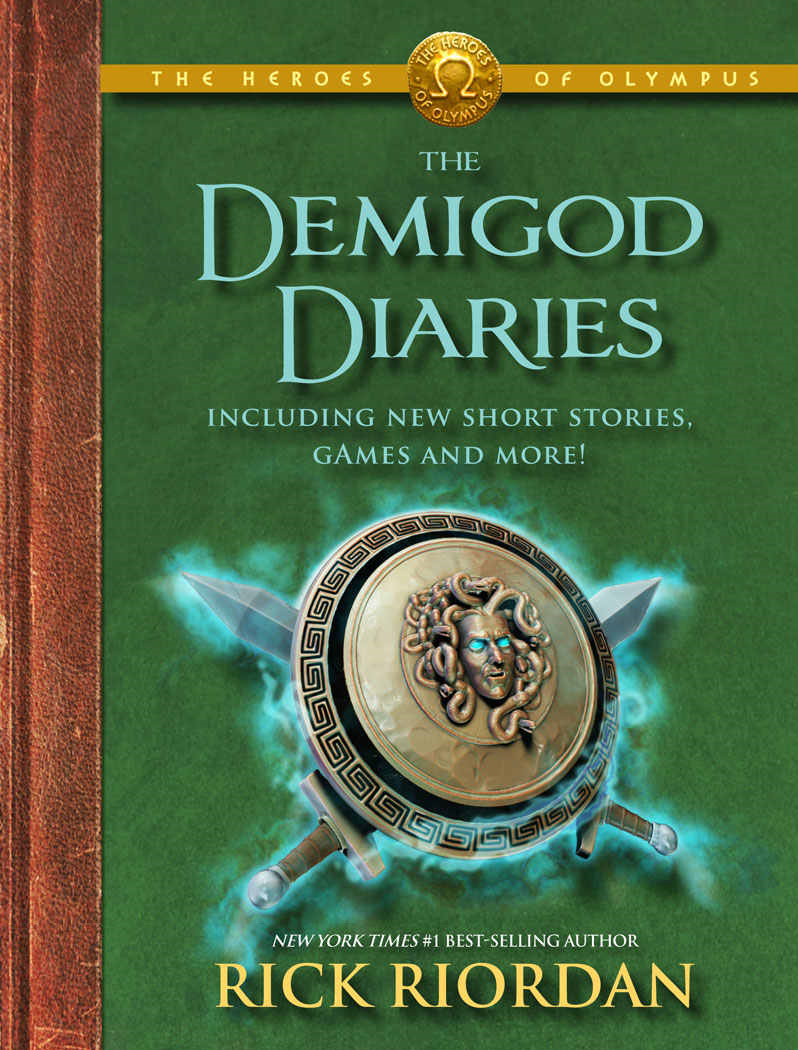
There isn't really much to analyze on the cover.  We have a green background, along with a brown spine, with the shield Aegis and two swords all glowing.  Simple, but I would say still reasonably effective. 

Well, I think that wraps up this retrospective.  Next time we're returning to the world of Egyptian Mythology to finish our adventure with the Kane siblings.  Join me again next time when we take a look back at The Serpent's Shadow.  I will see you then. 

Tuesday, August 28, 2018

Flag of the Kingdom of Leon

This is the flag of the Kingdom of Leon.  It comes from a world where the Reconquista failed and most of Spain remained under Islamic rule.  For many years Leon was forced to pay protection money to Al-Andalus.  However, after a while they were able to appeal to their powerful Christian neighbors for support.  For many years, the boarder of Western Europe was considered to stop at the Pyrenees Mountains.  The Iberian Peninsula was lumped in with the rest of the Islamic World.  This somewhat miffed Leon, as they were often lumped in with the rest of Iberia, when anyone remembered that they existed, that is.   

The discovery of the Americas was delayed by a few decades, but it still happened.  Albeit, it was by the English-funded John Cabot, rather than Christopher Columbus.  The colonization of the New World occurred rather differently than in our world.  For example, Al-Andalus colonized Mexico.  This resulted in a new form of Islam that combined Sunni Islam with tradition Aztec beliefs.  The native converts proved particularly zealous, and more than willing to wage jihad upon their neighbors.  Meanwhile, England colonized Brazil and France proved more successful in its colonization of Canada, among other developments. 

Leon got into the colonization game as well, though a bit later than the other powers.  Their first successful colony was Nova Asturias, located in what would have been the Southeastern United States.  Nova Asturias became a major producer of tobacco, cotton, lumber and other raw materials.  This allowed Leon to slowly build up its economy, rather than blowing through a bunch of money like Al-Andalus' did.  Leon also established colonies in Patagonia, Southern Africa, and even a few islands of Indonesia.  

What Leon lacks in sizes it makes up for in economic prowess.  Recently, despite years of resentment and conflict, relations with Al-Andalus have begun to improve considerably.  Leon is a nation that truly lives up its motto Sub Umbra Floreo, which is Latin for "I Prosper in the Shade".  This is a reference to Leon's historical existence in the shadow of Al-Andalus.

The flag is a simple crimson background with a golden and bejeweled Asturias Cross in the center. 


Sunday, August 26, 2018

Fan Art and Commissions #5

It's been a while since I've done one of these fan art and commission hauls.  Let's do something about that, shall we?

First up we have this piece by the artist Pelycosaur24.  Inspired by the excellent Neil Gaiman comic Marvel 1602, I wanted to see what Percy Jackson and Annabeth Chase would look like if they lived in the early 17th Century.  Thus we have Percy and Annabeth 1604.


It is always a pleasure to get to work with one of my favorite artists, and this piece was worth every penny.  I had them be Spanish because the Heart of the West always goes to whoever is the most powerful Western nation at a given time.  In 1604 that was arguably still Spain.  Annabeth's outfit incorporates elements from the Kamfrau and Trossfrau of Austria, because they were women who accompanied men onto the battlefield.  That was a suggestion from Pely, who is Austrian herself.  I especially love how the outfits evoke their present day clothes, while still being true to the fashions of the 17th Century.


This next one is inspired by that crossover fanfic I wrote combing Percy Jackson and the Olympians with DJ MacHale's Pendragon.  Well, those might have been the base two, but there are other territories and sub-territories in Halla.  Thus we have Pyrrha Nikos from RWBY and Mizore Shirayuki from Rosario+Vampire, travelers from the territory of Remnant and the sub-territory of Yokai Academy, training with Loor on Zadaa.  I'm very happy to have gotten a quality work at a modest price.  As a bonus, I got Stardust-Phantom, the South African artists who made this piece, into RWBY.


Speaking of Stardust-Phantom, that brings us to our next piece.  A Crossover Christmas Carol.  Starring Edward Elric from Fullmetal Alchemist as Ebenezer Scrooge, Weiss Schnee from RWBY as The Ghost of Christmas Past, Bolin from Legend of Korra as The Ghost of Christmas Present, Nico di Angelo from Percy Jackson as The Ghost of Christmas Yet to Come, and Grover Underwood from Percy Jackson as Charles Dickens. 


We're blowing a turkey for Stardust-Phantom.  This one's another one relating to that Percy Jackson/Pendragon crossover.  Here we have Silena Beauregard giving Aja Killian some pegasus riding lessons and explaining a bit about the history of Camp Half-Blood.  Aja is less than thrilled at all of the potentially dangerous stuff that goes on at Camp Half-Blood.  


This one is another crossover clothes swap brought to us by BiCOV.  There was no plot to this one, I just wanted to see how they'd look in each other's clothes.  We've got Annabeth from Percy Jackson swapping with Kurumu from Rosario+Vampire, and Reyna from Heroes of Olympus swapping with Ahsoka from Star Wars: The Clone Wars.  Another quality piece at a bargain price.


Sometimes the fanfictions in my head take on a life of their own.  Case in point, this piece from SophiaBlackoodArt.  I don't exactly know how or why I started pairing Reyna and Ahsoka together, it's just one of those things that kind of just happened.  Well, in the Heroes of Olympus it was said that if Reyna found love it wouldn't be with a demigod, and Rick Riordan had considered making her lesbian.  Also, Ahsoka and Bariss certainly had there moments, as though the Clone Wars writers we're doing everything short of making them a couple.  Make of this what you will.


My inadvertent shipping of Reyna and Ahsoka proved so popular I actually got fan request to commission more art of them together.  That's where this piece from an Australian artist named makeupaname.  Here we have Reyna and Ahsoka celebrating Discovery of Puerto Rico Day, which is a real holiday by the way.  The invisible dude is Millard Nullings from Miss Peregrine's Home for Peculiar Children.  The dude you can actually see is Nico di Angelo from Percy Jackson.  


Speaking of makeupaname, we're got another piece from her.  We've got Superman, one of the most iconic heroes of the 20th Century, along side Percy Jackson, a hero of the 21st Century.  Superman is passing the torch to a new generation of heroes.  Percy isn't sure that he's worthy, but Superman is assuring him that he will do fine, that Percy made him proud, and that he knows the world will be in good hands.  


This piece is another one from LadyLoriel.  The Doctor from Doctor Who has been captured by Cthulu.  So, Dream from Neil Gaiman's Sandman has assembled a team of heroes from across time and space to save him.  We've got Percy Jackson, Bobby Pendragon, Katniss Everdeen from The Hunger Games, and Utena Tenjou from Revolutionary Girl Utena.  They're alert on the streets of an abandoned city as Dream watches over them.  


We'll finish off with another piece from LadyLoriel.  In this one, Inuyasha traveled to the present day to help the Silver Bullets fight crime, but was a bit too reckless with destruction of public property.  So a judge sentenced him to either time in jail or community service.  He opted for community service, which turned out to be volunteering at a summer camp.  So here he is with Skuld from Ah! My Goddess, Arnold from The Magic School Bus and SpongeBob SquarePants.  They're lost in the woods just as the sun is beginning to set.  SpongeBob doesn't seem to mind though.  

Well, I think that should do it for now.  Hopefully we'll be able to do this again soon.  Until then, I will see you guys next time. 


Friday, August 24, 2018

Riordan Retrospective: The Son of Neptune


Welcome once again to the Riordan Retrospective.  For those of you just joining the fun, this is my look back at the works of Rick Riordan.  That means we're taking a look at Percy Jackson, its sequel series and its spin-off series. This is less of a formal review, and more of a look back, along with my thoughts and observations.  Last time we returned to The Kane Chronicles for a look back at The Throne of Fire.  This time we're returning to The Heroes of Olympus.  We're taking a look back at The Son of Neptune, The Heroes of Olympus book 2. 


Percy Jackson is confused and on the run from monsters.  He can't remember why he's on the run, or much of anything for that matter, but thanks to the wolf goddess Lupa he's made it to a safe haven.  Oh, but this isn't Camp Half-Blood, this is Camp Jupiter: training camp for children and descendants of the Roman gods.  Percy barely has time to adjust to this brave new world when he soon finds himself on a quest with his fellow campers Frank Zhang and Hazel Levesque.  The three of them must free Thanatos, the god of death.  To do this they must travel the west coast of North America to the Land Beyond the Gods: Alaska!

As per usual, there will be spoilers, so turn back now if you don't want any.  Okay, everyone who wants out gone?  Then let's begin.

The Son of Neptune always felt like a much better start to The Heroes of Olympus than The Lost Hero to me.  It almost feels as though it was written in response of the criticisms of The Lost Hero.  We're got Percy, a long established and beloved character, to act as our anchor as we are introduced to new characters and new settings.  Also, rather than wasting time on build up, we get straight to the point with all of the revelations and new information. 

One thing in particular that I like was that Percy still acted like the seaweed brain we all know and love even with his amnesia.  This is particularly note worth as it is in sharp contrast to Jason Grace, who appeared to have no personality.  Boy, was that ever foreshadowing about Jason's lack of personality.  On a side note, if you'll remember back to The Titan's Curse, one of the Ares campers was also named Jason.  Just a fun little tidbit I thought I'd point out. 

It was a bit disappointing that Percy lost his Curse of Achilles so early on, but I understand why it had to happen.  Well, you know, apart from the curse being Greek, so he had to lose it to go into Roman territory.  If Percy was, effectively, invincible it would be hard to maintain a sense of drama and tension.  Though, granted, he could always have been in danger from choking or poison.  In fact, he nearly gets killed in that bet with Phineas, but is smart enough to know that he's too important to Gaea for her to let him die.  That scene is also a prime example of how, though he might not be book smart, Percy is smart in other ways. 

After the build-up of The Lost Hero we finally get to see Camp Jupiter and New Rome, and they are glorious.  We've gotten a few hints of Roman Mythology, a few gods like Janus here and there, but this is the first time it's front and center to the plot.  In edition to the mythology we also get a good dose of Roman History.  One of the things that always kind of disappointed me a bit about Camp Half-Blood was that it didn't really do much with the history and culture of Ancient Greece.  New Rome also gives us an answer to the question of what happens after camp, at least for Roman demigods.  After they serve their time in the legion they get to retire to New Rome and do whatever they want, and they don't have to fear any monster attacks.

Unsurprisingly, New Rome appeals to Percy, but I think there's an even deeper level to that.  We learn that Neptune, Poseidon's Roman counterpart, is considered a fairly unimportant god by the people of New Rome and Camp Jupiter.  At Camp Half-Blood he's a living legend and many of the other campers hold him on a pedestal.  At Camp Jupiter he has a chance to be just another face in the crowd.  The fact the Camp Jupiter is decided into cohorts, rather than cabins, probably appeals to him as well.  It might be nice to have Poseidon Cabin all to himself for privacy, but it probably gets lonely in there at times. 

We also get an answer to the question of, what happens when demigods have kids, in the form of legacies.  Legacies apparently get powers too, but those powers get weaker with each successive generation.  Octavian is described as looking like a faded copy of an Apollo kid.  We only ever see Roman legacies, but Greek demigods don't have an equivalent of New Rome, so the implication is that most of them get killed before they can have kids.  Well, that's actually not quite accurate, but more on that in just a minute.  You get a tattoo based on your godly parent and/or ancestor when joining Camp Jupiter.  Do legacies get combo tattoos?  That could lead to some pretty complex tattoos.  If I did have one minor quibble it would be that legacies didn't really factor much into the plot of the series, baring a few notable exceptions, as demigods did.

Now let's talk about the characters.  I really loved Reyna.  She was stoical, a strong leader and overall a woman in control.  Yet beneath it all she has her own doubts and insecurities.  I'm very happy that she got to play an even bigger role in the later books.  Some people have noted that she and Annabeth has some similarities, but I think she different enough to be interesting.  For example, Annabeth is very fiery and outspoken, but Reyna is more reserved and introspective.  She's also very Roman, given that her mother is Bellona.  Technically, Bellona's Greek equivalent is Enyo, but they are as different as night and day.  Enyo was, essentially, the female version of Ares.  Bellona, by contrast, was a much more honorable and noble goddess, not all that dissimilar to how Mars contrasts with Ares. 

Now let's talk about Hazel.  Like Nico and Bianca she's from the 1940s, but unlike them she actually remembers what it was like back then.  She spends most of her time at Camp Jupiter, so culture shock doesn't come up that much, which I'd say was a bit of a wasted opportunity.  She's a child of Pluto, but her powers are more oriented towards gems and precious metals, rather than the dead.  It does make a certain amount of sense; Hades/Pluto was the god of wealth, especially with regards to the riches beneath the Earth, in addition to being the god of the dead.  

Still, ever since Hazel showed up Nico definitely started to specialize in death powers, while ignoring his earth-related powers.  Also, apparently Bianca opted for reincarnation, so there goes any hope of her and Nico being reunited, even if only temporarily.  Well, at least Nico's still got Hazel, if nothing else.  Something I found interesting is that Hades/Pluto is the only god of the Big Three to not break the promise to not have any more kids.  Going back to the myths, Hades was the most faithful of the Big Three; he only cheated on Persephone twice, and both times ended badly for the women he got involved with.  I like to think he said faithful because Persephone scared him so much those two times. 

With Frank Zhang with get our first major character from outside the United States.  Well, technically Sadie Kane spent most of her life in Britain, but she was born in America.  Frank, by contrast was born and spent most of his life in Canada.  I liked how it was explained that he had Greek and Roman ancestry despite being Chinese.  He's descended from Romans who were capture by Parthians, who were in-tern captured by the Chinese and taken to China.  Riordan clearly put some thought into that, and I tip my hat to that.  I loved Frank's interactions with Mars, and how it really showed just how different Mars is from Ares.  Mars is a kind and honorable god, as well as a loving father; by contrast, Ares is a bully who's relationship with his children is...rocky at the best of times.

Mars also gives us a brief candid look into the life of the gods.  He says he somewhat envies humans because their lives are finite.  Personally, I've always been of the option that immortality would be pretty great; you'd get to see all your long-term projects to the end, wouldn't have to fear death, ect.  However, Mars does raise the point that you'd also have to watch your loved ones get old and die.  Humans must seem like mayflies to the gods.  I've touched on this before, but maybe that's part of why the gods tend to ignore their children and mortal lovers.  Not getting too attached makes it easier when they enviably die.  On a lighter note, Mars also provides one of the funniest prophecies, because of just how direct it is.

I found Octavian to be entertaining just because of how shamelessly evil he was.  He was just so bombastic and over the top; subtly clearly isn't his style.  He certainly inherited his great-grandfather's flair for the dramatic.  Speaking of which, the fact that he's a legacy of Apollo makes his hatred of Greeks all the more ironic.  Apollo was one of the most quintessentially Greek gods, he even has the same name in both Greek and Roman Mythology.  

All in all, I found the Camp Jupiter characters to be a welcome addition to the Riordanverse, and I welcomed them with open arms.  

We also get some insight into demigod history.  Apparently, the American Civil War was a fight between the demigods; the Greeks fought for the North and the Romans fought for the South.  It's explained that Greek and Roman demigods have been at each other's throats ever since the Trojan War.  The Romans believed themselves to be descended from Trojan refugees, and in the Riordanverse, they really were.  The American Civil War killed so many demigods that the gods decided to keep them separate and ignorant to each other existence.  In real life, the American Civil War killed two percent of America's overall population, and is one of the deadliest wars America has ever fought; only the American Revolution rivals it in total body-count.  The Greeks are always in the East, and the Romans are always in the West, because of the way the Roman Empire was split; with Byzantium/Constantinople as the eastern capital and Rome as the western capital. 

We'd gotten hints of this before, it was mentioned in the original series that most of the Union generals were demigods, and so was Harriet Tubman.  However, it is also stated that the gods came to America in 1860, which makes no sense.  At the point in history the British Empire was at the height of its power and influence.  That means the Heart of the West should have still been in Britain.  It would have made more sense for it to come to America after World War II, or after World War I at earliest; in both of those cases, America was becoming a rising star and major power on the world stage.  

While we're on the subject of historical discrepancies, our trio of heroes discover that New Rome's navy is a single rickety dingy.  Hazel and Frank didn't even know New Rome had a navy.  It is explain that this is because the Ancient Romans didn't put much stock in naval power.  This is a gross oversimplification.  It is certainly true that the Romans didn't trust any water that their horses couldn't drink from, and their ships tended to be coast-huggers.  However, they were by no means slouches in regards to sea power.  During the Punic Wars, Rome defeated Carthage, the top naval power of the time, by reverse-engineering Carthaginian ships they captured.  

These are only a few issues, overall the information about Roman History is perfectly solid.  Moving along, we also get an answer to a question I've pondered for quite some time: what if an Iris Message was sent to something doing something where they would want to be seen?  Turns out it goes through all the same, as Frank found out when he sent one to Reyna while she was taking a bath.  We also finally get an on-screen appearance by Iris, and she's a hippie.  Well, rainbows are often associated with hippies.  She's also debating is she ought to convert to Buddhism or Taoism.  Amusingly enough, Buddhism teaches that it is perfectly possible to be both a god and a Buddhist, since even the gods are subject to the cycle of rebirth.  

Speaking of gods, I loved pretty much every scene Terminus was in.  As our heroes travel they get assistance from a couple of adult demigods and legacies who live outside of New Rome.  None of them are name nor do they having speaking role, and that's a shame.  It would have been interesting to see the perspective of an older demigod or legacy, and to hear their words of advice to our heroes.  As another side note, Amazon.com being run by actual Amazons was kind of obvious, but I loved it nonetheless, especially the scenes with Kinzie. 

I'd also like to take a moment to plug the audiobook version of this book. 

Now let's analyze the cover.  The cover depicts the climactic scene in Alaska. Percy triumphantly arises from the water carrying the lost standard of the Twelfth Legion.  If you'll note, you can see him wearing a purple Camp Jupiter t-shirt.  Up on the cliffs we can see the builds of Alcyoneus.  

All in all, The Son of Neptune was a much better start to The Heroes of Olympus than The Lost Hero, and I loved every minute of it.  We're going to be doing something a little different next time, because we're taking a look at another collection of short stories.  Join me next time when we take a look back at The Demigod Diaries.  I will see you all then.