Showing posts with label Dinotopia. Show all posts

Tuesday, September 3, 2019

Book Review: Dinotopia: Journey to Chandara by James Gurney

We've made it to our final trip to Dinotopia. It is a bittersweet occasion, but I won't waste any more time with intros. We're taking a look at Dinotopia: Journey to Chandara by James Gurney.


Arthur Denison has received a letter from the distant empire of Chandara. Emperor Hugo Khan himself has heard of Arthur'd exploits and requests an audience with him. Arthur, along with his faithful protoceratops translator friend Bix, are off on an adventure to parts little known.

Not the most exciting description, but let's talk about the plot. This book is a welcome return to form after The World Beneath and First Flight. Much like A Land Apart from Time, the plot is mostly an excuse to explore new parts of Dinotopia, and I've got no complaints. There's also no anti-technology messages, just pure fun and adventure.

I've always found it interesting that Arthur tends to get more focus in the books than Will. You'd expect that Will would get more focus, due to being a teenage boy, but that's not the case. This certainly hasn't hurt the book, as they are beloved by both kids and adults alike. This isn't to say that Will is totally absent, but he's spending most of his time with his fellow Skybax riders.

I enjoyed getting to see more of Sauropolis. I found their resident philosophers, the Spotter and the Stripers, rather amusing. They always argue any issue by taking the opposing side. When Lee Crab steals Arthur's invitation, for example, one of them argues that it wasn't really stolen, as it is merely the physical representation of Hugo Khan's desire to a see Arthur. Thank goodness nothing really bad, like murder, ever happens in Dinotopia. Granted, we do see that Sauropolis has a fire department, who utilize sauropods to great effect, but appears to lack a police force.

One of the most notable aspects of Journey to Chandara is the introduction of feathered dinosaurs. Gurney likes to keep as up to date as possible when it comes to portraying his prehistoric animals. This is probably why Enit and Malik don't appear, at least visually, as their designs are now out of date. On a side note, many paleontologist love Dinotopia due to the attention to detail Gurney includes. Many have said they'd book a ticket in a heartbeat if they could.

Up until this book, Dintopia has had a fairly European, particularly Western Europe, feel to it, baring a few minor exceptions here and there. Chandara, by contrast, has much more of an Asian feel to it. Chandara is bordered by a desert that evokes the Middle East and Mongolia, as well as some aspects of Central Asia and the Silk Road. Chandara proper features aspects of China, India, Thailand, Indonesia, Russia and Eastern Europe. Arthur and Bix also venture into the high mountains, which were perviously established to have a bit of a Himalayan and Tibetan feel to them. I'm all for diversifying Dinotopia's cultural and architectural aspects.

The journey to the high mountains also features several prehistoric mammals beyond the typical Ice Age bunch. We see Macrauchenia, Paracertherium, giant ground sloths, and Megalocerous, among other creatures. Must admit I was hoping to see a few terror birds somewhere along the way, but maybe next time. Here's hoping we get a fifth book at some point.

Arthur and Bix happen across a village of Pilgrims on their way to Chandara. Well, sort of. They're decedent of the Mayflower's sister ship the Sunflower. They live in Polynesian style Tahitian long houses. They love to play games. In fact, whenever they have work to do, they find some way to turn it into a game. Somewhere, John Calvin is spinning in his grave. Puritans were Calvinists, and Calvinists despised anything resembling fun. Idle hands are the devil's workshop. So they've obviously abandoned Puritanism, but it does raise an interesting question. How does religion work on Dinotopia? Do dinosaurs have their own religions? I understand that perhaps Gurney wanted to avoid potentially thorny subjects, but it is fun to think about.

Anyway, so Will and his fellow Skybax riders make an appearance at a giant Egyptian-style statue of King Ogthar that serves as a Skybax rider retreat of sorts. The inside is hollowed out and full of rooms. One of their favorite pastimes is sky jousting. It's kind of like regular jousting, though the lances have blunted ends tied in cloth. The riders have parachutes to land safely on either land or water. Still, gotta wonder about what happens if the parachute malfunctions. I sure hope Skybax are fast.

I also liked how Chandara displayed different social rules than other parts of Dinotopia. For example, the feather dinosaurs of Chandara use a lot of body language related to their feathers. As such, human fashions often include artificial feathers to take this into account. We also get to see a guide to the alphabets of Dinotopia. They're basically the same, just different shapes based on the foot shape of the dinosaurs. There's also a transitional alphabet for those who use the Roman alphabet. I wonder if they do that for other alphabets? Chandara even has a footprint amphitheater, obviously invoking calligraphy.

Chandara is the last of the four great empires of Ancient Dinotopia. Well, unless you count the forerunners of the mountain peoples. Though, I guess they don't count, since their current form is different from their predecessors. Anyway, this ties into Chandara's Asian theme. China is the world's oldest continuous civilization. Ancient Egypt, Ancient Greece, the Roman Empire, the Inca Empire, all of these have faded, but China alone remains. That is, it has more or less retains its original culture and connection to the past.

So, just who is the mysterious Hugo Khan? Why, a microraptor, of course. Everyone thinks he'd be something big and imposing, but he's a small feathered raptor. He is a wise and just ruler. Every night he flies across the city to ensure that all is well with his subjects. Every night before bed, the people of Chandara leave notes in their shoes with wishes and requests, the emperor reads all of them, and considers how to respond.

We get a pretty big revelation when the ministers of the arts make presentations to Hugo Khan. One of the duos is a human and a butterfly. Yes, apparently butterflies are sentient in Dinotopia. Wait, so just butterflies, or is anything more intelligent than a sea sponge sentient? If the latter, then how does that jibe with the whole pescatarian and eating insects thing the Dinotopians have going on? Yeah, I'm going to say only butterflies. Still, why them? What makes them so special compared to other invertebrates? Hmm, wonder if the giant insects of the Carboniferous are sentient?

Towards the beginning of the book we get a framing device of Gurney discovering Arthur's journal in an antiques shop. This is a nod to A Land Apart from Time, where he found the original journey in a library. Gurney mentions that Dinotopia is not on any modern maps. Oh no, did something bad happen? Did Dinotopia sink into the sea like Poseidos did? I'd hate to think that all the weird and wonderful things on Dinotopia are gone for good.

Or maybe there's a more hopeful explanation. What if Dinotopia is located in a pocket dimension that interests with our world? That would explain how we have creatures from millions of years apart living on the same island. Perhaps time works differently in Dinotopia's pocket dimension. I like this idea best.

Well, I think that covers everything. It's been a great ride, and I certainly hope that Gurney makes a fifth Dinotopia book, and perhaps a sixth and seventh, one of these days. I will see you guys next time.

Friday, August 30, 2019

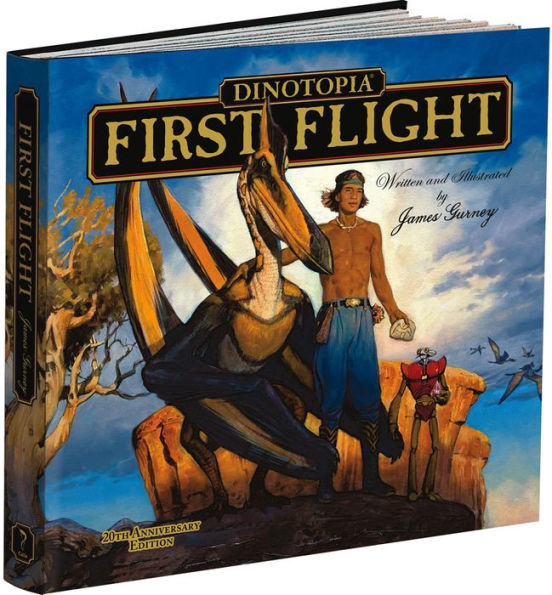
Book Review: Dinotopia: First Flight by James Gurney

I've been on a Dinotopia kick as of late, and you guys know it. As such, I'm going to get right to the point of today's review. We're taking a look at Dinotopia: First Flight by James Gurney.


First Flight is set thousands of years in Dinotopia's past. It was an age when Dinotopia was divided among several warring empires. In particular, there is the Empire of Poseidos. They are technologically advanced, with everything from robots to flying cars. They also hate dinosaurs and are seeking to replace them with machines. The story follows a boy named Gideon Altaire. Unlike most of Poseidos, he loves dinosaurs and is fascinated by them. His life changes forever when he takes in an injured pterosaur named Razzamult. Gideon soon finds himself wrapped up in a plot to save the dinosaurs of Dinotopia from certain destruction.

The framing device is that Gideon's story is a scroll that Will Denison is reading in the library of Waterfall City. This is the shortest of the main four Dinotopia books, but it certainly packs a punch. I loved how First Flight expanded upon the worldbuilding of Dinotopia. We see that there was a time when things weren't so idyllic and utopian. One of the big themes is how Poseidos is so obsessed with technology that they've forgotten the importance of the natural world. Apparently, they've given up actual food in favor of nutrition pellets. The message is there, and yet Poseidos certainly looks glorious thanks to Gurney's artwork. I loved how science fiction elements like robots and flying cars were incorporated into the world of Dinotopia. I also loved how all of the machines were modeled off of living creatures. It gave them a nice aesthetic.

The generally aesthetic of Poseidos kind of reminded me of Star Wars. This is amusing, as First Flight was published in 1999. That was the same year The Phantom Menace came out. Back in the review of A Land Apart from Time, I noted how George Lucas homaged the parade in Sauropolis with the parade on Naboo the end of The Phantom Menace. It certainly makes for an amusing parallel.

One thing I noticed is that the military officials all wear hats vaguely similar to the one that Lee Crab wears. Now, consider that Lee Crab hates dinosaurs, and that the Poseidons were trying to commit genocide against the dinosaurs. Hmm, I wonder what Gurney could possibly be suggesting?

First Flight does have a bit of an anti-technology message. However, unlike The World Beneath, I feel like it was more organic to the story. It is also mitigated somewhat by one of Gideon's allies being a robot. In hindsight, it is rather amusing that the Skybax that Gideon bonds with is named Avatar. We've got a male hero from a technologically advanced society who joins a less advanced, but more in-tune with nature, society and defends them from the invading technology users. Oh, and he defeats a large flying machine with the help of his loyal pterosaur, and the use of a primitive weapon via his friends. When Gideon makes it to mainland Dinotopia he befriends some lemurs and a mammal-like reptile from the Permian. It is always good to see some non-Ice Age mammals get some representation, and the same goes for pre-dinosaur reptiles.

If this book does have a weakness, it's that it is shorter than the other books in the main series. Gideon's story clocks in at a mere sixty pages, less than half the length of the other books. Granted the 20th Anniversary edition of First Flight does mitigate this somewhat by including a fair bit of bonus material. Still, even with all that the book sits at 112 pages, compared to the 192 pages of the other books.

Speaking of the bonus material, let's discuss it. We get a mostly prose bonus story about a hero named Blake Terrapin. Like Gideon, he grew disillusioned with life in Poseidos and traveled to mainland Dinotopia to defend the dinosaurs. It is written in present tense, and feels a bit like a script for a book that never materialized. Still, it does help to flesh-out Dinotopia's past, and we do learn some very interesting things. For example, apparently Waterfall City began life as a military fortress. During this age, know as the Heroic Age, Dinotopia was divided into four empires. We already know about Poseidos, and Chandara will be important in the next book. We also have Armakia, the forerunners of those who live in the high mountains with the Ice Age mammals. Finally, there is Pelledrine; they're a tribal confederation that has befriended the predators of the Rainy Basin. Blake goes to train with them.

At first I thought that it was a bit odd that Blake dress like a European knight, given that his story is set over 4000 years in the past. Then I remembered back to A Land Apart From Time, and how it mentioned various people who left Dinotopia over the years. It isn't that he looks like a medieval knight, it's that knights look like Dinotopians. I should have mentioned this before, but I liked how the buildings in Poseidos have a vaguely Ancient Indian look to them.

We also get a series of sepia-tone sketches that, while certainly interesting, also hint that there was going to be more to this book than what we got. In fact, we also get some concept art that seems to support this hypothesis. I wonder if there was pressure on Gurney to rush this book before it was ready. Don't get me wrong, what we got was great, but it could have been even better.

This all kind of gives the book the feel of a lost historical document. A lot of times, historians will have to deal with primary sources having gaps, or only being preserved in fragments. It's like looking at a dried-up riverbed to try and determine what a river was like, and where it went. You have to make educated guess, and sometimes accept that you might never truly know the answers. This gives an air of authenticity to First Flight, but it is still a bit frustrating.

Well, I think that should do it. First Flight is a good book, but it is a bit on the short side. It feels like it could have been even better if it had been expanded properly. I hope you guys have been enjoying our look at Dinotopia as much as I have. I will see you guys next time.

Thursday, August 29, 2019

Book Review: Dinotopia: The World Beneath by James Gurney

You guys seemed to really like my review of Dinotopia: A Land Apart from Time. I'm certainly glad to hear that. Big thanks to Jordan Harbour of Twilight Histories for sharing it. I've been wanting to take a look at the other Dinotopia books, and now is as good a time as any. We're taking a look at Dinotopia: The World Beneath by James Gurney.


Arthur and Will Denison have been adjusting well to their new lives on the island of Dinotopia. Will is continuing to have adventures with his fellow Skybax riders. Meanwhile, Arthur is preparing to mount an expedition to the mysterious World Beneath. It is the caverns where the ancestors of the Dinotopians survived the K-T extinction. It may also hold the key to answering several questions about the early days of Dinotopia. One thing is for certain, the Denisons aren't over with adventures just yet.

There's a slight change in the format of this book. The first book was told in first-person as Arthur and Will's journal. This book switches to a third-person perspective. As I've said, Arthur and Will go on their own separate adventures, but their paths do eventually cross.

I've said that the Dinotopia books really evoke a lot of those 19th century adventure novels. This influence is very strong in this book. The entrance to the World Beneath is located underwater, and we do get some scenes evocative of 20,000 Leagues Under the Sea. We also got some great appearances by various prehistoric sea creatures such as dunkleosteus, leopleurodon and the creatures of the Burgess Shale. Once we get to the World Beneath it all feels a bit evocative of Journey to the Center of the Earth, with just a pinch of Indiana Jones.

From this expedition we learn that Dinotopia was once divided into many different empires. One of these, Poseidos, was actually quite technologically advanced. However, their hubris and love of machines proved to be their undoing. Eventually the island of Poseidos sank into the sea, and served as the inspiration for the legend of Atlantis. The thinking is that Poseidon sunk Atlantis, and Poseidos sounds like Poseidon, so Poseidos inspired Atlantis.

Unfortunately, this leads us to my biggest issue with this big. There is a pretty obvious anti-technology and anti-science message running throughout this book. Arthur has been tinkering and building machines throughout the book, but they almost always end in disaster. Naturally, this requires him to be saved by friendly dinosaurs. Similarly, one of the big downfalls of Poseidos was how they tried to replace their dinosaurs with machines. The message seems to be "you can have dinosaurs, or you can have robots, but you can't have both." This is particularly odd because the Dinotopians weren't shown to be Luddites before this. Moreover, Arthur was always treated with respect and admiration for being a man of science.

Arthur get a love interest in the form of Oriana Nascava. On the one hand, I'm glad to see that Arthur is moving on from his wife's death and finding new love. On the other hand, Oriana contributes to the anti-technology message. She constantly poo-poos his idea about reviving Poseidon technology, because who needs robots when you have dinosaurs. To be fair, other than these moments of pontificating, she wasn't too bad. Meanwhile, Will is doing well with his own love interest Sylvia.

I guess my problem with the anti-technology message is that way it presents a black and white view of things. Well, that and how it ignores the ways that technology has improved our lives. All the lives saved thanks to advances in medicine, the revolutions in agriculture that have fed millions, and countless other great things are thanks to technology. Moreover, wouldn't the dinosaurs like for their workloads to be lightened a bit? The implication seems to be that the robots would inevitably replace the dinosaurs. It would have been better if the message was less "technology is evil" and more "technology can be used for good or evil, so learn to use it wisely." The book didn't even need to have a message. A Land Apart From Time didn't have a message, the plot was mostly just there to explore the worldbuilding, and it was perfect just the way it was. 

Also, Lee Crab was hired to help-out with the expedition. Really, Arthur, just what were you expecting to happen when you hired Lee Crab? I know it seemed like a good idea at the time, but still.

Still, if you ignore the clunky message, The World Beneath is a pretty fun adventure book. Hey, it's a James Gurney book, so you are guaranteed to get tons of gorgeous illustrations to go along with the text. I probably should have mentioned this before, but the dinosaurs survived in the World Beneath thanks to sunstones. Sunstones, as their name suggest, are capable to generating light, but they can also be used to power machines. If you squint very, very hard you might be able to see evidence that the sunstones are what gave the dinosaurs their sentience. So, if the World Beneath is where the Dinotopian dinosaurs came from, then where did the Ice Age mammals come from? For that matter, there's also several animals, particularly sea animals, from before the dinosaurs. And how does plate tectonics play into this and...you know what, I'm not going to question it. I love Dinotopia and its menagerie of creatures too much to serious question the logic of it all.

Similarly, the books take place in the 1860s, but Arthur knows the names of various dinosaur that hadn't been discovered yet. For example, tyrannosaurus wasn't discovered until 1902. Then again, given that's it's already odd that the dinosaurs are referred to by their scientific names, it's a bit of a moot point.

I did enjoy how this book expanded upon the history and mythology of Dinotopia. I'm especially intrigued by the legendary King Ogthar; he was said to have been half-human and half-dinosaur, and brought peace and stability to Dinotopia. We get hints that there was a time when Dinotopia wasn't so idyllic and utopian. I also loved how the inhabitants of the Rainy Basin weren't shown in a bad light just because of their lifestyle. In fact, a group of tyrannosaurs even helps to save the day.

And here’s a fun fact, The World Beneath played a role in the history of paleoart. It was one of the first, if not the first, depictions of giganotosaurus in pop culture. In fact, James Gurney consulted with Rodolfo Coria, the paleontologist who named giganotosaurus and argentinosaurus. In fact, Gurney made the first portrait of giganotosaurus. Gurney asked Coria about what he should do for colors. Coria quipped “Color? That’s your problem.”  The moral of the story is, don’t stress about your paleoart. You’re in good company.

Well, I don't think there's much more to add. The Worth Beneath is certainly a flawed book, but I still had a good time overall. And hey, we got plenty of great artwork to look at. I think I'll be keeping up this Dinotopia kick. I will see you guys next time.

Wednesday, July 10, 2019

Book Review: Dinotopia: A Land Apart from Time by James Gurney

Dinosaurs have captured the imaginations of many people, myself included for generations. Wouldn't it be something to get to see living dinosaurs? Preferably, without getting killed. Just what would a world where humans and dinosaurs co-existed look like? Well, in the book we're reviewing today, all of that and much more is possible. We're taking a look at Dinotopia: A Land Apart from Time by James Gurney.


Dinotopia begins in the year 1862. Father and son Arthur and Will Denison have been on a two year voyage of discovery. They’ve been washed up on a mysterious island following a particularly nasty storm in the South Pacific. Ah, but this isn't just any island, it's Dinotopia! It is an island where dinosaurs survived the K-T extinction and live side-by-side with humans. The book follows the Denisons as they explore the strange and wonderful world of Dinotopia.

Technically, this is a picture book, but it isn't just for kids. The texts tends to be fairly substantive paragraphs, and while there's isn't anything inappropriate, there are a few jokes and references that older readers would be more likely to catch. For example, when Arthur and Will attend a performance of hadrosaurs, Arthur remarks that he hasn't heard such a ruckus since he sat-in on a meeting of congress. The text and illustrations work together to tell the story. As such, I consider this to be something of an honorary comic book.

James Gurney used to work as an illustrator for National Geographic, and it certainly shows in his art. All of the illustrations are photorealistic oil paintings. Gurney even went as far as to build miniatures and models just to make sure that the visions in his head were represented in their full glory. The man has some serious dedication to his craft, and the book is all the better for it.

I'm not sure that I'd call this book alternate history per se. Other than the existence of Dinotopia, and they made a point of stay out of world affairs, the world isn't too different than our own. It's more akin to those 19th Century adventure stories where the heroes find lost world's and exotic new lands. In fact, the framing story is that the book is an adaption of a long-lost journal that Gurney found at a library. Thus, history went just as it did in our world. That having been said, this book should appeal to alternate history fans. Dinotopia is home to shipwrecked people from across the world, and consequently, is home to a wide variety of cultures.

The reason Dinotopia avoided detection is that it is surrounded by a massive storm system and an equally massive reef. Hey, it's called Shipwreck Reef for a reason. Thankfully, friendly dolphins are at the ready to escort new arrivals to shore. In fact, new arrivals to Dinotopia are called Dolphinbacks. This is how you know this book was written in the 1990s. If it was written today, some nitwit would probably wrongly assume Gurney was making racist remarks about Mexicans with a name like that.


The plot is mostly just there as an excuse to explore the world the Gurney has created. Hey, I've got no complaints. I had an absolute blast getting to explore the wonders of Dinotopia. Why don't we discuss some of that? So, the only animals on Dinotopia, besides humans and dolphins, are extinct animals. Most obviously, you see the dinosaurs, but there are also ice age mammals up in the high mountains. Hmm, I wonder is there are any animals that were driven extinct by humans such as dodos, quaggas, and moas on Dinotopia? Anyway, all of the dinosaurs and ice age mammals have human-level intelligence. However, only a few, such as protoceratops, are capable of human speech. This is because they have parrot-like mouths. Naturally, protoceratops, such as the Denisons' friend Bix, often works as translators.

As you can imagine, having so many sentient species creates some dietary restrictions. Pescatarianism is pretty much mandatory for everyone who needs to eat meat. Though, curiously, we never see anyone eating eggs. Maybe dinosaur find the concept too icky, and humans follow suit? Also are extinct humans like Australopithecus and Neanderthals somewhere out there in Dinotopia? There are certain carnivorous dinosaur who can't do this, or don't like civilized society, and choose to live in the Rainy Basin. We're talking dinos like tyrannosaurus, allosaurus, carnotaurus, giganotosaurus and the like. I liked that these predators aren't demonized as is so often the case in fiction. It's just part of who they are, and it's treated as an alternative lifestyle more than anything else. In fact, some dinosaur who are close to the end of their lives will journey to the Rainy Basin to donate their bodies as their final gift to the world. All the same, it is best to bring offerings of fish and eels when journeying through the Rainy Basin.

Though I have to ding some points for teosinte being a major crop. It is explained that it was brought over by a shipwrecked Aztec. To honor his contributions, many plates have miniature drawings of the Aztec riding a dolphin. Problem is that teosinte isn't a very good crop. Oh, it was useful for teaching the Mesoamericans the basics of agriculture, but it had a lot of room for improvement. Teosinte is very small, way smaller than corn, and you only get a few grains per stalk. Said grains are also very tough. Thankfully, through years of selective breeding, and a lot of patience, the Mesoamericans bred teosinte into the corn we know today. It is a testament to Mesoamerican civilization that they were able to do this. I'm not so sure we'd have the skill of patience to do such a thing today. Point being, there's no way teosinte would be a major crop on Dinotopia.

In many ways, Gurney was ahead of the curb when it came to Dinotopia. For example, he portrays oviraptors as loving parents and devoted nurses at hatcheries. At the time, paleontologist assumed that fossil of oviraptors clutching eggs were because they stole from other dinosaurs. This is why their name means "egg thief" in Latin. However, we now know that these eggs were in fact oviraptor eggs, and Gurney was right all along.

Of course, there's also a couple things that now look inaccurate with our current paleontology knowledge. For example, when the Denisons are in Waterfall City they meet a troodon time keeper named Malik and a deinonychus librarian named Enit. Both of them have no feather, which is probably why they don't appear in the later books, when Gurney added feathered dinosaurs. Though, personally, I think they look perfect just the way they are. Plus, you could always chalk any differences up to evolution. After all, Dinotopian dinosaurs have been around for an extra sixty-five million years. There's bound to have been at least some evolutionary changes that happened in that time. Gurney was aware that the dinosaurs should have evolved more, and that it didn’t make sense to have them basically unchanged from the Mesozoic era. However, he didn’t want to get bogged down in the details. Hey, you’ve got no complaints from me. 

 Gurney also portrayed deinocheirus as being the Dinotopian equivalent of a race horse. In fairness, only the arms has been discovered at the time. Little did paleontologist know that deinocheirus had a prominent hump, a skull like a hadrosaur, and claws like a therizinosaur. In fact, its overall body plan was like therizonosaurs, but Gurney couldn’t have known that.

I should probably talk about Waterfall City, and the many other destinations throughout Dinotopia. Waterfall City, as its name suggest, is a city located directly on top of a waterfall. There were three paintings that served as the basis for what would become Dinotopia, and one of them was of Waterfall City. It has a somewhat European feel, brining to mind Venice, but it also has Mayan pyramids. It is the cultural and intellectual heart of Dinotopia, though not the capital. You can only enter the city via special gliders.

Moving along, there's also Canyon City. It is built into the tops and walls of a massive canyon. It is the home of the Skybax Riders. Skybax is what Dinotopians refer to quetzalcoatlus as. I always did find it a little weird that Skybax were the only creatures not referred to by their scientific name. It does make sense that quetzalcoatlus would be giving humans rides, given that they were the largest pterosaurs. Plus, most series would probably have given the role to pteranodon, though I do love my pteranodons. Oh, but pteranodons do exists too. They're the guardians of the World Beneath; the underground cavern the ancestors of the Dinotopians used to survive the K-T extinction. More on it when we review the next book in the series.

Treetown is, unsurprisingly, a series of giant tree houses. It is where young people get a taste of independence under the watchful eye of resident cool old lady Nora. Youths who do well in Treetown have the opportunity to be Habitat Partners. Habitat Partners are a pair, one human and one animal, that protect the various ecosystems across Dinotopia.

Sauropolis is the capital of Dinotopia. It is built in the style of an Ancient Roman city. The larger dinosaurs prefer the large streets and wide avenues of Roman architecture. There's a scene towards the end where there's a big dinosaur parade in Sauropolis. This was another painting that served as the basis for Dinotopia. This one scene was so influential that George Lucas used it as the basis of the parade at the end of The Phantom Menace. Well, he's more or less admitted to it. For his part, James Gurney doesn't mind. He's just glad that his books are providing others with inspiration.

There's some interesting architecture throughout Dinotopia. For example, engineers have been able to build more efficient bridges by studying sauropods. Certain cities, like Pooktook, have a very Art Nouveau style to them. Dinotopia is, in many ways, a utopia where humans and dinosaurs live in harmony. This makes its name slightly ironic, as Dinotopia means "terrible place" in Greek.  Though, admittedly, that’s more in the archaic sense of the word.  Terrible as in, awe inspiring in a way words can’t properly articulate.  Think like how the wizard in The Wizard of Oz is called Oz the Great and Terrible.  

About the only person with any complaints is Lee Crab. He's convinced that it's all a sham, and that the humans are slaves to the dinosaurs. Though his main gripe seems to be that there's no red meat to eat. He claims to have tamed a pair of pachycephalosaurs, but in reality, they only pretend to be under his control. They're keeping an eye on him to make sure he doesn't get into too much mischief.

Overall the places and cultures we see in this book have a somewhat European feel to them. Granted, the characters do visit a Tibetan-style monastery in the mountains, they meet a Yoruba blacksmith, and there are plenty of non-white background characters. Maybe Gurney was trying to evoke fantastical settings like Middle Earth or Narnia, or maybe that's just what he felt like painting. We also see some ruins that look like something out of Ancient Egypt. However, it's the other way round. Over the years some Dinotopians ventured out into the wider world and founded civilizations such as Ancient Egypt, the Indus Valley, the Minoans, and Sumeria. And not just humans, dinosaurs got in on the action too. In fact, one dinosaur traveled to Egypt and inspired the myths of the god Thoth. I wonder if all those tales of dragons were actually misremembered encounters with travelers from Dinotopia.

I actually watched the Hallmark Channel miniseries adaptation of Dinotopia before I read the books. Having now read the books...wow, Hallmark Channel did not do this series justice at all. I might eventually review the miniseries, but maybe not for a while.

Well, I don't think there's anything more to add. James Gurney has created a world as rich, detailed and varied as anything you might find from J.R.R. Tolkien or George R.R. Martin...well, it's way more idealistic and lighthearted than anything Martin has written. Also, nobody gets killed or...oh, you know what I mean. If I haven't made it clear by now, pick up Dinotopia: A Land Apart from Time today. You'll be glad that you did.

I will see you guys next time.