Showing posts with label book. Show all posts

Saturday, October 3, 2020

Book Review: Lake on the Moon by H.E. Wilburson

I've already given my spiel about my policy with reviews. As such, let's cut right to the chase with this one. We'll be taking a look at Lake on the Moon, book two of The Martian Diaries, by H.E. Wilburson.


Lake on the Moon picks up the actions a few years after the previous book. Ogilvy the astronomer has come to a freighting conclusion: the Martians' collective conscious is spread via the mysterious red weed. He knows because he sampled some of the red weed, and made contact with the Martian hive mind. Worse, the red weed has infiltrated the water supply, meaning the Martians might gain the ability to take over human minds. Ogilvy and George, our narrator, are going to have to push themselves to the limits of their knowledge to find a solution to this impending crisis.

In my pervious review, I noted that The Day of the Martians, had a few issues. So, how does Lake on the Moon do addressing these? It's a bit of a mixed bag. As per usual, let's start with the positives. Lake on the Moon has much better pacing than The Day of the Martians. Lake on the Moon is twice as long as its predecessor, and it certainly benefits from the additional length. I also liked how the music was a much better fit for the time period of the story than last time round. The sound-effects were also somewhat better integrated into the story.

We also get an explanation for how Ogilvy is here, despite having died in The War of the Worlds. Lake on the Moon begins with a flashback to the first Martian invasion. Turns out he was only mostly dead when he got hit by a Martian heat-ray. That is, his body was covered in third degree burns, he was in quite a bit of pain, but he survived. I liked that this segment because it really focused on what it was like for average people caught-up in the invasion. At one point it is mentioned that the hospital had to start rationing medication because of the massive influx of patients. I mean, ouch, that can't have been fun.

One of my complaints with The Day of the Martians was that it played things safe in terms of plot, and that much of it felt like little more than glorified battle scenes. I appreciated that Lake on the Moon was willing to take more risks and try new things in terms of plot. The red weed being used not only as part of a Martian hive mind, but also as a mind control plot, was certainly a unique angle. In addition to the pacing, I felt there was much more solid plot structure than in The Day of the Martians. We didn't just get action scenes; it felt, for the most part, like the proper progression of a novel's plot. I also really like how it is revealed that the Martians are returning to Earth because of the connection that Ogilvy inadvertently established with their hive mind. I also liked how the early segments of the novel had the feel of a Victorian mystery novel, with even some slightly Gothic elements to them. 

I should have mentioned this last time, but I got a slight chuckle every time Crewe was mentioned. As a lifelong fan of Thomas the Tank Engine, I remember Crewe as being the place Henry the Green Engine was sent to so he could be rebuilt, and wouldn't need his special coal anymore. Admittedly, I didn't know that when I was a kid, since I grew up with the American version narrated by George Carlin. It was just a little something that probably only mattered to me.

Once again, Harry Preston returns as our narrator. He did slightly better this time round, but he still came across as a bit too flat and monotone. For example, there's a part where the main character's wife gets crushed to death by a tripod. This is a major emotional moment, but Harry's flat and monotone delivery undermines the moment. This might be an audiobook, not an audio drama, but that's no excuse for lackluster narration. If anything, an audiobook narrator must be even more committed, and have more range, because they alone are tasked with carrying the book all by themselves.

With all of this having been said, Lake on the Moon still has a few issues. We finally get an answer for how the Martian invasions effected World War I. Oh, it was delayed by a few years, but it went pretty much as it did in our world. The Spanish Flu also went basically as it did in our world. Really now, two invasions by aliens from Mars, and that had absolutely zero impact on geopolitics? I would be more willing to accept there still being a war if there had been at least a few changes. Maybe a few changes in alliance, neutral nations picking a side, or participants from our world choosing to sit the war out. Or, maybe instead of Entente vs. Central Powers, we could have the alliances be based on something else.

Spanish Flu, maybe it could happen, but it still seems a bit unlikely. The name is a misnomer. Spain was neutral during World War I, so their newspapers were uncensored. As such, they were one of the only nations that talked about the flu before it got really big. This resulted in the flu becoming associated with Spain. It used to be believed that it came from either Kansas or Mexico, but now experts think it might have originated in China. So, would it have happened in the world of The Martian Diaries? Maybe, but still seems odd it went more or less as it did in our world.

So, what about the titular lake on the Moon. It is discovered by our narrator early into the novel. It is a liquid water lake located on the surface of the Moon. Does this mean humanity is going to develop a space program and take the fight to the Martians? Are we going to have an adventure on the Moon? Nope, turns out it was a bit of a red herring. Though the main character does advocate for humanity going into space at the end of the novel. So, I suppose it was setting things up for book three.

The Day of the Martians suffered from having too simple of the plot, but Lake on the Moon has the opposite problem. I felt that the plot became a bit too complex and convoluted for its own good. Apparently, Ogilvy believes that they need to somehow go back in time and ensure the Martians never invade Earth in the first place. When I first heard this, I got very excited. It sounded like it was setting up a crossover with The Time Machine, another of HG Wells' novels. Unfortunately, this does not happen, which is a shame because that was a serious missed opportunity. Apparently, the time travel is mental in nature, and is achieved by consuming the red weed...I think. It was all very confusing and difficult to follow.

Then the plan gets changed to possibly changing things so that Mars was never habitable to multicellular life...somehow. Again, it was confusing and hard to follow. It seemed like it was going to setting up alternate timelines and history, but we didn't get that...or maybe we did, but if so, it was hard to tell.

I would be remiss if I didn't say that Lake on the Moon is a much stronger novel than The Day of the Martians. Even if the execution didn't work out, it was at least willing to take chances, take more risks, and try new things. It also had a stronger sense of pacing, and integrated music and sound-effects into the audiobook much better than its predecessor did. That all having been said, it still has quite a few issues, and perhaps bit off a bit more than it could chew. Although, if there is a third book, I would very much like to think that all of this is a sign that said third book will be even stronger than this one.

Well, I think that should do it from me for now. I will see you guys next time.

Tuesday, September 3, 2019

Book Review: Dinotopia: Journey to Chandara by James Gurney

We've made it to our final trip to Dinotopia. It is a bittersweet occasion, but I won't waste any more time with intros. We're taking a look at Dinotopia: Journey to Chandara by James Gurney.


Arthur Denison has received a letter from the distant empire of Chandara. Emperor Hugo Khan himself has heard of Arthur'd exploits and requests an audience with him. Arthur, along with his faithful protoceratops translator friend Bix, are off on an adventure to parts little known.

Not the most exciting description, but let's talk about the plot. This book is a welcome return to form after The World Beneath and First Flight. Much like A Land Apart from Time, the plot is mostly an excuse to explore new parts of Dinotopia, and I've got no complaints. There's also no anti-technology messages, just pure fun and adventure.

I've always found it interesting that Arthur tends to get more focus in the books than Will. You'd expect that Will would get more focus, due to being a teenage boy, but that's not the case. This certainly hasn't hurt the book, as they are beloved by both kids and adults alike. This isn't to say that Will is totally absent, but he's spending most of his time with his fellow Skybax riders.

I enjoyed getting to see more of Sauropolis. I found their resident philosophers, the Spotter and the Stripers, rather amusing. They always argue any issue by taking the opposing side. When Lee Crab steals Arthur's invitation, for example, one of them argues that it wasn't really stolen, as it is merely the physical representation of Hugo Khan's desire to a see Arthur. Thank goodness nothing really bad, like murder, ever happens in Dinotopia. Granted, we do see that Sauropolis has a fire department, who utilize sauropods to great effect, but appears to lack a police force.

One of the most notable aspects of Journey to Chandara is the introduction of feathered dinosaurs. Gurney likes to keep as up to date as possible when it comes to portraying his prehistoric animals. This is probably why Enit and Malik don't appear, at least visually, as their designs are now out of date. On a side note, many paleontologist love Dinotopia due to the attention to detail Gurney includes. Many have said they'd book a ticket in a heartbeat if they could.

Up until this book, Dintopia has had a fairly European, particularly Western Europe, feel to it, baring a few minor exceptions here and there. Chandara, by contrast, has much more of an Asian feel to it. Chandara is bordered by a desert that evokes the Middle East and Mongolia, as well as some aspects of Central Asia and the Silk Road. Chandara proper features aspects of China, India, Thailand, Indonesia, Russia and Eastern Europe. Arthur and Bix also venture into the high mountains, which were perviously established to have a bit of a Himalayan and Tibetan feel to them. I'm all for diversifying Dinotopia's cultural and architectural aspects.

The journey to the high mountains also features several prehistoric mammals beyond the typical Ice Age bunch. We see Macrauchenia, Paracertherium, giant ground sloths, and Megalocerous, among other creatures. Must admit I was hoping to see a few terror birds somewhere along the way, but maybe next time. Here's hoping we get a fifth book at some point.

Arthur and Bix happen across a village of Pilgrims on their way to Chandara. Well, sort of. They're decedent of the Mayflower's sister ship the Sunflower. They live in Polynesian style Tahitian long houses. They love to play games. In fact, whenever they have work to do, they find some way to turn it into a game. Somewhere, John Calvin is spinning in his grave. Puritans were Calvinists, and Calvinists despised anything resembling fun. Idle hands are the devil's workshop. So they've obviously abandoned Puritanism, but it does raise an interesting question. How does religion work on Dinotopia? Do dinosaurs have their own religions? I understand that perhaps Gurney wanted to avoid potentially thorny subjects, but it is fun to think about.

Anyway, so Will and his fellow Skybax riders make an appearance at a giant Egyptian-style statue of King Ogthar that serves as a Skybax rider retreat of sorts. The inside is hollowed out and full of rooms. One of their favorite pastimes is sky jousting. It's kind of like regular jousting, though the lances have blunted ends tied in cloth. The riders have parachutes to land safely on either land or water. Still, gotta wonder about what happens if the parachute malfunctions. I sure hope Skybax are fast.

I also liked how Chandara displayed different social rules than other parts of Dinotopia. For example, the feather dinosaurs of Chandara use a lot of body language related to their feathers. As such, human fashions often include artificial feathers to take this into account. We also get to see a guide to the alphabets of Dinotopia. They're basically the same, just different shapes based on the foot shape of the dinosaurs. There's also a transitional alphabet for those who use the Roman alphabet. I wonder if they do that for other alphabets? Chandara even has a footprint amphitheater, obviously invoking calligraphy.

Chandara is the last of the four great empires of Ancient Dinotopia. Well, unless you count the forerunners of the mountain peoples. Though, I guess they don't count, since their current form is different from their predecessors. Anyway, this ties into Chandara's Asian theme. China is the world's oldest continuous civilization. Ancient Egypt, Ancient Greece, the Roman Empire, the Inca Empire, all of these have faded, but China alone remains. That is, it has more or less retains its original culture and connection to the past.

So, just who is the mysterious Hugo Khan? Why, a microraptor, of course. Everyone thinks he'd be something big and imposing, but he's a small feathered raptor. He is a wise and just ruler. Every night he flies across the city to ensure that all is well with his subjects. Every night before bed, the people of Chandara leave notes in their shoes with wishes and requests, the emperor reads all of them, and considers how to respond.

We get a pretty big revelation when the ministers of the arts make presentations to Hugo Khan. One of the duos is a human and a butterfly. Yes, apparently butterflies are sentient in Dinotopia. Wait, so just butterflies, or is anything more intelligent than a sea sponge sentient? If the latter, then how does that jibe with the whole pescatarian and eating insects thing the Dinotopians have going on? Yeah, I'm going to say only butterflies. Still, why them? What makes them so special compared to other invertebrates? Hmm, wonder if the giant insects of the Carboniferous are sentient?

Towards the beginning of the book we get a framing device of Gurney discovering Arthur's journal in an antiques shop. This is a nod to A Land Apart from Time, where he found the original journey in a library. Gurney mentions that Dinotopia is not on any modern maps. Oh no, did something bad happen? Did Dinotopia sink into the sea like Poseidos did? I'd hate to think that all the weird and wonderful things on Dinotopia are gone for good.

Or maybe there's a more hopeful explanation. What if Dinotopia is located in a pocket dimension that interests with our world? That would explain how we have creatures from millions of years apart living on the same island. Perhaps time works differently in Dinotopia's pocket dimension. I like this idea best.

Well, I think that covers everything. It's been a great ride, and I certainly hope that Gurney makes a fifth Dinotopia book, and perhaps a sixth and seventh, one of these days. I will see you guys next time.

Friday, August 30, 2019

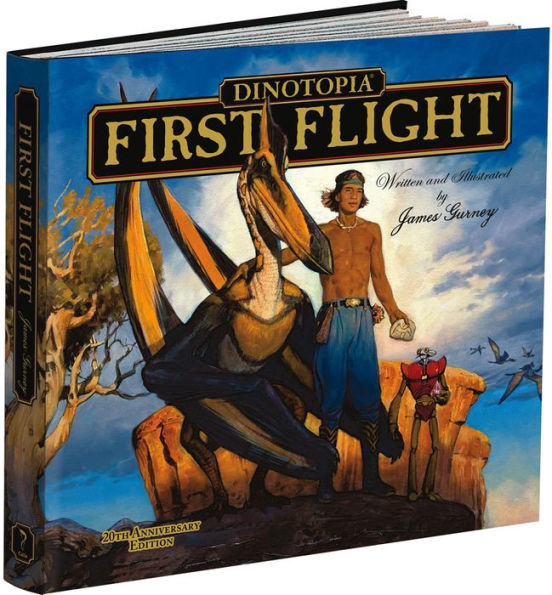
Book Review: Dinotopia: First Flight by James Gurney

I've been on a Dinotopia kick as of late, and you guys know it. As such, I'm going to get right to the point of today's review. We're taking a look at Dinotopia: First Flight by James Gurney.


First Flight is set thousands of years in Dinotopia's past. It was an age when Dinotopia was divided among several warring empires. In particular, there is the Empire of Poseidos. They are technologically advanced, with everything from robots to flying cars. They also hate dinosaurs and are seeking to replace them with machines. The story follows a boy named Gideon Altaire. Unlike most of Poseidos, he loves dinosaurs and is fascinated by them. His life changes forever when he takes in an injured pterosaur named Razzamult. Gideon soon finds himself wrapped up in a plot to save the dinosaurs of Dinotopia from certain destruction.

The framing device is that Gideon's story is a scroll that Will Denison is reading in the library of Waterfall City. This is the shortest of the main four Dinotopia books, but it certainly packs a punch. I loved how First Flight expanded upon the worldbuilding of Dinotopia. We see that there was a time when things weren't so idyllic and utopian. One of the big themes is how Poseidos is so obsessed with technology that they've forgotten the importance of the natural world. Apparently, they've given up actual food in favor of nutrition pellets. The message is there, and yet Poseidos certainly looks glorious thanks to Gurney's artwork. I loved how science fiction elements like robots and flying cars were incorporated into the world of Dinotopia. I also loved how all of the machines were modeled off of living creatures. It gave them a nice aesthetic.

The generally aesthetic of Poseidos kind of reminded me of Star Wars. This is amusing, as First Flight was published in 1999. That was the same year The Phantom Menace came out. Back in the review of A Land Apart from Time, I noted how George Lucas homaged the parade in Sauropolis with the parade on Naboo the end of The Phantom Menace. It certainly makes for an amusing parallel.

One thing I noticed is that the military officials all wear hats vaguely similar to the one that Lee Crab wears. Now, consider that Lee Crab hates dinosaurs, and that the Poseidons were trying to commit genocide against the dinosaurs. Hmm, I wonder what Gurney could possibly be suggesting?

First Flight does have a bit of an anti-technology message. However, unlike The World Beneath, I feel like it was more organic to the story. It is also mitigated somewhat by one of Gideon's allies being a robot. In hindsight, it is rather amusing that the Skybax that Gideon bonds with is named Avatar. We've got a male hero from a technologically advanced society who joins a less advanced, but more in-tune with nature, society and defends them from the invading technology users. Oh, and he defeats a large flying machine with the help of his loyal pterosaur, and the use of a primitive weapon via his friends. When Gideon makes it to mainland Dinotopia he befriends some lemurs and a mammal-like reptile from the Permian. It is always good to see some non-Ice Age mammals get some representation, and the same goes for pre-dinosaur reptiles.

If this book does have a weakness, it's that it is shorter than the other books in the main series. Gideon's story clocks in at a mere sixty pages, less than half the length of the other books. Granted the 20th Anniversary edition of First Flight does mitigate this somewhat by including a fair bit of bonus material. Still, even with all that the book sits at 112 pages, compared to the 192 pages of the other books.

Speaking of the bonus material, let's discuss it. We get a mostly prose bonus story about a hero named Blake Terrapin. Like Gideon, he grew disillusioned with life in Poseidos and traveled to mainland Dinotopia to defend the dinosaurs. It is written in present tense, and feels a bit like a script for a book that never materialized. Still, it does help to flesh-out Dinotopia's past, and we do learn some very interesting things. For example, apparently Waterfall City began life as a military fortress. During this age, know as the Heroic Age, Dinotopia was divided into four empires. We already know about Poseidos, and Chandara will be important in the next book. We also have Armakia, the forerunners of those who live in the high mountains with the Ice Age mammals. Finally, there is Pelledrine; they're a tribal confederation that has befriended the predators of the Rainy Basin. Blake goes to train with them.

At first I thought that it was a bit odd that Blake dress like a European knight, given that his story is set over 4000 years in the past. Then I remembered back to A Land Apart From Time, and how it mentioned various people who left Dinotopia over the years. It isn't that he looks like a medieval knight, it's that knights look like Dinotopians. I should have mentioned this before, but I liked how the buildings in Poseidos have a vaguely Ancient Indian look to them.

We also get a series of sepia-tone sketches that, while certainly interesting, also hint that there was going to be more to this book than what we got. In fact, we also get some concept art that seems to support this hypothesis. I wonder if there was pressure on Gurney to rush this book before it was ready. Don't get me wrong, what we got was great, but it could have been even better.

This all kind of gives the book the feel of a lost historical document. A lot of times, historians will have to deal with primary sources having gaps, or only being preserved in fragments. It's like looking at a dried-up riverbed to try and determine what a river was like, and where it went. You have to make educated guess, and sometimes accept that you might never truly know the answers. This gives an air of authenticity to First Flight, but it is still a bit frustrating.

Well, I think that should do it. First Flight is a good book, but it is a bit on the short side. It feels like it could have been even better if it had been expanded properly. I hope you guys have been enjoying our look at Dinotopia as much as I have. I will see you guys next time.

Thursday, August 29, 2019

Book Review: Dinotopia: The World Beneath by James Gurney

You guys seemed to really like my review of Dinotopia: A Land Apart from Time. I'm certainly glad to hear that. Big thanks to Jordan Harbour of Twilight Histories for sharing it. I've been wanting to take a look at the other Dinotopia books, and now is as good a time as any. We're taking a look at Dinotopia: The World Beneath by James Gurney.


Arthur and Will Denison have been adjusting well to their new lives on the island of Dinotopia. Will is continuing to have adventures with his fellow Skybax riders. Meanwhile, Arthur is preparing to mount an expedition to the mysterious World Beneath. It is the caverns where the ancestors of the Dinotopians survived the K-T extinction. It may also hold the key to answering several questions about the early days of Dinotopia. One thing is for certain, the Denisons aren't over with adventures just yet.

There's a slight change in the format of this book. The first book was told in first-person as Arthur and Will's journal. This book switches to a third-person perspective. As I've said, Arthur and Will go on their own separate adventures, but their paths do eventually cross.

I've said that the Dinotopia books really evoke a lot of those 19th century adventure novels. This influence is very strong in this book. The entrance to the World Beneath is located underwater, and we do get some scenes evocative of 20,000 Leagues Under the Sea. We also got some great appearances by various prehistoric sea creatures such as dunkleosteus, leopleurodon and the creatures of the Burgess Shale. Once we get to the World Beneath it all feels a bit evocative of Journey to the Center of the Earth, with just a pinch of Indiana Jones.

From this expedition we learn that Dinotopia was once divided into many different empires. One of these, Poseidos, was actually quite technologically advanced. However, their hubris and love of machines proved to be their undoing. Eventually the island of Poseidos sank into the sea, and served as the inspiration for the legend of Atlantis. The thinking is that Poseidon sunk Atlantis, and Poseidos sounds like Poseidon, so Poseidos inspired Atlantis.

Unfortunately, this leads us to my biggest issue with this big. There is a pretty obvious anti-technology and anti-science message running throughout this book. Arthur has been tinkering and building machines throughout the book, but they almost always end in disaster. Naturally, this requires him to be saved by friendly dinosaurs. Similarly, one of the big downfalls of Poseidos was how they tried to replace their dinosaurs with machines. The message seems to be "you can have dinosaurs, or you can have robots, but you can't have both." This is particularly odd because the Dinotopians weren't shown to be Luddites before this. Moreover, Arthur was always treated with respect and admiration for being a man of science.

Arthur get a love interest in the form of Oriana Nascava. On the one hand, I'm glad to see that Arthur is moving on from his wife's death and finding new love. On the other hand, Oriana contributes to the anti-technology message. She constantly poo-poos his idea about reviving Poseidon technology, because who needs robots when you have dinosaurs. To be fair, other than these moments of pontificating, she wasn't too bad. Meanwhile, Will is doing well with his own love interest Sylvia.

I guess my problem with the anti-technology message is that way it presents a black and white view of things. Well, that and how it ignores the ways that technology has improved our lives. All the lives saved thanks to advances in medicine, the revolutions in agriculture that have fed millions, and countless other great things are thanks to technology. Moreover, wouldn't the dinosaurs like for their workloads to be lightened a bit? The implication seems to be that the robots would inevitably replace the dinosaurs. It would have been better if the message was less "technology is evil" and more "technology can be used for good or evil, so learn to use it wisely." The book didn't even need to have a message. A Land Apart From Time didn't have a message, the plot was mostly just there to explore the worldbuilding, and it was perfect just the way it was. 

Also, Lee Crab was hired to help-out with the expedition. Really, Arthur, just what were you expecting to happen when you hired Lee Crab? I know it seemed like a good idea at the time, but still.

Still, if you ignore the clunky message, The World Beneath is a pretty fun adventure book. Hey, it's a James Gurney book, so you are guaranteed to get tons of gorgeous illustrations to go along with the text. I probably should have mentioned this before, but the dinosaurs survived in the World Beneath thanks to sunstones. Sunstones, as their name suggest, are capable to generating light, but they can also be used to power machines. If you squint very, very hard you might be able to see evidence that the sunstones are what gave the dinosaurs their sentience. So, if the World Beneath is where the Dinotopian dinosaurs came from, then where did the Ice Age mammals come from? For that matter, there's also several animals, particularly sea animals, from before the dinosaurs. And how does plate tectonics play into this and...you know what, I'm not going to question it. I love Dinotopia and its menagerie of creatures too much to serious question the logic of it all.

Similarly, the books take place in the 1860s, but Arthur knows the names of various dinosaur that hadn't been discovered yet. For example, tyrannosaurus wasn't discovered until 1902. Then again, given that's it's already odd that the dinosaurs are referred to by their scientific names, it's a bit of a moot point.

I did enjoy how this book expanded upon the history and mythology of Dinotopia. I'm especially intrigued by the legendary King Ogthar; he was said to have been half-human and half-dinosaur, and brought peace and stability to Dinotopia. We get hints that there was a time when Dinotopia wasn't so idyllic and utopian. I also loved how the inhabitants of the Rainy Basin weren't shown in a bad light just because of their lifestyle. In fact, a group of tyrannosaurs even helps to save the day.

And here’s a fun fact, The World Beneath played a role in the history of paleoart. It was one of the first, if not the first, depictions of giganotosaurus in pop culture. In fact, James Gurney consulted with Rodolfo Coria, the paleontologist who named giganotosaurus and argentinosaurus. In fact, Gurney made the first portrait of giganotosaurus. Gurney asked Coria about what he should do for colors. Coria quipped “Color? That’s your problem.”  The moral of the story is, don’t stress about your paleoart. You’re in good company.

Well, I don't think there's much more to add. The Worth Beneath is certainly a flawed book, but I still had a good time overall. And hey, we got plenty of great artwork to look at. I think I'll be keeping up this Dinotopia kick. I will see you guys next time.

Thursday, July 18, 2019

Book Review: Ready Player One by Ernest Cline

Sometimes there is a book or movie or what have you that I hear everyone talking about.  I might ignore them for various reasons, but eventually I just have to take a look to see what all the fuss is about.  Occasionally this is because my brother needs me to buy him an audiobook for school.  Now, in a roundabout way, that brings us to the book we'll be reviewing today.  We're taking a look at Ready Player One by Ernest Cline.


Ready Player One takes place in the 2040s.  America, and much of the the rest of the world, is reeling from economic recession and the world supply of oil starting to run low.  It's gotten so bad that many trailer parks stack trailers on top of each other into stacks like skyscrapers.  Still, there is some hope amidst the bad times.  There is OASIS, a massive multiplayer game that has basically replaced the internet.  Virtual reality is also very advanced, and you can basically be whoever or whatever you want in cyberspace, if you have enough experience points.  Enter Wade Watts, or Parzival, as he's known in OASIS.  James Halliday, the founder of OASIS, passed away a few years ago. However, he's left behind a virtual treasure hunt, and whoever solves it will gain control of OASIS.  Wade stumbles across the first clue, and overnight becomes a celebrity.  Wade will make new friend, and new enemies, as he joins the fight to determine the future of OASIS.

I've got to admit, this book pleasantly surprised me.  I didn't really have much love or appreciation for the pop culture of the 1980s.  I always viewed it as that thing that happened right before I was born.  I was born New Years Eve of 1992, for reference.  Well, I mean, I always liked Back to the Future and Bill and Ted, and I guess technically the original Star Wars counts, and so does Indiana Jones.  Still, after reading this book, I have a better understanding of why the 1980s are so highly thought of and remembered.  Halliday made all the clues based on his childhood, so they're all based on 1980s pop culture.  Since the prize is in the form of an Easter egg, those who search for it are called Gunters, a corruption of Egg Hunters. 

I felt that everything was very well explained even when I hadn't heard of the game/show/movie before.  I loved when Wade earns the bronze key by traversing a Dungeons and Dragons dungeon and battling a lich king to play a video game about jousting on ostriches.  Sounds totally bonkers, and yet it works.  I also liked that there's apparently a new type of video game where it's a movie, like WarGames or Monty Python and the Holy Grail, and you have to act out and say the lines of various characters.  That actually sound really fun.  I think I'd buy that if it was real.  I thought the part with the Capin' Crunch whistle was clever.  Especially given how it relates to real history.  Of course, I'd always get excited whenever there was a reference I was familiar with.  For example, Wade's friend Ache own the ship from Cowboy Bebop, and he owns a Firefly ship named the Kaylee.  In fact, the part of OASIS he won it from is called the Whedonverse.  I felt like Captain America in the first Avengers movie "I actually got that reference!"

At the same time, it made me want to learn more about the stuff I didn't know. I'm kind of interested in seeing Blade Runner since the Tyrell Building factors into the plot.  I should also get around to watching WarGames at some point.  Not sure I'd be into the various video games.  Just could never get over how primitive the graphic of retro games are.  Still, Cline does a good job of making them sound engaging.  The part where Wade talks about all of the stuff he's studied was relatable.  It kind of reminded me of myself, talking about all the things I'm passionate about. 

There has been speculation among fans that James Halliday might be on the autism spectrum.  He certainly does show certain signs.  He was known to be socially awkward and reclusive.  About the only people he really opened up to where his best friend, and business partner, Ogden Marrow and Ogden's wife Kira.  I should also note that Halliday had a not so secret crush on Kira during their college days in Dungeons and Dragons club.  We also know that Halliday had anxiety and clearly was very interested in a lot of very specific areas of pop culture.  All of this leads me to suspect that he had high function autism, such as Asperger's. 

I also wonder if perhaps Wade is autistic as well.  Granted, he does seem to have somewhat better social skills; though he does learn to be a bit less abrasive and less of a jerk as the book goes on.  However, that same speech where he gushes about all the things he's studied does very much seem like something an autistic person might say.  I'm on the autism spectrum, and it sounded legitimate to me.  I can't say for certain about Wade and Halliday, but it is fun to speculate. 

Now let's talk about Wade's friends and enemies.  I should mention there will be some spoilers, so turn back now if you'd rather avoid that.  If everyone who wants out is gone, then let's begin.

Well, let's start with Shoto and Daito.  They're a pair of Japanese boys who are really into old samurai movies.  They're not really brothers, but they treat each other as if they are.  They're initially frosty towards Wade, but eventually they warm up.  For example, they help Wade with a quest that is in Japanese, but he gives them the prize, the Beta Capsule from Ultraman, because he thinks it should belong to a Japanese person.  Yeah, you can win special teams that give you superpowers by completing quests.  This impresses them quite a bit, and Wade earns their trust.  This is particularly important after Daito is murdered by IOI, and Shoto gives the Beta Capsule to Wade, saying that it's what Daito would have wanted.

That brings us to the main villains: Innovative Online Industries, or IOI for short.  Their goal is to gain control of OASIS and start charging people for access and placing ads everywhere.  By contrast, Halliday allowed anyone to sign-up for a one-time payment of twenty-five cents.  They're led by Nolan Sorrento, who has thousands of employees researching and competing to find the Easter Egg.  Nolan will do anything, including attempting murder, to stop Wade and his friends.  Though IOI we see one of the main themes of the book: don't let corporations monopolize the internet.  In light of the debates about net neutrality, this is certainly a timely message. 

Moving back to allies, we have Wade's best friend Ache.  Ache's avatar is a gray-skinned male orc.  In reality, however, Ache is a black lesbian woman named Helen.  She and Wade never actually met in real life, because they attend school in OASIS.  The school requires that everyone use human avatar that match their actual gender, but Ache faked her records.  Her mother used to work as a telemarketer, and advised her to use a male avatar and voice modulator to be treated better.  Wade is perfectly fine upon learning Ache's true identity.  As far as he's concerned, she's still the same person he's gotten to know, and who she really is doesn't matter one bit.  Wade and Ache often rag on each other, but in a good-natured way. 

Finally we have Art3mis.  No, the 3 is not a typo.  She eventually becomes Wade's love interest, though their relationship certainly has its ups and downs.   Her real name is Samantha, and it's always a bit awkward when I encounter a girl character named Sam, but I managed.  I know some people say it's unrealistic that she'd be bother by her, fairly minor, birthmark, but I disagree.  I've known people who have been sensitive about lesser things.  I liked when she and Wade went on a date to The Rocky Horror Picture Show planet.  Yes, it was indeed named Transylvania. 

Wade himself goes through some character development throughout the book.  At the start he's a bit of a loner, but as the book goes on, he learns to care about other people.  He also learns the importance of exercising and healthy eating.  There is a point where he makes his OASIS rig not let him long on unless he gets in his workout.  As a result, he becomes quite ripped.  He also deliberately gets himself sent to debtors’ prison so that he can hack into the IOI database, and then he manages to escape.  Yeah, debtors’ prisons are back, and so is indentured servitude.  It's technically not slavery, so the government doesn't ban it, but it's still pretty shitty and sketchy.  Although it was kind of funny seeing Wade deal with stupid customer service callers.  I liked how the ending of the book reminded me of the ending of The Last Olympian; the last book of the original Percy Jackson series.

Also, random though, how do trailer stacks work?  Its implied that they don't have staircases or anything.  So how do the inhabitants get up and down?  Then again, after the trailer stack Wade, initially, live is is blown up, the authorities don't seem terribly concerned.  Maybe the government doesn't consider that terribly important? 

Anyway, I do think that the anti-escapism message of the does work for the most part.  As Halliday, or rather, his recording, says, reality is real.  Escapism can be good and even necessary.  I've said before about how the Percy Jackson books were one of the things that kept me going through high school.  I needed a way to get away from the daily grind, and imagine a world outside of my confines.  All the same, eventually you have to face your problems in the real world.  The book tries to impart this, and yet there no denying that OASIS certainly sound very cool and appealing.  The fight at the end where everyone was using giant robots was just awesome.  Personally, I'd I'd been there I probably would have used the original Megazord for mine.   

You can't discuss this book without touching on the controversy it has generate.  Just why is there so much hate for this book?  This is by no means a perfect book, and there are certainly legitimate criticisms that can be leveled at it.  That being said, I think there's another explanation.  Deconstruction is very much in the vogue among the big wigs of the speculative fiction community.  There's an increasing push to deconstruction, and in many case delegitimize, the past.  They may claim to be fighting racism and sexism, but really, when you get down to it, they're judging works of the past by modern standards of morality.  It reminds me of in Fahrenheit 451 where Captain Beatty explains to Guy Montag how the firemen where founded.  For those who don't know, one of the big pushes was people getting offended over everything, and demanding that everything even a little offensive be banned.

The point is, given how diametrically opposed to this mindset Ready Player One is, it's no wonder it has ruffled feathers of the woke brigade.  Ernest Cline wrote it as a love letter and celebration of his childhood.  It's also odd in that, as previously mentioned, the book does talk about the importance to being accepting of different people.  Albeit, it does so in a way that isn't preachy or pretentious, and does so in a way that is actually organic to the story. 

Now let's talk about the audiobook version.  It is narrated by Wil Wheaton.  Personally, I'm with Sheldon Cooper, the dude is insanely annoying and smug in real life.  However, all things considered, he's a pretty good narrator.  Amusingly, it is mentioned that Wil Wheaton is vice-president of OASIS.  Cory Doctorow is the president proper. 

Well, I think that covers everything of note.  As I said, I was genuinely surprised at how much I enjoyed