Showing posts with label The Heroes of Olympus. Show all posts

Friday, December 7, 2018

Riordan Retrospective: The Blood of Olympus

Welcome once again to the Riordan Retrospective.  For those of you just joining the fun, this is my look back at the works of Rick Riordan.  That means we're taking a look at Percy Jackson, its sequel series and its spin-off series.  This is less of a formal review, and more of a look back, along with my thoughts and observations.  Last time we took a look back at The House of Hades.  This time, we're hitting another major milestone and finishing our look back at The Heroes of Olympus.  We're taking a look back at The Blood of Olympus, The Heroes of Olympus book 5.  Let's start off with a quick summary.


Our heroes have been reunited, but this is no time to relax.  The big showdown with Gaea and the giants has arrived.  The seven heroes of the prophecy must unite with the gods to take down the greatest threat to Western Civilization since Kronos.  Meanwhile, Reyna and Nico are in a race against time to deliver the Athena Parthenos to Camp Half-Blood and prevent and all-out war between the Greek and Roman demigods.  

As usual, spoiler of plenty are to be found ahead.  Turn away now if you don't want any of that. Everyone who wants out gone?  Then let's begin.

Well this is it, the moment we've all been waiting for.  The big show down at the end of the series and...it's kind of a mixed bag.  Well, let's start with the stuff I enjoyed.  Reyna and Nico finally get their own viewpoint chapters, and personal, I found them to be the highlight of the book.  We get to see inside Reyna's head and...damn, she's been through some serious shit!  Turns out she was one of Circe's assistants from way back in The Sea of Monsters, and also she survive Blackbeard and his crew.  Of course, her biggest problem is that she killed her father in self-defense because he turned into a Mania.  Octavian knows this and is using it to blackmail her, because patricide is a major no-no in New Rome.  

The book tried to explain this as New Rome keeping with the traditions of Old Rome, but that doesn't quite hold water.  For example, New Rome allows as women to serve in positions of power and authority, something Old Rome wouldn't be caught dead doing.  Point is, they've clearly at least somewhat modernized, so it seems odd that they'd execute Reyna for acting in self-defense.  

I really loved the brother-sister dynamic Reyna and Nico had.  I was also surprised by how well Coach Hedge gelled with them.  As I've previously stated, in all of the previous books I found him both unnecessary and annoying.  Here, however, he shows a softer, less over-the-top, and almost fatherly side.  Going back to the soup analogy, he works better in combination with Reyna and Nico than he does with the seven.  

I also liked the scenes with Hades and Nico.  In his own, somewhat awkward way, Hades is trying to be a good father to Nico.  I don't know why he appeared as a Catholic priest in that scene in Portugal.  Then again, he did have that Catholic priest on a spirit chain the whole time.  Maybe Hades did it to be ironic?  Anyway, the French zombie driver was kind of humorous.  Though it would have been nice if Bellona had directly appeared and had some interactions with Reyna.

So, once we actually get to Camp Half-Blood we get to see Will Solace again. It was during the scene when Will slaps some sense back into Nico that he forever endeared himself to me.  After so many scene of heroes being unnecessarily mopey and angsty (more on that in a minute) it was refreshing and cathartic to hear Will tell Nico that nobody rejected him, he reject himself. I didn't expect him to be the one Nico wound up with, but all things considered, I think they actually make a good pair.  

Octavian might not have been the most complex villain, but he sure was an entertaining villain.  I just loved how full of himself and completely lacking in self-awareness that he was.  As I've previously mentioned, it was a bit disappointing that legacies didn't play a bigger role in the series.  Octavian and Bryce Lawrence were the only ones we ever see, and they're both evil, especially Bryce Lawrence.  Although, I will admit, that scene where Nico sent Bryce Lawrence directly to the underworld was pretty cool.  At one point Octavian is even described as a faded copy of Will Solace.  Granted, Frank is a legacy of Poseidon, but his son of Mars status is what tends to be emphasized.  

We'll get back to some of the good stuff, but for now, let's shift gears and talk about the stuff I didn't like.  One of my big problems with this book is that it repeatedly derailed good characters to make the less developed characters look better.  For example, there's the part where Percy and Jason go to meet Kymopoleia.  During the fight Percy deliberately dives into some poison because he has a flashback to his fight with Akhlys.  He felt that he didn't deserve to live, and it was at that moment it really sank in that Percy has PTSD.  So, as a result of Percy coming down with plot-induced stupidity, Jason swoops in to save the day.  When I said Percy should take his friends on more underwater adventures this is not what I meant!  

So, how does Jason respond to Percy's attempted suicide?  By smiling and chuckling without a care in the world.  Doesn’t stop to check if Percy is okay, just smiles and laughs when Percy cracks a joke about Jason saving him underwater.  He’s totally unfazed by the fact that he just witnessed Percy nearly commit suicide right in front of him.  Well what do you know, Jason does have a personality: he's a dick!  Moreover, after promising to build  Kymopoleia a shrine he make a grandiose speech to the gods about how he will finish what Percy started.  The dude's talking like Percy died or something!  He was in a coma for six months, as were you, Jason Grace.  Also, while we're on the subject, Percy has returned Zeus' stolen master bolt, sailed the Sea of Monsters, held up the sky, traversed the labyrinth, defeated Kronos and saved Mount Olympus from certain destruction.  What, dare I ask, have you ever done, Jason Grace?!

So after that shitshow, Percy and Jason go back to the Argo II and make a speech about what good friends they are.  Their speech is so stiff, wooden and robotic that I could practically hear the gears grinding in their heads.  Worst of all, we constantly hear characters using this instance to shill for what a great guy Jason is in the future books.  Even Percy shills for Jason in The Ship of the Dead!  

As if that wasn't bad enough, then we get to Sparta.  The narrative waxes poetical about how glorious Sparta was, and what a tragedy it is that hardly anything remains of it.  While I'm inclined to agree that it is a bit sad that we don't have more Spartan ruins, they were most certainly not glorious.  All Ancient Greek city-states practiced slavery, but Sparta made it the backbone of their society, and theirs was an especially cruel brand of slavery.  Slaves, known as helots, could be killed for pretty much anything; seriously, you could even be killed for being too beautiful.  The Spartan military school had a final exam, but anyone who killed a helot automatically passed it.  The Spartans also had an annual festival called Krypteia, where they killed the strongest helots in order to prevent slave uprisings and keep them in constant fear.  

So, Annabeth and Piper visited the temple of Phobos and Deimos.  While there Annabeth gets whacked with plot-induced stupidity and freaks out about her future.  Naturally, Piper swoops in to assure her she just needs to have faith rather than using logical all the time.  Did Rick seriously forget that Annabeth said nearly the same thing, minus the feels over reals bit, to Percy not one book ago?!  Again, he's derailing Annabeth to make Piper look good. 

This brings me to another problem I have with Piper.  It seemed like Rick was using her as a way to go "See!  See!  Aphrodite kids aren't useless!" but in the process he fell into a trap many middle grade and young adult writers tend to fall into when writing female characters.  There is an unfortunate belief that, in order to be considered strong, female character must swear-off traditionally feminine personality traits and interests.  The implication here is that Piper is strong specifically because she's a tomboy.  This is he biggest load of bullshit I've ever heard of.  There are many different kinds of strength, not just physical strength.  Emotional strength is just as important of a strength, and it's not like Rick doesn't know this.  Mrs. Jackson might not have any powers, but she has amazing emotional strength.  She raised Percy all on her own, soldered on despite the numerous misfortunes life threw at her, and provides emotional support to Percy and all of his friends.    

Riordan seems to have sensed this, and tried to rectify this, but his attempt fell flat on its face.  Moreover, at the end of the story Piper is best buddies with Annabeth and Reyna, but once again, it is just as artificial as Percy and Jason's so-called friendship.  For that matter, I don't think Piper and Reyna really had any interaction with each other.  If your underdeveloped characters can only shine when the other characters act like idiots, then you didn't do a very good job writing them.  

Now let's talk about Leo.  He wasn't necessarily a bad character from the get-go, unlike Jason and Piper.  However, he definitely overstayed his welcome.  He might have worked as a side character, but he got just plain annoying and obnoxious after so many books.  Of course, when not telling bad jokes and being generally irritating, he also takes time to be angsty and emo.  For example, he mentally curses Percy for failing to make good on his promise to free Calypso.  Leo, serious question, what do you think Percy was up to during his six month coma?  He acts like Percy did that on purpose, shades of Jason's pompous speech.  Leo also angst about how he's so isolated and everyone has rejected him.  Ugh, Will Solace needs to slap some sense back into this guy.  

Leo is a painfully obvious creator’s pet.  He almost single-handedly defeats Gaea, gets a hot girlfriend in the form of Calypso, he cheats dead itself, and when he dies everyone whines about what a great person he was, even though they couldn't stand him five minutes ago.  Of course, I think I've made it very clear by now that Jason and Piper are big time creator’s pets as well.  In the interest of fairness, I will add the scene where the three of them went to meet Asclepius was very well done.  They actually felt like three friends and allies rather than just three random strangers.  I'm also happy that the seven finally made it to Greece and got to tour all of the ancient sites.  Although, personally, I'm with the Hephaestus kids, more than just the seven should have gone to the Ancient Lands.   

The fight with the giants could have used some work, but wasn't completely bad.  The fact that summoning Gaea only took a couple drops of blood was a bit anticlimactic though.  On that note, the actually fight with Gaea was pretty damn anti-climatic, and it only required Jason, Piper and Leo to be pulled off!  The implication being that Percy, Annabeth, Frank and Hazel didn't matter all that much and were totally arbitrary to the quest.  Again, why does Riordan love Jason, Piper and Leo so damn much?  The other characters are lightyears ahead of them.  To put this in perspective, Piper and Leo got points of view in every book but The Son of Neptune, Jason got three plus a major focus in The Mark of Athena, while poor Annabeth, Frank and Hazel only got points of view in two books.  Lest we also forget that Nico and Reyna only got The Blood of Olympus. 

Suffice it to say, I cheered for joy when Leo died.  I'm pretty such Riordan didn't intend for me to do that, but he bungled Leo so much that I was glad to be rid of the little bastard.  Naturally, I was completely crushed when he came back to life.  Worse, I had to listen to all of the other characters whining about what a great guy he was, even though they could barely stand him not five minutes ago!  Seriously, why are they so hung up?  Percy wasn't nearly this mopey when he lost so many friends in The Last Olympian, and those characters had way more going for them than Leo does!  I should point out that this doesn't mean that Percy didn't morn them for feel guilty about their deaths; his time in Tartarus proves that. 

I've been haranguing on Jason, Piper and Leo a lot.  I think I should elaborate on just why they fail as characters.  Since you guys really liked it the last time I used archetypes, let's do that again.  It's often said that characters in fiction can be identified with one or more of the classical elements: water, earth, fire and wind.  Earth types tend to be leaders, and they are the rock that everyone else relies upon.  They're good at calming everyone down, and tend to be stoic.  Fire types are hot-heads ready to rush into battle, and are very passionate.  It isn't unheard of for them to be leaders, but usually an Earth type will be second in command to them.  Wind types are the idea guys and the ones who come up with plans.  Water times are the emotional ones, and tend to be prone to brooding.  They also tend to be the youngest member of the group.

I should emphasis that these archetypes aren't mutually exclusive; you can have a character by Earth ninety percent of the time, and Water ten percent of the time.  So, where do our heroes fall.  Annabeth is a clear Wind type; she's the tactician and the one who comes up with ideas.  However, we also see her show some Earth qualities in Tartarus, when she is Percy's rock.  Hazel and Nico are Water types; they're the brooders and the youngest members of the team.  Percy is an interesting case, because in the original series he was very much a Fire type, but in The Heroes of Olympus we see him transition to an Earth type.  During The Son of Neptune he is the rock Hazel and Frank rely upon, and when he is in Tartarus the rest of the seven feel his lack of stabilizing influence. 

Reyna is largely an Earth type, her power is the ability to boost her comrades moral, but in this book we get to see her Water side.  Coach Hedge is, obviously, a Fire type.  Chiron is another obvious one, he's an Earth type.  I'm not sure what Frank is; he doesn't seem like he fits any one of the four types.  I could maybe see him as a Wind type, but I'm not entirely sure.   

Now, as with all thing, when these archetypes are taken too far they become a problem.  Earth types taken too far can become stiff, rigid, flat, set-in-there ways and run a considerable risk of being written as bland.  Jason is a prime example of this problem.  On the flip side, Water types taken too far lose any sympathy and become whinny and insufferable.  Piper started out like this, before getting a heaping dose creator’s pet syndrome.  Wind types taken too far can suffer from disorganization, leading them to become a whirlwind in a way, or suffering from paralysis by too much analysis.  Riordan tried to do this to Annabeth, but it rang hollow because it contradicted her character development up to that point.  Leo, as previously mentioned, suffered from creator's pet syndrome, and prior to this book Coach Hedge was just plain obnoxious.  For those wondering, Fire types taken too far become self-destructive.  

No one archetype is necessarily better than the other, and all four complement one another and balance each other out.  

Also, at one point, Reyna mentions that, during American Revolution, the Greek demigods fought for America and the Roman demigods fought for Britain.  There is some justification, we already know George Washington was a son of Athena.  We also learn that one of the British generals was a son of Bellona.  Except that this violates the rule of Romans in the West and Greeks in the East.  Riordan tries to justify this by claiming that the Romans had a great empire like the British, but America was fighting against a monarchy, something the Romans were very famous for doing.  Once again, Riordan is very bad about sticking to his previously established rules.  

Okay, with all of that out of the way, what do I think of The Heroes of Olympus as a whole?  Well, it certainly doesn't have the charm of the original series, but there's still a lot to love.  The Lost Hero was a lackluster start, The Blood of Olympus left something to be desired, but The Son of Neptune, The Demigod Diaries (mostly), The Mark of Athena and The House of Hades were all worthy successors to the original series.  It's great seeing the continuing adventures of Percy and Annabeth.  The Roman demigods are all welcome additions to the Camp Half-Blood family, and I really loved the scenes at the end of The Blood of Olympus of them interacting with the Greek demigods.  All things considered, The Heroes of Olympus is still worthy of your time, and is worth a read.  

So, for one final time, let us analyze the cover.

We see the giants standing amidst the ruins of the Pantheon atop the Acropolis, but the seven are there to take them down.  We see Hazel astride Arion and we see Jason leaping into action with electricity crackling.  

For one final time I'm also going to plug the audiobook version.  

With that, our look back at The Heroes of Olympus has come to an end.  We've reached another major milestone, and I'm glad you've all come along for the ride.  So, we've reached another point where we're going to alternate a bit.  From here on out we'll do a retrospective of one Magnus Chase book and then one Trials of Apollo book in alteration.  With that having been said, join me again next time when we begin our look back at Magnus Chase and the Gods of Asgard with a look back at The Sword of Summer.  I hope to see you all then.  


Friday, October 12, 2018

Riordan Retrospective: The House of Hades


Welcome once again to the Riordan Retrospective.  For those of you just joining the fun, this is my look back at the works of Rick Riordan.  That means we're taking a look at Percy Jackson, its sequel series and its spin-off series.  This is less of a formal review, and more of a look back, along with my thoughts and observations.  Last time we took a look back at The Mark of Athena.  This time we're taking a look back at The House of Hades, The Heroes of Olympus book 4.  Let's kick things off with a quick summary.


Percy Jackson and Annabeth Chase are in Tartarus, literally.  After taking a massive fall into a seemingly bottomless pit they're now in the worst part of the Underworld.  Danger lurks around every corner, and it's going to take every ounce of strength and cunning they've got to survive.  Meanwhile, the remaining crew of the Argo II are racing against the clock.  They've got to make it to the Doors of Death and seal them once and for all, or else monster will keep instantly regenerating.  Hold on tight, all Hades is about to break loose.  

As per usual, there are quite a few spoilers beyond this point, so turn back now if you don't like that sort of thing. 

Okay, let's get the really big revaluation out of the way first: Nico is gay.  I gotta admit, I did not see that coming.  Really, I think none of us did.  It may have been unexpected, but I think it was fairly well done.  Nico is still fairly young, around thirteen, or fourteen at most...well, biologically speaking anyway.  The point being, he's only recently started going through puberty, so it isn't that unbelievable that it hasn't come up before.  A lot of gay people take a bit of time to figure out their sexuality.  

What made the revelation work so well was Nico's sexuality isn't the be-all-end-all of who he is.  We've had plenty of time to get to know him, and there is way more to him that just his sexuality, so he's not just a token.  I mean, in real life, most gay people have way more to their personality than just their sexuality.  That's one thing I'll give to The Heroes of Olympus.  It is clear that Riordan was trying to diversify the cast, but none of the characters felt like tokens.  Oh, many of them had other problems, but tokenism was among them.  I'll also add that I really like how Cupid was written as a tall handsome man who knows that love can hurt sometimes.  

One thing I found particularly noteworthy was that Jason seemed to have more chemistry with Nico than he did with Piper, his alleged girlfriend.  Jumping ahead a bit, but in The Burning Maze, Jason and Piper broke-up because they didn't find each other to be a good fit after the war against Gaea was over.  Make of that what you will.  It almost felt like originally Riordan wanted Jason and Nico to get together, but got cold feet.  That, or he gave their friendship a bit too many undertones.  

So, let's talk Percy and Annabeth in Tartarus.  Damn, they got put through the wringer and lived to tell the tale.  One thing particularly of note, especially during the scenes where they face the arai, is how the trip through Tartarus provides an absolutely brutal deconstruction of the original series.  In the original series, Percy and the gang don't really give much thought to all the monsters they kill.  Yet here, we see that maybe there was more to the monsters than just being mindless killers.  Many of them had hopes and dreams too.  They didn't have anything personal against Percy and the gang, they were just acting according to their nature.  Really, when you get down to it, the difference between friendly spirits like Grover and the monsters is really just a matter of degree.  

Then there's Bob, aka Iapetus, from all the way back in "Percy Jackson and the Sword of Hades".  It's made clear that without him, and other allies such as Damasen, Percy and Annabeth wouldn't have stood a chance at surviving in Tartarus.  Percy feels bad about having to manipulate Iapetus to survive, but he's just doing what he had to do.  Of course, couldn't you say that about the gods and all of their manipulating?  

When Percy and Annabeth first arrive in Tartarus, in the waters of the River Cocytus, we see the true extent of Percy fatal flaw.  Percy fatal flaw is that he will sacrifice everything for the ones he loves.  However, that also makes it sting all the more when he fails to save those who matter to him.  He's clearly been carrying around a lot of guilt and regret, even for things that were completely outside of his control.  It really confirms something I've long suspected: Percy has PTSD.  Really, I'd expect most demigods have PTSD, considering all of the horrors they have to confront on a regular basis.  This is even worse when you consider that, unless Camp Half-Blood and Camp Jupiter have some equivalent of psychiatrists, most demigods probably won't be able to seek help without getting thrown in a loony bin.  

Yet even at his lowest moment Percy has Annabeth to help him pick himself back up.  She reminds him that they can start a life in New Rome, and that there is always hope.  She's also the one who gets Percy to calm down after he nearly drowns the goddess Akhlys in her own poison.  Although, it does seem a bit odd that a goddess of poison would be effected by poison.  It reminded me of the episode of Doctor Who where The Doctor and Donna Noble meet for the first time.  Hey, Rick is a big Doctor Who fan, so you never know.  That scene also hints that Percy might have a darker side lurking beneath the surface.  Even Percy finds the thought chilling.  

Keep that thought about Percy having PTSD, and Annabeth being his rock, in mind.  It's going to be very, very important during our next retrospective.  

I thought the way Percy and Annabeth sent the message, and got supplies, from the shrine of Hermes was clever.  I always did wonder how the Stoll brothers got the note out of the fire, but we'll get to that when we get to Camp Half-Blood Confidential.  Also, yay, Grover and Rachel got a cameo!  It was kind of disappointing that Rachel didn't play a bigger role in The Heroes of Olympus than she did.  Especially with all of the pomp and circumstance about her being the Oracle of Delphi now, and the one who gave the prophecy of the seven.  

Tartarus, the godly personification of the realm, only makes a brief appearance, but damn, what an appearance it was.  I liked the characterization of Damasen, in that he showed that even giants have a few good members, further adding the greying of morality.  

The Doors of Death being in Tartarus does explain why we never see any of the good figures from Greek and Roman Mythology back in the land of the living.  Still, that was a bit of a missed opportunity.  Imagine the seven hanging out with the great heroes of the past.  Percy with Theseus, Annabeth hanging out with Odysseus, Frank and Hazel chilling with Aeneas.  Well, maybe it wouldn't have been totally sunshine and lollypops, but still, think of all the cool stuff that could have happened.  

This is just me, but having actually been to Venice, the scene set in Venice felt like they lacked a little something.  I've been to Venice twice, it's an amazing city, and I'd happily visit it again.  It's just, ever since I've actually went there, works of fiction set in Venice always feel like they're missing something.  Like, because I've actually been, it demystified Venice and maybe took away from a bit of the legend, exoticism and romance.  Like I said, that's really just a weird thing with me.  The scenes in Bologna, Croatia and Epirus still hold up pretty well for me.  I particularly loved when everyone first arrives at the Necromateion and the ritual they perform, with the special potion and the barley cakes, is an actual ritual the Greeks performed in ancient times.  

This book is also notable in that it is the only book where all seven of the heroes get a viewpoint chapter.  It's also the only book set almost exclusively outside of the United States of America.  

We're finally reunited with Calypso and she is much more fiery than she was when we last left her.  It's almost like Riordan felt he made her a bit too perfect the first time around, so he felt the need to fix that, and I'm certainly all in favor of the new snappier Calypso.  We also get set up between her and Leo, but more on that next time.   

So, Hazel got some magic lessons from Hecate, the goddess of magic.  That seems a little odd, since it would have made more sense if Hazel was a child of Trivia, Hecate's Roman form.  Once again, we have an instance where the minor gods and their children get the short end of the stick, in favor of a child of the major gods.  Also, apparently Mist manipulation is a special skill only a select few can learn, rather than something anyone could accomplish.  Kind of contradicts The Titan's Curse.  Though I will say that the scenes with Sciron were pretty cool.  Hecate also seems much more in-character here than she did in "Son of Magic".  

Meanwhile, Jason makes his big choice and gives up New Rome for Camp Half-Blood...in an utterly anti-climactic scene.  Once again, show, don't tell.  We never see Jason feel conflicted or struggling beyond a few times that the text states, but never shows, that this is the case.  For that matter, we barely know what he was like back when he lived at Camp Jupiter.  It appears that Jason's personality is...well, not having a personality.  This makes it all the more baffling as to why Riordan seems to love him so much.  He's clearly been trying to set Jason up as the new Percy, but Jason doesn't even come close to comparing with our beloved seaweed brain.  Still, the part where Frank and Nico brought the dead Romans to life using the Staff of Diocletian was pretty cool. 

On the flip side, I loved Reyna's character development in this book.  She's torn between her loyalty to New Rome and her loyalty to the seven.  This is made worse in that Octavian has taken over the senate and is planning on launching on attack on Camp Half-Blood.  He's also planning on blackmailing Reyna.  I'm sure that the people of Old Rome would be very proud that New Rome is preserving their longstanding traditions of scheming, backstabbing and politicking.  Yes, New Rome is very devoted to preserving the ways of Old Rome, including the ones that are probably best left to the dustbin of history.  

In all seriousness, Reyna was very well written.  She learns that she can be loyal to the idea of Rome, rather than the current government of New Rome.  Kind of like what Captain America learned during his time as Nomad.  Her character development only keeps getting better in the next book, but more on that in the next retrospective.  Reyna, in many ways, feels like the character Jason should have been.  

I should have brought this up before, but does New Rome have any version of Child Services?  We know Jason was an orphan, so who raised him?  We never get any mention of foster parents, so did the legion collectively raise him?  Also, what do the adults of New Rome think of Octavian's plans?

Naturally, I'm plugging the audiobook version.  This audiobook sees Joshua Swanson depart in favor of Nick Chamian.  It's usually not a good sign when audiobooks switch narrators; sort of like switching horses mid-stream.  However, Nick does a great job.  In fact, I'd actually say he does an even better job than Joshua did.  

Despite a few hiccups along the way, The House of Hades remains one Hades of an emotional ride.  It is also one of the core three good books of The Heroes of Olympus.  Now then, let's analyze the cover.

We see Percy and Annabeth pulling themselves out the River Cocytus, the river of lamentation.  They're in pretty rough shape and they're know they're in for a bumpy ride as Tartarus stretches before them.  

Well I think that should do it for now.  Join me again next time when we finish our look back at The Heroes of Olympus with a look back at The Blood of Olympus.  I will see you all next time.  


Friday, September 21, 2018

Riordan Retrospective: The Mark of Athena


Welcome once again to the Riordan Retrospective.  For those of you just joining the fun, this is my look back at the works of Rick Riordan.  That means we're taking a look at Percy Jackson, its sequel series and its spin-off series.  This is less of a formal review, and more of a look back, along with my thoughts and observations.  Last time we finished our look back at The Kane Chronicles with a look back at The Serpent's Shadow.  This time we're returning to The Heroes of Olympus with a look back at The Mark of Athena, The Heroes of Olympus book 3.  As usual, let's kick things off with a brief summary. 


The seven heroes of the prophecy have been united at last.  The Argo II has arrived in New Rome and the journey to the ancient lands can officially begin.  Tensions remain high as the Greeks and Romans are forced to put aside old prejudices in order to work towards a common goal.  None are more conflicted than Annabeth Chase.  She must shoulder the burden as leader of the quest, but also has a special task from her mother Athena.  Once in Rome, Annabeth must find the long-lost Athena Parthenos statue.  Wisdoms's daughter must walks alone as the Mark of Athena burns through Rome.

As usual, spoilers of plenty beyond this point.  Turn back now if you don't want any of that.

As you may have guessed, Annabeth gets a bit of a special focus throughout this book.  Well, Percy, Piper and Leo get chapters from their perspectives, but Annabeth is really the center of this particular book.  After two and half books, Annabeth and Percy are reunited, and it feels so good.  We also finally get an answer to a question fan have been pondering since The Titan's Curse: what did Percy and Annabeth do about the grey streaks in their hair from holding up the sky?  Turns out they did nothing, but the grey is starting to fade, so no big deal.  It certainly isn't unusual for younger people's hair to grey up well ahead of schedule; so not like it would be too hard to explain.  I got my first grey hairs when I was a teenager, and early grayness is a bit of a genetic trait on my mom's side of the family...yeah, it sure will be fun when I'm thirty and have a head of completely grey hairs, but I digress.

Anyway, we finally get a look inside Annbeth's head, but it just felt off to me.  She came across as far more self-conscious, critical and insecure than in previous books.  Now, granted, you could argue that, since the original series was from Percy's perspective, it was a bit biased.  You could even make the case that Annabeth was making an effort to hide these sides of her in order to appear strong and in-control.  Still, it just feels off to me.  One of the most egregious instances was when the heroes are in Charleston, South Carolina.  Aphrodite/Venus is having a tea party with Annabeth, Piper and Hazel.  Annabeth thinks to herself about how fattening all the sweets are...um, what?  I'm pretty certain that Annabeth gets a lot of physical exercise, particularly when it comes to training to fight monsters.

For that matter, I'm pretty sure keeping in shape is mandatory for all demigods.  As the movie Zombieland noted, fatties are always the first to get eaten during a monster attack.  Having Annabeth go "OMG, so fattening" was so stereotypical, for a teenage girl, it was downright painful; especially given that she wasn't even hinted to have that mindset before.  It was also way out of character that she needed Frank to explain Chinese fingercuffs to her, even if she was distracted at the time.

Also, let's talk about Athena and Minerva.  Athena/Minerva has tasked Annabeth with finding the Athena Parthenos so that she can reclaim the honor the Romans strip of her by reducing her to a minor goddess.  This is flat-out incorrect.  Minerva may not have had the war goddess aspects of Athena, and she was certainly more focused on the domestic arts, but she was by no means a minor goddess.  The Capitoline Triad, three of the most important gods in Rome, consisted of Jupiter, Juno and Minerva.  The Temple of Jupiter Optimus Maximus, arguably the most important temple in all of Rome, honored these three gods.  Minor goddess my ass!  This is especially glaring given Riordan's usually impeccable attention to mythological accuracy.

I promise I'll get to the positives in a minute, but we got one more negative to cover.  We get more insight into the American Civil War, as it pertains to demigods.  Apparently, the Romans supported the South because the Ancient Romans kept slaves.  Jason admits it wasn't one of the Roman demigods' finer moments.  This is rather odd, considering that the Ancient Greeks also kept slaves.  I should here note that slavery in Ancient Greece and Ancient Rome was different than slavery in Antebellum America.  Greeks and Romans practiced colorblind slavery; if you were a barbarian (read: non-Greek/Roman) or were a conquered enemy, it didn't matter what color you were, you had potential to become a slave.  In pre-Civil War America, by contrast, slavery was entirely race-based.

Okay, you've had your vegetables, now it's time for desert...unless you like vegetables and hate sweets.  In which case, scratch and verse what I just said.  I consider The Mark of Athena to be one of the best books in The Heroes of Olympus, along with The Son of Neptune and The House of Hades.  I loved that Reyna and Annabeth, and by extension the other Greeks and Romans, finally got to interact with each other, and that the series finally starts to get into international territory.

Annabeth's navigation through the catacombs of Rome was awesome from start to finish.  She's the only member of the seven without any powers, but that didn't slow her down.  The scene where she encounters the lares who are followers of Mithras was particularly amusing.  She doesn't know much about their religion, and mostly gets by by guessing at at the symbols they used.  This is a nod to how scholars know basically nothing about Mithraism, and what little we do know comes from archaeology and educated guesswork.  I also liked that the Athena Parthenos, an actual historical artifact, was central to the plot of the book.  Really great to see more Ancient Greek history being incorporated into the series. 

The scene at the Pillars of Hercules was particularly well done, especially when Jason and Piper meet Hercules himself.  Turns out that, over the years, Hercules has grown rather cynical, jaded and a bit of a jerk.  This has particularly relevance when you think back to The Last Olympian, and the gods' offer to make Percy a god.  You can almost see Hercules as a shadowy image of what Percy could have become.  That makes Percy's wish that he could have been the one to meet Hercules carry that much more irony.  Back in The Titan's Curse, Percy said that Hercules was his favorite hero, because of how relateable he found him.  Had he taken the gods up on their offer, he might have related to Hercules on a whole other level. 

We also learn that there's an undersea camp for children of the aquatic gods, except children of Poseidon, run by Chiron's brothers Aphros and Bythos.  I know they had the rule about Poseidon's kids, but come on, Percy should have visited them.  Underwater stuff is his wheelhouse.  I wouldn't have minded if Frank and Leo tagged along, I certainly think that Percy should be taking his friends on more underwater adventures, but he shouldn't be missing out.  Also, if Poseidon kids can't come to the underwater camp, why was Triton one of their alumni?  Maybe he was so bad they banned all other Poseidon kids?  Whatever the reason, I feel that the underwater camp was seriously underutilized, especially since it never reappears after this book.

I also think it's a shame that Poseidon never really appear in this series, apart from when he was with the other gods.  How would he come across to demigods other than Percy?  Would he still be a nice god, or would be see a darker side of him?  What does Poseidon think about Annabeth being a daughter of his rival Athena?  Is Neptune pretty much the same as Poseidon, or does he have a different personality?  There's a lot of potential that never really got tapped.

As I've previously mentioned, I listened to The Sea of Monsters when I was taking a school-sponsored trip to Italy the summer before my junior year of high school.  In a way, seeing Percy, Annabeth and the gang having adventures in Rome felt like things coming full-circle.  It brought back memories of that trip.  Well, I didn't have to fight monsters and giants, or go on any quests for the gods, but you get the point.

I enjoyed getting to see Bacchus when the seven stopped in Kansas.  I never thought I'd miss Mr. D so much, but Camp Half-Blood just hasn't felt the same since he left.  Like the song says, sometimes you really don't know what you got til it's gone.  I do hope that he will appear in The Trails of Apollo at some point.  Hmm, if Dionysus is Mr. D, does that make Bacchus Mr. B?

Now let's talk about Coach Hedge.  My biggest question about him is, well, why do the seven even need him?  They're clearly more than capable taking care and defending themselves.  About the only thing I can think he'd be good for is making sure the seven aren't fooling around and having sex, or anything like that.  I bring that up because there was that one scene of Percy and Annabeth falling asleep in the ship's hold, and then getting discovered by everyone else.  Now, they never outright say it, but based on the way everyone else was reacting, I think there just might be a chance that Percy and Annabeth were getting a little frisky.  Hey, Riordan would have had to keep that sort of thing under the radar.

Now let's get a bit more speculative.  Coach Hedge is much more aggressive than the other satyrs at Camp Half-Blood.  In Greek Mythology, satyrs were very lustful and wild, a sharp contrast to the ones at Camp Half-Blood.  This could be because Riordan wanted to keep things family friendly.  It could be, but what if there's a slightly darker reason?  What if the satyrs are that way because they've been neutered, except for studs used to replenish the population?  Hmm, nah, I'm probably reading too much into that.

Speaking of satyrs, let's touch on Grover's absence.  Grover was a key part of the originally series, especially in the trio he formed with Percy and Annabeth. You can see them as the Freudian Trio; impulsive Percy as the Id, brainy Annabeth as the Superego, and Grover as the Ego who mediates the two approaches.  You can also see them as a reflection of the concept of Mind, Body and Spirit.  Grover is the Body; he, like all nature spirits, is intrinsically bound to the physical world.  Annabeth is the is the cool and calculating Mind. Percy is the impulsive and passionate Spirit, but also embodies it in his empathy and compassion for others, and his drive to defend them.

The point I'm making is, I think this is why the seven, in the combination they stand, rubbed a lot of people the wrong way.  Grover, a key part of the original series core, has been completely sidelined, and his absence is felt very much.  Strange isn't it, one satyrs life touches so many other's.  When he's not around he leaves a awfully big hole.  We'll touch about this more in The House of Hades, but The Heroes of Olympus sees some notable character development for Percy.  He's the heart of the seven, the one who binds them all together.  He's an Id transitioning into an Ego.  This does make sense; he's old, wiser, more experienced and more mature.  Yet at the same time he's still the Seaweed Brain we all know and love.

Alright, I've put it off for long enough, let's talk about Jason.  I'd really hoped that this book would clear up his characterization and give him some development.  Yeah, that did not happen at all.  My biggest problem with Jason is that he runs foul of "show, don't tell".  We are told that Jason feels conflicted, we are told that Jason is drawn to Camp Half-Blood, we are told that he is a great praetor.  We are told all of this, but we are never shown any evidence of this.  Again, a prequel short story set at Camp Jupiter might have helped out here.  It appear that his personality was...well, not having a personality.  The Ancient Romans prized stoicism, it is true, but this is not a case of that.  It just comes across more as lazy writing and a lack of planning.

One thing I noticed was that the seven didn't really work as a whole collective unit, but they did work in certain combos.  For example, I was surprised at how well Hazel, Frank and Leo gelled together, especially towards the end of the book.  It's kind of like how you can have ingredients to make a soup, and maybe they work in certain combos, but don't really work together as a whole.  This will become a bit of a reoccurring theme as we move forwards.  Just keep that in mind.  Also, Leo's great-grandpa being named Sammy means that we finally got a character named Sam!  Well, I thought that was significant anyway.

And of course we have to talk about the ending.  Percy and Annabeth falling into Tartarus...I mean, damn.  I did not expect something like that.  That was Thanos snaps his fingers level of "damn!"  Of course, we'll discuss that more in depot in our next retrospective.  And I'm also going to take a moment to plug the audiobook version.

Now let's analyze the cover.  We see Percy and Jason riding Blackjack and Tempest about to duke it out.  The storm is gathering as a pair of owl eyes, obviously symbolizing Athena, watches over them.

I hope I didn't sound too nitpicky.  The Mark of Athena is one of the core three good books of The Heroes of Olympus, and I enjoyed it very much.  Well, I think that should do it for now.  Join me next time when we take a look back at The House of Hades.  I will see you all then.


Saturday, September 1, 2018

Riordan Retrospective: The Demigod Diaries


Welcome once again to the Riordan Retrospective.  For those of you just joining the fun, this is my look back at the works of Rick Riordan.  That means we're taking a look at Percy Jackson, its sequel series and its spin-off series. This is less of a formal review, and more of a look back, along with my thoughts and observations.  Last time we took a look back at The Son of Neptune.  This time we're taking a look at the short stories collection The Demigod Diaries. 


As per usual there will be spoilers, so turn back now if you don't like that sort of thing.  Everyone who wants out gone?  Good, then let's begin.

The first story is called "The Diary of Luke Castellan".  It takes place several years before The Lightning Thief and follows Luke, Thalia and Annabeth before they came to Camp Half-Blood.  In fact, it takes place not too long before Luke and Thalia met Annabeth for the first time.  Before that, however, they must meet with a son of Apollo named Halcyon Green.  He has the power to see into the future, but what will he say about Luke and Thalia's futures?

A lot of people had been asking Rick to write a story about Luke, Thalia and Annabeth's adventures before they arrived at Camp Half-Blood.  As such, I'm sure this story made many people very happy.  Can't say I was exactly one of those people, but overall I enjoyed this story.  One of the first things that stuck out to me about this story was the tone.  Even at its darkest moments, the Riordanverse always had an undercurrent of wonder and awe at all of the mythical things going on.  That feeling is completely absent here.  There's a much more ominous and sinister tone.  This story almost feels more like a horror story than a fantasy story. 
  
We see the seeds that would lead Luke down his path to try to overthrow the gods.  We also get to find out just where the knife Luke gave to Annabeth came from.  I get the feeling that this isn't the last we'll see of Halcyon Green.  He's just too good of a character for Rick to not being back in some capacity in The Trials of Apollo.  This story was a great way to provide a sympathetic look of one of the Riordanverse's most tragic villains.  All in all, "The Diary of Luke Castellan" was a great way to start off the collection.   

Our next story is "Percy Jackson and the Staff of Hermes".  This story takes place between The Last Olympian and The Lost Hero.  In fact, it takes place about a month after the end of The Last Olympian.  Percy and Annabeth are celebrating their one month anniversary when the god Hermes ask for their help.  His caduceus has been stolen by the giant Cacus, and it's up to Percy and Annabeth to get it back. 

This one was probably my favorite story of the bunch.  It's another story that shows that Percy and the gang are having adventures even when it isn't the summer.  Cacus serves as some great foreshadowing about how Roman Mythology is going to start playing a bigger role in Percy and Annabeth's lives.  At one point he brags about the time he stole all the cattle in Rome.  Well, he serves as foreshadowing to Percy and Annabeth, at any rate.  By this point, we already knew about the Roman demigods and their corner of the world.  My only really criticism is that it seemed like Percy forgot about his Curse of Achilles.  For that matter, Rick Riordan also seems to have forgotten, given that Percy gets minor injuries even though he shouldn't have. 

Hermes rewards our heroes with a romantic dinner in Paris.  That was awfully nice of him.  Of course, going back to The Sea of Monsters, Hermes has always been one of the nicest and friendliest gods Percy and the gang have encountered.  The scene where Percy turns on the caduceus' laser function was fun, and George and Martha, are always fun.  "Staff of Hermes" is a really great story that helps to expand the Riordanverse.

 Our third story is "Leo Valdez and Quest for Buford".  It takes place between The Lost Hero/The Son of Neptune and The Mark of Athena.  Jason, Piper and Leo are scrambling to find a mechanical table Leo made before the chemicals it contains blows the woods up.  Also, said chemicals are vital for the construction of the Argo II.  If they want to get to Buford they're going to have to put up with some very crazy Maenads.

This was probably my least favorite story of the bunch.  The first problem it had is that it stars Jason, Piper and Leo.  I think I've already made it quite clear that I don't find them to be compelling characters in the slightest.  The second, and by far the greater issue, is that it didn't develop them as characters.  Leo is the same annoying Leo, and Jason and Piper are just as bland and uninteresting as ever.  It would have been better if the story had been set at Camp Jupiter before the events of The Lost Hero.  It would have been a great opportunity to get insight into Jason's character, and to develop him as a character.  Also, the Camp Jupiter characters are much more fun to read about than Piper and Leo; just saying.

For the life of me, I just don't understand why Riordan seems to love Jason, Piper and Leo so much.  Well, I suppose I ought to throw this story at least one bone or two.  I did enjoy the Maenads; I had been wondering when they were going to show up.  They claimed they were drinking kid-friendly non-alcoholic eggnog, but they sure did seem awfully buzzed.  While we're on the subject, same goes for Dakota, a son of Bacchus from Camp Jupiter.  He claims that he only drinks kool-aid, but I've got my suspicions about that.  Also, this story claims Camp Half-Blood doesn't celebrate Christmas, but this is contradicted by what we saw in The Titan's Curse.  Well, anyway, let's move on to the last story.
  
Our final story is "Son of Magic".  It follows Dr. Howard Claymore, a leading researcher into the study of death.  During one of his talks he is approached by a boy named Alabaster C. Torrington.  Alabaster wants to know if there is a way to stop death.  Dr. Claymore is hesitant at first, but agrees to follow up with Alabaster.  Before long, Dr. Claymore finds himself drawn into a world of gods, monsters and things he can't even begin to fathom. 

This story is unique compared to the other three because it is not written by Rick Riordan.  Instead, it is written by Rick's son, Haley Riordan.  The first thing that stuck me about this story is the tone.  It's dark, ominous and there is a strong sense of foreboding.  That goes hand-in-hand with the second way this story sticks out: the protagonist is both an adult and a bog-standard mortal.  This is a first on both of those counts.  Dr. Claymore' reaction to discovering the world of demigods and monsters is, I would say, pretty realistic.  We all might fantasize about visiting the Riordanverse, but without magic powers or special training, it would probably be a downright terrifying place to live in.  At times this felt very much like a horror story.

Now let's talk about Alabaster, son of Hecate.  He was one of the demigods who fought for Kronos.  Even after the war ended, he wanted to keep fighting, and refused to accept the armistice.  The gods worried that he might cause an uprising, but Hecate convinced them to spare Alabaster, in exchange for him being exiled from Camp Half-Blood.  He is the first, and thus far only, demigod this has ever happened to.  Chalk another one up for how dark this story is.  I actually had wondered if there were demigods who wanted to keep fighting after the war was officially over, and now I have my answer. 

We also finally get an answer for why monsters can smell demigods so easily. Lamia, the mother of monsters, did it after Hera killed her children in retaliation for Zeus trying to court Lamia.  This was back before Lamia was turned into a monster.  Anyway, due to being a daughter of Hecate, Lamia cast a spell so that monsters could find demigods easily.  She did this so that Hera would know what it's like to lose a child.  Unfortunately, Hera's feelings for demigods ranges from indifferent to downright antagonistic...unless they're Jason Grace, for some reason.  So yeah, thanks a lot Hera. 

Though, I suppose she did throw them one bone.  Well, besides the whole bringing the camps together to fight Gaea the giants thing.  Argus, the hundred-eyed giant, was Hera's faithful body guard.  She loaned him out to Camp Half-Blood as the head of security.  I always thought it was kind of a shame that Argus didn't play a bigger role in the stories, but I digress.

Hecate overall was reasonably well written, though this depiction seems at bit at odds with how Hecate appears in The House of Hades.  However, my biggest issue with this story also involves Hecate.  There are several times that Dr. Claymore has visions/conversations with Hecate where she is sitting in a church and praying.  The implication being that the Judeo-Christian god is real, and all of the polytheistic gods are subservient to him.  The biggest problem I have with this is that it just doesn't fit with the established universe. 

We've seen multiple times that the afterlife is radically different than what Christians say.  Back in The Lightning Thief we even saw a corrupt televangelist burning in Tartarus.  Why would the Judeo-Christian god let people go to pagan afterlives?  It just makes no sense.  Rick has hinted that maybe the Judeo-Christian god does exists somewhere out there, but given the afterlife problem, it feels like red herrings more than anything else.
  
Still, despite these hiccups, overall this story was quite well written.  I'm still partial to "Staff of Hermes" but "Son of Magic" can certainly give it a run for its money.  I see a bright future for Haley Riordan and his writing career.  A very bright future indeed. 

I'll also take a moment to plug the audiobook version of this short story collection.  Each story is narrated by a different narrator.  "Diary of Luke Castellan" is narrated by Nick Chamian, "Staff of Hermes" is narrated by Jesse Bernstein, "Quest for Burford" is narrated by Joshua Swanson, and "Son of Magic" is narrated by Aaron Groben. 

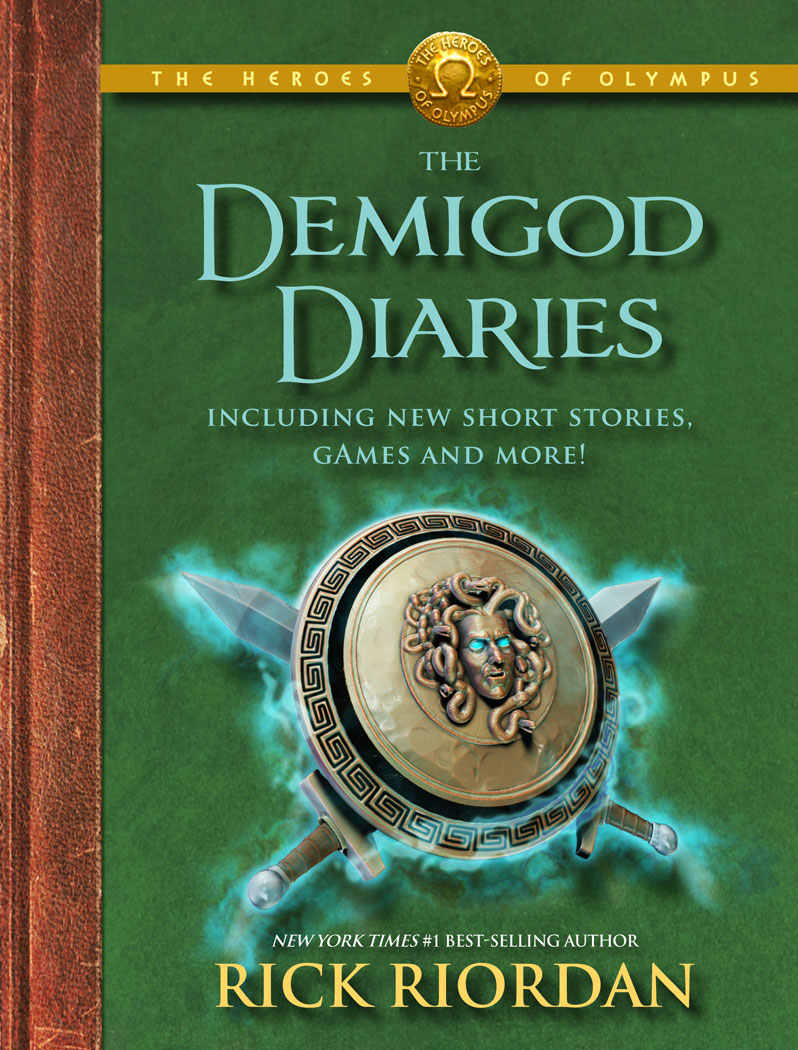
There isn't really much to analyze on the cover.  We have a green background, along with a brown spine, with the shield Aegis and two swords all glowing.  Simple, but I would say still reasonably effective. 

Well, I think that wraps up this retrospective.  Next time we're returning to the world of Egyptian Mythology to finish our adventure with the Kane siblings.  Join me again next time when we take a look back at The Serpent's Shadow.  I will see you then. 

Friday, August 24, 2018

Riordan Retrospective: The Son of Neptune


Welcome once again to the Riordan Retrospective.  For those of you just joining the fun, this is my look back at the works of Rick Riordan.  That means we're taking a look at Percy Jackson, its sequel series and its spin-off series. This is less of a formal review, and more of a look back, along with my thoughts and observations.  Last time we returned to The Kane Chronicles for a look back at The Throne of Fire.  This time we're returning to The Heroes of Olympus.  We're taking a look back at The Son of Neptune, The Heroes of Olympus book 2. 


Percy Jackson is confused and on the run from monsters.  He can't remember why he's on the run, or much of anything for that matter, but thanks to the wolf goddess Lupa he's made it to a safe haven.  Oh, but this isn't Camp Half-Blood, this is Camp Jupiter: training camp for children and descendants of the Roman gods.  Percy barely has time to adjust to this brave new world when he soon finds himself on a quest with his fellow campers Frank Zhang and Hazel Levesque.  The three of them must free Thanatos, the god of death.  To do this they must travel the west coast of North America to the Land Beyond the Gods: Alaska!

As per usual, there will be spoilers, so turn back now if you don't want any.  Okay, everyone who wants out gone?  Then let's begin.

The Son of Neptune always felt like a much better start to The Heroes of Olympus than The Lost Hero to me.  It almost feels as though it was written in response of the criticisms of The Lost Hero.  We're got Percy, a long established and beloved character, to act as our anchor as we are introduced to new characters and new settings.  Also, rather than wasting time on build up, we get straight to the point with all of the revelations and new information. 

One thing in particular that I like was that Percy still acted like the seaweed brain we all know and love even with his amnesia.  This is particularly note worth as it is in sharp contrast to Jason Grace, who appeared to have no personality.  Boy, was that ever foreshadowing about Jason's lack of personality.  On a side note, if you'll remember back to The Titan's Curse, one of the Ares campers was also named Jason.  Just a fun little tidbit I thought I'd point out. 

It was a bit disappointing that Percy lost his Curse of Achilles so early on, but I understand why it had to happen.  Well, you know, apart from the curse being Greek, so he had to lose it to go into Roman territory.  If Percy was, effectively, invincible it would be hard to maintain a sense of drama and tension.  Though, granted, he could always have been in danger from choking or poison.  In fact, he nearly gets killed in that bet with Phineas, but is smart enough to know that he's too important to Gaea for her to let him die.  That scene is also a prime example of how, though he might not be book smart, Percy is smart in other ways. 

After the build-up of The Lost Hero we finally get to see Camp Jupiter and New Rome, and they are glorious.  We've gotten a few hints of Roman Mythology, a few gods like Janus here and there, but this is the first time it's front and center to the plot.  In edition to the mythology we also get a good dose of Roman History.  One of the things that always kind of disappointed me a bit about Camp Half-Blood was that it didn't really do much with the history and culture of Ancient Greece.  New Rome also gives us an answer to the question of what happens after camp, at least for Roman demigods.  After they serve their time in the legion they get to retire to New Rome and do whatever they want, and they don't have to fear any monster attacks.

Unsurprisingly, New Rome appeals to Percy, but I think there's an even deeper level to that.  We learn that Neptune, Poseidon's Roman counterpart, is considered a fairly unimportant god by the people of New Rome and Camp Jupiter.  At Camp Half-Blood he's a living legend and many of the other campers hold him on a pedestal.  At Camp Jupiter he has a chance to be just another face in the crowd.  The fact the Camp Jupiter is decided into cohorts, rather than cabins, probably appeals to him as well.  It might be nice to have Poseidon Cabin all to himself for privacy, but it probably gets lonely in there at times. 

We also get an answer to the question of, what happens when demigods have kids, in the form of legacies.  Legacies apparently get powers too, but those powers get weaker with each successive generation.  Octavian is described as looking like a faded copy of an Apollo kid.  We only ever see Roman legacies, but Greek demigods don't have an equivalent of New Rome, so the implication is that most of them get killed before they can have kids.  Well, that's actually not quite accurate, but more on that in just a minute.  You get a tattoo based on your godly parent and/or ancestor when joining Camp Jupiter.  Do legacies get combo tattoos?  That could lead to some pretty complex tattoos.  If I did have one minor quibble it would be that legacies didn't really factor much into the plot of the series, baring a few notable exceptions, as demigods did.

Now let's talk about the characters.  I really loved Reyna.  She was stoical, a strong leader and overall a woman in control.  Yet beneath it all she has her own doubts and insecurities.  I'm very happy that she got to play an even bigger role in the later books.  Some people have noted that she and Annabeth has some similarities, but I think she different enough to be interesting.  For example, Annabeth is very fiery and outspoken, but Reyna is more reserved and introspective.  She's also very Roman, given that her mother is Bellona.  Technically, Bellona's Greek equivalent is Enyo, but they are as different as night and day.  Enyo was, essentially, the female version of Ares.  Bellona, by contrast, was a much more honorable and noble goddess, not all that dissimilar to how Mars contrasts with Ares. 

Now let's talk about Hazel.  Like Nico and Bianca she's from the 1940s, but unlike them she actually remembers what it was like back then.  She spends most of her time at Camp Jupiter, so culture shock doesn't come up that much, which I'd say was a bit of a wasted opportunity.  She's a child of Pluto, but her powers are more oriented towards gems and precious metals, rather than the dead.  It does make a certain amount of sense; Hades/Pluto was the god of wealth, especially with regards to the riches beneath the Earth, in addition to being the god of the dead.  

Still, ever since Hazel showed up Nico definitely started to specialize in death powers, while ignoring his earth-related powers.  Also, apparently Bianca opted for reincarnation, so there goes any hope of her and Nico being reunited, even if only temporarily.  Well, at least Nico's still got Hazel, if nothing else.  Something I found interesting is that Hades/Pluto is the only god of the Big Three to not break the promise to not have any more kids.  Going back to the myths, Hades was the most faithful of the Big Three; he only cheated on Persephone twice, and both times ended badly for the women he got involved with.  I like to think he said faithful because Persephone scared him so much those two times. 

With Frank Zhang with get our first major character from outside the United States.  Well, technically Sadie Kane spent most of her life in Britain, but she was born in America.  Frank, by contrast was born and spent most of his life in Canada.  I liked how it was explained that he had Greek and Roman ancestry despite being Chinese.  He's descended from Romans who were capture by Parthians, who were in-tern captured by the Chinese and taken to China.  Riordan clearly put some thought into that, and I tip my hat to that.  I loved Frank's interactions with Mars, and how it really showed just how different Mars is from Ares.  Mars is a kind and honorable god, as well as a loving father; by contrast, Ares is a bully who's relationship with his children is...rocky at the best of times.

Mars also gives us a brief candid look into the life of the gods.  He says he somewhat envies humans because their lives are finite.  Personally, I've always been of the option that immortality would be pretty great; you'd get to see all your long-term projects to the end, wouldn't have to fear death, ect.  However, Mars does raise the point that you'd also have to watch your loved ones get old and die.  Humans must seem like mayflies to the gods.  I've touched on this before, but maybe that's part of why the gods tend to ignore their children and mortal lovers.  Not getting too attached makes it easier when they enviably die.  On a lighter note, Mars also provides one of the funniest prophecies, because of just how direct it is.

I found Octavian to be entertaining just because of how shamelessly evil he was.  He was just so bombastic and over the top; subtly clearly isn't his style.  He certainly inherited his great-grandfather's flair for the dramatic.  Speaking of which, the fact that he's a legacy of Apollo makes his hatred of Greeks all the more ironic.  Apollo was one of the most quintessentially Greek gods, he even has the same name in both Greek and Roman Mythology.  

All in all, I found the Camp Jupiter characters to be a welcome addition to the Riordanverse, and I welcomed them with open arms.  

We also get some insight into demigod history.  Apparently, the American Civil War was a fight between the demigods; the Greeks fought for the North and the Romans fought for the South.  It's explained that Greek and Roman demigods have been at each other's throats ever since the Trojan War.  The Romans believed themselves to be descended from Trojan refugees, and in the Riordanverse, they really were.  The American Civil War killed so many demigods that the gods decided to keep them separate and ignorant to each other existence.  In real life, the American Civil War killed two percent of America's overall population, and is one of the deadliest wars America has ever fought; only the American Revolution rivals it in total body-count.  The Greeks are always in the East, and the Romans are always in the West, because of the way the Roman Empire was split; with Byzantium/Constantinople as the eastern capital and Rome as the western capital. 

We'd gotten hints of this before, it was mentioned in the original series that most of the Union generals were demigods, and so was Harriet Tubman.  However, it is also stated that the gods came to America in 1860, which makes no sense.  At the point in history the British Empire was at the height of its power and influence.  That means the Heart of the West should have still been in Britain.  It would have made more sense for it to come to America after World War II, or after World War I at earliest; in both of those cases, America was becoming a rising star and major power on the world stage.  

While we're on the subject of historical discrepancies, our trio of heroes discover that New Rome's navy is a single rickety dingy.  Hazel and Frank didn't even know New Rome had a navy.  It is explain that this is because the Ancient Romans didn't put much stock in naval power.  This is a gross oversimplification.  It is certainly true that the Romans didn't trust any water that their horses couldn't drink from, and their ships tended to be coast-huggers.  However, they were by no means slouches in regards to sea power.  During the Punic Wars, Rome defeated Carthage, the top naval power of the time, by reverse-engineering Carthaginian ships they captured.  

These are only a few issues, overall the information about Roman History is perfectly solid.  Moving along, we also get an answer to a question I've pondered for quite some time: what if an Iris Message was sent to something doing something where they would want to be seen?  Turns out it goes through all the same, as Frank found out when he sent one to Reyna while she was taking a bath.  We also finally get an on-screen appearance by Iris, and she's a hippie.  Well, rainbows are often associated with hippies.  She's also debating is she ought to convert to Buddhism or Taoism.  Amusingly enough, Buddhism teaches that it is perfectly possible to be both a god and a Buddhist, since even the gods are subject to the cycle of rebirth.  

Speaking of gods, I loved pretty much every scene Terminus was in.  As our heroes travel they get assistance from a couple of adult demigods and legacies who live outside of New Rome.  None of them are name nor do they having speaking role, and that's a shame.  It would have been interesting to see the perspective of an older demigod or legacy, and to hear their words of advice to our heroes.  As another side note, Amazon.com being run by actual Amazons was kind of obvious, but I loved it nonetheless, especially the scenes with Kinzie. 

I'd also like to take a moment to plug the audiobook version of this book. 

Now let's analyze the cover.  The cover depicts the climactic scene in Alaska. Percy triumphantly arises from the water carrying the lost standard of the Twelfth Legion.  If you'll note, you can see him wearing a purple Camp Jupiter t-shirt.  Up on the cliffs we can see the builds of Alcyoneus.  

All in all, The Son of Neptune was a much better start to The Heroes of Olympus than The Lost Hero, and I loved every minute of it.  We're going to be doing something a little different next time, because we're taking a look at another collection of short stories.  Join me next time when we take a look back at The Demigod Diaries.  I will see you all then.