Showing posts with label Percy Jackson and the Olympians. Show all posts

Thursday, January 7, 2021

Riordan Retrospective: Camp Jupiter Classified

Welcome back to my Riordan Retrospective. For those of you just joining the fun, this is my look back at the works of Rick Riordan. That means Percy Jackson, its sequels, and spin-offs. This is less of a formal review and more of a relaxed look back. Last time, we took a look back at The Tyrant's Tomb. This time, we're taking a look back at Camp Jupiter Classified: A Probatio's Journal. As usual, we're going to start things off with a brief summary.


Camp Jupiter Classified is told in the form of a journal written by a camper named Claudia. She's a legacy of Mercury; specifically, he's her great-grandfather, and her dad was a former centurion in the Twelfth Legion. She has survived her training with Lupa and is ready to explore the wonders of Camp Jupiter and New Rome. At first, things go great, and she even makes some friends. Then a series of mishaps and strange occurrences begin to happen, and Claudia is suspect number one. Claudia must clear her name while unraveling a mystery that may hold the fate of Camp Jupiter and New Rome in the balance.

As soon as Camp Half-Blood Confidential came out I immediately thought "You know, I sure hope Rick makes a Camp Jupiter version of this." As you can see, Rick did indeed follow through on that. In fact, not only this as good as Camp Half-Blood Confidential and Brooklyn House Magician's Manual, I'd argue it exceeds them both in terms of quality. It is actually an interesting progression. Camp Half-Blood Confidential had a series of vignettes, Brooklyn House Magician's Manual had vignettes and also a continuous frame narrative, while Camp Jupiter Classified forgoes the vignettes in favor of a single continuous narrative told in the style of a journal. We also don't get interrupted by ads for various attractions, like Camp Half-Blood Confidential, or mythology quizzes like Brooklyn House Magician's Manual. Also, the text is accompanied by black and white pencil illustrations. I thought that it was a nice touch.

I really liked Claudia as a protagonist. She isn't a character we've previously encountered; this is her debut as a character. I loved that she's a legacy rather than a...well, we'll get into that soon enough. Back on-topic, I've been saying for a while that we need more characters that are legacies, preferably without being evil like Octavian and Bryce Lawrence. Thankfully, Claudia fulfills that much needed role. As a legacy of Mercury, she prefers to rely on her cunning and wits rather than brute force to solve her problems. For example, she likes to dig trenches or climb up a tree and drop things on her opponents. She was worried that it wouldn't be considered a proper Roman tactic, but thankfully, it's considered a perfectly valid form of combat.

I've also been saying that need more children of the minor gods, and we got that too. Claudia makes a friend named Janice, who is a daughter of Janus. Before you ask, unlike her father, she only has one face. This really adds fuel to my speculation that the gods have a thing for puns, especially when it comes to names. Janice was also born and raised in New Rome. In fact, I think it would be nice to have more demigods and legacies who are native to New Rome. Hmm, I wonder if those born and raised in New Rome have to train with Lupa before joining the legion? The Roman gods are usually more hands-off compared to their Greek counterparts. However, occasionally they will disguise themselves as humans and settle down in New Rome for a bit to raise families. Keep this in mind, it will be important later on.

Rounding out the trio we have Blaise, a son of Vulcan. I'm not a super hardcore Star Trek fan, more of the very casual sort, but Blaise being a son of Vulcan got a chuckle out of me, though he is not stoic. We get some extremely vague hints that Claudia might like him, but for now at least, they're just friends. I thought it was a nice touch to have a girl and a boy be friends without being romantically involved. Like most children of Vulcan, he's quite handy with a forge and inventions.

I liked that we got to explore more of Camp Jupiter and New Rome through Claudia's eyes. I've said before that I feel that the Roman demigods get the short end of the stick when it comes to the main books. As such, it was nice to have a book entirely devoted to the Roman side of the Riordanverse. We see that there is a shop that sells action figures of the Roman gods and goddesses, with accessories sold separately. Amusingly, this does have some historical basis. Several souvenirs and trinkets were sold at gladiator games and chariot races, including figurines of the different types of gladiators. You could also buy commemorative glasses made of actual glass. Here's hoping the toy shop didn't have any Pluto action figures in stock when Nico visited New Rome. Probably would have evoked bad memories about how Bianca died.

Speaking of gladiator games, they are still a popular form of entertainment in New Rome. They haven't changed that much since the days of Old Rome. Well, fights aren't too the death anymore, but they're still violent and bloody; in fact, Claudia gets to sit in a section call The Splash Zone specifically because that's the part that gets the most blood spatter all over it. Okay, that's just plain unsanitary. There are plenty of pathogens that are spread via blood. Granted, New Rome does have plenty of magical healing options that are probably superior to mortal medicine, but it still seems like an awfully cavalier attitude to public health and sanitation. On a minor note, you have to bring your own seat cushions. I know that New Rome is try to preserve as much of the legacy of Old Rome as possible, but really, is it all that bad give some cushions for the coliseum?

We also learn that the bathhouse has a secret entrance, though it involves swimming through a pipe and some netting. Personally, that sounds way too scary for my taste. Still, apparently some legionaries like to use it for romantic rendezvous after curfew. Normally, the life guards don't like people getting too frisky in the bathhouse. Wait, does that mean bathing is communal? I mean, it was during Roman times, but even then, the bathhouses were separated by gender. I would assume that the bathhouse would also be separated by gender, given how Reyna reacted when Frank accidentally sent an Iris Message to her while she was using the bathhouse.

It was nice to see more of the mundane aspects of life at Camp Jupiter. For example, at one point Claudia is assigned to clean the stables are part of her Elephants, Unicorns, and Giant Eagles class. Turns out you have to be quick when bagging the poop, or else you'll still be holding onto the bag when the eagles swoop it away. Also, on multiple occasions it is mentioned that Claudia chooses to wear sandals, only for that to prove to be a bad idea. I'm just saying, the definition of insanity doing the same thing twice and expecting different results. Also, at one point the mess hall gets donuts, but Claudia has to go chat with Elon the faun. By the time she gets back the only donuts left are coconut, and for some reason she finds this terrible. Really, Claudia? How can you not like coconut donuts?

Anyway, so Claudia does some digging around based on mysterious dreams and messages she's been getting. This leads her to a startling discovery: the ancile is missing! Okay, some explanation is in order. The ancile was a cello-shaped shield that was kept the temple of Mars Ultor. As long as the ancile survived, then so too would Rome. These days, the ancile is supposed to be kept at the temple of Mars Ultor in New Rome. If the ancile were to be destroyed, it would be New Rome's equivalent of the hearth fire of Camp Half-Blood getting destroyed. In fact, it might actually be worse, as the ancile would take the last remnant of Old Rome with it. That would mean all the mythical beings associated with Rome would potentially go poof; no more fauns, no more cynocephali, even Bombilo the two-head barista would be toast. The Olympians would probably be powerful enough to survive, and they've got their Greek counterparts to fall back on, but the minor gods would be in serious danger of fading away. The Romans had tons of minor gods for oddly specific things. Apparently, many of these minor gods and goddesses are basically on life support because hardly anyone remembers them anymore.

I should have mentioned this before, but as usually with these retrospectives there will be spoilers, so be careful about moving beyond this point if you don't want any of that. But if you want to see my thoughts on "The Singer of Apollo" skip down a few paragraphs.

I liked the way Claudia investigated the strange dreams she'd been having. She tried talking to Terminus, but he blew her off. So, she takes one step back from the Pomerian Line, then step forward again, because Terminus always appears whenever someone sets foot on the Pomerian Line. He blows her off again, but she repeats this process until he finally caves and answers her questions.

So, who would want to destroy the ancile, and with it, Camp Jupiter and New Rome? Well, Claudia's dad used to be in the legion, and he helped a young girl named Mimi find her way to Camp Jupiter. She was a daughter of Mefitis, the goddess of noxious vapors that emanate from the earth. Did I mention that the Romans had some weirdly specific minor deities? Unfortunately, this meant she had quite the odor, and even Terminus tried to turn her away. The other campers couldn't stand her stink, and eventually she was kicked out of Camp Jupiter. These days, she lives in a trailer at the San Francisco landfill, and is still harbors great resentment towards Camp Jupiter.

Okay, plotting to destroy New Rome is going way to far, but Mimi is kind of right that Camp Jupiter screwed her over. Surely, they could have found something for her to do. Maybe have her work in sanitation and disposal, or sewer maintenance, or help clean the stables? She didn't choose to be born with super stink powers that she can't control. Yet none of the characters ever dwell on this or acknowledge it. I guess she lost their sympathy with the whole plotting to destroy Camp Jupiter and New Rome thing. Also, remember when Apollo wished he knew some children of Cloacina, the goddess of sewers? Well, turns out she does have kids at Camp Jupiter, but unlike children of Mefitis, they do not smell stinky.

Also, I noticed that Reyna came across as a bit harsher and sterner than usual. Though, I guess you could justify it in that the book is told form Claudia's perspective, so that skews things. Though, Frank's characterization seemed fairly correct. Having said that, it was pretty weird that Hazel was nowhere to be seen. Maybe it was because Claudia only ever sees Frank doing praetor stuff with Reyna. Still, you'd think Claudia would have encountered Hazel at some point, even if only briefly.

So, the day is saved, and Claudia even get to meet her long-lost mother. Turns out she's Cardea, goddess of hinges and thresholds. That means that, in addition to being a legacy, Claudia is also a child of one of the minor gods. That just makes her even more awesome than she already was. We also get confirmation of something I've long suspected. When Cardea gives Claudia her tattoo, she gets a hinge for Cardea and a caduceus for Mercury. I wonder if there is a cut-off point of being a legacy. If not, then presumably there's at least a few campers with tattoos like Scar from Fullmetal Alchemist. Also, apparently getting your Camp Jupiter tattoo does indeed hurt. But hey, we end with the feeling that this is just the start of many more adventures for Claudia and her friends.

We'll discuss this more when we get to The Tower of Nero next time, but Rick has said The Trails of Apollo will be the last multibook series. However, he is open to doing standalone novels in the future. He says he wants these standalones to be something people could read without needing to read the other fifteen books of the Camp Half-Blood series. You can see Camp Jupiter Classified as something of a trail run for these hypothetical standalone books. It should give you a rough idea of what they would be like. I think it would be great to have them focus on new original demigods and/or legacies. Though it might be nice to have some that explore pre-existing minor characters in more detail. Hey, I can't be the only one holding out hope for a Charles Beckendorf and/or Silena Beauregard prequel novel, can I?

Yes, there is indeed an audiobook version of Camp Jupiter Classified. You should know by now that I will plug those. It is narrated by Erin Cahill, who does a great job. Let's also do a brief cover analysis. The cover is simple yet understated. A purple background with the gold Camp Jupiter logo on it, and a Roman column on the side. Though, personally, the column looks a bit more Greek to me.

So, that was Camp Jupiter Classified. Another short but sweet companion book that I absolutely loved. Hmm, you know, it just occurred to me that I haven't done a retrospective of the short story "Percy Jackson and the Singer of Apollo." Well, we're already here, so let's take care of that right here and now.

"Percy Jackson and the Singer of Apollo" begins with Percy and Grover hanging out together in celebration of Grover's birthday. It all starts off well enough, but then the god Apollo ropes them into a quest. One of the chryseae celedones, a group of mechanical singers, is missing. Percy and Grover have to capture the celedon and bring it to Mount Olympus before sundown. One thing is for sure, this is one birthday Grover and Percy will never forget.

This short story was originally published in 2013 as part of the collection Guys Read: Other Worlds, edited by John Scieszka. Guys Read is a series of short story anthologies aimed at boys, particularly reluctant readers, and designed to encourage a lifelong love of reading. Obviously, I bought Other Worlds specially so that I could get "The Singer of Apollo." However, I can attest that, barring one or two exceptions, the other stories are also quite excellent. In fact, I think I may have to do a separate review of them some time.

I had a great time with "The Singer of Apollo." It was like taking a walk down memory lane to the early days when Percy Jackson and the Olympians was just starting out and trying to make a name for itself. In hindsight, it is very nice that this story focuses on an adventure with just Percy and Grover. G-Man was sorely missed in The Heroes of Olympus. This is another story that shows that Percy is having adventures even when he isn't on a major quest, or at Camp Half-Blood.

Another hindsight aspect is that this story demonstrates how much Apollo has grown as a character throughout The Trials of Apollo. Here, he sends Percy and Grover to do his dirt work without a second thought, or a care for their safety or prior birthday plans. He can't even be bothered to remember which of them is having the birthday. It also interesting to contrast how he is presented. Here, Apollo comes across as a Mr. Cool Dude celebrity type, but also reads as straight. We only get the slightest hints of the flamboyant and fabulous bisexual personality he has in The Trials of Apollo.

Riordan has said that "Singer of Apollo" is set between The Last Olympian and The Lost Hero. Despite this, Percy doesn't mention his Curse of Achilles, and he is concerned about falling off of a billboard at one point, even though that shouldn't have been an issue. I will say I did love how Percy was able to get out of said situation with the billboard by thinking about what Annabeth would say to him. Also, Naked Cowboy made a surprise cameo at one point. He isn't referred to by name, but it is clearly meant to be him. He's a musician who plays guitar in Times Square wearing nothing but a cowboy hat, boots, and two pairs of underwear. If you're wondering, under New York City law, one pair of underwear is considered nudity, but two pairs are considered clothing.

Jesse Bernstein once again returns as narrator for the audio version, and he does an excellent job as usual. Yes, there is an audiobook of the anthology. It features a different narrator for each story, and they are all very talented.

All in all, another excellent short story.

Okay, so that covers Camp Jupiter Classified and "Percy Jackson and the Singer of Apollo." Check them both out if you haven't already. This is the penultimate installment of the Riordan Retrospective, and that means next time is the big finale. It is a surreal feeling, but I will touch on that much more next time.

Speaking of which, join me next time for one final retrospective as we take a look back at The Tower of Nero. I will see you guys next time.


Saturday, December 28, 2019

Riordan Retrospective: Demigods and Magicians


Welcome once again to my Riordan Retrospective.  For those of you just joining the fun, this is my look back at the works of Rick Riordan.  That means Percy Jackson, its sequels, and spin-offs.  This is less of a formal review and more of a casual look back.  Last time, we finished our look back at Magnus Chase and the Gods of Asgard with a look back at 9 From the Nine Worlds.  This time, the moment you've all been waiting for has arrived.  We're looking at the Percy Jackson/Kane Chronicles crossover Demigods and Magicians


I'd been putting this one off because the audiobook wasn't available through Audible.com, my preferred source of audiobooks.  However, it is available via iTunes, but not as a complete set.  Just type in the name of the individual stories: "The Son of Sobek", "The Staff of Serapis", and "The Crown of Ptolemy."  The one you want is the one that cost $2.99, because those are the ones that comes with the audiobooks.  While we're on the subject, there is a very special narrator for "Son of Sobek" and "Staff of Serapis".  You see, Rick Riordan himself narrates these stories.  He is just as great a narrator as he is a writer.  It is certainly interesting to see how he imagines the characters sounding.  It isn't terribly different to how Jesse Bernstein narrates.  Incidentally, Jesse returns to narrate "Crown of Ptolemy".  He is as excellent as ever. 

The first story is called "The Son of Sobek."  Carter Kane is on a mission to Long Island to investigate reports of mysterious magical activity.  He's nearly eaten by a giant crocodile, but is saved by a teenager wielding magic like nothing Carter's ever seen before.  The teenager's name?  Percy Jackson.  Carter and Percy are going to have to team up to take down a petsuchos.  

Interesting that the crossover begin's from the Kane's point-of-view, rather than Percy's.  Then again, 2/3 of the crossover are told from Percy and Annabeth's point-of-view.  Also interesting in that the monster of the story was a purely Egyptian creature, rather than a Greco-Egyptian hybrid like the other stories.  I like how these story feel like a throwback to the early days when Percy Jackson and the Olympians was still making a name for itself.  We'd all been hoping for something like this; epically after all the hints Rick left in The Kane Chronicles.  Also, we finally get to see Percy use his hurricane generation powers again.  It takes quite the strain on him, which is why he doesn't use it as often, but still it was nice.  

There's an amusing scene towards the beginning where Percy asks Carter if he's a half-blood, as in a demigod.  However, Carter briefly misinterprets it as a racial slur.  This is how you know Percy Jackson and the Olympians was first written in 2005.  If it had started today, some idiot would get offended over the use of the word half-blood, and faux-outrage would ensue.  Anyway, all in all an excellent start to the collection. 

The second story is called "The Staff of Serapis."  Annabeth Chase is on her way to an architect interview when she attacked by a monster with the heads of a lion and wolf.  Thankfully, a mysterious girl Sadie Kane soon arrives to help take down the monster.  The two girls are going to have to team up to take down the Greco-Egyptian god Serapis.  

There's a great scene at the beginning where Annabeth evades the monsters by tricking its heads into arguing with each other.  It recalls her time in the catacombs of Rome in The Mark of Athena.  It goes to show, particularly in how she worded things, that she and Percy might not be so different after all.  Annabeth and Sadie get along noticeably better than Carter and Percy did.  Granted, Percy and Carter got into a fight not long after meeting, which probably set the tone for things.  

They are facing off against Serapis.  He was originally a minor Egyptian deity, but rose to prominence during the Ptolemaic Dynasty.  In fact, Serapis was considered the head of the combined Greco-Egyptian pantheon for many years.  Several centers of learning where built from temples dedicated to Serapis known as Serapeum.  The Ptolemaic Dynasty gets its name from Ptolemy.  He was one of the three generals who inherited Alexander the Great's empire.  Alexander died childless, so his four general carved the empire among themselves.  Ptolemy got Egypt, and his dynasty would be the last to rule Egypt before the Romans conquered them.  As you can imagine, the Ptolemaic Dynasty saw quite a bit of mixing of Greek and Egyptian culture. 

Interesting fact, Alexander the Great claimed to be both a son of Zeus and the reincarnation of Achilles.  Knowing the Riordanverse, there's a high probability that he wasn't just blowing smoke.  I can't help but wonder if that will become relevant in the future, but I digress.  Also, in case you're wonder, the other three generals were Seleucus, Antigonus, and Cassander.  Seleucus got Persia, and the Seleucid Dynasty is named after him.  Cassander got most of mainland Greece, and Antigonus got Turkey and the bits of Greece Cassander didn't get. 

Serapis was trying to build a new Lighthouse of Alexandria, also known as the Pharos.  Alexandria was founded by Alexander the Great, and served as the capital of the Ptolemaic Dynasty, so it is certainly fitting.  He was doing this to harness enough Greek and Egyptian magic to take down the other gods.  Also, thanks to Rick narration, I realize I've been pronouncing Hecate wrong all these years.  It is "heck-at" not "heck-uh-tea."  Once again, an excellent story.  

Our final story is titled "The Crown of Ptolemy."  The rouge undead magician Setne has been behind all the strange happenings.  Setne plans on attaining ultimate power by combining both Greek and Egyptian magic.  However, if he wants to do that he's going to have to take down Percy, Annabeth, Carter, and Sadie.  To stop Setne, our heroes are going to have to do a bit of mixing and matching of their own.  

I knew we'd be seeing something like this as soon as I got to the end of The Serpent's Shadow.  Setne was still missing, the Kanes had reports of mysterious magic on Long Island, it was all there. Throughout the collect there has been a them about working together, and combining the best aspects of both systems.  That theme is especially strong here.  Early on, Percy loses Riptide when Setne absorbs it into his body.  So he makes due with one of Carter's spare wands, which turns into a kopis, a variation on the khopesh used during the Ptolemaic Dynasty.  Later, Carter uses Annabeth's invisibility cap as part of the plan.  

Oh, but that's just the warm-up.  Percy winds up hosting the vulture goddess Nekhbet.  This makes him quite possibly the first Greek demigod, that we know of, to host an Egyptian deity.  He's also quite possibly the only person without blood of the pharaohs to do so.  Of course, demigod blood is more than a sufficient substitute, as Nekhbet attests.  Also impressive in that Nekhbet and Poseidon have nothing in common.  We know from previous books that bad things can happen if a host and their god use different sorts of magic.  Then again, Percy was kind of perfect for the role.  He turned down the opportunity to become a god, and that willpower and determination allows him to keep Nekhbet in check. 

Then, as if that wasn't awesome enough, Sadie tells her Annabeth her ren; as in, secret name.  This allows Annabeth to temporarily gains the ability to read hieroglyphics and perform Egyptian magic.  That makes Annabeth among a select few to crack the magic of hieroglyphics without having blood of the pharaohs.  There's an amusing scene where Percy muses that Sadie is like what would happen if he and Annabeth were to have a kid.  She has Annabeth's looks, but is impulsive and fidgety like Percy.  I liked the bits where Percy and Sadie interacted, and the same with Carter and Annabeth interacting.  I kind of wish we'd gotten two more stories; one with Percy and Sadie teaming up, and one with Carter and Annabeth joining forces.  

I should mention that Setne is trying to absorb Nekhbet and the cobra goddess Wadjet to gain the power of the Crown of Ptolemy.  That way, he can become a god, absorb the other gods, and gain the ultimate power of both the Greek and Egyptian pantheons.  I kind of wish Wadjet had been the one Percy hosted, since we already encountered Nekhbet in the main Kane Chronicles series.  Nekhbet and Wadjet are the snake and vulture on the double crown of the pharaohs, and are both guardians of the pharaohs.  Nekhbet for the white  crown of Upper Egypt, and Wadjet for the red crown of Lower Egypt.  He's doing all this on Governor's Island, because it is halfway between Manhattan and Brooklyn, the hearts of the Greek and Egyptian pantheons in America. 

While overall Jesse does great with the narration, there is one minor point I have to ding him on.  He has Setne talk like Elvis, because Percy says he looks like Elvis.  There's is no evidence that this is how Setne talks.  You know, when a series has multiple narrators, they really should exchange notes with each other.  

Anyway, Setne is defeated and sealed in a snow globe.  Our heroes decide that, in light of everything that has happened, it's best that they not tell anyone about their adventures.  Thus, we get the overall moral of the short story collection: multiculturalism will inevitably lead to disaster...wait a minute, that can't possibly be correct!  The real moral is that we should all stick to our own kind...oh gods, that's even worse!  Uh...yeah, Rick probably didn't intend it, but the collection does inadvertently end with a "we're better off apart" feeling. 

Sure, there would be more problems if Camp Half-Blood and Brooklyn House knew of each other, but also more solutions.  Just think of the potential.  I'm sure Percy and the other demigods would have been grateful for some Egyptian magic during the war against Gaea.  I'm also pretty sure that the magicians of the House of Life would have appreciated some Greek assistance for the battle against Apophis.  Just think of the potential.  Sadly, it seems that Percy, Carter, Annabeth, and Sadie will be the only ones to know of both the Greeks and Egyptians.  Well, I'm pretty certain that Chiron and Uncle Amos know, but you get what I mean. 

Still, despite the unintentionally message, this was still an awesome story.  In fact, the whole collection is a welcome return to form after the trainwreck that is Magnus Chase and the Gods of Asgard.  Now let's analyze the covers.  For the story collection as a whole we see Riptide and an Egyptian Khopesh crossed over each other.  Simple yet effective.  


Next we move on to the cover for "The Son of Sobek" where we see...ahhh!  Percy!  Carter!  What have they done to you?!  The covers for the individual short stories are by Antonio Camparo.  He...leaves something to be desired as an artist.  It would seem that he is drawing inspiration from John Rocco's character art.  I think we can all agree that it is better now that Viria has replaced John Rocco as the official character artists.  Rocco usually makes great cover art, but his charcter art leaves something to be desired.  Percy and Carter look like they're about to eat the reader.  It's even worse since Carter kind of looks like a young Bill Cosby.  


Next we the cover for "The Staff of Serapis."  We see here...no!  Annabeth!  Sadie!  Not you too!  Annabeth looks like she's become a meth addict, and Sadie isn't much better.  It's always a bad sign when the monsters look friendlier and more appealing than the heroines.  I would not like to meet these character portraits in a dark alley, or anywhere, for that matter. 


Finally, we have the cover of "The Crown of Ptolemy."  Well, I guess it isn't completely terrible.  Of course, that's also like saying that this cover was the shiniest turd in the pile.  It’s still pretty bad.  All the characters look like those 30-year-old high schoolers you’d see on television shows from the 1990s and early 2000s.  Stress can cause premature aging, but not like this.  Thank goodness the collection has a better cover than the individual stories.  


Here, have a picture of Percy that Viria drew so that we all don't lose our sanity.  And be sure to check out all of her other excellent official character art over here.  You can also find her over on DeviantArt

And that was "Demigods and Magicians."  A highly anticipated crossover that did not fail to deliver. It was a long time coming, but it was worth the wait.  Now, we've got one more Kane Chronicles stop to make before returning to The Trials of Apollo.  Join me next time when we take a look back at Brooklyn House Magician's Manual.  I will see you guys next time.  

Saturday, September 1, 2018

Riordan Retrospective: The Demigod Diaries


Welcome once again to the Riordan Retrospective.  For those of you just joining the fun, this is my look back at the works of Rick Riordan.  That means we're taking a look at Percy Jackson, its sequel series and its spin-off series. This is less of a formal review, and more of a look back, along with my thoughts and observations.  Last time we took a look back at The Son of Neptune.  This time we're taking a look at the short stories collection The Demigod Diaries. 


As per usual there will be spoilers, so turn back now if you don't like that sort of thing.  Everyone who wants out gone?  Good, then let's begin.

The first story is called "The Diary of Luke Castellan".  It takes place several years before The Lightning Thief and follows Luke, Thalia and Annabeth before they came to Camp Half-Blood.  In fact, it takes place not too long before Luke and Thalia met Annabeth for the first time.  Before that, however, they must meet with a son of Apollo named Halcyon Green.  He has the power to see into the future, but what will he say about Luke and Thalia's futures?

A lot of people had been asking Rick to write a story about Luke, Thalia and Annabeth's adventures before they arrived at Camp Half-Blood.  As such, I'm sure this story made many people very happy.  Can't say I was exactly one of those people, but overall I enjoyed this story.  One of the first things that stuck out to me about this story was the tone.  Even at its darkest moments, the Riordanverse always had an undercurrent of wonder and awe at all of the mythical things going on.  That feeling is completely absent here.  There's a much more ominous and sinister tone.  This story almost feels more like a horror story than a fantasy story. 
  
We see the seeds that would lead Luke down his path to try to overthrow the gods.  We also get to find out just where the knife Luke gave to Annabeth came from.  I get the feeling that this isn't the last we'll see of Halcyon Green.  He's just too good of a character for Rick to not being back in some capacity in The Trials of Apollo.  This story was a great way to provide a sympathetic look of one of the Riordanverse's most tragic villains.  All in all, "The Diary of Luke Castellan" was a great way to start off the collection.   

Our next story is "Percy Jackson and the Staff of Hermes".  This story takes place between The Last Olympian and The Lost Hero.  In fact, it takes place about a month after the end of The Last Olympian.  Percy and Annabeth are celebrating their one month anniversary when the god Hermes ask for their help.  His caduceus has been stolen by the giant Cacus, and it's up to Percy and Annabeth to get it back. 

This one was probably my favorite story of the bunch.  It's another story that shows that Percy and the gang are having adventures even when it isn't the summer.  Cacus serves as some great foreshadowing about how Roman Mythology is going to start playing a bigger role in Percy and Annabeth's lives.  At one point he brags about the time he stole all the cattle in Rome.  Well, he serves as foreshadowing to Percy and Annabeth, at any rate.  By this point, we already knew about the Roman demigods and their corner of the world.  My only really criticism is that it seemed like Percy forgot about his Curse of Achilles.  For that matter, Rick Riordan also seems to have forgotten, given that Percy gets minor injuries even though he shouldn't have. 

Hermes rewards our heroes with a romantic dinner in Paris.  That was awfully nice of him.  Of course, going back to The Sea of Monsters, Hermes has always been one of the nicest and friendliest gods Percy and the gang have encountered.  The scene where Percy turns on the caduceus' laser function was fun, and George and Martha, are always fun.  "Staff of Hermes" is a really great story that helps to expand the Riordanverse.

 Our third story is "Leo Valdez and Quest for Buford".  It takes place between The Lost Hero/The Son of Neptune and The Mark of Athena.  Jason, Piper and Leo are scrambling to find a mechanical table Leo made before the chemicals it contains blows the woods up.  Also, said chemicals are vital for the construction of the Argo II.  If they want to get to Buford they're going to have to put up with some very crazy Maenads.

This was probably my least favorite story of the bunch.  The first problem it had is that it stars Jason, Piper and Leo.  I think I've already made it quite clear that I don't find them to be compelling characters in the slightest.  The second, and by far the greater issue, is that it didn't develop them as characters.  Leo is the same annoying Leo, and Jason and Piper are just as bland and uninteresting as ever.  It would have been better if the story had been set at Camp Jupiter before the events of The Lost Hero.  It would have been a great opportunity to get insight into Jason's character, and to develop him as a character.  Also, the Camp Jupiter characters are much more fun to read about than Piper and Leo; just saying.

For the life of me, I just don't understand why Riordan seems to love Jason, Piper and Leo so much.  Well, I suppose I ought to throw this story at least one bone or two.  I did enjoy the Maenads; I had been wondering when they were going to show up.  They claimed they were drinking kid-friendly non-alcoholic eggnog, but they sure did seem awfully buzzed.  While we're on the subject, same goes for Dakota, a son of Bacchus from Camp Jupiter.  He claims that he only drinks kool-aid, but I've got my suspicions about that.  Also, this story claims Camp Half-Blood doesn't celebrate Christmas, but this is contradicted by what we saw in The Titan's Curse.  Well, anyway, let's move on to the last story.
  
Our final story is "Son of Magic".  It follows Dr. Howard Claymore, a leading researcher into the study of death.  During one of his talks he is approached by a boy named Alabaster C. Torrington.  Alabaster wants to know if there is a way to stop death.  Dr. Claymore is hesitant at first, but agrees to follow up with Alabaster.  Before long, Dr. Claymore finds himself drawn into a world of gods, monsters and things he can't even begin to fathom. 

This story is unique compared to the other three because it is not written by Rick Riordan.  Instead, it is written by Rick's son, Haley Riordan.  The first thing that stuck me about this story is the tone.  It's dark, ominous and there is a strong sense of foreboding.  That goes hand-in-hand with the second way this story sticks out: the protagonist is both an adult and a bog-standard mortal.  This is a first on both of those counts.  Dr. Claymore' reaction to discovering the world of demigods and monsters is, I would say, pretty realistic.  We all might fantasize about visiting the Riordanverse, but without magic powers or special training, it would probably be a downright terrifying place to live in.  At times this felt very much like a horror story.

Now let's talk about Alabaster, son of Hecate.  He was one of the demigods who fought for Kronos.  Even after the war ended, he wanted to keep fighting, and refused to accept the armistice.  The gods worried that he might cause an uprising, but Hecate convinced them to spare Alabaster, in exchange for him being exiled from Camp Half-Blood.  He is the first, and thus far only, demigod this has ever happened to.  Chalk another one up for how dark this story is.  I actually had wondered if there were demigods who wanted to keep fighting after the war was officially over, and now I have my answer. 

We also finally get an answer for why monsters can smell demigods so easily. Lamia, the mother of monsters, did it after Hera killed her children in retaliation for Zeus trying to court Lamia.  This was back before Lamia was turned into a monster.  Anyway, due to being a daughter of Hecate, Lamia cast a spell so that monsters could find demigods easily.  She did this so that Hera would know what it's like to lose a child.  Unfortunately, Hera's feelings for demigods ranges from indifferent to downright antagonistic...unless they're Jason Grace, for some reason.  So yeah, thanks a lot Hera. 

Though, I suppose she did throw them one bone.  Well, besides the whole bringing the camps together to fight Gaea the giants thing.  Argus, the hundred-eyed giant, was Hera's faithful body guard.  She loaned him out to Camp Half-Blood as the head of security.  I always thought it was kind of a shame that Argus didn't play a bigger role in the stories, but I digress.

Hecate overall was reasonably well written, though this depiction seems at bit at odds with how Hecate appears in The House of Hades.  However, my biggest issue with this story also involves Hecate.  There are several times that Dr. Claymore has visions/conversations with Hecate where she is sitting in a church and praying.  The implication being that the Judeo-Christian god is real, and all of the polytheistic gods are subservient to him.  The biggest problem I have with this is that it just doesn't fit with the established universe. 

We've seen multiple times that the afterlife is radically different than what Christians say.  Back in The Lightning Thief we even saw a corrupt televangelist burning in Tartarus.  Why would the Judeo-Christian god let people go to pagan afterlives?  It just makes no sense.  Rick has hinted that maybe the Judeo-Christian god does exists somewhere out there, but given the afterlife problem, it feels like red herrings more than anything else.
  
Still, despite these hiccups, overall this story was quite well written.  I'm still partial to "Staff of Hermes" but "Son of Magic" can certainly give it a run for its money.  I see a bright future for Haley Riordan and his writing career.  A very bright future indeed. 

I'll also take a moment to plug the audiobook version of this short story collection.  Each story is narrated by a different narrator.  "Diary of Luke Castellan" is narrated by Nick Chamian, "Staff of Hermes" is narrated by Jesse Bernstein, "Quest for Burford" is narrated by Joshua Swanson, and "Son of Magic" is narrated by Aaron Groben. 

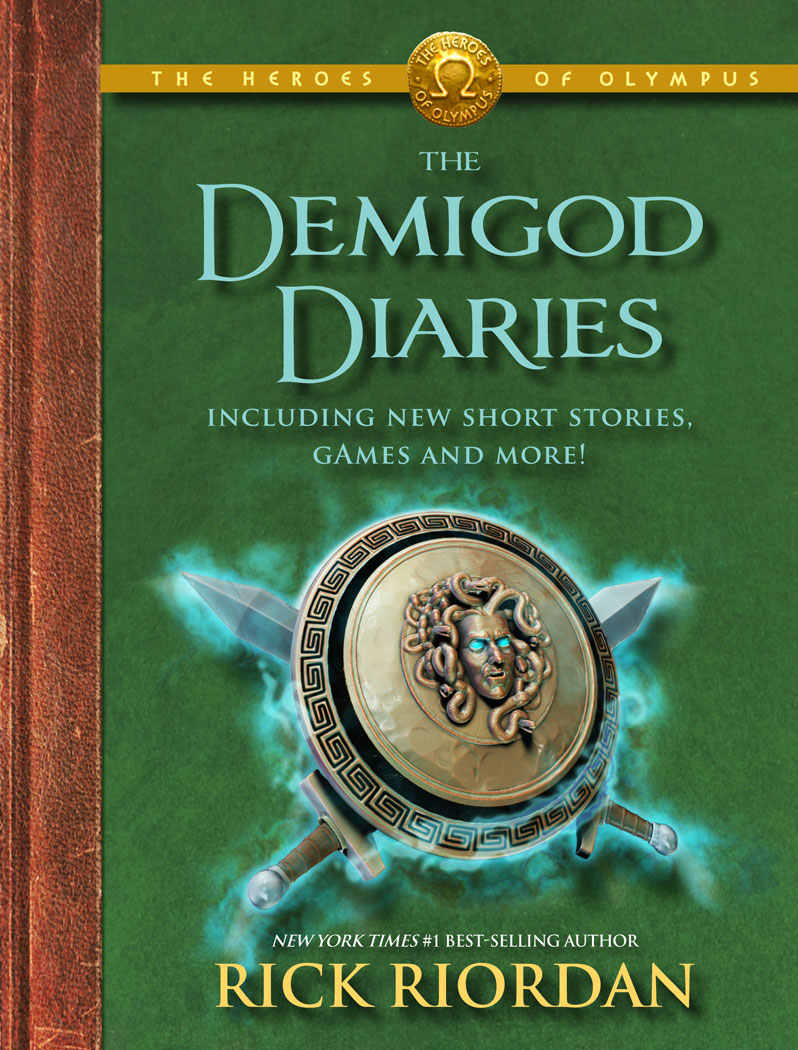
There isn't really much to analyze on the cover.  We have a green background, along with a brown spine, with the shield Aegis and two swords all glowing.  Simple, but I would say still reasonably effective. 

Well, I think that wraps up this retrospective.  Next time we're returning to the world of Egyptian Mythology to finish our adventure with the Kane siblings.  Join me again next time when we take a look back at The Serpent's Shadow.  I will see you then. 

Tuesday, March 6, 2018

Riordan Retrospective: The Last Olympian

Well, we've made it.  The Riordan Retrospective is about to hit its first major milestone.  For those of you who haven't heard, this is my look back at the works of Rick Riordan.  That means Percy Jackson and the Olympians, it's sequel series and its spin-off series.  Last time, we took a look back at The Demigod Files.  This time we're looking back at The Last Olympian, Percy Jackson and the Olympians book 5.  As we have done in all of the previous retrospectives, we're going to kick things off with a brief summary.


Against all odds, Percy Jackson, demigod son of Poseidon, is almost sixteen-years-old.  The big moment has finally arrived, the war against the titans has officially begun.  The demigods of Camp Half-Blood are about to make their last stand against the armies of Kronos.  I really can't add much more than that, so let's jump into the commentary.

So, like I've already said, this book is the culmination of everything Percy Jackson and the Olympians has been building up towards.  As usual, there will be spoils ahoy beyond this point.  Turn back now if you don't like spoilers.  With that out of the way, let's continue.

I've been hinting at this in past retrospectives, but let's finally examine Luke, and what makes him such an effective villain.  Percy and Luke have a similar dynamic to them as Superman and Lex Luther, in that's they're mirror images of one another.  Percy is a son of Poseidon, one of the rarest demigods of all; while Luke is a son of Hermes, an utterly common garden variety demigod.  Percy is far from dumb, but he tends to rely more on fighting and raw power, rather than his brains.  Luke, by contrast, is a schemer and a master manipulator and tactician.

On the other hand, perhaps they aren't so different after all.  Back to the comic book comparison, it's often said that Batman's villains are a dark reflection of himself.  The same can be said of Luke's relationship with Percy.  Luke could be seen as a shadowy reflection of how Percy might have turned out if he'd made different decisions, or given into temptation.

One thing I find interesting about Luke is that he doesn't appear to have any close friends or confidants.  He clearly knows how to work a crowd, and drum-up support, but he doesn't seem to have anyone he's particularly close to.  Percy, by contrast, has plenty of friends and loved ones.  Annabeth, Grover, Mrs. Jackson, Paul, Tyson and Chiron are the most important, but everyone at Camp Half-Blood had an impact on him in one way or another.  It could be argued that, even though Percy was naturally good, his friends and loved ones played a major role in nurturing that inherent goodness.  I know I've been referencing comics a lot, but you should never forget the major impact Jonathan and Martha Kent had on how Superman turned out.  It really makes me wonder how Luke would have turned out if he'd had even one true friend by his side.

What makes Luke such and effective villain is that many of the points he raises have a fair degree of truth to them.  Granted, that doesn't completely excuse his actions.  If his plan had succeeded, Western society, and probably the world as a whole, would have crumbled.  Millions, possibly even billions, would have been killed, and the remaining world would be ruled by the iron fist of Kronos.  Having said all of that, Luke is right when he says that the gods are incredibly neglectful of their children, have a tendency to abuse their power, and that something should be done to fix this.  He's also shown to be sympathetic to the plight of children of the minor gods.  Luke's problem isn't what he's trying to change, but the way he proposes to bring about that change.

Let's now change gears and talk about Percy.  I've hinted at it in the past, but we are now going to discuss what is so significant about his name.  It's mentioned within the books that Mrs. Jackson named him Perseus because Perseus is one of the few Greek heroes with an unambiguously happy ending.  However, it goes a bit deeper than that.  In the myths, Perseus kills his grandfather, who had previously tried to kill him and his mother.  In this book, Percy plays a major role in helping to kill Kronos, his grandfather on Poseidon's side of the family.

Side note, I loved the scene where Percy battle Hyperion and creates his own mini-hurricane.  It's a pity he never did it again in any of the sequel series, but it's implied that it drains a lot of energy out him, so it must be used sparingly.  Hyperion being one of the villains was amusing in itself, since the books are published by Disney-Hyperion.  Relatedly, Rick Riordan seems to have struck up a deal with Scholastic Publishing to help distribute the books.  I think it is really great that Percy and the gang have become members of the Scholastic family.  I have many happy memories of attending Scholastic book fairs, and ordering from their book order catalogs.

Now let's talk about Beckendorf and Silena.  As I've mentioned in my previous retrospectives, I've always been incredibly fond of them, despite their status as minor characters.  So, as you can imagine, their deaths hit me hard.  I often wonder if it is because they died that I appreciate them that much more. Like the song says, sometimes you don't know what you got til it's gone.  I'm not sure why, but there was just something about them that made me always so fond of them.  At the time I read this book, I wondered how Beckendorf got killed in a fiery explosion if he was as son of Hephaestus, god of fire.  As the Heroes of Olympus later reveled, only a rare few Hephaestus kids get fire manipulation powers.  So, it stands to reason that Beckendorf was sadly not one of those lucky few.

Going back to the theme of history and mythology repeating, this time around we have not only the Titanomarchy, but also the Trojan War.  The way Silena rallies the Ares Cabin to join the war, by putting on armor and pretending to be Clarisse, parallels Patroclus leading the Greeks into battle while pretending to be Achilles.  That puts Silena and Clarisse's friendship in an...interesting light. Now, granted, Silena is very devoted to Beckendorf, and his death is a major blow she never quite recovers from.  Clarisse has a boyfriend as well, Chris Rodriguez, but I can't help but wonder if her feeling for Silena weren't entirely platonic.  The way she was just so devastated when Silena was killed by the dracon could have been because of a deep friendship...or maybe there was something more there.  Does all of that make the dracon Hector?  Who can say, but it is fun to speculate.

So, just who is the Last Olympian spoken of in the title?  Why, Hestia of course.  It's easy to miss, but the early books mention a girl tending the fire in the center of cabin row at Camp Half-Blood.  Turns out, that girl was Hestia, and her hearth provides the camp with magical protection.  She gets her name because she's the one who stays behind to tend the hearth while all the other Olympians are out to battle.

In hindsight, I find it strange that Percy never got to have a meeting with Demeter.  Sure, we get a brief scene of her in the Underworld with Persephone and Hades, but never a proper introduction.  Kind of seems like a glaring omission.  Was there really no way she could have been introduced in the previous books?  Demeter kind of came across like a stereotypical crabby old Jewish woman, which was...a tad odd, given that she's a pagan deity and all.  Also, in rather on the nose names, the head councilors of Demeter Cabin are named Katie Gardner and Miranda Gardiner.  Yes, their last names are pronounced the same, but spelled slightly differently.  Fun fact, one of Rick's former students was named Katie Gardner.

Speaking of meetings, I did enjoy that Percy finally got to meet Amphitrite and Triton.  I'd always wondered what they'd make of him.  From what we briefly glimpse, they try their best to be polite, but they're clearly very frosty towards him.  It was a nice scene and all, but I kind of wish it had gotten a bit deeper...well, it did take place at the bottom of the sea...oh, you know what I mean!  Anyway, when I read this book I wasn't entirely sure where the small of the back was, so as far as I was concerned, Percy's Curse of Achilles might as well have covered his whole body.

So, before the big battle, Morpheus puts all the mortals in Manhattan to sleep.  On the surface, not too bad, but then you start to really think about it.  How many people were cooking dinner, or in the middle of surgery, or any other manner of things that could get nasty if left unattended?  Yeah, The Mist probably had to work overtime to cover-up all the casualties that Morpheus caused.  That's not even getting into all the sleeping mortals who might have been eaten by monsters, or killed by stray arrows or Greek Fire.

The statues of New York coming to life to aid the demigods was really cool, especially when the Statue of Liberty joined the fight.  There a scene at the end where a statue of Susan B. Anthony strangles a statue of Frederick Douglas.  This might have been a clever historical joke on Riordan's part.  It could be a reference to how the 15th amendment granted black men the right to vote, but women of all races were denied the right to vote until the 19th amendment passed in 1920.  Riordan was a middle school social studies teacher before becoming an author, so you never know.

So we finally get a resolution to the Great Prophecy of the series, but not the way we expected.  Turns out it was Luke, not Percy, who was the hero of the prophecy.  By choosing to killed himself, while playing host to Kronos, he scatters Kronos' spirit for a long time, and brings and end to the war.  As I've mentioned above, Luke's a complex villain, and perhaps also a tragic one.  Greek Mythology is big on the concept of fate and predestination; he couldn't change the big picture any more than the other characters, but he could still change the details.  Of course, if that is the case, then it means that free will is an illusion, and that we're all little more than puppets acting out our roles.  One that note, we finally find out who's string The Fates cut way back in The Lightning Thief.  Turns out it was Luke's string all along.

There's that old saying that it's not how we fall, but how we chose to pick ourselves up, that truly speaks to who we are as people.  Perhaps it holds true for Luke as well.  It's the same for Silena; she was working as spy for Kronos, but only because Luke blackmailed her, and she did it to protect Beckendorf and her friends.  Given the sacrifice she made for the Half-Blood army, I'd say she more than redeemed herself in the end.

Well, that got surprisingly dark, let's lighten the mood a bit.  So, Percy and Annabeth officially become a couple in this book; as if there were ever any serious doubt.  Also, Rachel takes over as the new Oracle of Delphi just in time to set things up for the sequel series, but we'll get to that in our due time.  We also get an answer to a question that has long plagued fans: is it incest if two demigods get into a relationship?  Turns out, gods don't have DNA, so thankfully no.  It is mentioned that two campers from the same cabin dating is frowned upon, though this is hinted to be more of a cultural thing than anything else.

So despite all the trails and hardships, most of our heroes live, and get their rewards from the gods themselves.  I kind of wonder what would have happened if Percy had taken the gods up on their offer to become a god.  Obviously, he was going to say no so he could be with Annabeth, and remain available for the sequel series.  Still, I gotta wonder about what he'd be like as a god.  Sure, Percy is a good person at heart, but how well would he live up to his lofty ideals if he had access to godly powers?  You know what they say about absolute power, but just perhaps, he might prove to be a benevolent deity after all.  I can easily see him getting into epic battles with the other gods.

Of course, that's just speculation.  Percy instead uses his wish to get the gods to acknowledge their children, gives the minor gods much needed representation on Olympus and at Camp Half-Blood, free Calypso, and let's the Big Three gods have kids again; also, Annabeth gets to live her dream of redesigning Mount Olympus.  There a scene near the end where Poseidon hints that Percy has other siblings somewhere out there.  This appears to have been a red herring.

So, things are looking up for the demigods of Camp Half-Blood.  Still, gotta wonder about those who fought in Kronos' army.  I can't imagine they had a particularly warm welcome to camp, and you'd think there'd still be bad blood between them and the campers.  If nothing else, you'd think both sides would need time to get over the war and adjust to life in peace time.  We kind of get an explanation of this in The Demigod Diaries, but more on that when we get to it.  Still, I can live with the ending as it was.  I love a good happy ending.

Now it's time to analyze the book covers.  This time around, the covers are actually fairly similar.  They feature Percy flying on Blackjack next to the Empire State Building.  And, as all good Percy Jackson fans know, Mount Olympus is located on the 600th floor of the Empire State Building.  Blackjack, in the old cover, has been noticeably slimmed down since his last appearance on a book cover.  In the new cover, we can see Typhon lurking in the clouds.  I think it's kind of nice how the new cover pays homage to the old cover.


And now, as a special treat, I will so you what the new covers look like when they're all placed together.  I must say, it is quite the sight be behold.  Also, for one final time, I will give a shout-out to Jesse Bernstein's excellent narration of the audiobook version.


With that, we have officially completed our look back at Percy Jackson and the Olympians.  Ah, but the Riordan Retrospective shall continue.  We're moving onto The Kane Chronicles and The Heroes of Olympus next.  Since they occurred concurrently to each other, I'll alternate between reviewing a Kane book and reviewing a Heroes book.

So, all that having been said, I want to take this opportunity to thank you all for joining me on this look back at the works of Rick Riordan.  Join me again next time when we take a look back at The Red Pyramid.  I will see you all next time.

Thursday, November 9, 2017

Riordan Retrospective: The Demigod Files

Welcome once again to the Riordan Retrospective.  For those of you just joining the fun, I'm taking a look back at the works of Rick Riordan, collectively known as the Riordanverse.  That means the Percy Jackson series, its sequels and its spin-offs.  Last time, we took a look back at The Battle of the Labyrinth.  This time, we're taking a look at The Demigod Files.


Now, this time is going to be a bit different; since we're looking back at a short story collection rather than a novel.  As such, this retrospective might run a bit shorter than the rest, but there's still lots of fun to be had.  Let's get started by talking about the stories themselves.  As per usual, beware of potential spoilers beyond this point. 

Our first story is entitled “Percy Jackson and the Stolen Chariot”.  Percy is at school when he looks out the window and sees Clarisse La Rue being attack by feather-shooting birds.  After getting excused from class, Percy learns that Clarisse is on a mission to retrieve Ares missing war chariot.  It's been stolen by her brothers, the gods Phobos and Deimos, who have hidden it at the Staten Island Zoo.  Percy and Clarisse have until sundown to get the chariot back to Ares temple, aka the USS Intrepid.

Overall, I thought that “Stolen Chariot” was a great way to expand on the worldbuilding of the Riordanverse.  We get the sense that Percy is having adventures even when he isn't at Camp Half-Blood.  This is also the first time that minor gods have played a major role in a story.  Granted, Janus appeared in Battle of the Labyrinth, but this time minor gods are front and center.  Also, this story confirmed a theory I'd long suspected: Percy can walk on water!  Albeit, it takes an extreme amount of concentration on his part.  The fact that the gods still have temples, of a sort, has...interesting implications.  We'll touch more on this when we get to next retrospective.

We also gain some interesting insights when Percy and Clarisse confront their greatest fears.  Not so much what their greatest fears were; Clarisse fear being a disappointment to Ares, and Percy fears that his friends would get hurt and he wouldn't be able to save them.  No, the interesting part is that Percy apparently counts Clarisse as one of his friends.  It really says something about how far they've come since the series began.  Rick Riordan originally posted this story, in three parts, to his blog back in 2007 to help hold readers over until book four came out.  So, chronologically, I'd say this story takes place between The Titan's Curse and The Battle of the Labyrinth.

Our next story is “Percy Jackson and the Bronze Dragon”.  Percy Jackson and Charles Beckendorf, son of Hephaestus, are on the same team in capture team in capture the flag.  Things are not looking very optimistic.  Athena Cabin and Ares Cabin are playing on the same team and kicking everyone's butts.  Things only get worse when Beckendorf is captured by a swarm of Myrmekes when trying to retrieve a bronze dragon head from their nest.  The head belongs to a mechanical dragon the used to help guard the camp.  Percy's going to have to team up with Annabeth and Silena Beauregard, daughter of Aphrodite, to save Beckendorf and put the bronze dragon back together.

In every series there's always a few ensemble darkhorses, as TV Tropes would put it.  They're those character who, even though they don't necessarily play a major role in a given work, but you love them anyway.  Everyone has their personal ensemble dark horse, but to me, it's always been Beckendorf and Silena.  I can't really explain why, but I've always been fond of them.  So, I was very happy that they both played starring roles in this short story.  These stories might seem like fun little side adventures, but they have actual relevance to the overall plot of the series.  The titular bronze dragon becomes incredibly significant in The Heroes of Olympus

In terms of chronology, I'd say that this story takes place between The Titan's Curse and The Battle of the Labyrinth.  It a plot point that Beckendorf wants to ask Silena to the Fourth of July fireworks show, the biggest dating event at Camp Half-Blood.  This is significant because Silena and Beckendorf didn't officially become a couple until the end of Battle of the Labyrinth.  Then again, that doesn't necessarily work out so...you know what?  Don't question it, it's a story with Beckendorf and Silena, enjoy it for that alone.  It was also really nice to have a story set a Camp Half-Blood where the fate of the world wasn't at stake.  As with “Stolen Chariot”, it helps to expand the worldbuilding.  

Our third and final story is “Percy Jackson and the Sword of Hades”.  It is set between The Battle of the Labyrinth and The Last Olympian.  Percy, Thalia and Nico have been summoned to the underworld by the goddess Persephone.  Hades new sword has been stolen by a demigod working for Kronos, and it's up to the children of the Big Three to get it back.  This is especially important because the Keys of Hades have been forged into the sword.  The keys allow anyone to enter the underworld, or free any spirits in the underworld, anytime they please.  

This is another story that winds up having huge significance in The Heroes of Olympus.  This is when we first meet the titan Iapetus, or as he's known after falling into the River Lethe, Bob.  Thalia and Nico have always been very popular ensemble darkhorses in their own right, and I like to think that this story made a lot of fans very happy.  In fact, Nico gained such popularity that he'd later go on to play a major role in The Heroes of Olympus.  I loved that the story included an appearance by Melinoe, goddess of ghosts.  She's definitely not a goddess most people would know off the top of their heads. 

Fun fact, Rick wrote this story for World Book Day back in 2009.  I gotta say, I did not see the end of this story coming.  Turns out it was Persephone who made the sword in hopes of bringing balance of power among the Big Three.  Hades had not clue, and wasn't entirely happy about what Persephone was up to.  That actually brings up an interesting point.  Zeus has his thunderbolt, Poseidon has his trident, but Hades doesn't really have any iconic weapon.  He has his Helm of Darkness, and his two-pronged staff, but nothing with any offensive capabilities.  

Now that's we've talked about the short stories, let's talk about the character interviews.  Well, actually, let's talk about the introductory letter.  From this letter we learn that Rick Riordan himself is a character in the Riordanverse.  Specifically, he's apparently the head scribe of Camp Half-Blood.  The Kane Chronicles would later reaffirm Riordan's existence as a character in the Riordanverse.  This is certainly interesting, but it does raise the question of why Percy never mentioned Rick in any of the books.  

Okay, now let's talk about the interviews.  They're a collection of fictional interviews with Percy, Annabeth, Grover, Clarisse and the Stoll Brothers.  Overall, I thought they were pretty fun.  My favorite bit was when the Stoll brothers recalled the time they tossed a golden mango with the words "To the Hottest" into the Aphrodite Cabin and then laughed their asses off as all the Aphrodite girls fought over it.  Of course, it was the Aphrodite girls who ultimately got the last laugh.  Also, their names are Conner and Travis Stoll, and their dad is Hermes, god of thieves (amoung other things).  Funny, but it should be noted here that one of Rick Riordan's former students really is named Travis Stoll.  Also, I'd like to take the opportunity to point out that, contrary to popular fan belief, Conner and Travis aren't actually twins.   Rick has stated this multiple times, as has Percy in various books. 

The Grover interview was also pretty fun.  I especially liked he part where he asked his story about meeting wood nymphs in Upsate New York to be retracted.  He wouldn't want to upset his girlfriend Juniper, after all.  I did find it a bit disappointing the everyone said their favorite god, besides their parents, was Zeus.  That just seemed too predictable.  I like to think they said something else, but then they heard a clap of thunder and changed their answers.  

There a few bonus features including a crossword puzzle, a word jumble, a look inside Annabeth's camp trunk, and a sneak peak at The Last Olympian.  There's also a map of Camp Half-Blood, but it has since become out of date.  

There's not much to say about the cover, as there's just the one.  We see a sword, presumably Percy's sword Riptide, in front of a glowing trident symbol. This is accompanied by a swirl of bubbles and set against a blue background. As per usual, you know I'll take this moment to plug the excellent audiobook version.

Well, I think that wraps up this retrospective of The Demigod Files.  Join me again next time when we take a look back at The Last Olympian.  Until then, I will see you guys next time.