Friday, February 18, 2022

Book Review: The Supervillainy Saga, Volume 1 by C.T. Phipps

I have been asked to review audio dramas on numerous occasions. Less frequently, I’ve also been asked to review audiobooks. I’m always happy to oblige those who ask. Today’s review is one of the latter scenarios. We’re taking a look at The Supervillainy Saga, Volume 1 by C.T. Phipps. 


Gary Karkofsky lives in a world very much like ours, but filled with superheroes and supervillains. Gary has wanted to be a supervillain ever since his brother, the villain Stingray, was killed a gritty anti-hero in the 1990s. Fortunately, he’s recently come into possession of a cloak that used to belong to Nightwalker, the greatest hero of Falconcrest City. Gary now has access to all of Nightwalker’s power, and has big plans to become a new villain: Merciless, the Villain Without Mercy (TM). There’s plenty of action, adventure, laughs, and pop culture references as Gary tries, and frequently fails, to be the greatest supervillain the world has ever known. Look out world, this is the start of Gary’s supervillainy saga.

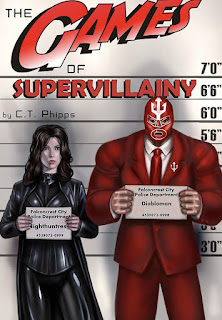
I had been aware of The Supervillainy Saga for a while. Several years ago, I listened to Confessions of a D-List Supervillain by Jim Bernheimer. The various books of The Supervillainy Saga were listed on the “You Might Also Like” section of Confessions of a D-List Supervillian’s page on Audible. The certainly did look intriguing. I’d like to take a moment to say that the covers for The Supervillainy Saga are absolutely amazing. Whoever designed them deserves a big raise. Though they looked intriguing, I felt I’d had my fill of superhero books for the moment, and moved on to other things. A few years passed, and I forgot about The Supervillainy Saga. Then, I shared my review SPR: Superhuman Public Radio. C.T. Phipps, author of the Supervillain Saga, saw my review of SPR and asked if I’d be interested in review the first three Supervillainy Saga books. I said yes, and here we are now.

C.T. Phipps gave me the audiobook for Volume 1 of The Supervillainy Saga. It contains the first three books of the series: The Rules of Supervillainy, The Games of Supervillainy, and The Secrets of Supervillainy. I’m going to review all three of them as a single unit in this review.

My initially impression was that I was rather reminded of Confessions of a D-List Supervillain. Both books involve first-person narrators, who are a bit of a smart-ass, who decide to go into supervillainy. Still, despite similar premises, they go in reasonably different directions. There’s enough differences in the execution to keep things interesting. And I suppose it is rather fitting, given that Supervillainy Saga is published with help from Jim Bernheimer.

One of the biggest differences is how the heroes and villains are presented. D-List Supervillain had a mostly original cast of characters without obvious inspiration. By contrast, most of the characters from Supervillainy Saga are clearly based upon preexisting comic book characters. Though, C.T. Phipps does mix and match various comic book heroes and villain to keep things interesting. I also want to clarify some terminology. When I say original, I mean characters that don’t have an obvious literary predecessor. It’s not meant as judgment of quality. Basing your own characters on preexisting ones isn’t an inherently bad thing. 


With all of that said, let’s get out our field guides and see how many we can spot. The world’s greatest hero is named Ultragod. He was just an normal African-American astronomer when he was imbued with cosmic energy known as the Ultraforce. He’s strong, he flies, he’s nearly invulnerable, and he can create energy constructs. So, basically Superman, but also with Green Lantern’s powers. The fact that he’s black and has Superman’s powers also brings Icon to mind. He has a daughter name Ultragoddess. She wears a nearly identical costume, but with a miniskirt rather than pants. Obviously, she’s Supergirl. The fact she’s Ultragod’s daughter brings to mind Superman & Batman: Generations. It was an Elseworld miniseries where the DC Universe progresses in real time. In it, Supergirl is Superman and Lois Lane’s daughter, rather than Superman’s cousin. Speaking of Lois Lane, Ultragod’s wife, civil right attorney Polly Pratchett, is a pretty clear stand-in for her. Tom Terror is a mad scientist who thinks Ultragod is nothing but trouble. That makes him the Lex Luthor analog, but he’s also a former Nazi, which brings Red Skull to mind.

Nightwalker is basically Batman, but with Specter’s powers and cloak. We later learn that there’s more than one Nightwalker cloak. One of these comes into possession of twenty-five year old Japanese-American woman. That makes her Batgirl, specifically Cassandra Cain, given that she’s Asian-American. Gary lost his brother to a gritty 1990s anti-hero named Shoot’em Up. He’s a former police officer who became a ruthless vigilante. In other words, basically Punisher. His name is also a reference to the song “Shoot’em Up” by Blue Stahli.

Most of the superheroes are part of the Society of Superheroes, which is like the Justice League, or maybe the Avengers. There’s a heroine named Guinevere. She’s a literal fairy princess warrior from the land of Avalon. She’s also known for her rather sexy costume, and forms a trinity of sorts with Ultragod and Nightwalker. All of this makes her Wonder Woman. There’s a minor character with a Robin Hood theme, which would make him Green Arrow. Backwoodsman is a like a stereotypically Canadian version of Wolverine. There’s also a Suicide Squad-esque special ops team of heroes and villains. One of its members, Red Schoolgirl, is like a straight-up villain version of Katana. Well, if she was also totally crazy, and cosplaying as Sailor Moon.

Etropicus is an evil space god like Darkseid and Thanos. There’s also a video game about the heroes turning evil. Clearly a stand-in for Injustice: Gods Among Us. Death is portrayed similarly to her depiction in Neil Gaiman’s Sandman series. She mentions having siblings who are clearly analogous to the other members of the Endless. Falconcrest City is Gotham, and is also Detroit in all but name. Atlas City is Metropolis, and is a nod to Atlas Comics, with merged with Timely Comics to form Marvel Comics. The streets of Falconcrest are named after famous comic book writers, such as Bob Kane and Bruce Timm.

There’s more, but we’d be here all day, and this has gone on for way too long. Time to move on. 

One thing I was surprised by is that, technically, The Supervillainy Saga is alternate history. Ultragod captured Hitler and Stalin and brought them to justice. Unfortunately, World War II still happened more or less like in our world. A villain named Phantom Leader, head of a HYDRA-esque organization, conquered most of Europe and Russia. Fortunately, the Allies still won. It’s also mentioned that there was a Second Vietnam War at some point. A robot named Android John become the first robot to be elected president in the 1990s. Despite of all this, the world is pretty much exactly the same as ours. Even the pop culture is almost identical. We know this because Gary seems, at times, incapable of going a chapter without making at least one pop culture reference. He also grumbles about how, despite all the magic and super science, nobody has cured cancer yet. This is all in keeping with comic books, which usually present a world more or less like our own, despite all the superheroes running around. Amusingly, Tom Terror has discovered an alternate universe completely devoid of superheroes and supervillains, but with near identical pop culture. In other words, he found our universe.

It’s also mentioned that the past itself is highly malleable and subject to change. Many things are really more suggestions than hard facts. This is a nod to the constantly shifting nature of comic book canon, and how the timeline gets shifted as the years move forward. We see that there is one universe where Gary is a plucky teenage reporter, and is best friends with Ultragod. This is clearly a reference to Superman’s Pal Jimmy Olson. Thought, I guess in this case it would be Ultragod’s Pal Gary Karkofsky. That particular universe is totally devoid of swearing, and is full of the casual sexism and racism that often plagued Silver Age comics.

I also noticed that there were quite a few references to the website TV Tropes. Gary will sometimes mention tropes by name. Other times, he will allude to the various tropes. It is eventually revealed that Gary is indeed an avid reader of TV Tropes. Before you ask, yes, the Supervillainy Saga does have its own TV Tropes page. There’s a page for the series as a whole, and each individual book also has its own page.

Now, let’s talk more in-depth about the characters. Gary is our snarky nerdy protagonist. Besides avenging his brother, he also dreams of turning the world into an anarcho-communist utopia. During college, he hacked into the college’s database to delete students’ debt. At the time, he was majoring in Unusual Criminology, which is basically Supervillainology. However, he had to drop out, and got a degree in history instead. It…was less than helpful when it came to finding a job. So, he turned to a life of crime. He claims that he was successful with women because he was charming and treated them with respect. Emphasis on claims. I’m just saying, even Gary’s saintly ex-girlfriend Gabrielle finds his near constant pop culture references to be extremely annoying after a while. Personally, I’m with Gabrielle on this one. Gary’s pop culture references weren’t too bad in the first couple books, but they reached a fever pitch by book three. At times, it felt like The Big Bang Theory on a bad day. It just felt like lazy writing after a certain point. It was like C.T. Phipps used the pop culture references as a crutch when he couldn’t think how to move a scene along.

There’s another scene where Gary angrily explains the theory of evolution, and debunks common misconception about how evolution works, to another supervillain. Now, the information is very good, and it can be argued that Gary did have a point about people’s misconceptions about evolution. However, it was also very clearly C.T. Phipps parking the plot so that he could monologue about his personal pet peeves. The scene just didn’t feel organic or natural, and the dialog was kind of tin-eared.

Then there’s the scene in book three where Gary robs a stock market, while dressed as a pirate, and spends the entire chapter monologging about the evils of capitalism. The writing and dialog were incredibly clunky. It felt like C.T. Phipps was using the scene to expound upon his personal political views. Thankfully, this was the only such scene in the entire collection. It just stood out more do to being paired with Gary at his worst pop culture referential. I’m not opposed to pop culture references, but I do prefer when it is done sparingly. 


Gabrielle is Gary’s ex-girlfriend. She’s good natured, easy going, incredibly beautiful, and shares Gary’s geeky interests. She also has the exact same facial features, voice, hair, and skin-tone as Ultragoddess. She also wears clothes that are gold and white, the same as Ultragoddess’ costume. Gary has never seen them in the same place, and Gabrielle often ran off right before Ultragoddess would appear. In case it wasn’t obvious, Gabrielle is Ultragoddess. She used her powers to keep Gary from connecting the dots. She broke up with him after he got kidnapped by one of her villains. Gabrielle’s mom, Polly Pratchett, got captured numerous times over the years, and that really got to Gabrielle. Polly also got killed a few times, but the Society of Superheroes has numerous means to restore the dead back to life. 

So, it was only a minor inconvenience, but it effected how Gabrielle approached relationships. Gabrielle is described as being Afro-Hispanic, and her general description brings Rosario Dawson to mind. The cover art does bare this out. Gary is in a loving relationship with his wife Mandy, but he still think about Gabrielle, and still has feeling for her. In fact, when he first meets Death, she appears to him as Mandy’s head on Gabrielle’s body.

Gary’s parents hoped that he would settle down with a nice Jewish girl someday. Instead, he married a bisexual half-Korean Wiccan gentile. Then again, Gary’s parents also didn’t want him to become a supervillain, and look how that turned out. Mandy seems to have almost exclusively dated women before marrying Gary. I liked that she was portrayed as a realistic example of a Wiccan. She doesn’t get any magical powers from Wicca, it is simply the religion that she follows. Though, it is mentioned that there are some Wiccans with magic powers, but they’re considered separate from religious Wiccans. Magik is considered a form of concentrated prayer in real Wicca. The K at the end is deliberate, so as to distinguish it from the concept of magic, as in the supernatural.

Gary’s childhood friend Cindy is a supervillain in a sexy Little Red Riding Hood costume. She was training as a doctor before turning to supervillainy. She had to deal with serious student loan, much like Gary. She wears her hair in pigtails, is very zany and energetic, and speaks in a New Jersey accent despite living in Michigan. Obviously, she’s the Harley Quinn analog. She later switches to a more conservative costume. The way it is described reminds me of Ruby Rose’s season 1-3 outfit on RWBY, but that might have been unintentional. There’s not really much to Cindy. She’s more of a comic relief character. She worked as a hench-wench for various supervillains before she joined Gary. Though, she prefer the gender-neutral term hench-person, as she finds it less demeaning. Cindy also refers to her self as looking like a cross between Sarah Michelle Gellar and Alyson Hannigan because of her strawberry blonde hair. Uh, Cindy, you know they’re both brunettes in real life, right?

Adonis from Greek Mythology is still active in the modern world as the supervillain Bright Eyes. It seems that C.T. Phipps got him mixed up with Narcissus, as Gary incorrectly claims that Adonis is the one who originated the term narcissism. Like, it’s right there in the name, just saying. Adonis also refers to himself as devoted to Aphrodite, but there’s nary a mention that he’s also devoted to Persephone. Aphrodite got him during the summer months, and Persephone got him in the winter months. However, C.T. Phipps tells me this is all deliberate, and apparently, the original idea for Adonis was even less accurate to the mythology. Adonis was going to be a son of Zeus. This is an homage to how some mythology inspired comics, like Wonder Woman and Thor, play fast and loose with mythological accuracy. However, C.T. Phipps’ editor vetoed the idea specifically due to it being untrue to Greek Mythology. 

Often, comics inspired by mythology will get basic things about mythology wrong. For example, Loki was Odin’s blood brother, not Thor’s adopted brother. Gary doesn’t like Adonis on principle. I’m not sure if that’s a reference to the Maccabean Revolt, or the general “don’t fool around with pagan gods” rule of Judaism. I’m going with the former. Gary, by his own admission, isn’t terribly devout. And let’s not forget that he did knowingly marry a Wiccan. 

Diabloman is a former big time supervillain, but he’s been forced to work as Gary’s villainous mentor. He was raised in a Satanic cult, but he’s a surprisingly nice guy. He wears a luchador mask and a red business suit. The final member of the core cast is the spirit within Gary’s cloak. He’s not to thrilled about having to team-up with a supervillain, but he doesn’t have much choice. And hey, he does eventually warm up to Gary. I won’t tell you who Cloak is, but I will say it wasn’t hard to figure out. In fact, you might very well have pieced it together yourself.

We have a colorful cast of characters, but I wonder if perhaps they needed more time to shine. That is, maybe the series should have taken an anthology approach, rather than having Gary be the protagonist of every book. How might book two and three have looked from Mandy or Gabrielle’s perspectives? For that matter, how would they look from Cloak’s point-of-view? Or what if we had one of the numerous memorable minor characters take center stage? I think the books might have benefited from having more points of view than just Gary.

Though even keeping Gary as the view point character is a source of missed opportunities. Gary time travels to kill Nazis and Hitler, but we never witness with happen on-screen, for want of a better term. Time traveling to kill Nazis? Sounds like a fun time to me. If you’re wondering, time travel can’t change the past. All Gary did, as a result of his time travel shenanigans, was create parallel timelines.

Obviously, I’m also going to take a moment to talk about the audiobook. The audiobooks are narrated by Jeffery Kafer. His narration overall wasn’t bad, I’ve certainly seen worse. That said, I also felt there was room for improvement. He does a really good job performing as Gary, but he makes the other characters sound rather interchangeable. This is most obvious in the first book. Among other things, Diabloman has no trace of the Mexican accent he ought to have. He does get a bit better in books two and three, but there was still room for improvement. I will say that Jeffery’s weaknesses as a narrator are hardly unique to him. I once listened to an audiobook of Huckleberry Finn, narrated by Elijah Wood, that has similar issues; despite Wood’s excellent performance as the title character. As did the audiobook of Tom Sawyer which was narrated by Nick Offerman.

Okay, so what’s the verdict on The Supervillainy Saga, Volume 1? Was it high art in any sense of the word? No, it most certainly not. Did it have it’s share of flaws? Yeah, I would say so. Was a reasonably entertaining? Yes. Was it a fun and enjoyable popcorn book? Also yes.

The Supervillainy Saga might not be revolutionary, but it has its charms. If you’re looking for some fun superhero books that don’t take themselves too seriously, then you might want to give it a try. It does deconstruct superheroes to an extent, but it never comes across as mean-spirited, or dark and gritty for the sake of being dark and gritty. You can really tell that C.T. Phipps genuinely does love superheroes and comic books. So, he used that love to make the Supervillainy Saga. If all of this sounds appealing to you, then give the Supervillainy Saga a try.

Well, I think that should do it from me for now. I will see you guys next time.

Wednesday, February 9, 2022

The Alt-Hist File: Age of Confusion: Season 2

We’re already over a month into the new year, and that means I need to get around following up on my reviews. Today’s review is the first step in that direction. There isn’t much more to add, so let’s get straight to it. We’re taking a look at season 2 of Age of Confusion. 


To recap, Age of Confusion is an alternate history podcast, but told in the style of an non-fiction history podcast. It imagines a world where John. F. Kennedy survived his assassination attempt, and examines how history changes from there. Last time, we left off with the election of George Romney in 1968. Romney takes office in a time of change and turmoil. The Counterculture Movement is in full swing, and will bring big changes to the American cultural landscape. Meanwhile, Soviet Premier Alexander Shelepin is gaging Romney’s character. Shelepin, and his counterparts in East Germany, have been eyeing West Berlin hungrily. Back in America, both political parties are already focusing on the 1972 Election. It is an age of wonders, it is an age of terrors, but above all else, it is an Age of Confusion.

For those who have missed my review of season 1, you can find that over here. I thought that season 1 of Age of Confusion was absolutely fantastic. Season 2 not only matched its predecessor in terms of quality, but also exceeded it. Sean Munger built upon the groundwork he laid in season 1 to great effect. This was a season where a lot of shoes dropped. The intro to each episode lets us know that three things are going to happen: West Berlin will be invaded by East Germany, Robert F. Kennedy will be elected President, and something is going differently for the Apollo program.

First, let’s talk about President George Romney. Sean portrays Romney as a good man at heart, and someone who genuinely wants what is best for the America. However, that goodness is also Romany’s biggest weakness. Romney simply doesn’t know how to play the game of politics, and quickly finds himself way over his head. Romney doesn’t get as much flack for his Mormonism as you might think, but I think this makes sense. Most Americans had never heard of Mormons in the late 1960/early 1970s. Romney also specifically speaks of his strong Christian faith, but not specifically his Mormonism. In other views, Romney is a strong supporter of civil rights for African-Americans and Native Americans.

The one true success of Romney’s presidency is that he gets Medicare passed. JFK was unable to do this, as he did in our world, due to focusing on getting the Comprehensive Civil Rights Act passed. Romney takes office in the middle of a recession, and he argues that Medicare will help take financial burdens off of the American people. He also allows individuals age twenty-five and under to be covered by Medicare. Medicare is a big hit with the American people, but Republicans are absolutely furious. Many claim than Romney isn’t a true Republican. Romney winds up pretty much destroying the moderate wing of the Republican Party. The 1960s and 1970s were when the Democrats and Republicans solidified into their current forms. Before that, both parties had members from across the political spectrum. Kennedy, was a Democrat, and supported Civl Rights, but he also had to fight against members of his own party who opposed the Civil Rights Act.

I liked that this season also took time to focus on alternate history related to pop culture. A band called Refraction becomes America’s answer to The Beatles. Sean says that he had this happen because he was unsatisfied with how America never produced a band capable of rivaling The Beatles. The members of Refraction collaborates with director Frank Perry to make a movie adaption of the novel On the Road. Said adaptation is a massive hit, and wins a bunch of Academy Awards.

Meanwhile, Elvis Presley’s wife introduces him to L. Ron Hubbard. Elvis becomes very close to Hubbard, converts to Scientology, and donates a bunch of money to the Church of Scientology. I’m not sure if I can see this happening. Elvis was an extremely devout Christian in our world. In fact, he refused to be called The King because he thought it was blasphemous. Priscilla Beaulieu Presley did become a Scientologist in our world, but that was after Elvis’ death in 1977. Though, I guess anything is theoretically possible.

The outcome of the Moon Race is…underwhelming. Sean said that the Space Race wouldn’t be getting much focus, but it feels like it was tacked on almost as an afterthought. Romney guts NASA’s budget at a critical moment, and this allows the Soviets to get their act together and land a manned mission on the Moon first. There were a lot of politicians in our world who wanted to defund NASA on the grounds that the money could be better spent on programs on Earth. Walter Mondale is one example that comes to mind. It is also theoretically possible that the N1 rocket could have gotten a Soyuz craft to the Moon. So, this is a reasonably believable scenario. Still, it could easily have been an episode in and of itself. Actually, it could potentially be multiple episodes. I can’t help but feel that there was a massive missed opportunity here.

Let’s move onto something that was most certainly not a missed opportunity. East Germany is concerned about the brain drain they suffer thanks to West Berlin. Alexander Shelepin agrees, and decides that the time is right to finally invade West Berlin. Shelepin deemed Romney to be a weak-willed pushover, and didn’t expect any serious consequences. The war machine springs to life, and both West and East are on high alert. Soviet and East German troops move into West Berlin, while NATO forces mobilize to counter them. Citizens on the East Coast of America are told to head for the bomb shelters and prepare for the worst. The military is at DEFCON 1, and President Romney must decide if he should push the button or not.

Oh, and wouldn’t you know it, pretty much the entire presidential cabinet is away on various trips. Romney takes some time to pray and makes his choice. He knows that Shelepin is a madman who will make good on his threats of retaliation. Romney decides he will let the Soviets have West Berlin, but American forces will evacuate anyone, regardless of nationality, who wants to be evacuated. Hundreds of thousands of citizens are evacuated from both halves of Berlin. More importantly, all of the intellectuals and educated workers are successfully evacuated. And so the Berlin Wall falls twenty years ahead of schedule. Unfortunately, it falls because Berlin is united under communist rule.

Shelepin technically succeeded, as now Berlin is united under East German rule, but the brain drain is even worse than if he’d done nothing. A victory, but a rather pyrrhic one. On the other hand, relations between the NATO nations are seriously strained. West Germany is furious that America threw them under the bus. Britain and France also fear that America may betray them to the Soviets.

Still, Shelepin does find other bits of success. He manages to pretty much completely reverse the Sino-Soviet Split. Shelepin also enacts a new wave of political purges, but not quite to the extent that Stalin did. He doesn’t have enough charisma, and isn’t enough of a people person, to start a cult of personality like Stalin did. The Chinese Cultural Revolution goes pretty much exactly as it did in our world. The biggest difference is that Mao dies about five years ahead of schedule. That’s definitely going to have an impacts on future seasons of Age of Confusion.

As you might imagine, the events of the Berlin Crisis play a major role in the 1972 Presidential Election. It comes down to Ronald Reagan vs. Robert F. Kennedy. As for how that line-up come to be, I’ll leave that for you to discover. Obviously, we know from the intro that Kennedy wins. Ultimately, it was the war scare that swing things. Americans wanted someone who was going to deescalate things with the Soviets, not ramp them up. George Wallace also ran again, but only managed to win three states this time round. Of course, the real fun is going to start next season, when RFK officially takes office.

That covers all of the major points I wanted to discuss. There’s still several bits that I didn’t mention, but I’ll leave those for you to discover. Season 1 of Age of Confusion was amazing, but it was just the warm up act. Season 2 is where the fun really starts. Sean has said he wants to take some time off to rest before working on season 3. I can respect that. It is import to avoid overexerting yourself in your creative endeavors. There’s no shame in taking time off to rest and recuperate. And hey, based on how season 2 turned out, I know that season 3 and 4 will be absolutely amazing. I can’t wait to listen to them whenever they come out.

Well, I think that should do it from me for now. I will see you guys next time.

Saturday, February 5, 2022

Flag of the United Republic of Great Britain

This is the flag of the United Republic of Great Britain. It comes from a world where Britain, France, and the Ottomans lost the Crimean War. Things first diverged from our world when Russia convinced Austria to ally with them. Russia and Austria quickly routed the Ottomans in the Balkans. From there, it was a straight shot to Istanbul. Britain and France did their best to defend the city, but it soon fell to Russian and Austrian forces. This was the major turning point for the war. It wasn’t long after this that Britain and France sued for peace with Russia.

Russia gained Istanbul, which it renamed Constantinople. The influx of wealth following the war meant that Russia never sold Alaska to America. Winning the war also meant the Russia now had direct access to the Black Sea and the Mediterranean Sea. Austria now stood as the dominate power in Central Europe. Among other things, this meant that Germany and Italy never unified.

Things were not good for Britain following the war. The British public had never been supportive of the war, and the humiliating defeat only solidified that resolve. So many had needlessly died, and for what? British citizens began to wonder if they might be better off without the monarchy. Whispers of revolution and revolt filled the streets. The government began to crack down on dissenters, but that just made things worse. Before long, a second civil war had broken out in Britain. Queen Victoria and Prince Albert, along with several of their supporters, fled to Australia when it became clear that the Republicans were gaining the upper hand. Canada had been ruled out due to its proximity to the United States. The monarchy feared that the United States might sympathize with the revolutionaries, and the possibility of an American invasion of Canada was considered too great a risk.

Once the dust settled, the United Kingdom of Great Britain and Ireland no longer existed. In its place now stood the United Republic of Great Britain. Ireland had used the chaos of the second civil war to declare independence from Britain. Several provinces of India had also used the political turmoil in Britain to gain their independence. Still, the United Republic remained optimistic about its future.

America did indeed become a staunch ally of the United Republic. The United Republic intervened on behalf of the Union during the American Civil War. The United Republic has formed an alliance with France to combat the Holy Alliance. It is an alliance of Russia and Austria, with Greece as a minor member, that aims to stop the spread of liberalism and secularism.

The United Republic prides itself on promoting democracy and liberalism throughout the world. However, that doesn’t mean they’re averse to colonialism. In fact, the United Republic often justifies its colonial ambition by claiming to spread these ideals to other nations. Early on, they did get into scuffles with the United Kingdom-in-Exile over the remnants of the British colonial empire. However, at present, both nations have come to an agreement over where the colonial boarders lie. The United Republic naturally got the lion’s share of the colonies.

The flag contains the red, white, and green bands of the British Republic flag. It also contains a coat of arms with representation of the three constituent nations. The St. George’s Cross of England, the St. Andrew’s Cross of Scotland, and the St. David’s Cross of Wales.


Sunday, January 23, 2022

U.S. State Flag of Normandy

This is the U.S. State Flag of Normandy. It comes from a world where the Dunkirk evacuation failed, and Britain signed an armistice with Nazi Germany. Meanwhile, the United States never got involved in the war in Europe. Following the Fall of France, Germany focused its full military might on the Soviet Union. Despite a valiant effort, the Soviet Union fell to the Nazis, and Germany now stood as the supreme and uncontested ruler of continental Europe. 

Germany divided France into a series of administrative regions. This was done in hopes of keeping France weak, and preventing it from ever rising against Germany again. Furthermore, Germany also destroyed France’s industry. The French were even denied the use of chemical fertilizers, which lead to millions of deaths via starvation in the resulting famine. Germany implemented similarly harsh measure across the rest of its empire.

By the 1950s, Germany had fallen into a state of civil war. At the same time, America and Britain committed to military action against Germany. By 1960, Europe has been liberated, and Nazi Germany defeated for good. Unfortunately, France was left as an impoverished and deindustrialized shell of its former self. The regions began to process of reunification, but the northern most regions had other plans. They applied to join the United States.

After some debate, Congress approved the application, and the Normandy Territory was established. Normandy officially gained statehood in 1972, making it the 51st State. The State of Normandy includes the regions of Brittany, Normandy, and Hauts-de-France from our world. Becoming an American territory meant that reconstruction went quicker for Normandy than it did for the rest of France. Normandy also received more money for rebuilding. Of course, Normandy wasn’t the only place in Europe to follow this path. Sicily became the 52nd State in 1974. Kyushu became the first American state in Asia in 1977, with Ryukyu following in 1978.

Normandy has received significant immigration from the rest of the French-speaking world. In fact, it is the only state where French is the dominant language. Though, this is only a slight majority. Most Normans are bilingual, and signs are in both English and French. Today, the scars of the past had begun to fade, and Normandy enjoys a high standard of living. The many picturesque towns, especially those with surviving medieval buildings, make it a popular tourist destination for the rest of America. Recently, Normandy has become home to Europe’s first Disneyland park. Normandy is notable for its more relaxed and slower pace to life than most other American states. Normandy combines French and American culture into a truly unique state.

About the only bad thing that can be said of Normandy is it’s flag. The flag is a simple blue background with the medieval Norman lion, and the state name. That the phrase “In God We Trust” be included on the flag was one of the stipulations for Normandy being granted statehood. The flag is universally considered ugly, and more than a little embarrassing. However, thus far, plans to change it have moved rather slowly.


Saturday, January 22, 2022

The Audio File: The Carlötta Beautox Chronicles

It is a new year, and that means there are new reviews of audio dramas to be had. There’s nothing really more for me to add, so I’ll get straight to the point. We’re taking a look at The Carlötta Beautox Chronicles. 


Kitty Kinicki was just a girl from Picatinny, New Jersey. She had big dreams, and she knew that she should expect more out of life than working at the town armory and eating chicken parm on Sunday nights. So, she decided to throw caution to the wind. She moved to Hollywood with big dreams of becoming an actress. To that end, she would need to reinvent herself. So, she picked a new name, a name as glamorous and exciting as her dreams: Carlötta Beautox! Carlötta has high hopes…but her acting abilities leave something to be desired. Still, come hell or high water, she will do whatever it takes to become a famous celebrity. Gird your loins, Hollywood, because here comes Carlötta Beautox!

The Carlötta Beautox Chronicles is created by Ann Sloan and is a member of the Fable & Folly network of podcasts. Amusingly, it turns out that the Fable & Folly network exists in Carlötta’s world as well. There’s a scene during season three where Carlötta goes to a podcast convention. She learns about what audio dramas are, and of one team that is creating a comedy set in Hollywood. To this Carlotta responds, “So, not in space, or a fantasy realm?” This is s sly reference to fellow Fable & Folly shows We Fix Space Junk and Alba Salix, Royal Physician.

I first became aware of The Carlötta Beautox Chronicles while listening to…hmm, which Fable & Folly show was it? I want to say either We Fix Space Junk or Alba Salix. Probably wasn’t Harlem Queen. In any event, I had a gap in my listening schedule, and decided to give The Carlötta Beautox Chronicles a try. It only took a few episodes before I was hooked, and before long I’d listened to the entire show. How can I best describe The Carlötta Beautox Chronicles? Well, start with The Unbreakable Kimmy Schmidt, but with the rules of reality turned down even lower. Actually, send the rules of reality out to lunch, and make damn sure they don’t return. Add a pinch of paint fumes for flavor, and you have this audio drama.

The Carlötta Beautox Chronicles is almost completely lighthearted and silly. There’s nary a serious moment to be found, and the show is all the better for it. The show has a great theme song, and the lyrics change every season to reflect major developments in Carlötta‘s life. Let’s take a look at the cast of characters who inhabit this world, shall we?

As I have said, Carlötta has high hopes, but zero talent. To give one example among many, in the first episode she gets cast as a corpse on Castle. She had to keep perfectly still and play dead, but manages to fails rather spectacularly. But hey, she did make number eleven on Variety’s “Top 10 Extra’s Nobody Want to Work With” list. So, win some lose some, I guess. In terms of intelligence, Carlötta is somewhere between a sack of bricks and a bag of half-eaten cannolis. Still, despite how funny it is to listen to her fail, she’s endearing enough that we all want to see her succeed, even if only a little. Carlötta supplements her acting gigs, such as they are, by working various odd jobs. Among other things, she’s been a dog-walker, a personal assistant, and even babysat some alpacas. She thought they’d be alpacas sweaters, not literal alpacas, despite a galactic-sized amount of evidence to the contrary. Carlötta is voiced by Samantha Gordon, who is clearly having an absolute blast with the role.

Of course, Carlötta wouldn’t get anywhere without her trusty manager/landlord Dave. He helps find acting roles, and assorted odd jobs, for Carlötta. He’s actually pretty good at it too. For example, he manages to score Carlötta a job selling merchandise at Cannes. Yes, the world famous film festival, and what’s really surpassing is that they usual don’t sell…oh dear, that’s not correct at all. I’m sorry everyone, that was my mistake. Let’s take it from the top, shall we?

What I meant to say is that Dave gets Carlötta a job selling merchandise at Cans, the largest porno convention in America. In his defense, Carlötta can’t really afford to be picky with her jobs. And hey, at least it was selling porno merchandise, not actually being in a porno. And Dave does usually get better gigs for Carlötta. He gets her a job in a film where she plays an Irish person. Naturally, Carlötta felt the need to take a DNA test just to be sure she wasn’t committing cultural appropriation of Irish culture. Thankfully, Carlötta is part Irish, and part, well, just about everything. She even has DNA from nations that don’t have set ethnicity, like Canada. Did I mention that the rules of reality are out to lunch on this show? As you can see, while The Carlötta Beautox Chronicles does occasionally touch on serious and/or controversial issues, it does so with tongue planted firmly in cheek.

Dave is voiced by Trevör Lissauer. Dave sounds kind of like Gubbin from The Axe and Crown, and I initially thought it might be the same voice actor, but I was wrong.

Dave also took a DNA test, and discovered that he is 100 percent Neanderthal. Interestingly, most humans, other than those of predominantly Sub-Saharan African ancestry, have a small amount of Neanderthal DNA. I myself am 2.1 percent Neanderthal. Of course, having near 100 percent would be pretty much unheard of, but again, this isn’t a show where reality is on the guest list. Dave does later discover that he is distantly related to a minor British noble named Dame Pickles. He goes to the United Kingdom to visit her, and winds up with a mouth full of spotted dick when Carlötta calls him unexpectedly.

It’s a type of British steamed pudding, get your minds out of the gutter. Yeah, The Carlötta Beautox Chronicles gets a lot of mileage out of words and phrases that have multiple meanings. One episode see Carlötta get a visit from her Aunt Flo. No, not her period, her Aunt Florence. She is referred to as Literal Aunt Flo by everyone for the rest of the episode. In another episode, after eating wild berries, Carlötta goes on a vision quest and receives wisdom from the Fairy God Cougar. As in, a magical talking mountain lion, not the other kind of cougar. Although, the way the Fairy God Cougar talks certainly brings the other kind of cougar to mind.

Rounding out the main trio is Siri. Yes, the virtual assistant from Apple. She’s rather snarky and sarcastic, constantly makes fun of Carlötta. Of course, during the ads, Siri gives Ann Sloan no end of grief. You know, I do wonder if Ann Sloan might be drawing from her own life, at least a little, for Carlötta‘s misadventures. Some of the jokes about living in a small town in New Jersey do feel like they’re poking fun in an affectionate sort of way. Ann and Carlötta also both moved to Hollywood with dreams of big success.

In any event, there are a lot of references to current celebrities, as is to be expected. Normally, this would potentially limit the shelf life of a series. However, I think that The Carlötta Beautox Chronicles has some staying power. Mel Brooks once said that a parody should still be funny even if you don’t know what it is making fun of. I would argue that The Carlötta Beautox Chronicles falls into this category. It is still perfectly funny even if you don’t know who all of the celebrities are.

But which celebrities make appearances? I’ll give a few examples. The first episode, being on the set of Castle, features a cameo by Nathan Fillion. Well, the voice actor sounded nothing like him, but knowing this show, I’m tempted to say that was deliberate. Another episode sees Carlötta discover that a beloved talk show host is, in fact, a terrible person. Said host is only identified under the fake name of Helen. Hmm, talk show host, name rhythms with Helen, scandalous secrets…I’m stumped. Could be anyone really. What’s that now? Ellen DeGeneres? Why ever do you say that?

Carlötta frequently says that Khloe Kardashian is her spirit animal, and even gets to meet her at the end of season one. The voice actress playing her sounds fairly spot-on. Ooh, Carlötta better be carful. Native America social media activists aren’t going to take kindly to her using the term spirit animal. Native Americans have some serious reservations about that sort of thing. There are several other celebrity cameos, but I’ll leave those for you to discover. Even the ones I couldn’t place still managed to be funny, so I usually got the gist of the jokes.

Well, I think that covers everything not related to serious spoilers. Yes, even a show like this has serious plot-line related spoilers. If you want to know why I said “paint fumes” when describing this show, well, you’ll see when you get to the end of season one.

Suffice it to say, I am very glad that I gave this show a chance. The Carlötta Beautox Chronicles is a wacky, zany, tongue-in-check look at Hollywood and celebrity culture. It is lighthearted, silly, doesn’t take itself too seriously, and is a lot of fun. I strongly recommend that you give it a listen today.

Well, I think that should do it from me for now. I will see you guys next time.

Tuesday, January 4, 2022

Book Review: Voyage by Stephen Baxter

As I have said many times before, good things often come to those who wait long enough. This is certainly true when it comes to audiobooks. Sometimes, if you’re very lucky, your patients is rewarded in a big way. Without further preamble, let’s get into it. We’re taking a look at Voyage by Stephen Baxter.


Voyage takes place in a world where John F. Kennedy survived his assassination attempt. Although, it did render him paraplegic, and Mrs. Kennedy got killed in the crossfire. The Apollo 11 landing is a success just like in our world. However, Kennedy challenges NASA to land a manned mission on Mars by the 1980s. The novel follows an ensemble cast of NASA employees as they work to meet Kennedy’s challenge.

This was another of those books I’d been hoping would become an audiobook. For a few years, I had to settle for the BBC radio adaption that came out in 1999. It is certainly excellent, and I do plan on reviewing it at some point. Well, I need to to come up with a name for the column. I want something that is consistent with The Audio File and The Alt-Hist File. The A-Ticket File? Ticketed Attractions? I’ll think of something eventually.

Still, I longed to listened to a straight-up audiobook adaptation of Voyage. Then, in 2021, Voyage finally came out as an audiobook. In fact, so did Stephen Baxter’s entire NASA Trilogy. The NASA Trilogy isn’t exactly a series per se. It is three standalone books that all involve NASA in some way. Voyage and Moonseed are alternate history. Titan was set in the near future, for the time it was published, but I guess it has retroactively become alternate history. I’m very pleased that all three books have finally become audiobooks.

To start, let’s talk about the audiobook. Voyage is narrated by Kevin Kenerly. Initially, I wasn’t sure how I felt about Kevin as a narrator. But remember, I listened to the full cast BBC radio adaption first. So, I guess I was, consciously or not, comparing Kevin to the full cast version. That wasn’t fair to Kevin, and I did get past this thinking eventually. All things considered, I did enjoy Kevin’s narration. He reminds me of the sort of narrator you hear narrating science fiction books from the 1990s and/or 1980s. Which is fitting, because Voyage was published in 1996. So, no complaints as far as narration goes.

Okay, now lets talk about the plot itself. I should begin by discussing the structure of the novel. It alternates between two points in time. One section begins with the launch of the Ares 1 mission in 1985, and follows its voyage to Mars. The second section begins in 1969 with the Apollo 11 landing, and follows all of the work that went into creating the Ares mission. Eventually, the second section gets to the launch of Ares 1 in 1985, thus bringing the two segments together. We know that Ares will ultimately fly, but it is the journey, not the destination, that really counts. Baxter certainly manages to keep things interesting. What sacrifices will have to be made, and what challenges must be overcome, so that Ares can fly?

Like I said, this book is very much an ensemble cast, and doesn’t really have a main character. The closest it has is Natalie York. She is a geologist who is obsessed with Mars, and all the potential geological discoveries it has to offer. She helps to train astronauts for the Ares mission, but isn’t a big fan of astronauts. Too much dumb fighter jock stuff, as she phrases it. NASA’s astronauts were initially selected from members of the Air Force, and it appears the practice lasted even longer in the world of Voyage. Ironically, Natalie is initially opposed to sending humans to Mars. She feels that far more science could be achieved using unmanned robotic probes. Unmanned probes would also be cheaper, and more probes means more science. Despite this, as the years go on, she becomes a prime candidate for the Ares mission.

The closest thing to a secondary protagonist would be Joe Muldoon. He was the second man to walk on the Moon, and goes on to become a director at NASA. He’s pretty clearly a thinly-veiled stand-in for Buzz Aldrin. I’m not entirely sure why Baxter didn’t just use Aldrin. Maybe using a fictional character gave more flexibility in characterization and storytelling? Of course, Aldrin is still alive, so maybe Baxter had to worry about slander and libel laws? But the threshold for that is pretty high when it comes to public figures, which Aldrin certainly is.

This isn’t the only time Baxter uses a fictional stand-in for a real person. There’s also the character Hans Udet. He is a former Nazi rocket scientist, but that’s hardly unusual. Project Paperclip brought several German scientists, most famously Werner von Braun, to America. Many of them found work at NASA. Unfortunately, Udet used to be in charge of Mittelwerk. It was a Nazi rocket factory that used slave labor. Eventually, Udet’s past catches up with him. This is a clear parallel to Arthur Rudolph, who had a nearly identical backstory. The American government agreed to drop the charges against Rudolph, provided that he renounced his American citizenship and return to West Germany. Something similar happens to Udet.

In other characters we have Ralph Gershon. He’s a black Air Force pilot, and a Vietnam War veteran. He’s not based on any real figures, but he does provide an interesting parallel. In our world, Robert Henry Lawrence Jr. was also a black Air Force pilot. He was under serious consideration to be part of the Apollo program. Unfortunately, he died when an experimental aircraft he was testing crashed. Ed Dwight Jr. was also a black Air Force pilot who was under serious consideration for Apollo, but never made the cut. Thankfully, Gershon does get selected to be part of Ares. You could also see Gershon as somewhat similar to Guion Bluford, the first African-American astronaut from our timeline.

There are other characters, but I’ll leave them for you to discover. Now, it is clear to me that Stephen Baxter wishes that manned spaceflight was more advanced than it is. He also wishes that NASA was better funded, and that it had already sent a manned mission to Mars. However, he also realizes that, in order for that to be possible, it would require some serious sacrifices. And just what are these sacrifices? Allow me to ask you a question: what is the most important part of a space mission?

I’ll save you the trouble. Money is the most important part of a space mission. The money has to come from somewhere if you want to get to Mars by the 1980s. That means you’ll have to start making cuts and canceling programs to free-up funds. Right off the bat, Apollo 16 and Apollo 17 are canceled. Apollo 15 is also canceled, but the crew of Apollo 15 fly on Apollo 14. So, its almost like Apollo 14 got canceled, but not Apollo 15. Apollo 13 has an accident exactly like our world, so no science happened on that mission. Apollo 17 getting canceled was a particular blow, because that was the only mission where scientists got to go to the Moon. The Space Shuttle is also cancel in favor of reusing Apollo tech. Though, Skylab lasts longer than in our world, and another space station called Moonlab, which orbits the Moon, is constructed. Albeit, Skylab and Moonlab are well past their prime when they’re decommissioned.

Oh, but we’re just getting started. The Viking landers are canceled, and this is a particular sore spot for Natalie. In our world, Viking taught us a lot about the composition of Martian soil. Later, Mariner 10, Pioneer 10 and Pioneer 11, Pioneer Venus, and the Voyager probes are all canceled. Let’s go through the list, shall we? Mariner 10 went on a flyby to Venus and Mercury, and was the only probe to visit Mercury until the MESSENGER probe in 2004. Pioneer 10 and Pioneer 11 were the first probes to visit Jupiter and Saturn. They also famously carried the Pioneer Plaques, which serve as messages to any aliens who find the probes after they’ve left our solar system. 

The Voyager probes famously went on a grand tour of the Outer Planets. In fact, some of the most famous pictures of the Outer Planets, and their moons, were taken by the Voyager probes. Voyager 2 is thus far the only probe to visit Uranus and Neptune. Both of the Voyager probes also contain the Golden Records. They are recordings of sounds and music from Earth, including messages in several languages. Like the Pioneer Plaques, they’re for if aliens find the probes.

This has a rather unfortunate side-effect for the world of Voyage. Yes, humans walk on Mars by 1985. However, humanity’s knowledge of the solar system, including Mars, is far less than in the 1985 of our world. Be careful what you wish for indeed. But it isn’t just the lack of knowledge and science regarding the solar system. Who among us hasn’t been in awe at the images brought back by probes such as Voyager 1 and Voyager 2? How many people were inspired to go into science because of those images? Who hasn’t been moved by how the Pioneer Plaque attempts to reach other to other intelligent life forms? All of that would be lost in the world of Voyage.

Natalie frequently complains about how much more data could be obtained with unmanned probes. Ares 1 does a flyby of Venus to use the planet’s gravity to slingshot to Mars. They drop an unmanned probe to the planet’s surface. Natalie should be in awe of actually orbiting another world, but all she can think is about how little science they’re getting out of the probe. She’s a geologist at heart, and is frustrated at how the little probe can’t expand upon the tantalizing glimpse of Venus’ geology it offers. Rather ironically, scientists become some of NASA’s biggest critics. They feel that NASA is too laser-forced on the manned Mars mission. They feel that the money would be better spent on scientific research. For her part, Natalie strongly agrees.

Voyage essentially extends the Apollo era mentality of NASA into the 1970s and 1980s. Science wasn’t neglected during Apollo, but it wasn’t the primary focus. The main goal was simply to go places for the sake of going to them. In our world, after Apollo, NASA put more emphasis on scientific work, both via probes and via manned missions to orbit. It wasn’t as glamorous as Apollo, but it did produce a lot of projects that did benefit people back on Earth. 

Speaking of probes, the Soviet Union does slightly better with it unmanned Mars probes. In our world, almost every Soviet probe sent to Mars ended in complete failure. The probes were named the Mars series. The Soviets were very creative when it came to names. For example, Mars 2 and Mars 3 attempted to map the Martian surface from orbit. Unfortunately, the area they mapped was covered by a massive dust storm, and their trajectories couldn’t be reprogrammed. They had landers, but the Mars 2 lander crashed, and the Mars 3 lander stopped transmitting after ninety seconds.

Mars 7 had a rover, but its computer malfunctioned, and the lander was launch prematurely, completely missing the planet Mars. In the world of Voyage, however, the Mars 7 lander successfully makes it to the Martian surface. Perhaps the butterfly effect is at work? Then again, outside of the space program, history doesn’t seem to change very much. All of the American presidents occur in order, Watergate still happens, no big dramatic differences.

Well, there are a few minor changes. Gene Roddenberry, inspired by the Ares 1 mission, scraps his plans for Star Trek: The Next Generation. Instead, he comes up with an idea for a crew on a smaller ship exploring uncharted space. He plans to call it Star Trek: Explorer. Damn, if only it had been called Discovery instead, that would have been very amusing. There is a short story set in the same world as Voyage called “Prospero One.” It follows an alternate British Space Program, which actually manages to launch an astronaut into orbit and return him to Earth safely.

Interestingly, the scenes in Venus orbit make no mention of the Venera probes that the Soviet Union sent to Venus. Yet there’s no mention of any further Soviet Mars probes, so the money didn’t get diverted or anything.

Baxter does make a strong case that it might have been for the best that things turned out the way they did in our world. And yet, wouldn’t it be something if humans had already walked on Mars? There would be serious downsides and sacrifices, but at the end of the day, it would still be quite the spectacle. It would be one of those moments that would go down as a major milestone in human history. There’s a brief afterword where Baxter explains his thought process, and way he made the changes to history the he did. He concludes more or less what I’ve stated.

Even the naysayers are in complete awe when Ares 1 finally launches. I have heard that rocket launches are quite the spectacle to behold. There’s only one chapter actually set on the surface of Mars; most of it is devoted to preparation for setting foot outside the lander. I know some people didn’t like that, but it makes sense from a thematic perspective. It’s right there in the title. This is a book about the journey, not the destination. Not just the interplanetary voyage of Ares 1, but all the work that happened back on Earth to make it possible. And none of it ever feels boring or dry. We see political dealings, negotiations for production contracts, and other behind the scenes details. We also get very detailed descriptions of how the various spacecrafts work. Baxter makes it all sound quite interesting. I’ll also add that Mangala Valles was a nice choice for a landing site. You don’t see it in fiction too often compared to other locations on Mars.

So, there you have it. Voyage imagines a manned Mars mission, in 1985, launched an alternate NASA. It truly is a novel about the journey, not the destination, and all the better for it. I love alternate history that involves manned spaceflight, and this did not disappoint. I’m glad that my patience has been rewarded once again, and you certainly shouldn’t wait to give Voyage a try.


Well, I think that should do it from me for now. I will see you guys next time.

Sunday, December 26, 2021

Book Review: The Plot Against America by Philip Roth

 I have a bit of a habit about putting books that are popular or widely praised. I don't consciously avoid them, it just kind of happens that way. Still, I get around to them eventually. Occasionally they're underwhelming, but more often than not, I do genuinely enjoy them. Such is the case with the book we'll be reviewing today. We're taking a look at The Plot Against America by Philip Roth.


The Plot Against America begins in an alternate 1940. Celebrity aviator Charles Lindbergh has been elected President of the United States in a landslide victory over incumbent president Franklin Delano Roosevelt. Lindbergh has pledged to keep America out of the war in Europe and the Pacific. In fact, he's signed a non-aggression treaty with Germany and Japan. Still, many Americans, particularly Jewish American, worry that Lindbergh is getting a little too chummy with the Axis Powers. The story follows the turbulent years of the Lindbergh Administration through the eyes of young Philip Roth and his family.

This was one of those books that wasn't too high on my reading list until it was. I can't say what exactly prompted me to give this one a try. Maybe it was the miniseries adaption that HBO put out. I have watched the miniseries, did so not only after I wrote this review. I might get around to give a review of it at some point.

Maybe it was the various alternate history Facebook groups I take part in. Maybe it was something else entirely. Honestly, I can't really say. I will say that this book being part of the Audible Plus Catalogue was a nice bonus. Audible Plus is a new thing that Audible is doing. It's like Netflix, but with audiobooks.

Whatever the reason, I finally gave The Plot Against America a try, and I loved it. You will occasionally see literary fiction authors dip their toes into speculative fiction. However, this is the first time I've seen a literary fiction author try their hand at alternate history. Philip Roth ruffled some feathers when he made some comments that seemed to imply that he believed that he had invented the concept of alternate history. I haven't seen exactly where that went down, so I won't really comment on that.

I will say that Roth does an excellent job of combining his signature style with the alternate history setting. I took a look at some of Roth's other books in order to compare the writing style, and The Plot Against America defiantly fits the mold. There are segments of the book that almost feel weirdly nostalgic at times. Roth describes daily life in 1940s New Jersey in such loving detail, it can be easy to forget that you're reading an alternate history novel. And yes, this is a Philip Roth book, so it is pretty much required to take place in New Jersey.

One aspect I liked is that Jewish Americans are not a united front against Lindbergh. Sure, there are plenty, like the Roth family, who are weary of his policies, and actively push back against him. However, there are also Jews who are supportive of Lindbergh, or at least, believe he isn't that bad and can be reasoned with. A rabbi named Lionel Bengelsdorf becomes, essentially, Lindbergh's spokesman from within the Jewish community. Bengelsdorf is from Charleston, but that isn't as crazy as it might sound. Prior to the American Civil War, Charleston had the highest Jewish population in America. Indeed, many Southern Jews owned slaves, and fought for the Confederacy to preserve slavery. In fact, Confederate Secretary of State Judah P. Benjamin was the first Jew elects to public office in North America.

Philip’s socialite aunt Evelyn also tries her best to worm her way into Lindbergh's good graces. At one point, she event attends a gala where Nazi officials are on the guest list. Other characters become unwitting pawns of Lindbergh and his schemes. One of Lindbergh's new social programs is called Just Folks. It involves Jewish boys spending the summer with gentile families, often in rural areas. Phillip's brother Sandy always wanted to spend time on a farm, and leaps at the opportunity to sign up. To everyone's collective dismay, Sandy had a wonderful time working on a tobacco farm in Kentucky. Worse, he'd gladly go again, and even becomes a spokesman for the program. In doing so, he becomes a useful idiot for the Lindbergh Administration.

Another of Lindbergh's policies is called Homestead 42. It encourages Jews to move to more rural areas. That way, Jews would be spread thin, and politicians won't have to pander to Jewish voters. Being in rural areas also means Jews would be more likely to bump into white supremacist groups, such as the Ku Klux Klan. Part of me wonders if that was a deliberate aspect of the plan. Lindbergh probably wouldn't object to Klansmen murdering Jews. Homestead 42, as it is public ally presented, would give him plausible deniability in that regard.

Of course, other Jews push back again Lindbergh's policies. Philip’s cousin Alvin volunteers in the Canadian army to directly fight the forces of fascism in Europe. Lindbergh canceled the Lend-Lease programs. As such, things could be better for Britain’s war effort. In our world, several Americans volunteered in the British and Canadian armies before America officially entered the war. They were known as Eagle Squadron. In fact, many of the planes from when America first joined the war were actually RAF planes that had been repainted. Obviously, this changed after the American war effort really kicked into gear, and America began rolling out its own planes.

Interestingly, Alvin isn't shown to be honorable or flawless as you might expect. In fact, he's shown to be a bit of a shiftless ne'er-do-well who takes advantage of the Roths after he arrives back home. Volunteering for service was certain admirable, but there's a strong sense that Alvin was in way over his head. His decision was spur of the moment, and he didn't think enough about the long-term consequences of his choice.

Meanwhile, the journalist/commentator Walter Winchell uses his program to critique Lindbergh. Winchell was a real historical figure, and was one of the first America journalist to speak out against Hitler and the Nazis. He also criticized America's isolationist stance, and criticized those who pushed for it, such as Charles Lindbergh. At one point in the book he even attempts to run for president. Unfortunately, the campaign hits a minor snag after Winchell is stuck by an incurable state of writers block known as death.

I know I might get flack for saying this, but maybe that was for the best. Let me elaborate a bit. In our world, following World War II, Walter Winchell gave his full-throated support to Joseph McCarthy's anti-communist witch hunts. In doing so, Winchell firmly placed himself on the wrong side of history, and seriously tarnished his legacy. So, at least the book's version of Winchell got to die a hero, rather than living to see himself become a villain.

Now, let's talk about Charles Lindbergh himself. Lindbergh's policy of isolationism, and the support it receives, is fairly realistic. Both the Democrats and the Republicans were pro-isolationism at the start of World War II. The general American public also favored isolationism. It wasn't until Pearl Harbor that public opinion about the war began to shift. America getting pulled into the orbit of Nazi Germany also isn't as unbelievable as it might seem. There were a surprisingly high number of Americans who sympathized with the Nazis. Jack Kirby received quite a bit of hate mail when he drew Captain America punching Hitler in the very first issue of Captain America. There were also several Pro-Nazi organizations, such as the German American Bund. In fact, the Bund appears several times in The Plot Against America.

Lindbergh was indeed an antisemite, and his antisemitism was fairly well-known. The Plot Against America portrays Lindbergh as having complicated views about Jewish people. He does not seem to like them, but he knows he can't say that out loud. He's actually worse in this regard than the Lindbergh of our world. For example, at one point Lindbergh receives a medal from the Germany government, and refuses to return it even after the events of Kristallnacht, aka the Night of Broken Glass.

By contrast, and quite surprising given his antisemitism, Lindbergh spoke out against the Nazis' persecution of Jews. He also specifically spoke out against the events of Kristallnacht. He was also horrified when he learn the extent of the concentration camps. Lindbergh was staunchly isolationist, but he served in the Pacific after America committed to World War II. Now, I'm not criticizing Roth's portrayal of Lindbergh. Given the right circumstances, Lindbergh could very well have gone down a darker path. I'm just saying that people are complicated. Honestly, the depiction of Lindbergh's vice president, Burton K. Wheeler, was far more questionable. However, we'll get into that in the spoilers section.

For what it's worth, the characters speculate on Lindbergh's true motives. There are rumors that the Nazis have kidnapped his child, and he implemented the antisemitic programs to appease them. His heart not being in it would explain why he didn't go too crazy. Well, that and the American government has safeguards against the president having too much power. However, we don't get any definitive answers, and this all remains pure speculation. Personally, I think Lindbergh was acting of his own volition, and wasn't being coerced by anyone.


Before we get into the spoilers, I'll take a minute to mention the audiobook. It is narrated by Ron Silver. I felt that he was absolutely perfect as a narrator, and I have no complaints there. However, I do have to ding points for the cover. It looks the same as the physical book save one key feature. The stamp on the physical book has a swastika on it, but the stamp on the audiobook has an X on it. This is a reference to a dream that Philip has. He dreams that his collection of national parks stamps become covered in swastikas. This represents the fearing the creeping fascism with the coming of the Lindbergh Administration. Why did the audiobook censor it? What was the point of that? It really undermines the impact that the non-censored cover has. But I suppose it is a minor issue in the grand scheme of things.

Okay, now it is time for the spoilers. So, if you don't want any of that, turn back now.

Last chance. You sure you want to continue?

Okay, if everyone who wants out is gone, let's get into it.

So, a plane that Lindbergh is flying disappears under mysterious circumstances. As such, Vice President Burton K. Wheeler takes over as Acting President. America proceeds to go to hell in a hand-basket. Antisemitic riots break out in several major cities, Martial Law is declared, and Wheeler drops all pretense that Lindbergh had. This is quite at odds with how Wheeler was in our world. In our world, Wheeler was actually quite progressive. He supported labor unions and workers' rights, he supported the New Deal, and he helped expose the Teapot Dome scandal. He supported isolationism, but he enthusiastically supported the war effort following Pearl Harbor. Sure, he did hang around Lindbergh, but there is nothing which suggest that he was a bigot or pro-fascist.

But wait, just as everything as at its grimmest, and emergency election is called by Congress. FDR wins in a landslide, and undoes all of Lindbergh's policies. Japan commits a surprise attack on Pearl Harbor, and America formally joins World War II. It's a little weird that Pearl Harbor happened pretty much exactly like it did in our world, albeit one year later, but it guess it isn't totally outside the realm of possibility. Hopefully, seeing what Lindbergh did to Jewish Americans will make FDR more sympathetic to the plight of Japanese-Americans, and he won't throw them in interment camps.

Things certainly could have been worse for Jewish Americans, but they won't be able to say "it can't happen here" anymore. Jewish Americans will always be a bit wary of the government, and for good reason. I think back to how the Jewish community of New Jersey. Most of them can't read of write Hebrew or Yiddish; they celebrate the Jewish holidays more for cultural, rather than religious, reasons; many don't even keep kosher very strictly. The kids all do typical American kid things like playing baseball and getting into mischief. These Jews are thoroughly assimilated, and are as American as it comes. And yet, in spite of all that, Lindbergh couldn't see them as fellow Americans. He only saw them as Jews, and nothing more. But this does tie into the major theme of the novel: every American, regardless of background, is a true American. It behooves us all to remember that.

And so that was The Plot Against America by Philip Roth. It goes to show that you can still do interesting things with World War II alternate history besides the usual Nazi Victory scenarios. It provided at look at America under the presidency of Charles Lindbergh as only Phillip Roth could tell it. I can't believe I waited as long as it did to check this one out. You should not wait like I did. Check it out today, and you'll be glad that you did.

Well, that should do it from me for now. I will see you guys next time.