Showing posts with label science fiction. Show all posts

Tuesday, October 28, 2025

The Audio File: Spaceships: Season 2

Well, this is the third time in a row that I’ve done a review of a new season of an audio drama. I don’t really have anything to add. So, let’s get right into it. We’re taking a look at season two of Spaceships


When we last left UHS freighter William Mackie, he’d just gone through a wormhole in search of new adventures. And find them he did. A massive orbital ring named Deity is planning on conquering the galaxy. To this end, she is recreating organic life by combining the DNA of all sentient lifeforms into a composite organism. The result, admittedly, leaves something to be desired. But hey, Will likes the little abominations. Will, along with his old pal Otto, is going to have to protect the new organoids. Not just from Deity, but from other spaceships who aren’t keen on the return of organic life. There’s adventure, thrills, and even a little reality television on this season of Spaceships.

Spaceships started things off with an excellent first season. How does season two compare? Why, as a worthy follow up.

So, we’ve got a few new characters this season. Will has a repair drone that can go outside of him and fix things. The drone doesn’t talk, but the general impression that I got was something like R2-D2. That is to say, communicates in beeps and boops, that would probably translate into something along the lines of “Can somebody please explain why I’m working for this guy, again?”

But, the most significant addition would be Will’s little mutant adoptive baby. As previously mentioned, the new organoids are what happens when you throw the DNA of all sentient lifeforms in a blender and set to extra chunky. I’d compare them to ogres, but frankly, that would be an insult to ogres. They’re dimwitted, slovenly, and incredibly violent. On the other hand, they’re also fairly resilient. They can survive getting thrown out of an airlock, among other things. Sure, they’re prone to getting into fights with each other, but then, wasn’t humanity? And for that matter, from what little we hear, the other sentient races didn’t get along so well either. I guess what I’m saying is, perhaps a certain spark of humanity does live on in those little mutant genetic abominations.

I had speculated back in season one that perhaps something like the Immortality Drive could be used to revive humanity. I seems I was somewhat right, but in a far different way than I could have imagined. Oh, and the new organoids have fifteen fingers…on each hand. Well, you know how A.I. tends to be when it comes to getting the correct number of fingers.

The way that Will dotes on his organoid reminds me of Human B-Gon, and how Kit would, in his mind, dote on Poo-Poo. Actually, I know I’ve joked about Spaceships being a secret sequel to Cars, but what if it’s actually a prequel to Human B-Gon? Yeah, probably not, at least as things currently stand in Spaceships canon. That, and they’re made by different creators. Still, I thought it was an amusing joke theory.

We also get a lot of fun episodes that aren’t directly related to the main plot. One of my favorites is about a spaceship who runs a podcast about the history of spaceship civilization. It was a loving spoof of The History of Rome with Mike Duncan, and of history podcasts in general.

Though, the part where the spaceship discontinues the podcast because history has become a subscription service was…well, I don’t know if I felt like laughing or crying. I still remember, from a few years back, the fear that losing Net Neutrality would lead to a tiered internet. No doubt with various subscription and premium fees rolling out. Thankfully, that hasn’t happened, and here’s hoping it never does.

On a lighter note, Mike Duncan has since dipped his toes into science fiction. The latest season of Revolutions chronicles the fictional Martian Revolution.

Another fun episode has Otto visit a planet where their entire culture is based on reality television. Otto actually does surprisingly well and actually comes to enjoy it. You might think Will would be in heaven, but that was in a different episode. Specifically, the one where he gets to visit a shipping center, and find a warehouse full of televisions are far as his sensors can detect.

I suppose we also ought to talk about Deity and Archangel. Deity is a ringworld, which you might know from the Larry Niven novel of the same name. For those who don’t, imagine a giant artificial ring, even bigger than a planet. And on this ring there are mountains, seas, forests, and all the other types of land you’d expect on a planet. As her name suggests, Deity hopes to position herself as the goddess of the new organoids, but also of the spaceship civilization. Archangel, fitting to his name, is her ever loyal lackey.

Besides them, Will also has to keep the organoids a secret from the Spaceship Alliance. They aren’t too keen on the idea of organic life returning to the universe. I mean, I can see their point. Their concern is that organics would expect spaceships to be their servants and/or slaves. All the same, as an organic being myself, I’m on Will and Otto’s side.

Now, as fun as this season was, I do have a few minor critiques. Primarily, how Will dealt with Maya’s death from last season. He hasn’t exactly forgotten her. There are a few occasions where Will evokes Maya’s belief in spaceships building a peaceful civilization, and co-existing with organics. However, he seems to have gotten over her death fairly quickly. True, there’s a lot going on this season, and maybe that distracted him. And it is true that Will took his crew’s deaths in considerable stride. Still, you’d think he’d take a few quiet moments to reflect and mourn.

What does the future hold for Spaceships? Well, I’ve got no speculation, but I certainly hope we get a third season at some point.

I’d also like to take a moment to thank Filip Momirovski for running the trailer for The Books of Thoth on certain episodes of Spaceships.

So, there you have it. Season two of Spaceships brings more high flying science fiction dramedy. Will and Otto return for another out of this world adventure. If you enjoyed season one, you’ll want to listen as soon as possible.

Well, I think that should do it from me for now. I will see you guys next time.

Monday, March 17, 2025

The Audio File: Observable Radio: Season 1 (Part 2)

I don’t really have an introduction to add. So, I’ll get straight to the point. Welcome back to my review of Observable Radio. We’ll be covering episodes 9-15 in this review. If you’re looking for Part One, which covers episodes 1-8, it can be found over here. With all of that out of the way, let’s checkout some more radio transmissions from alternate universes. 


Episode nine is “Fathom Under.” It is set in a world where there has been wide scale ocean colonization. Millions of men and women live and work under the sea. It has been discovered that there is quite a bit of water located beneath the sea floor. The global water crisis has been solved. However, there is something else lurking beneath the subterranean ocean. Something absolutely massive, and something that isn’t pleased with humanity’s meddling.

Oh, well what do we have here? Ah, this is a kaiju episode. The Showa era Godzilla movies were a big part of my childhood. I didn’t so much walk, as much as ran, when Pacific Rim came out in theaters. I am still pissed about how Pacific Rim: Uprising turned out, however. I was very pleased to see references to both Godzilla and Pacific Rim in this episode. Ah, but do I detect some other kaiju references? I also see hints of The Beast From 20,000 Fathoms, and The Kraken Awakes. Yes, this episode is a fine vintage indeed. Not much more to say. Just a good solid fun kaiju episode.

Very much recommended for all you kaiju fans, and lovers of other giant monsters.

Episode ten is “Best Minds.” It takes places in a seemingly idyllic world ruled over by an A.I. known as Salom. Every year, a select group of students are chosen to attend a very special academy. You have to be among the best and brightest in order to be selected. At the end of term, the students will personally get to contribute their knowledge to Salom. Allen will soon be making his contribution to Salom, but he’s beginning to have second thoughts.

This episode is another anti-A.I. parable. Albeit, one that takes a more allegorical approach to the subject than “Large Models” did. One of the arguments against A.I. is that it steals the labor and knowledge of the lower classes for the benefit of the wealthy and powerful. It also see hints of classic science fiction short stories. I get some notes of “The Ones Who Walk Away From Omelas.” Salom is more or less powered by forsaken children; or rather, teenagers, as the case might be. I also see echoes of “Examination Day.” The theme of doing well on a big test actually being to one’s detriment.

Overall, not a bad episode. It didn’t get me excited the way “Fathom Under” did, but still a fairly solid episode.

Episode eleven is “Earworms.” It is set in a world where Earth is experiencing a visit from an alien race. They come in peace, and they really do seem friendly. They are small wormlike beings. Small enough to slip in your ear. But don’t worry, they only want to be your guide, and provide you with some helpful advice and companionship. However, not everyone is convinced of the aliens’ intentions. Some people claim that the aliens are actually an invasion force. One which humanity has welcomed with open arms. But it can’t happen here, can it?

The first thing that came to mind when I listened to this episode was Animorphs. Or rather, the basic set-up of Animorphs, but without superpowered kids swooping in to save the day. Well, save the day, and deal with deep-seated psychological trauma as the result of being child soldiers. Yeah, Animorphs is to kids books what Neon Genesis Evangelion and Attack on Titan are to shonen anime. However, as it was as I was writing this review that I realized there was another influence. This episode clearly draws from the miniseries V. It also deals with aliens who present themselves as friendly, only to later turn out to have not benign intentions for humanity. And yes, it too followed a resistance cell of humans.

Come to think of it, many episode of Observable Radio are tributes to other works of fiction. “Cattle Drive” draws heavily on Soylent Green. “As Below” is a self-admitted prequel to The Time Machine. “Fathom Under” is a kaiju sampler platter. None of this is meant as a criticism, merely an observation.

I can say, completely, of my own volition, that this was another fine episode of Observable Radio.

Episode twelve is “Bloodwork.” It is set in a world where vampires rule over humanity. However, it isn’t as bad as you might imagine. Humanity has experienced an unprecedented era of prosperity and harmony. The only thing the vampire ask in exchange is that humans offer a small blood donation every month. However, not all humans are happy with this state of affairs. There are whispers that humanity are merely slaves to the vampires. Sure, the donation of blood is low now, but what if the vampires decide to raise it? We follow a resistance cell of humans who are plotting to overthrow the vampires.

There are several people who consider vampires something of a cliché. I, however, am not one of those people. I found this episode to be delightful. You don’t typically see too many vampire dystopias. Usually, you get vampires hunting humanity like animals. So, it was a breath of fresh air to see the vampires establishing a Vichy regime. Speaking of dystopia, this episode has even stronger V vibes than “Earworm” did. I guess, in this case, V is for Vampires, rather than Visitors. I also liked seeing cameos from famous vampires such as Dracula and Carmilla. And then there was that ending. Wow, I actually kind of found myself rooting for the vampires. It was just so impressive how they were three steps ahead of the resistance cell.

See, it turns out vampires don’t need to drink blood, and they aren’t immortal. The names are, basically, titles passed from vampire to vampire. Most of the blood they collect is used in agricultural feed, iron and nutrition supplements, or sold back to hospitals. I bring this up because the plan of the resistance was to infect the blood supply with prions. So, they only wound up hurting their fellow humans. George S. Patton famously described Erwin Rommel as a magnificent bastard. I’m tempted to say the same of these vampires.

Now, granted, this does raise some questions. Do vampires have any differences at all from standard humans? Are the vampires really just humans who tricked the other humans into serving them? Pretty impressive if that’s the case, but it’s more fun if the vampires really are vampires. I know this episode had an anti-capitalism slant to it, but it also feels a bit muddled. The monthly blood donations are mandated by the people running the government, and there is no way to opt out of them. So, in other words, taxation. Now, I’m just spitballing here, but I’m pretty sure Cameron Suey is not a Libertarian. However, muddle message or not, this still remains one of my favorite episodes of Observable Radio.

First we got a wonderful kaiju send-up, then we got a vampire dystopia. How is Observable Radio going to top this one?

Episode thirteen is “Palimpsest.” It all began in the 1860s when a comet passed by Earth. Before that, only psychics and mediums had the ability to communicate with ghosts and spirits. After the comet, everyone gained the ability to see and hear the dead. At first, it was a time of great rejoicing and celebration. The living were reunited with their dearly departed loved ones. Slowly, however, things began to change. The psychics and mediums began to get overwhelmed by increasing visions of the dead. Decades past, and with their passing, humanity’s collective clairvoyance grew. Soon, people could see the spirits of animals, but then the spirits of plants began to manifest. What if the visions never stopped? What if humanity gained the ability to see the spirits of every living organism all at once?

How would Observable Radio top “Bloodwork?” Quite well. Quite well indeed. If I absolutely had to pick a favorite episode of Observable Radio, it would have to be “Palimpsest.” I looked it up, and a palimpsest is a manuscript that has evidence of previous writing still on it. You know how when you erase something and you can still sometimes see the outline of what you wrote? That’s an example of a palimpsest. So, I suppose you could say that ghosts are a form of spiritual palimpsest.

I have never encountered a ghost apocalypse story before. Certainly not one anything like this. So, this episode was even more of a breath of fresh air than “Bloodwork” was. I also liked the alternate history aspects of this one. Queen Victoria is far less dour now that her beloved Prince Albert has been returned to her. In our world, she spent the remainder of her life in mourning after Albert died. Meanwhile, the American Civil War ended earlier due to ghosts from both sides pleading for the war to end. Though, I do wonder if anyone listened to what the Black ghosts had to say.

In a way, we are living on top of a graveyard. Ninety-nine percent of all species that have ever existed have gone extinct. It might be cool to get to see spectral dinosaurs, and other extinct creatures. And it would be nice to know that death is not the end, and that there is something on the other side. It would also be nice to see my dog Wolfie and my cat Tiger again. Of course, not being able to see anything due to all of the ghost bacteria would definitely take a lot of the shine off of all that.

There really is not enough I can say about what an absolutely fantastic episode this was. I recommend it in the strongest possible terms.

Episode fourteen is “High Strange.” This episode follows a group of meddling kids who find themselves in a strange town. The town is in the middle of the desert. It is a place where the rules of reality seem to be out to lunch. So, yeah, this episode is basically a crossover between Scooby-Doo and Welcome to Night Vale.

This episode wasn’t bad per se. The idea of a Scooby-Doo/Welcome to Night Vale crossover was a fun concept. However, given the incredibly strong string of preceding episodes, it is hard not to see this episode as a bit of a let down. It doesn’t help that the plot is interspersed with the plot of the finale. The final two episodes deal with Observer and Trapper. As previously mentioned, Observable Radio failed to make me care about the Observer segments. So, it was kind of hard to get invested in the finale.

Now, let me elaborate a bit. Out of Place was an audio drama that took a similar approach; an anthology with a recurring meta plot. The difference, however, is that it made me care about Andrew the Archivist and his personal life. The Observer segments sound like the ravings of a madman, and I couldn't make any sense out of them. As such, I just couldn’t get too invested in the Observer. So, maybe listen to “High Strange”, but skip the two-part season finale.

I don’t want to end this review on a sour note. So, I’ll briefly talk about some of the other offerings from Observable Radio. Cameron Suey has been sharing some bits of his other fiction during the wait for season two. He has published these stories across the internet under different pseudonyms. I was pleasantly surprised to discover that I’d listened to one of them before.

Thaw” follows an astronaut who has been put into cryogenic preservation for a space mission. However, he wakes up to find that something has gone terribly wrong. I had listened to this story on the creepypasta channel CreepyPastaJr. I was pleasantly surprised when the story started playing. It was like meeting an old friend that I hadn’t seen for years. Though, in hindsight, it is unfortunate that CreepyPastaJr is how I know of “Thaw.” He and CreepsMcPasta both got busted for attempting to solicit underaged fans of theirs. But, at least we now have another audio recording of “Thaw.”

I was also quite fond of the story “Sick, Or, The Algorithm.” It follows a man who is being poisoned by a powerful man. The power man has an equally powerful algorithm, and hordes of loyal followers, he can use to help eliminate our protagonist. But the protagonist isn’t going down without a fight. He’s going to get an untainted meal; even if he has to resort to…unconventional methods to do so. This story was almost like a bizarre superhero origin story. Something more along the lines of V for Vendetta. I was on the edge of my seat trying to figure out how the protagonist would outwit the powerful man.

Season two of Observable Radio is going to take a different approach. It will be a single self-contained story told across the season. It is set in the near future, after everyone on Earth has had a vision of an apocalypse involving a solar flare. It seems we will follow a different person each episode, and how the vision has impacted their lives. So, something along the lines of The Phone Booth or The Program Audio Series. Whatever the future holds, I’m excited to see what Observable Radio will do next.

So, there you have it. Observable Radio is an anthology of radio transmissions from parallel universes. It is a fine mix of horror, science fiction, and a bit of alternate history. Tune in if you dare, and I certainly hope that you do dare.

Well, I think that should do it from me for now. I will see you guys next time.

Friday, March 7, 2025

The Audio File: Observable Radio: Season 1 (Part 1)

As many of you know, I got my start on my audio drama listening journey with anthology shows. There’s something magical about having each episode be a new present to unwrap. Each story a new adventure to begin. I suppose it was fitting that I also began my audio drama production journey with an anthology. And as I’m sure you have gathered by now, we shall be reviewing an anthology today. We’re taking a look at season one of Observable Radio


Observable Radio is presented as a series of radio transmissions from parallel universes. Each episode covers a different universe experiencing, if not an apocalypse, then something rather unpleasant. We have a universe dealing with a kaiju invasion. There’s a universe undergoing a ghost apocalypse. There is one where AI has gotten out of control. There’s even one were The War on Christmas has a far more literal meaning. At the beginning and ending of each episode we get some commentary from Trapper or the Observer. They are…well, actually, let’s put a pin in that for now.

As with many things, I first became aware of Observable Radio thanks to the r/audiodrama subreddit. However, they significantly boosted themselves on my radar by listening to my own audio drama The Books of Thoth. Observable Radio recommended The Books of Thoth alongside several other audio dramas they’d been listening to. So, I decided to return the favor by listening to Observable Radio. I’m happy to report that I give them a recommendation as well. Observable Radio is created by Cameron Suey, and performed by an ensemble of actors and actresses.

Observable Radio reminds me a lot of another audio drama I enjoyed: Out of Place. Particularly the second seasons of Out of Place; which also dealt with apocalypses from across the multiverse. Though, Observable Radio is more conventional style audio drama; in the sense it doesn’t rely as much on narration and after action reports to set the scene. Not that there's anything wrong with the latter approach, mind you. Merely an observation on my part.

Now, on that note, there’s something Observable Radio and Out of Place have in common. I couldn’t review Out of Place without getting into serious spoilers. And the same is very much true here. So, if you don’t like spoilers, consider this your first and only warning.

With that out of the way, let us begin.

We’ll start with a brief word about Trapper and the Observer. I have no clue what was going on there. I could never make heads or tails of what they were saying. It was cryptic to the point of being incomprehensible. Also, I felt the show failed to make me care about those bits. I found myself drumming my fingers during those parts and thinking “Get to the good stuff already!” Let’s be real, the transmissions from the parallel universes are the true stars of the show; as they rightly should be. Thankfully, you can ignore the Trapper and Observer segments and you won’t miss out on anything. Well, the season finale will make no sense, but we’ll get into that.

We shall start with “A Night Indoors.” This episode that place in a world that seems to be presently stuck in the 1940s. We start off with a typical American wartime broadcast, big band orchestra and all. However, there is something sinister lurking in the background. And something is about to go very wrong.

There was technical proficiency here. Observable Radio did an excellent job of mimicking the style of a 1940s radio broadcast. However, the writing left something to be desired. What was the message here? Don’t idealize the past? Nostalgia is evil? Was there even a message, or are we trying to subvert expectations. This was, I think, not the best foot Observable Radio could have put forward. But I felt perhaps there was potential for this audio drama. So, I decided to give the next episode a go.

The second episode is “Cattle Drive.” It takes place in a world that is has been experiencing a food shortage. The Barnyard Flu decimated the poultry and pork supply, but cattle industry has never been better. It isn’t all sunshine and rainbows, however. Joseph Clay is a whistleblower who has uncovered a major scandal within the cattle industry. He is currently on trial, and the outcome will have major ramifications for the cattle industry.

I admit, I really wasn’t sure about this episode at first. Initially, I assumed it was going to have an annoyingly preachy pro-veganism message. I’d already been burned by an episode of Wrong Station that suffered from that problem. The technical aspects of “Cattle Drive” were as good as ever, but I was prepared for my eyes to flying out of their sockets from all the rolling.

Then the ending came, and it changed everything. You see, there are two types of twist endings in fiction. The first is the big mystery everything has been building towards. This is sometimes referred to as the J.J. Abrams Mystery Box School of Writing. Such endings can certainly be fun, but they kind of diminish the re-reading/re-listneing value of the works that use them. The second type, however, is one that recontextualizes everything that came before it. These sort of endings increase the re-read/re-listen value of a work. The most famous example of this is Tyler Durden and the narrator of Fight Club being the same person.

The ending of “Cattle Drive” is the second variety. I thought back to how the episode mentions cattle, but never uses the words beef or cow. You see, Soylent Green is people, and so are cattle. Observable Radio had been on the ropes up until this point. I was seriously considering dropping the show. That ending, and how it completely recontextualized everything that came before it, is what convinced me to stick with the show. This was the point the writers officially had my attention, and I had a better idea of what they were capable of.

Sure, there are some nitpicky things I could say. For example, humans would make a pretty horrible food source due to our high caloric requirements. But you know what, I’m willing to overlook it. If the story is good and holds my attention, I can forgive less than plausible plot points.

All this to say, “Cattle Drive” get two huge thumbs up from me. This is the episode you really want to start with for Observable Radio.

Episode three is “Large Models.” It takes place in a world where everything is run by A.I. They deliver food, they run the power grid, they handle emergency services, and of course they produce entertainment. Everything was working perfectly, up until it didn’t. The AIs began to malfunction. Food stopped being delivered, blackouts went unfixed, and society came apart at the seams. We follow a man named Mitch. He is desperate to find other survivors in the desolated wasteland that used to be Los Angles. He has been communicating with a woman named Hope. She claims to know where other survivors are. But hope can be a dangerous thing when you live in desperate times.

Okay, admittedly, I figured out the twists about halfway through the episode. I’m sure you probably have as well. It is often said it is the journey, not the destination, that counts. I don’t completely agree with that. The Mystery Box, as previously mentioned, is an example where not even the journey can salvage the ending. However, I do agree with the sentiment overall. And the journey with “Large Models” was certainly worth it.

Earlier this year, Spotify put out their usual Wrapped recap. They also included an A.I. summary. It summarized my year of listening in the style of a chat podcast with two hosts. It was almost scary how natural and lifelike it sounded. “Large Models” definitely did a good job of replicating the feel of those sorts of AIs. So, major points to everyone in the voice cast.

I am officially agonistic when it comes to A.I. and the future. I do understand the anxiety everyone feels about how arts and entertainment might become automated. Thing is, this isn’t the first time we’ve had this conversation. There was quite an uproar among artists when photography started to take off. The writings and correspondence of those artists sounds very similar to modern artists talking about A.I. There’s this fear that photography would put traditional artists into the poor house. But drawings and paintings didn’t disappear.

The genie isn’t going back in the bottle. We don’t have to like it, or be happy about it, but that’s the hand we’ve been dealt. Personally, the biggest argument in favor of human artists is how annoying AIs can be. I’m sure you’ve all had to deal with the automated phone service. I’d rather talk to an actual human, and describe my vision to them. Same with voice actors. I’ll happily wait for a human voice actor to give me a performance. They are infinitely more likely to know what I mean when I request a specific performance. I don’t use AIs to write my reviews, and I do not intend to change that.

On the other hand, I’m not naive about potential abuse. Imagine how worse scam calls would be if A.I. could perfectly replicate a loved one’s voice. Too much automation would lead to mass unemployment. This is one of the reasons I support some form of Universal Basic Income. There’s also, as the episode demonstrates, the issue of redundancy. Basically, you need to make sure you have enough humans in case the AIs go haywire. So, you don’t want to go all in on automation. At the same time, the AIs won’t always be broken. Which leads back to the mass unemployment issue.

This was certainly a very timely and topical episode. As you’ve noticed by how many tangents I went on. “Large Models” is very much worth listening to.

Our forth episode is “Signs & Signifiers.” The comet Hasegawa is going to be making a rendezvous with Earth. Ah, but don’t worry, this isn’t Armageddon. Unfortunately, that doesn’t mean this world will get off so easily. Strange reports have been coming in across the world. It seems that the comet has brought an infection, but not an organic one. This alien invasion is one of sonic origin.

This was certainly not a bad episode by any stretch of the imagination. I enjoyed it overall. However, it did have the misfortune of being sandwiched between two particularly excellent episodes. So, it wound up getting outshone by its siblings. So, it was an enjoyable episode, but just not quite as memorable as some of the other episodes this season. So, let’s move on.

The fifth episode is “The Holiday.” It is set in a world where The War on Christmas has a much more literal meaning. Well, the people of this world simply refer to it as The Holiday. Every year, hordes of children armed with guns, axes, and other weapons duke it out with Santa’s elves on the field of battle. This year, there’s even rumor that the big man himself is going to get involved in the battle.

This was a much more humorous offering that Observable Radio is typically known for. However, it was certainly not unwelcome. There is still some social commentary amidst the humor. You can definitely see a satirization of American gun culture in all of the scenes where parents cheerily talk about weapons shopping with their kids. Come to think of it, there’s a lot of satirizing of suburban America in general. There are scenes of parents who are proud of their kids for enlisting, or being selected, for the big fight. It brings to mind those parents who get way too competitive about school sports. And, of course, nobody thinks to question the annual tradition. After all, that’s not very patriotic. But beyond all the commentary on American life, the idea of a literal War on Christmas got a considerable chuckle out of me.

My present for this episode is two thumbs up.

The sixth episode is “Sweet Hereafter.” The afterlife is real. Or rather, humanity has made it real. AfterCare specializes in creating digital afterlives for all their clients. You don’t have to worry about not having enough time with grandma. Thanks to AfterCare, you can visit her anytime you want. And you can spend as much time…as your subscription plan allows! Isn’t that dandy? But hey, there’s more! AfterCare doesn’t just make digital heaven, it also makes digital hell. That way, criminals and wrong doers will truly have to pay for their crimes. But uh oh, what’s this? It seems there’s been a bit of an issue with the backup files. What will happen to everyone who has been uploaded.

It is a common trope in science fiction to cheat death by uploading your consciousness into a computer. Personally, I’m a little skeptical of how well this would work. The mind is a byproduct of the brain. You can’t just download it like a computer program. All you’d be doing is creating a digital replica of yourself. That’s all well and dandy, but it doesn’t change that fact that I, as an individual, am still doomed to die. AfterCare claims they keep their clients souls on the tapes. But I can’t help but wonder if that’s merely poetic wording. If so, well, then I suppose that’s the point. AfterCare is depicted as a shady corporation.

There’s also, I sense, a commentary on the private prison system with the digital hell. There’s also potential commentary on the death penalty. I see certain parallels. Use the digital hell as a deterrent for crime, but would it really work? Is it needlessly cruel? Should there be a statute of limits for souls in the digital hell? And most pressing of all, what if an innocent soul unjustly gets sent to the digital hell? I can only answer the last question, and I suspect you might know the answer as well.

Well, actually, I do know the answer to one other question? Should you give this episode a listen? The answer is yes, yes you should.

Our seventh episode is “Hollow Ring.” This episode seems to take place in a world where democracy was never invented. Countless dynasties and noble families carve the globe amongst themselves. But this isn’t just lines on a map. There are several megacorporations controlled by noble families. Lord Osmand, the head of House Hanover-Gore has been murdered. It has been quite a while since an assassination has occurred, and this has sent shockwaves across the dynasties. Who is the murderer, and what is their motivation?

There was potential here, but the episode failed to achieve that potential. We get some tantalizing glimpses of this world. We know that Egypt is still ruled by Pharaohs. There’s brief mention of a House of Argos. Perhaps related to Jason of the Argonauts? There’s also mention of a place called Ondonga. Perhaps the Iroquois managed to maintain their independence? Which is odd, given that they didn’t have nobility, and practiced a form of democracy. In fact, the Iroquois Confederacy is one of the longest continuous democracies in history. Only the Icelandic Althing has been around for longer. There’s also mention of luxury airships. I know some people consider airships a cliche, but I like them.

The further back the point of divergence, the more alien of a world you get. This world was certainly alien, but I felt I never got a feel for how it functioned. I felt like I was being thrown in the deep end without an explanation. I certainly wished we would have gotten to know more about the history of this world.

There was so much potential, but this episode failed to make the most of it. Thumbs down, unfortunately.

Episode eight is “As Below.” We follow a community of folks living deep underground. They tend to their crops and keep the great machine running. It’s just as their sacred forefathers commanded them to do. It isn’t much, but it’s honest work. They hold the great machine in an almost religious revere. But some folks are beginning to question that devotion. Perhaps all is not as it seems.

This was another episode that had potential, but didn’t quite hit the mark. Apparently, according to Observable Radio’s social media accounts, this episode is meant to be a prequel to H.G. Well’s classic novel The Time Machine. A way to explain how the Morlocks and Eloi came to be. I guess I can kind of see that. Wells was making a point about class conflict with the Morlocks and Eloi. Though, Wells also seemed to assume that the middle class would never become a thing. The reveal was certainly fun, but I don’t feel the journey was quite worth it. This episode also had the misfortune of being followed by one of my favorite episodes of Observable Radio, but we’ll get into that next time.

For now, however, I unfortunately have to point in the direction of this episode. Thumbs down.

And this is where I’m going to stop for now. I will split the review into two parts to make for easier reading. We’ll cover episodes nine though fourteen next time. I don’t want to end this half on a sour note. Overall, I very much enjoyed Observable Radio. To whet your appetite, I will add that some of the best episodes are yet to be discussed on this blog. I loved getting to hear all these broadcasts from other universes.

Observable Radio is a fine blend of horror, science fiction, and just a hint of alternate history. Always excellent to find another fellow anthology show. If you think the half was great, wait until you see what the back half has to offer. Speaking of which, I should get to work on part two of this review.

Well, I think that should do it from me for now. I will see you guys next time.

Saturday, January 25, 2025

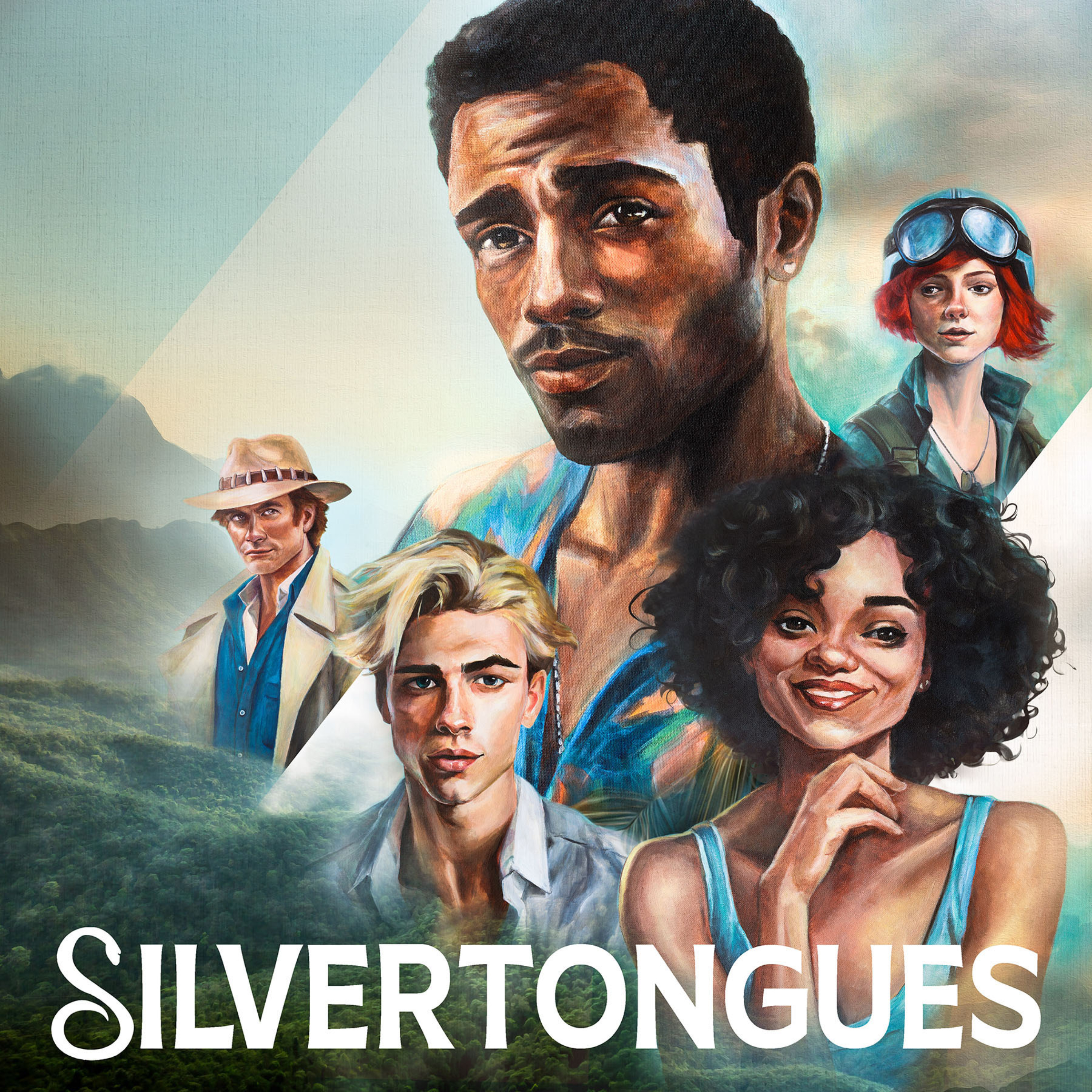
The Audio File: Silvertongues

The new year has arrived, but there is still a lot of old business to attend to. Chief among them is that my requested reviews queue has got quite the backlog. So, I’m going to try to put a dent in that. To the best of my ability. Anyway, enough with the rambling, let’s get on to the main event. We’re taking a look at Silvertongues


Roscoe Talbot and Tavi Jones are almost literally in paradise. They run a juice bar in beautiful Hawaii. It’s a simple life, but they don’t have any complaints. Until now that is. Roscoe and Tavi have discovered that there are absolutely no records of their existence. No driver’s license, no social security number, no records of housing or employment. Absolutely nothing. In fact, they can’t even recall anything about their lives from before they started working at the juice bar. Well, there is one exception. They find a news article about Roscoe competing in a limbo contest on the island of Kalalani. Roscoe and Tavi must travel to this mysterious island to uncover the truth about their past. But danger lurks around every corner. Kalalani is ruled by a mysterious figure named Kai. To call him a cult leader is a major oversimplification. Kai has a way with words to a supernatural degree. When he says jump, his followers don’t even have to ask how high, or when to stop. You could say Kai is a real Silvertongue.

Silvertongues is created by Josie Eli Herman and Michael Alan Herman. They both previously created the audio drama The Call of the Void. As you might recall, I quite enjoyed The Call of the Void. So, as soon as Silvertongues was announced, I was very eager to see what Josie and Michael had cooked up this time. And they certainly did not disappoint with their second audio drama.

I should start by discussing the format of Silvertongues. The episodes alternate between main episodes set during the Present Day, and minisodes set seven years earlier. The minisodes do eventually catch up to the start of the main episodes. They’re also very important for unraveling the secrets of Roscoe and Tavi’s past. So, make sure you don’t skip the minisodes.

Let’s start by talking about the soundtracks. Silvertongues has some absolutely fantastic music. The opening theme starts things off strong with some funky 1970s inspired beats. Then we’ve got the closing theme with some groovy disco-inspired music. Of course, the soundtrack is also capable of getting more sober and introspective during those serious scenes. Honestly, the soundtrack for Silvertongues has easily become one of my favorite audio drama soundtracks. Each episode is introduced by the dulcet sounds of local DJ Seth Budarocci. I liked how the last line of the final episode is him giving a sign-off. It was a nice little touch.

I was very excited for the story to be set in Hawaii. I was going on a bit of a Hawaiian kick around the time I listened to Silvertongues. Also, I really wanted to try an açaí bowl after I heard about them on Silvertongues.

I really want to visit Hawaii, and I’ve already got a list of places I want to see. I want to see the Iolani Palace and the Bishop Museum in Honolulu. I want to visit a black sand beach and explore the Hawaiian rainforests. I want to see the lava fields, and I want to visit the Valley of the Temples. It might be fun to go snorkeling too, but we’re getting sidetracked here.

Some of you might be wondering if Silvertongues is set in the same world as The Call of the Void. It was established in The Call of the Void that the multiverse does exist, and we even briefly encountered an alternate version of Topher. Well, Silvertongues does feature the unexpected return of a character from The Call of the Void

Ladies and gentlemen, listeners of all ages, Fargo Kaminski is back. Ah, but Fargo isn’t alone. We also get to meet her sister Tasch. She is just as crazy as Fargo, but also like Fargo, Tasch is quite good at what she does. Tasch is one of the best, if not the best, pilot in all of Hawaii. Granted, her landings sometimes leave something to be desired. She flies an old Soviet cargo plane, well, that’s where most of it came from. The other bits came from here and there, occasionally being held together with duct tape.

Fargo does briefly mention that she dealt with some crazy stuff in the swamps of Louisiana. This would seem to confirm that Silvertongues is set in the same world as The Call of the Void. However, Tasch is voiced by Josie Eli Herman, who also voiced Etsy in The Call of the Void. You’d think that Fargo would have commented on how similar Tasch and Etsy sound. Then again, this is Fargo we’re talking about. It is entirely possible she did notice, but didn’t consider it worth commenting on.

There is a third character who falls into the crazy, yet awesome, category. Darcy Bennet has a name that is clearly a reference to Mr. Darcy and Elizabeth Bennet from Pride and Prejudice. And let’s see, what else am I forgetting? Oh, right. In terms of personality, he’s basically Crocodile Dundee. Yes, Crocodile Dundee, not Steve Irwin. Steve was an awesome Australian dude, wasn’t afraid to get up close with dangerous animals, but he was not crazy.

And don’t bring up the time with the stingray. I get asked that three times, at minimum, whenever I work in the stingray gallery at the Shreveport Aquarium. That was a freak accident. He didn’t see it, and it didn’t see him. It reacted like a scared animal, not out of malice. Nine times out of ten, stingrays will swim away rather than sting. If they sting, there’s a risk their barb will get stuck in whatever they stung. And if it gets ripped out…well, imagine ripping out a fingernail, but twenty times worse.

Getting back on track, Darcy is the go-to guy for, well, just about anything you need. Need a boat on short notice? He’s got you covered. Need someone who knows a thing or two about snakes, deadly and otherwise? He’s your man. He’s also…well, he’s certainly enthusiastic with explosives, at any rate. Darcy is voiced by Michael Alan Herman. I would not have guessed that had I not listened to the credits. I listened a little more carefully after that, and I kind of picked it up. Still, quite an excellent demonstration of Michael’s range.

Now, you might have noticed I’ve been neglecting Roscoe and Tavi. This isn’t because they are bad characters. They were certainly engaging enough. However, much of Silvertongues revolves around their quest for identity. So, it is kind of hard to discuss them without getting into spoilers. There is one more character that we have to discuss before we get to that.

Kai is the titular silvertongue. Well, one of them anyway, but more on that in the spoilers. Kai has what can best be described as the power of persuasion. Everyone who hears his voice is compelled to obey any command he gives. And I do mean any. For example, if he tells you that you are chained to the floor, you will not be able to get up. Doesn’t matter that there isn’t anything physically holding you down. Kai’s power will make you believe that you are chained to the floor. Kai rules over Kalalani as an iron-fisted dictator and wannabe demigod. Kai claims to have been chosen by the gods of the island to rule Kalalani.

I’m a bit reminded of Amy Carlson. She was the leader of the Love Has Won cult who, among other things, claimed to be the reincarnation of the Hawaiian volcano goddess Pele. As you might imagine, Native Hawaiians weren’t too pleased to see a White woman from Colorado claiming to be one of their deities. The cult faced considerable protest when they attempted to move to Kauai.

This does kind of tie into something I’d been thinking about. Now, Hawaii is notable for being the only majority minority state of the United States. Asian are the largest demographic group at about forty percent of the population. Whites, by contrast, are only about twenty-two percent of the population. Hawaii is also the most multiracial state, as mixed race people account for twenty-one percent of the population. Native Hawaiians, of full-blood ancestry, are about seven percent of the population.

I bring all of this up because I kind of felt that Silvertongues was a bit lacking in the diversity department. Now, I have to be fair here. Since this is an audio drama, an inherently non-visual medium, it is hard to tell what race everyone is supposed to be. Also, Kalalani, gives the vibe of one of those exotic resorts attended almost exclusively by rich White people. Still, the lack of Asian people does feel a bit off. Though, granted, this is a common issue with fiction set in Hawaii, but created by mainlanders. The lack of Native Hawaiian characters also creates some slight problems that we’ll get into in the spoilers section.

Speaking of which, the time has come at last. If you don’t want any spoilers, turn back now.

Last chance, are you sure you wish to continue.

Okay, if everyone who wants off the ride is gone, let’s get into it.

When I heard that Michael Alan Herman would be voicing Kai, I joked to myself that Silvertongues might prove to be a gender flipped version of The Call of the Void. As it turns out, this wasn’t entirely off. So, a few years before the events of the story, Kai was exposed to radiation from a meteor. This is how he got his powers. Admittedly, this makes the science fiction in Silvertongues about as soft as it was in The Call of the Void. I’m reminded of those 1950s science fiction stories where radiation was basically magic, and could do whatever that plot required. Of course, it isn’t how hard or soft your science fiction is, but what you do with it that counts. And Silvertongues did tell a very compelling, and thrilling, story.

Ah, but Kai wasn’t the only one exposed to the radiation. A pair of federal investigators were also investigating the meteor. Their names were Roscoe Talbot and Tavi Jones. Roscoe got the same dosage that Kai did, and also has the same ability that he does. Roscoe and Tavi followed Kai to Hawaii. However, it turns out that silvertongues are not immune to each other’s abilities. And thus, the plot was set in motion. I had been suspecting that this might be the case for a while. However, there was an additional twist I didn’t see coming.

Kai has a complete god complex. He believes that the gods of Kalalani have chosen him to rule the island. However, towards the end of the series, it turns out that the gods of Kalalani are real. As you might imagine, they aren’t pleased with what Kai has done to the island. Now, this isn’t bad in and of itself, and there is a lot of potential with the idea. However, I feel it could have come with a bit more foreshadowing. There was nothing to suggest they were anything other than figments of Kai’s megalomania. This is what I meant about the lack of Native Hawaiian characters. Granted, not all Native Hawaiians follow traditional beliefs, but perhaps a character that does could have been used to foreshadow the existence of the gods.

The dynamic between Roscoe and Tavi, when Roscoe is rediscovering his power, reminded me of the dynamic between Etsy and Topher in The Call of the Void. Though, with the genders reversed. Also, I must give praise to Dan Johnson. He made Roscoe sound like the last person who would have anything special about him. Of course, Sabrina Dahlgren, who voices Tavi, is no slouch in the voice acting department either.

By the end of the series, Roscoe and Tavi don’t have all of their memories back. In fact, they might never recover them at all, and will have to move forward with their lives anyway. I was reminded of the experience of people with amnesia. Contrary to what television and movies would have you believe, getting your memories back isn’t as simple as bonking your head again. Sometimes you slowly recover them, sometimes you get some back, but not all. And there are those who never truly recover their memories. For better or worse, our memories are part of what makes us who we are. It can be hard to maintain a sense of identity when you can’t even remember who you were.

The ending of Silvertongues touches on all of these themes. Still, Roscoe and Tavi have each other, and they are as close as ever. So, personally, I give them strong odds and a healthy prognosis. There are a few other revelations I could mention here, but I’ll leave those for you to discover.

There don’t appear to be any plans for a second season of Silvertongues. The series ends on a fairly definitive note. However, season one of The Call of the Void seemed to be closed and done, yet we got two more seasons. We know that there’s been two silvertongues; who’s to say that there aren’t more lurking out there? Alternatively, perhaps there might be other meteors, with other radiation, and other side-effects. I will also add that the ending of Silvertongues didn’t feel rushed like the ending of The Call of the Void’s first season was. Rather, it was more like the satisfying ending of the third season.

Whatever the future holds, I can say that I had a great time with Silvertongues. It was a thrilling adventure set on the sunny shores of Hawaii. It was an excellent follow-up from the team behind The Call of the Void. Come take a thrilling tropical auditory vacation from the comfort of your own home. 

Well, I think that should do it from me for now. I will see you guys next time.

Friday, August 9, 2024

The Audio File: Project Pulse

Anime and audio dramas have a bit of a history together. Many anime often create audio drama tie-ins. There are several anime fans within the indie audio drama scene. Many audio dramas take influence from anime in on form or another. The audio drama we’re taking a look at today, however, truly captured lightning in a bolt. It managed to perfectly distill the essence of a shonen anime, and put it into audio drama form. Without further ado, onto the main event. We’re taking a look at Project Pulse


The world was changed forever on April 15th, 2022. That was when a company called Octic burst onto the scene. Brent Nolewood, the CEO of Octic, lead a revolution in the field of augmented reality. Artificial intelligence, robotics, and medical technology saw almost overnight advances. Much of the workforce was rendered obsolete thanks to advances in automation. Though, Universal Basic Income also became a thing, so that helped. Still, the people needed something to keep them occupied. That something was Project Pulse. A unique three-on-three battle of wills and human spirit. Each team uses special augmented abilities to defeat their opponents in combat.

It is into this world that Derrick Walker enters. He is the last blind kid on Earth, but he carries the legacy of his mother. She believed that disabilities aren’t a weakness, but a difference to be accepted and cherished. He’s determined to climb his way to the top of Project Pulse.

I’d discovered Project Pulse thanks to Julie Hoverson of 19 Nocturne Boulevard. She used to run the AD Infinitum account on Twitter. It was decided to promoting indie audio dramas. She had to shut it down due to changes to the way Twitter lets you set up automated tweets. Still, we here at The Audiophile, and by extension The Books of Thoth, thank Julie for her service. It truly was an invaluable resource.

Back on topic, I’m glad I finally got to listen to Project Pulse. There have been many audio dramas that take inspiration from anime. However, Project Pulse is, in my opinion, the one the really managed to distill that essence. Now, I should probably preface this by saying that anime is a medium, not a genre. Nine time out of ten, whenever someone says that something is anime-inspired, they are referring to shonen. That is, anime aimed at boys between the ages of twelve and eighteen. That tends to be stuff like Naruto, One Piece, Fullmetal Alchemist, or JoJo’s Bizarre Adventure. Though, on occasion, you also get darker stuff that startles the line like Attack on Titan, Death Note, or Neon Genesis Evangelion. When you have an anime that is aimed at adult men, we call that seinen. Shojo and josei are the female counterparts to shonen and seinen respectively.

Derrick starts off as an underdog, but one with great potential. He is taken in by an unlikely ally. Said ally whisks him into a world of adventure. Derrick proves himself to be incredibly talented, despite being a newcomer to the world of Project Pulse. One of his new allies is a guy with glasses who oozes cool. The other is a snippy, sarcastic girl, but she turns out to have hidden depths. Throughout it all, Derrick strives to be the very best, like no one ever was. Oh, and it all takes place in a future with super advanced holograms and AI. Put that all together, and it sure sounds like the start of a science fiction shonen, doesn’t it?

Ah, but it isn’t just the premise that gives that anime feeling. I have to take a moment to praise the fantastic voice acting. I don’t know if Project Pulse was intentionally trying to sound like an anime dub, but they really captured the aesthetic. Now, I know dub vs sub is a very touchy subject in the anime fandom. I admit I tend to consume my anime dubbed. That’s a personal preference on my part. There’s nothing wrong if you prefer subbed anime. I will admit I’ve watched some anime where the subbed version was, overall, a bit better. That having been said, there’s also plenty of quality voice acting on the dubbed side of things. I am pleased to say that the spirit of those quality dubs is alive and well in the voice acting of Project Pulse.

Okay, now it is time to meet the characters. Derrick is blind, so in a way, we are experiencing the story from his point of view. Or lack thereof, as the case might be. He could have had this corrected via surgery, but he chose not to. However, he compensates for this using the same technology that Pulse players use. Octic tech grants Pulse players enhanced physical abilities. In Derrick’s case, he uses an app called Telescopic Hearing, which allows him to focus his hearing, and tune out excessive noise. I wondered if perhaps he was going to be depicted like Daredevil. That is, having his other senses heightened to superhuman levels to compensate for his blindness.

Well, there’s a scene early on where Derrick runs into some thugs…and promptly gets his ass handed to him. Honestly, that was actually a really smart move on the part of the creators. That scene shows that Derrick has a lot to learn before he’s going to make it to the top of Project Pulse. It makes his victors feel more genuine and actually earned.

Kato Atadori fills the role of the smart guy with glasses who absolutely oozes coolness. I mean, the dude is cool as ice, and that extends to his Pulse abilities. You see, there are different classes of Pulse players who each specialize in different abilities. In Kato’s case, he is an Elemental. He is the master of all things ice, and he’s very creative in how he uses it. The way that Project Pulse is described, everything is created using holograms. However, the Elemental powers sound more like magic. Kato’s ice is genuinely cold, and he can use it to make shields and protective domes. He can also use it offensively to create blizzards. Maybe it's like in Star Trek where the holograms are somehow solid. Then again, plenty of anime also feature surprisingly solid holograms. Clarke’s Third Law is clearly at play here.

Kato is the one who takes Derrick under his wing and introduces him to the world of Project Pulse. The Project Pulse website has a section that includes information about the characters that hasn’t been included in the show. At least, not yet anyway. From this, we learn that Kato is third generation Japanese-American, and is quite proud of his heritage.

Mia Clark is the Speedster of the group. As the name suggests, they are Pulse players who specialize in fast attacks. She is also the resident tsundere. For those of you who aren’t otaku, a tsundere is someone who starts off kind of mean and snippy, but then they turn out to have a hidden nice side. Sometimes, though not always, they act mean because they’re hiding a deep sadness or hurt. This is certainly the case with Mia. She comes from a wealthy family, but her parents are dead. So, she lives with her Uncle Heath. He used to be a construction worker, but that was rendered obsolete due to the technological revolution Octic ushered in. Heath didn’t know what to do with himself, and turned to drinking to drown his sorrows. 

Mia gets a monthly stipend, which should be enough to live in a nice loft uptown. Unfortunately, Heath usually spends the money on alcohol and drugs. Quite ironically, Mia’s family got so wealthy because her mother invested stock in Octic during the early days of the company. Heath tries to pull himself together for Mia, but almost always falls back into temptation. Mia could easily abandon him, but Heath’s the only family she has left, and she feels obliged to him. I feel kind of bad for finding Mia’s tsundere tendencies amusing in the first season. Poor girl sounds like she could seriously use a hug.

In other characters, we have Emma. She is Derrick’s AI assistant. She takes the form of a blue-haired anime girl. She likes to tease and sass Derrick, but she’s always there for him. Especially since she doesn’t want to be factory reset. I would remark that this is slavery, and that factory reset amounts to lobotomy, but that’s kind of an omnipresent trope in works featuring artificial intelligences. Well, that, and we increasingly see the world of Project Pulse is not quite as utopian as Octic would have us believe.

Speaking of AI, let’s talk about Mark Bolt. Well, technically the Mark Bolt in the series is an AI replicant of the real Mark Bolt. Mark is a popular Pulse announcer who gives play-by-plays of the action. This is a creative way of letting us, the out-of-universe audience, know what we should be visualizing. It has the bonus of being diegetic, and makes sense in-universe without coming across as unnatural or forced. Although, if AI voices have gotten that advanced, well, that has grim implications for the voice acting industry.

I’d be remiss if I didn’t mention one unexpected ally Derrick finds. Derrick is transported to the underworld during one of his first Pulse matches. He meets the Greek god Hades. Hades offers Derrick the use of his bident as a Pulse ability. The bident is the two-pronged staff Hades is often depicted holding. Okay, so we started off as an anime, and then we turned into Percy Jackson. I remember listening to that scene and thinking “This show just keeps getting better and better!” Hades might have only appeared in that one scene, but it was certainly a memorable one. Though now that I think about it, a mythological god in a futuristic anime setting, is that a Persona reference?

Okay, now we’re going to switch gears and talk about a few of the things I didn’t like. The creators of Project Pulse were clearly trying to give positive representation to people with disabilities. However, I feel that they missed the mark. Derrick’s mother, Catherine, was a big champion for the downtrodden. She was also a big believer that disabled people can do anything. Unfortunately, that attitude also got her killed. When Derrick was little, he and his mom came across a burning apartment building. The automatic firefighting drone malfunctioned, and Catherine decide to rush in and rescue the trapped tenets. Did I mention that she was paraplegic?

I mean, where do I even begin? Catherine’s wheelchair didn’t appear to be anything other that a standard chair. How did she get up the stairs? How did she navigate fallen debris and fires? She didn’t come across as a hero, she came across as an idiot who senselessly threw her life away. Derrick had to grow up with a mother, and Mr. Walker lost his beloved wife. Frankly, I wonder if Catherine really cared about those people in the burning building. Let’s suppose she’d done the sensible thing and hadn’t intervened. In doing so, she’d have to admit that there are legitimately some things disabled people just can’t do. Yes, sometimes in life we have to make hard calls. It might seem cruel, but the cold equations have to be balanced somehow. Sometimes that means not everyone gets to live.

This also leads me to another point. I feel that having Derrick willing abstain from corrective surgery might not have been the best move. One of the arguments disability advocates give against such procedures is that there will always be those who can’t get them. The thinking is, this will lead to a shrinking of the disabled community. Those who get left behind will find themselves increasingly isolated from society. However, this is not the case with Derrick. His refusal frankly comes across more as him wanting to feel special and unique. Personally, I feel it would have been better if Derrick had a one in a billion genetic fluke that not even Optic could fix. He’d still get to be the last blind kid, he’d still be disability representation, but he wouldn’t come across as trying to be special for the heck of it. Plus, it would tie into the previously mentioned real world issues.

Now, I want to emphasize I don’t think any of this is inherently unfixable. One of the key points of Pulse is the case system. Each special ability takes up a certain number of slots in a player’s case. There are ten slots total, so players have to pick and choose carefully. Telescopic Hearing takes up three slots already. Kato emphasizes that Derrick might have to consider switching it out some day. Perhaps, when that day comes, Derrick will seriously have to consider getting corrective surgery. Now, I’m not saying he’s got to go through with it, but I do see that as a potential source of internal conflict for him.

Perhaps, we could also have him question his mother’s choices. He could acknowledge that she was a good woman at heart, but had her share of flaws. He can decide to honor her legacy, but avoid repeating the same mistakes she did. Unrelated, but at one point Derrick realizes he’s been holding a corndog upside-down, and Kato didn’t tell him. Uh, do what now? You don’t need eyes to figure that one out.

On an unrelated note, I also felt the depiction of Universal Basic Income was a bit inconsistent. Derrick hypes it up as being this wonderful thing that finally ensured equality for everyone. Yet we see that there’s still a fair degree of wealth inequality. Mia and her uncle aren’t the only people we see living below the poverty line. Granted, it would make sense that there would still be rich and middle class people. Presumably, wealth from the old world carried over to the new. However, the way things are presented, it gives the impression that the only reason poor people still exist is that they’re irresponsible with their money. Granted, we do get hints that there’s a sinister undercurrent lurking just beneath the surface of this world. So, perhaps this is by design.

I don’t want to end this review on a negative note. Taken as a whole, I was very pleased by Project Pulse. Season one was absolutely fantastic. Season two only has a couple episodes out so far, and production seems to have stalled. I certainly hope it gets moving again, because I’m dying to know what happens next. Season one was centered on Derrick, but it seems that Mia will be taking center stage in season two.

So, there you have it. Project Pulse is an absolutely fantastic anime-inspired science fiction audio drama. I have seen few other audio dramas that capture the spirit of anime so perfectly. You definitely do not want to miss this one if you are an anime fan. Don’t sit on this one like I did. 

Well, I think that should do it from me for now. I will see you guys next time.

Tuesday, July 2, 2024

The Audio File: The Earth Moves

Some audio dramas last for numerous seasons. Some fizzle out after only a single season. That’s not even getting into serialized vs anthology vs hybrid. The point being, audio dramas come in all different shapes and sizes. The audio drama we’re looking at today clocks in at only two episodes, and slightly less than an hour in runtime. Still, as is often said, good things frequently come in small packages. We’re taking a look at The Earth Moves


Brent Ziff is something of a modern-day Howard Sterns. He runs an internet radio show where he interviews various callers. Inevitably, they are brought on so that Brent can make fun of them for being strange or otherwise unconventional. Tonight, however, it is Brent who will receive the jolt of a lifetime. Leo Short is calling into the show. Leo is a big fan of the show, and he has an equally big message. Leo has a strange superpower. He gets intense intestinal distress whenever a major natural disaster is due to occur. Leo explains it as being able to sense the movements of the Earth itself. Leo’s power tells him that tonight won’t just be one earthquake, it will be lots of them. Leo is trying to convince Brent to help him get the word out.

I first came across this audio drama while perusing the r/audiodrama subreddit. I was in the mood for something shorter, and I decided to give it a shot. I did very much enjoy The Earth Moves. I sometimes share what I’ve been listening to lately on the Twitter account for my own audio drama The Books of Thoth. Gideon Media, the creators of The Earth Moves, were delighted by my brief Twitter write up. They even followed The Books of Thoth. So, I kind of felt a bit like my arm was being twisted. And if that’s the case, congratulations, it worked. But, just a tip, the best way to get my attention for potential reviews is to take the direct approach.

So, a bit briefly about Gideon Media. They are an audio drama production studio. They are in the same weight class as studios like QCODE and Realm. Gideon Media has attracted some very big names. They’ve adapted the plays of Wallace Shawn into audio dramas. They’ve also been commissioned to make audio dramas for Audible, including one based on Are You Afraid of the Dark?

The Earth Moves is a two-man show, but both of the leads carry it fantastically. Abe Goldfarb channels his inner edge lord as he portrays Brent’s devil-may-care, take no prisoners persona. At the same time, he doesn’t neglect Brent’s more human moments. He is really about to sell us on how Brent cares about his mom back in Minnesota. Brain Sillman starts Leo off as a dorky, but good natured, sort of guy. You can see why Brent might be hesitant to believe Leo at first. Ah, but then the tables turn, and Brain adds a bit more confidence to his performance as Leo.

In a way, The Earth Moves can be seen as a deconstruction of the disaster movie genre. Most disaster movies end with the heroes having survived the major calamity. Sure, the city, or nation, is in ruins. And yeah, they might have lost some pals along the way. But hey, they lived to tell the tale, and the future looks bright as the happy music swells triumphantly. Ah, but therein lies the rub. You see, most disaster movies end there because, well, they kind of have to. If they were to keep going things would be feeling a lot less triumphant and happy.

I was in middle school when Hurricane Katrina happened. My nuclear family lives in North Louisiana, but I’ve got family all through South Louisiana. My dad’s half of the family is scattered throughout the greater New Orleans area. I can remember seeing those images of the flooded city, but still not being able to grasp the scale of the destruction. All these years later, and I’m still not sure I can really comprehend just how bad it was. That’s not even getting into all the looting and rioting that happened after law and order broke down. I remember having family coming over to stay until things cleared up. I also remember having several classmates who were refugees from down south. 
What happened with the Audubon Aquarium of the Americas hits even harder now that I work at the Shreveport Aquarium. 

All these years later, and it still feels like we’re dealing with the scars of Katrina. I went through a lot of those same feelings when Hurricane Laura hit Lake Charles. My mom’s side of the family is scattered across that general area, but especially in DeRidder. 

The point being imagine that sort of destruction, but on a global scale. Oh, there would be some areas spared from the destruction. Particularly, the higher inland areas that avoided the tsunamis. However, Leo rightfully points out that the supply lines that keep the world running would be completely severed. Food shortage would be all but guaranteed. Ironically, so would fresh water. Hey, all that salty ocean water is sure to contaminate sources of freshwater. Medical supplies would also be an issue. Going back to New Orleans, we saw numerous displays of kindness and generosity among the survivors of Hurricane Katrina. However, we also saw that this altruism had its limits. Eventually, people are going to prioritize themselves, and their families.

And yet, The Earth Moves does not take a nihilistic view to all of this. Leo acknowledges how horrible things are going to be. And that’s exactly why he believes it is so important to get the word out. There won’t be anyone to swoop in and help the survivors. Therefore, the survivors must band together if they want to do more than just scrape by. I’m reminded of one of the Norse sagas. I can’t remember which it was, but there were a group of Vikings who didn’t believe in the gods. Or perhaps, viewed the gods as cold and uncaring. They knew they couldn’t depend on anything but their own strength. So, they banded together against the cruel and indifferent world. I see much of that same sentiment in The Earth Moves.

So, we have an audio drama that doesn’t sugarcoat the human cost of a global disaster. And yet, it paints an optimistic view of humanity’s survival, and ends on a hopeful note. There really isn’t anything for me to really critique about The Earth Moves. If I were to get super nitpicky, there is a scene where Brent watches a livestream of a right-wing rally in…Seattle. Uh, this was supposed to be our universe, right? Like, I’m pretty sure the Republican part of Washington state is on the other side of the Cascades. Like I said, an extremely minor nitpick, didn’t ruin the show in the slightest.

The Earth Moves isn’t just available as an audio drama. It was also adapted into a film, with Abe Goldfarb and Brain Sillman reprising their roles. I haven’t had the chance to watch it, but the trailer looked pretty good.

So, there you have it. The Earth Moves is a darkly comedic audio drama about a shock jock getting the shock of a lifetime. It deals in disaster, but keeps things surpassingly hopeful. It is short, but sweet, and well worth your time.

Well, I think that should do it from me for now. I will see you guys next time.

Wednesday, February 14, 2024

The Books of Thoth: Starshot

The second episode of my audio drama anthology The Books of Thoth is here. It is titled “Starshot.” 

A fleet of alien space probes enter the night sky. But this is not our sky, and the probes are from Earth. A scientist from Alpha Centauri studies the probes aboard a space station. What will the scientist discover about their place in the universe?


A big thank you to Angela Yih for performing this episode. Be sure to listen to her audio drama Residents of Proserpina Park, if you haven’t done so already. You guys should know by now how much I love Residents of Proserpina Park. So, it was awesome to have Angela as part of The Books of Thoth.

What I wanted to do with “Starshot” is tell a story of First Contact between humanity and extraterrestrials, but from the perspective of the aliens. I wanted it to be hopeful and optimistic. Where the aliens are looking for a friend amidst the darkness, just like humanity is.

The title is a reference to Breakthrough Starshot. It is an proposed space mission to send a series of probes, via solar sail, to Alpha Centauri. It would take between 20-30 year, plus an additional four years for any messages from the probes to reach Earth. Hundreds of probes would initially be launched, with most being lost along the way due to collisions with interstellar dust and other debris. But, hopefully, a lucky few would survive the journey across the ebon sea. Pictures and/or video from another star? Now there’s a thought.

I also attempted to answer the question of the Fermi Paradox. That is, if the universe is so big, where’s all the alien. Perhaps they are in the same boat as us. Advanced enough to wonder who’s out there, but not advanced enough to initiate significant contact. Perhaps it is only just now that intelligent life has finally evolved in the universe. I suppose they would make a kind of sense. Look how long it took for intelligent life to evolve on Earth. Well, intelligent as we define it, anyway.

I wanted to evoke the feelings of wonder and frustration from archeology. Especially with regards to civilizations where we have yet to translate their languages such as the Minoans or the Indus Valley Civilization. I suppose that makes the protagonist a xenoarcheologist.

Still, that isn’t to say you can’t find at least some meaning. Even if it wasn’t the kind you were initially looking for. So, I wanted the story to end with a sense of awe and wonder. With the feeling the the universe is so much bigger, and isn’t that great?

But most of all, I hope that all of you enjoy “Starshot.” I kind of rushed this one so I could get it out before Christmas and New Year’s. It is a bit more low-key than my previous episode, “Paleontology Conference” was. But I felt Starshot was a very personal, intimate sort of story, and it didn’t need as many bells and whistles. And hey, we got some nice music to listen to along the way.

You can listen to The Books of Thoth on your podcast platform of choice. 

Tuesday, November 21, 2023

The Books of Thoth: My First Foray into Audio Drama Production

I’m back with another update post, and this one is an especially big update. You see, I’ve finally done it. I have officially launched my audio drama anthology podcast The Books of Thoth.


We’re kicking things off with “Paleontology Conference.” million years in the future. Humans are extinct and squids rule the Earth. They only know us from the fossils we leave behind. What will the squids make of us?

As you might guess, The Future is Wild was a big inspiration for this episode. I blame that show for igniting my love of terrestrial cephalopods. The part where the narrator speculates about the Squibbons developing their own civilization always sparked my imagination. The All Todays segment of the book All Yesterdays was another big inspiration. I love the way it pokes fun at how our notions of prehistoric animals sometimes turn out to be very wrong. You do get some references to how our views on prehistoric animals have changed. The part where the professor mentions chordates used to be viewed as slow and lumbering, but then were viewed as active and dynamic? That was almost word-for-word how our views of dinosaurs changed over the years. And there’s a few more in-jokes if you’re paying attention for them.

A bit about where the title for the podcast came from. Thoth is the god of wisdom, writing, and magic in Egyptian Mythology. He possessed an ultimate book of spells known as the Book of Thoth. Among other things, it had spells that could enable you to speak the language of animals, restore the dead to life, and peer through the layers of reality and gaze upon the gods themselves. Thoth acted as scribe of the gods, and he’s probably written quite a few scrolls in his time. And those scrolls are bound to have some pretty good stories within them.

The Books of Thoth has been a long time coming. I’m both nervous and excited. I admit that maybe there were a few things I could have tweaked. But after a certain point, perfect becomes the enemy of good. And so, I decided to release my audio drama into the wild for all to enjoy.

A big thank you to everyone who made this episode possible. Thank you to Marnie Warner, Amy Young, Faye Holliday, Juan Cruz III, Tiffany Perdue, and Melissa Bowens for providing the voices. As well as my thanks to Geno Samuel for providing the opening narration. And to Nadine Trollip, aka Stardust-Phantom, for providing the series cover art.

The Books of Thoth is hosted on RedCricle, and you can find it on all major podcast platforms. Including, but not limited to, Spotify, Apple Podcasts, iHeart, Podcast Addict, Amazon Music, Player.FM, Audible, TuneIn, RadioPublic, Apollo Podcasts, and Goodpods. And yes, I do have transcripts available.

It hopefully won’t be too long before I have more episodes for your listening pleasure. But in the meantime, I do hope that you enjoy the inaugural episode of The Books of Thoth.

Saturday, October 28, 2023

The Audio File: Regina Prime

I have said, on many occasions, that sometimes it takes me a bit before I get to certain audio dramas. Other times, I make a point of listening and reviewing as quickly as possible. Today, we are taking a look at an example of the second scenario. Without further preamble, here is my review of Regina Prime.


Regina Prime begins in the form of an urban exploration vlog. We follow a woman named Regina who is exploring an abandoned research laboratory. Everyone starts of pretty normal, but then strange things begin to happen. It also becomes clear that Regina is hiding something. Or perhaps she’s being forced to hide something. Oh, but we aren’t done yet. Each episode is split between Regina’s adventures, and the happenings of another woman. Well, multiple women, and they all have very similar voices to Regina. These women have been kidnapped by a shadow organization that is seeking Regina Prime. Just what is going on here?

Regina Prime is created by Jessica Berson, who also created the audio drama Echoes (in) Between. It was an audio drama that was very much about slowly peeling back the layers of the central mystery like an onion. Regina Prime is very much cut from the same cloth. In fact, I’d argue that it is even more so. Most episodes of Regina Prime are only about half the length of a typical Echoes (in) Between episode. So, I had to be a bit coy with the summary. I will do my best to keep things spoiler-free for as long as I can.

Now, back to the subject of Echoes (in) Between. Those of you who read my review will know that I felt immense guilt for putting off reviewing Echoes (in) Between. This is due to the tragic way in which the show came to an end. To make a long story short, Jessica Berson had a pretty nasty falling-out with her production partner. It is highly doubtful a review from me could have prevented this. All the same, I felt bad after I learned about what happened. However, towards the end of my review, I also expressed confidence that Jessica would one day rise from the ashes like a phoenix.

My confidence was certainly not misplaced. Jessica has, in addition to Regina Prime, also started an anthology audio drama called Blue Rose Stories. I’m waiting til it has a few more episodes before I review that one. I will say that the episodes that Blue Rose Stories has out so far are really great.

I first became aware of Regina Prime when I got followed by the show’s Twitter account. I was very pleased to see that Jessica was making another serialized audio drama. I made a note that I was going to be proactive and not drag my feet this time round. I had to take care of a few personal matters first, but here we are now. It seems that Jessica is taking a back to basics approach with Regina Prime. As I have previously noted, the episodes are about half the length of a typical Echoes (in) Between episode. Jessica also provides the voices for all of the characters. She manages to give them all distinct personalities, and that’s no small task, given how similar most of the characters sound. As for why that is, well, that’s something for the spoilers section. One of the characters is a computer AI. Jessica considered using an AI voice for the role, but ultimately decided against it. She felt it wouldn’t be the right thing to do. And speaking of AI…but that’s another thing for the spoilers section.

I hadn’t really given urban exploration much thought before listening to Regina Prime. I’ve seen a couple YouTube videos, and of course I remember when the Tomb of the Burger King was discovered. Easily the greatest archeological discoveries of our times. That was a joke about some urban explorers who discovered an almost perfectly preserved Burger King from the 1980s. I know urban exploration isn’t the main point of Regina Prime, but it still made me want to learn more about it.

Okay, I’ve put it off for as long as possible. It is time to get into the spoilers section. So, if you don’t want any of that, turn back now.

Last chance, you sure you want to continue?

If everyone who wants out is gone, let’s get into it.

I’m going to go on a slight tangent for a moment, but just bare with me here. There was this show I remember briefly watching once called New Amsterdam. It was about this guy, named John Amsterdam, who was an immortal living in New York City. Oh, and it was also a detective show. As the title suggests, John’s been around since when the Dutch owned Manhattan. They had another show called Forever, which had basically the same premise, but I personally liked Forever better of the two. Ironically, both shows got canceled after only one season. Quite a shame really.

I bring this up because of something I found interesting about New Amsterdam. John has to keep a detailed list of all his descendants so that he doesn’t accidentally wind-up committing incest. I should probably mention that he’s looking for his true love, who will be the one to cure his immortality.

I’d never really considered it, but that would be a concern for someone who is immortal. But what happens when you have multiple immortals running around? And let’s assume these immortals can reproduce. Oh, nothing too bad would happen at first. Slowly but surly, however, the gene pool would start to get shallower and shallower. Iceland has had to deal with a variation of this problem. They’ve had little to no immigration over the years. Most Icelanders are descended from the original handful of Viking settlers. So, accidentally hooking up with a distant cousin is a reasonably legitimate concern. In fact, there’s an app that cross references two people’s family trees using government records. The app works when two people bump their phones together, and its slogan is “bump this app before you bump in bed.”

Okay, where am I going with all of this? Well, Regina Prime takes into consideration the ramifications of having a bunch of immortals running around and having kids. Well, that, and the effects of widespread cloning. Remember that part about the people being held captive? I initially believed it to be concurrent with Regina’s own adventures. As it turns out, I was wrong. The second segment actually takes place hundreds of years after Regina’s adventures. In that time, cloning has become very wide spread. Many people choose to have their kids cloned from donated tissue cultures. Regina’s sample proved very popular, but she had a genetic mutation that made her biologically immortal. All of her clones share this mutation, but they can still be murdered.

Hmm, a sample of immortal cellular tissue? Could that be a reference to the HeLa cells? They are a sample of cancer cells that have continued to divide long after the point they should have died. They were controversially harvested from Henrietta Lacks, who died of cervical cancer. The HeLa cells proved invaluable in numerous cancer treatment studies. However, the Lacks family didn’t learn about this until many years later.

People turning to cloning to ensure their kids are smarter, faster, stronger, and better might seem far fetched to some. However, I’d argue it isn’t too different to what is going on in the here and now. Think about all those people who pursue artificial insemination. Oh, they might claim to be opposed to things like eugenics. But when you get down to it, they’d probably prefer a tall, blonde hair, blue-eye, athletic college professor as their donor. They probably aren’t going to go for a short, flat-footed, perpetually anxious, autistic guy who writes audio drama reviews.

Obviously, all of the prisoners are clones of Regina. But why have they been captured? More importantly, who has captured them? I’ll leave all of that for you to discover. I will, however, reiterate that Jessica does a great job of giving the clones all distinct personalities. I helped that Epsilon, the clones are all referred to by Greek letters, has a British accent. Jessica does refer to herself as a committed Anglophile on her Twitter account. Hmm, going by that, I wonder if we’ll eventually see a clones who is obsessed with baseball?

I think we’ll wrap it up here. Season one of Regina Prime was really great. It is excellent to see Jessica Berson making audio dramas again. I can’t wait for season two to come out. And I have full confidence that there will indeed be a season two. If you enjoyed Echoes (in) Between, you won’t want to miss out on Regina Prime.

Well, I think that should do it from me for now. I will see you guys next time.