Sunday, April 24, 2022

Flag of the Inca Empire

This is the flag of the Inca Empire. It comes from a world where the Inca were able to defeat Pizarro and his troops, and resisted Spanish conquest. The naturally mountainous terrain of the Andes helped give the Inca a considerable boost in self-defense against other European powers. The Inca played the various European powers off of each other to preserve their independence. The Inca initially considered a policy of isolationism, but this would prove untenable. Though, initially, the Inca limited their interactions with the Europeans as much as possible. 

As time went on, the Inca began to study and replicate European technology and ideas. The first major change being the introduction of gunpowder weaponry, and the establishment of permeant standing army. The Inca also established a formal written language; with its alphabet largely based on the Latin Alphabet, but with some unique flourishes. The Inca had been ravaged by smallpox, and other Europeans diseases, though not quite to the extent they were in our world. Naturally, the Inca sought out the vaccine for smallpox as soon as it became available in the 18th Century.

The 19th Century saw the next major wave of reforms. The Incan government reformed into a parliamentary democracy, with limits set on the Sapa Inca’s powers. The first stages of industrialization also began at this time. The Inca adopted Western styles of clothing, but mixed in their own designs and color choices. Indeed, to this day, the Incan clothing is known for its unique mix of Western and Indigenous designs. However, more traditional style clothing can be found at important events, such as major religious festivals, or the crowning of a new Sapa Inca.

Today, the Inca Empire is a prosperous modern nation. Cusco, the nation capital, is a true global city. It is home to several universities, museums and art galleries, restaurants, and temples that are the envy of the world. The Quechua people are the largest ethnic group within the empire. However, the empire is home to many other ethnic groups including, among others, Aymara, Mapuche, Wayuu, Het, Polynesians, and even Amazonian tribes. The Inca Empire also receives many immigrants from around the world.

Incan citizens enjoy a very generous social safety net. Government-funded healthcare is provided to all citizens, though private insurance also exists. The Department of Employment provides jobs to all citizens who find themselves unemployed. In the event that a citizen cannot fulfill any available jobs, they are instead given a welfare payment until new jobs become available. The Department of Culture helps provide funding for the arts. Some citizens, of course, cannot attend performances of the arts due to their financial circumstances. In this case, they can apply for free vouchers from the Department of Culture. This all means that most Inca citizens have fairly high taxes, but most consider the trade-off worth it.

The flag includes a stylized depiction of the sun god Inti. The Inca still largely follow their traditional religion; though secularism is on the rise. The blue symbolizes how the same blue sky stretches over all parts of the empire. In the corners of the flag are four chakana; a common geometric shape found in art across various Andes Civilizations. They are in the four corners of the flag in reference to the Inca Empire’s official name, Tawantinsuyu, which means Land of the Four Corners.


Saturday, April 23, 2022

The Alt-Hist File: Prototype World of Tomorrow: The Infinite Journey

I’ve been on a roll reviewing the latest seasons of several audio dramas. We find ourselves once again at Prototype World of Tomorrow, a show I utterly adore. Not much more to add, so let get on to the main event. We’ve taking a look at season three of Prototype World of Tomorrow: The Infinite Journey. 


Just to recap, Prototype World of Tomorrow is set in a world where Walt Disney’s dream to build an Experimental Prototype Community of Tomorrow became a reality. Everyone in Progress City is gearing up for the Eleusinian Tournament. It is a competitive video game tournament, and Tim E. Less is determined to win with a little help from his friends. This year, the players will be dematerialized, and reassembled within the game itself. It might seem like fun and games, but lurks around every corner within the digital world. Tim’s fellow private investigator, Eve R. Moore, wants him to help her investigate the companies behind the Eleusinian Tournament from within. Hold on tight, Tim and the gang are about to take a journey beyond their wildest imagination.

I think by know that it should be obvious that I absolutely adore Prototype World of Tomorrow. It started off strong with season one, and continued the momentum with season two. So, how does season three do? Quite well indeed. As usual, there are numerous references to Disney Park attractions. Specifically, there are numerous references to all three incarnations of Journey into Imagination. Contestants exit the game through a rainbow tunnel, as a nod to how Journey into Imagination featured a rainbow tunnel. Fun fact, the Journey into Imagination tunnel also appears in one of Michael Jackson’s music videos. At one point, Tim and company meet a computer program that takes the form of a purple dragon. Obviously, this is meant to be Figment, and I shall refer to him as such from here on out. Figment mentions that he used to have a friend, but hasn’t seen said friend in a while. This is a reference to Dreamfinder, and how he was absent from both the Journey into Your Imagination and Journey into Imagination with Figment incarnations of the ride. Speaking of which, Ron Schneider, who played Dreamfinder, once again returns as one of the computer voices.

This segue’s nice into my next point. The game for this years tournament is partially powered by the players’ own imaginations. Oh, there are servers, very powerful ones, but part of the computing power is offset by utilizing the players’ own minds. For example, when Tim and his teammates look at a berry, it looks different to all of them, because everyone has their own mental image of how a berry should look. Though as mentioned, the servers do play some role. For example, all of the trees share the exact same four designs. Honestly, using the contestants’ own minds to generate the game was actually kind of brilliant. I haven’t really seen anything quite like that in fiction about virtual reality. I especially liked some aspects of the game being subjective based on the players’ own imaginations. Let it never be said that Ben Lancaster is lacking in creativity and imagination. Also, the part where the announcer says “right now there’s not a whole lot going on in your imaginations” was a nod to Journey Into Your Imagination, when Eric Idle says the same thing.

Oh, and one more reference. In the first episode, Tim is excited that his friends got handwiches. Handwitches were a short lived Disney food item. They were billed as the sandwiches of the future by then Disney CEO Michael Eisner. Handwiches were bread cones which held a variety of both sweet and savory fillings. Unfortunately, pretty much only Michael Eisner thought they were a good idea. Even the people working the handwich stands were skeptical of them, and handwiches died a swift death. Still, handwiches developed a minor cult following. In fact, they became a minor meme after Defunctland made a video about them. It also occurs to me that Bonnie, the waitress at Tim’s favorite greasy spoon, might possibly be a reference to Bonnie Appetite from Kitchen Kabaret.

Now, lets talk about the new characters. Tim’s team is down a player, so they take on Pauline, who works at the same company as Tim’s girlfriend Annie. At first, Tim doesn’t want Pauline on the team, and it was at this point I worried that this season was going to become one of those preachy “gamers are sexists” stories. Thankfully, that turned out not to be the case. Tim just wants to have a chance to play alongside his buddies, and proudly admits to having lost to numerous all-female teams in the past. Pauline has a true passion for retrogames, but Tim and his team initially dismiss her because of this. And yet, not too long after this, they mention that past Eleusinian Tournaments have incorporated elements of retrogames. So, one would think that they wouldn’t be so quick to brush her off. Initially, Pauline comes across as introverted, shy, and slightly dorky. In fact, at first I wondered if perhaps she might have autism. You don’t often see women with autism depicted in fiction. However, once everyone gets into the game, she becomes far more confident and in her element.

I also really liked Tim’s friend Morris. He’s a huge paleontology nerd, and is very excited that this year’s game has a dinosaur theme. He can name all of the dinosaurs, and other prehistoric animals, and rattles of a list of facts about each of them. He must be really good at the game right? Yeah, no. He get’s killed in the tutorial of the game, but he emerges from the game with little more than a bruised ego. Yeah, that would be me in that scenario. I also have a deep love of prehistoric animals, and with my luck, I’d probably get killed in the tutorial as well.

There is an obvious comparison to TRON with this season taking place in the digital world. However, while the programs interact with humans, their appearance isn’t as anthropomorphized as programs are in TRON. It is explain that the processing power of the severs is far faster than that of a human mind. I looked it up, and that does check out. As such, a human mind can’t be plugged directly into the computer mainframe. Thus, programs are rendered as series of geometric shapes.

Well, mostly. We do meet a program who looks suspiciously similar to Eve’s supposedly dead fiancĂ©. We don’t get confirmation as to whether or not it really was him. That having been said, many strange things have been shown to happen in Progress. Personally, if I was the gambling sort, I’d put money on it actually being him. I’ll be genuinely surprised if it turns out it wasn’t actually him. But I guess we’ll have to wait and see what future seasons have in store for us.

The virtual world setting does provide some humorous moments as well. At one point, Eve hacks into the game, and enters via the microphone she gave Tim. However, because Tim swallowed the mic, Tim winds-up vomiting Eve into the game. This is one of those time that it is good that Prototype World of Tomorrow has no visual component. That scene would probably be pretty terrifying in a visual medium. There were points were it seemed that something would go wrong, and the characters might get mutated or glitched somehow. My personal speculations was that somehow everyone would switch bodies. It would be interesting to see the actors portray each other’s characters. But it would seem that I was wrong.

I liked the part where Tim and company muse on the fact that the game contains temple ruins. Does this mean that humans and dinosaurs coexist in the game? Or did the dinosaurs develop their own religion? My take? Probably a nod to how early video games often featured ruins that often seemed to have no function beyond being ruins. There’s also a scene at a digital circus where Pauline eats some peanuts, and notes that she’s a allergic to peanuts in the real world. She finds them to be okay. 

Series creator Benjamin Lancaster has a deep love for the original EPCOT theme park. That loves really shines through in this season, even more so than usual. 

And so there you have it. The Infinite Journey, season three of Prototype World of Tomorrow, keeps up the momentum of its predecessors. Prototype World of Tomorrow has bowled a turkey; three-for-three for great seasons of alternate history science fiction goodness. I can’t wait to see what surprise season four will have for us. From the looks of it, some exciting stuff is on the way.

Speaking of exciting stuff, I’d like to take a moment to talk about one of the projects Brian Ballance, the voice of Tim, is up to. He has recently started a podcast called The Interesting Podcast. As the title says, he interviews people he thinks are interesting. For example, he interviewed, Callie Wills, the voice of Eve. I would encourage everyone to go checkout Brain’s podcast.

Well, I think that should do it from me for now. I will see you guys next time. 

Wednesday, April 20, 2022

The Audio File: The Program: Part 3

Well, here we are at Part 3 of my review of The Program. Just a recap, for those of you joining us for the first time. The Program is an anthology show of sorts, but the stories all take place in the same world. It takes place at some unspecified point in the future. The Singularity has come to pass. The world has been completely transformed by an app known as The Program. It has combined money, government, and religion into a single entity. Each episode follows one or more ordinary people making their way through the extraordinary world of the future. You can find Part 1 over here, and Part 2 over here. 


I was first made aware of The Program when I was contacted by series creator Ivan Mirko S over on Reddit. I frequently post and comment in r/audiodrama. Whenever anyone ask for recommendations, I chime in with ever larger lists of various audio dramas I enjoy. Ivan noticed that I'm quite the connoisseur audio fiction, and recommended his own show. He also asked if I might give it a review. I did, and kept reviewing it, and had to split the review into multiple parts to make reading easier. And here were are at part 3.

For our first episode of this segment, we have Counterprograming. It is a series of reimaginings of popular works of fiction, in this case The Iliad, The Lion King, and The Bible. The Program changed them to better reflect the values of its new society. Though, the originals weren’t lost or destroyed, merely fell out of popularity. The resulting edits are rather humorous.

Well, that was unexpected. We start off with an interesting reimagining of the story of Helen and Paris, and then the other two segments turn into an episode of Monty Python’s Flying Circus. I can easily imagine the dialogue from the Bible segment appearing in The Life of Brian. The Lion King segment reminded me of the part of Holy Grail where the peasants on the commune debate the merits of different forms of government, and point out that soggy tarts handing out swords in no way to found a proper government.

I liked the more serious tone of the Iliad segment. In fact, it reminded me very much of Song of Achilles by Madeline Miller; a novel I greatly enjoyed. Though I found Circe, the follow-up to Song of Achilles, was a major step down in terms of quality. Don’t believe the hype with Circe. Well, on the one hand it is a bit sad that the original Iliad and Lion King have fallen out of fashion. But I suppose stories are always being imagined and reinterpreted. Lion King itself is, in large part, a reimagining of Hamlet. Song of Achilles hews closer to its source material, but it is also a reimagining. I like to think there would be at least a few people who would still enjoy the originals.

Also, how does intellectual property work? Was it abolished by The Program, and all of fiction is now a fanfiction free for all. Or does it still exist, but it a much less restrictive form?

Let it never be said that The Program lacks a sense of humor.

Next up we have Homepage not found. It follows a very disgruntled man who is attending a meeting of a Neighborhood and Home Owners Association. He is concerned about the lack of affordable housing available in the neighborhood. He also feels that the Home Owners Association is drowning out the voices of anyone who opposes their clique. He feels that working individuals, unmarried individuals, and pretty much anyone who isn’t wealth or well-off, is being ignored. How will be make the NIMBYs listen to him?

Brief note, NIMBY stands for Not In My Backyard. Now, The Program has never exactly been subtle about its views. However, I would argue that it succeeded because it wrapped these messages in creative thought experiments and excellent storytelling. This reminds me of the afterword to Kindred by Octavia E. Butler. The point of the afterword is that it is important for books to have good writing as storytelling, not just good messages. Kindred is an excellent example of this. It is about a black woman from 1976 Los Angles who, for unknown reasons, travels back in time to 19th Century Maryland. Specifically, to a plantation where her ancestors are kept as slaves. Obviously, there’s a lot of emphasis on the horrors of chattel slavery, but it never feels preachy or moralistic. Kindred is an excellent novel, I recommend it if you haven’t read it already.

Now, I bring this up because I feel that this episode ran a bit foul of that adage. I mean, it was about a subtle as a baseball bat to the face. I want to emphasize that I don’t think this episode was bad per se. It was far better than the first few episodes of The Program from way back when. However, it does feel like it was taken out of the oven before it had a chance to properly bake. I’m sensing some potential autobiographical elements with this one. There was a lot here that felt like insider baseball at times. There was some stuff I was able to parse out. I’m familiar with the sorts of nonsensical regulations that home owner associations impose upon neighborhoods. I also appreciated the satirization of…well, let’s call them Latte Liberals. Those suburban progressives who mouth along to left-wing causes, and make a lot of noise, but when the chips are down don’t put their money where their mouths are. Bourgeoisie Bohemians is another terms that I suppose would work here. However, I did feel there was a lot of stuff that sailed over my head, and maybe I’d understand it better if I was Canadian.

This almost felt like a parody at time. Like, it was what The Program would be like it you sold it to a major network, or put someone in charge who didn’t fully understand what makes the show work. It also kind of feels like what would happen if The Program emphasized getting out episodes as quickly as possible instead of taking time to ensue quality.

This was a nice rough draft, but as an actual episode I feel it leave something to be desired. Once more I must mention that it is important to have good stories, not just good messages. Oh, and there is a quiz that accompanies this episode. It deals with questions related to Home Owners Associations. I played the quiz. I thought the trick would be that they were all real, but it seems I was wrong. Give the quiz a try and see how you do.

Our next episode is Jakob's notebook: Antivirus solutions for home and business. This is another of Jakob’s many stories. It tells of Earth being visited by aliens known as the Baci. The Baci warn humanity about a horrible galactic plague that is about to befall Earth. Human doctors believe that the plague can be contained with face masks, social distancing, and vaccination. The Baci, however, insist that the plague can only be stopped by brain implants.

I’m not sure how I feel about this one. It had its funny moments. I liked the part where the Baci get kicked out of China because they acknowledge Taiwan as a nation. Or the part where they says that humans smell of elder berries. I also get that this story was meant to be a satire of the pandemic, and how it has been handled. But I just couldn’t quite get into this one.

The parts where the Baci tell humanity to not wear masks and not to use vaccines just felt awkward. I get that it was meant to be ironic, but with all anti-vaxx and anti-mask propaganda floating around, it just felt kind of uncomfortable. It was like the episode was simultaneously pro-vaxx and anti-vaxx. Like it was saying to listen to experts, but that the experts don’t know what they’re talking about. Maybe it was just a victim of bad timing.

I will say that this episode did a way better job satirizing then pandemic than Don’t Look Up did. It didn’t stretch the joke out way too long, and it wasn’t smug and conceited. Not a very high bar to jump over, but I appreciated it.

I also enjoyed the voice acting. I kept thinking why the Baci sounded familiar. At first, I thought they sounded like Minions, but then I realized that they sounded like the Mexican Squash from VeggieTales, who’s name escapes me. Well, they sound like the Mexican Squash with a vocal filter, but still. That made the American politician come across as even funnier, since he sounded like the old pickle dude, I think his name is Mr. Nezzer. This was probably unintentional, as I seriously doubt the dudes who made VeggieTales would want to act for The Program. It probably goes against their religion.

Also, the Baci got the island of Great Britain as their homeland? Does that mean that Scotland and Wales were considered accomplices in all the colonialism that England did? Also, does Northern Ireland exist as a rump state of the United Kingdom? If so, wow, apparently the United Nations looked back at The Troubles and were like “There was a lot of carnage and bloodshed, but I think we can do better here. Let’s see how many more bombs were can goad them into setting off. Place your bets now!” Well, on the plus side, at least they didn’t give them Israel and Palestine. Or did the displaced British flee to the Isle of Mann an the Channel Isles. A European Taiwan, if you will.

Anyway, this episode wasn’t for me, but maybe other people will enjoy it.

Our next episode is called Overclocking. It is set in a world much like our own. However, the people of this world have known that they are within a computer simulation since ancient times. Human took comfort in known that the Admin watched over them. Unfortunately, by the 14th Century CE, scientist discovered that the simulation is running out of computing power. The mere act of existing takes away computing power from the simulation. Worse, the Admin has mysterious stop responding to communication requests. The world is literally coming apart at the seams, and horrific glitches spring up everywhere. It is amidst this backdrop that our two protagonists are embarking on a great journey. You could, perhaps, even call it a pilgrimage. They have enlisted the help of a ferryman to bring them on a journey to the terminal. Once there, they hope they will finally be able to speak to the Admin. Danger lurks round ever corner. Our heroes must maintain their faith in the Admin if they are to find salvation for their dying world.

At ninety-three minutes in length, this is the longest episode of The Program yet. However, don’t let the length of this episode intimidate you. Like the intro said, after the first ten minutes, this episode flies right by. The first ten minutes are what we need to set-up the world of the episode. IMS said that he wanted to create a movie-length audio drama episode, and he certainly succeeded.

I see that this episode is meant as a reinterpretation of The Pilgrim’s Progress by John Bunyan. You’ve got two protagonists set off on a great journey from a land that is doomed to be destroyed. They hope to find salvation, and meet their “God” once they reach their destination. They must literally traverse the Valley of the Shadow of Death. One of them is carrying a heavy load, much as the character Christian did. It also didn’t escape my notice that the current year is said to be 1678 CE, the same year that The Pilgrim’s Progress was first published. The Ferryman can even been seen as a combination of the characters Atheist and Hopeful. He doesn’t believe in the Admin, despite overwhelming evidence, but he finds meaning in the struggles he undertakes. It was very interesting how this episode took a classic work of Christian literature, removed pretty much all the Christian elements, and yet still managed to remain true to the core and themes of the work. That is some quality writing, and another argument in favor of a strong Public Domain. A strong Public Domain allows us to reimagine, reinterpret, and re-examine works to classic literature in new and innovative ways.

The notion of a world coming apart at the seams, and that simply existing causes the destruction of the world, brings to mind entropy. Eventually, our universe will run out of energy, but that will be billions, if not trillions, of years in the future. In fact, for most of its existence, our universe will be a fairly dark and inactive place. So, whenever you feel down and out, take joy that you live in a time when the universe is full of stars and planet, and teeming with light and life. This episode almost feels like a way to bring the concept of entropy to a more human scale. And in doing so, make entropy, and an idea, more relatable for us humans. I was very much reminded of the short story “Exhalation” by Ted Chiang, which approaches entropy in a similar manner.

I won’t give away the ending, but I will say that it wouldn’t have been too out of place in the original Pilgrim’s Progress. Though, the idea of people within a computer trying to reach a terminal, in hopes of contacting their creators, also bring to mind TRON. Oh course, that’s rather interesting, as many have noted that TRON works surprisingly well as a Christian allegory. This was the first movie-length episode of The Program, and it did not disappoint. It is just as creative, engaging, and philosophic as a typical episode of The Program. The added length was more than necessary to do this episode’s story proper justice. You can always count on The Program to be innovative and try new things. 

Next up, we have a standard-length episode titled Disreet optimization. It takes the form of a father and mother recording a message for their daughter, who has recently run away. The father talks about his life before The Program. He helped develop an application called Serendipity, which eventually became part of The Program itself. Serendipity helped to provide options to people. Among other things, it would present them with the optimum responses when talking with people, or in other social situations. Serendipity proved a great success, but the father grew worried. He feared that people were relying on Serendipity too much, and it was eroding their free will. He turned against Serendipity, and indeed, against The Program itself. This lead him to make some very drastic choices, with very severe consequences.

The first thing that came to mind when I listened to this episode were a couple short stories by Ken Liu. Specifically, “The Perfect Match” and “The Algorithms for Love.” They also deal with themes of free will and the way that algorithms shape our lives.

I’m also reminded of the debate surrounding sociobiology and evolutionary psychology. Most people are okay with using evolution to explain how physical features came to be. However, quite a few people balk at the idea that our behaviors and psychology could be explained by evolution. There are various reasons for this. Some people are simply proponents of the tabula rasa view. Others fear that such thinking could be used to justify eugenics, or be used as an argument against fighting racial and gender disparities in various jobs. E.O. Wilson, the founder of sociobiology, frequently got accused of being a fascist by various campus activist groups. In reality, he was anything but one.

However, I think there’s another reason at play here. Humans tend to hold ourselves as being above mere animals. Evolution is fine for explaining animal behavior, but we’re special. At least, that’s what we like to tell ourselves. It’s like how geocentrism used to be so widespread. Sure, not a totally unreasonable assumption if you don’t know better. However, it certainly provided a nice ego boost to think we were literally the center of the universe. And then came Copernicus and Galileo. Of course, Aristarchus predates them both, but I digress.

Personally, I split the difference. I think, to an extent, human behavior is based on nurture and upbringing. But it wouldn’t surprise me if some things come pre-programmed. Or at least, we come predisposed towards certain personality traits and behaviors. Hey, humans are animals too. Why should we be any more special than the countless other species on this planet?

I liked the part about how humans tend to anthropomorphize everything. It’s like how, in cartoons with talking animals, the predators are always presented as evil. Despite the fact that many predators are obligate carnivores, and don’t have any other way to gain nourishment. Also, many herbivores can be pretty violent in real life. Hippos kill more people every year than lions and crocodiles combined.

I also see shades of the debate about genetically modifying children. What if you engineer a child to be the perfect athlete, but they decide that they’d rather play chess or join the debate team? What if they don’t like the hair and eye color you picked out for them? And what about kids with conditions such as autism or ADHD? Should they be forced to fit an arbitrary definition of normal? Or would the world be missing out on the unique insights and modes of thought that someone with these conditions might possess?

Though one minor quibble I had. In the past, The Program has been shown to have borderline god-like powers, up to and including time travel. So, reinstating the protagonist’s daughter to the system seems comparatively easy. Unless it was part of one of The Program’s many schemes. Perhaps, as a way of getting the protagonist to see the metaphorical light?

In any event, this was one more great and thought-provoking episode from The Program.

Our next offering is Planned obsolescence. The episode follows a cynical middle-aged First Nations man named Paul as he interacts with an AI named CODI. Paul is acting as CODI’s teacher. Paul will teach the AI about his life’s story, his Indigenous heritage, and what it means to be human. But why is Paul being tasked with teaching CODI all of these things?

Well, this was a pleasant surprise. I wasn’t expecting an episode of The Program centered around a First Nations person. I also loved the way that indigenous culture was woven into the plot of the episode. I even learned some new things, such as the concept of the Dish with One Spoon. It was philosophy the Iroquois used to share land with their neighbors. Each tribe only hunted for what it needed, and made sure to preserve resources for others. There was also emphasis on preserving the land for future generations. I’m always eager to find examples of science fiction that engage with Indigenous cultures. So, this episode was a real treat.

I liked that CODI had to be aged, albeit in an accelerated way, over time. I read a really interesting novella by Ted Chiang called “The Life Cycle of Software Objects.” The central premise of the novella is that true artificial intelligence has to be slowly nurtured over time. I suppose it makes sense. Human minds take at least twenty-five years to fully develop and mature. So, perhaps we shouldn’t expect true AI to emerge like Athena sprouting from the head of Zeus fully formed.

I enjoyed getting to hear the flute music. I feel like I’ve heard it before, and that is apparently because it is royalty-free music. Most likely from Kevin MacLeod, if I had to guess. 

Having Paul’s father be a victim of the residential school systems was a nice touch. The horrors of the residential schools have been getting more attention in recent years, but still deserves to be talked about more. Also, I can confirm that long haul truckers do indeed listen to lots of audiobooks and audio dramas. I’ve met a couple on r/audiodrama. I also remember D.J. MacHale, the author of The Pendragon Adventure series, giving an interview where he said that he discovered that long haul trackers were some of his most devoted fans. The truckers loved listening to the audiobooks, despite definitely not being Pendragon’s target demographic.

I saw CODI’s teenage days coming a mile away, but it was still funny. I also liked how Paul cured CODI’s ice cream obsession by indulging him until he was sick of it. Mrs. Piggle-Wiggle would be proud. Though, I do wonder if CODI would get thirsty from eating all of that digital ice cream. I also liked the part where CODI incorrectly guessed that sports are the modern day religion. I mean, from a certain point of view, he’s not wrong. Sports culture does have strong elements of ritual and superstition. In a way, sports are a form of simulated warfare and ritual violence.

And as for the big reveal towards the end…wow. That went in a very different direction than I was expecting. A true emotional gut-punch. 

A really excellent surprise to see an episode of The Program that combines science fiction with Indigenous culture. 

And so that is all of the episode of The Program out so far. It never ceases to blow me away with the consistent quality, and how it keeps getting better. The Program is a tale of ordinary people making their way through the extraordinary world of The Singularity. Check it out today. You'll be glad you did.

Well I think that should do it from me for now. I will see you guys next time. 

Tuesday, April 12, 2022

The Audio File: Residents of Proserpina Park: Season 2

I was really impressed by season one of Residents of Proserpina Park. I took a gamble on it all the way back when it only had one episode, and it payed off big time. So, season one was fantastic, but what about season two? Oh, it more than managed to keep up the momentum. In fact, that’s what we’ll be talking about today. We’re taking a look at season two of Residents of Proserpina Park. 


When we last left our heroes, Sam had received an unexpected visit from his cousin demigod cousin Terry. Sam also wasn’t too thrilled that Alina brought other visitors to Proserpina Park without his permission. Alina has returned to the park, but Sam is nowhere to be seen. Alina and her friends will venture further into the park, but danger lurks around every corner. This time, the creatures are going to be much deadlier. Alina and company are going to need all the help they can find. Meanwhile, Mirai, the narrator of the framing segments, has traveled to Japan in search of answers of her own. Along the way, she’ll meet a mysterious bus passenger with fox ears, who may have some of the answers she searching for.

Season one of Residents of Proserpina Park was absolutely fantastic, and I was eagerly awaiting for what surprises season two would have. Season one had a somewhat episodic feel to it. That’s not to say there was no continuity, but most episodes tended to involve Alina meeting Sam and learning about some new creature. Granted, the later episodes of season one do have a stronger sense of continuity. Alina did start to explore the park on her own, often with friends in tow. However, season two becomes full-on serialized. One episode directly leads into the next. I suppose that does make sense. We’ve gotten to know the characters and the park enough by now. So, no need to hold the listeners’ hand and ease them into the setting anymore.

I really loved the new way that the stories of the creatures are recounted. Whenever a character, usually Dog, explains what the creatures are, there will be noises, music, or a bit of dialog from people or creatures within the story. Often, this will have a somewhat comical undertone to it. It was a nice additional little touch. I always appreciate it when audio drama creators add these extra little flourishes. We also have more creatures directly appear on-screen, for lack of a better way of putting it.

It was previously established that creatures can appear outside the park. However, this season brings the first appearance of a creature somewhere other than the park. Well, the first not counting Dog. One episode takes place in Alina’s apartment, and an aitvaras appears. It is a household spirit from Lithuanian Folklore that takes the form of a flaming rooster, but can also turn into a dragon. It brings fortunes good and bad, and will provide all sorts of goodies to you, which it steals from everyone else. Why did the aitvaras appear in Alina’s apartment? Perhaps, she’s become more attune to the mythological due to her time in the park. Thus, such creatures are naturally drawn to her now. Or, maybe there’s something else going on here, but let’s put a pin in that for now.

We also get a closer look at some of the less than friendly residents of the park. In season one, most of the creatures tended to be things that were cool, but fairly harmless, or at least, not directly malicious or deadly. Come season two, and we get to see the many creatures of the night who call the park their own. Though, there’s plenty of danger lurking in the day as well. I knew that we were going to encounter aswang because I saw that on the list of roles that were open for audition. Aswang is sometimes used as a catch-all term for any mythical creature from the Philippines. However, it also refers to a specific type of monster, a sort of Filipino vampire/ghoul. I was very excited that this was coming, because I had recently gotten into Filipino Mythology and Folklore . And before you ask, yes, I’ve watched Trese on Netflix, and I loved it. Can’t wait for season two. Go watch if you haven’t already. It is a really great animated urban fantasy series with lots of Filipino Mythology and Folklore.

Anyway, back to Residents of Proserpina Park. So, back when season two was in production, series creator Angela Yih asked me if I had any suggestions for creatures to feature. I made a big list of suggestions, as is on-brand for me. One of my suggestions was the manananggal, which is also from Filipino Mythology. They’re another vampire-like creature, but take the form of women who detach their upper bodies from their lower bodies, and fly around with bat-wings. Angela did mention that many of my suggestions were slated to appear, and that it was freaky how in-synch we were with each other. Apparently, that included the manananggal. I suppose it makes since, given that the Aswang were already featured.

With regards to the manananggal, Residents of Proserpina Park actually got me to think and reconsider how I approach the legend. One of my biggest dreams is to have my own serialized audio drama, which I’m tentatively calling The Calliope Brigade. It will be set in a fantasy version of America called Usonia. It will feature a colorful cast of character, many of whom are mythical creatures, who are part of a traveling carnival. I had planned on featuring manananggals as a potential one-off antagonists. But then I listened to the episodes of Resident of Proserpina Park that deals with manananggals. Alina and the gang note that the manananggal legend has some decidedly sexist undertones. The way to defeat the manananggal is to rub salt on her lower body. Yeah, the manananggal‘s lower body is literally her downfall. Oh, and they like to feed on unborn children, and this is supposedly why miscarriages happen. Most of these elements were in the original manananggal stories. However, they really got emphasized once Spain colonized the Philippines, and pushed conservative Christian values onto the Filipinos.

I knew all of this, but maybe I didn’t about it as much as I should have. So, I reconsidered my plans, and I’m going to do a more nuanced take on the manananggals when I make The Calliope Brigade. Though, I’m just going to warn all of you, that’s a ways off at this point. I’ve still got a lot of ground work to lay, and a lot of audio drama production ropes to learn. Still, my thanks to Residents of Proserpina Park for helping me refine my own work.

Now, obviously Alina and the gang need protection, if they’re going to survive the park without Sam. At one point, they consider looking for the Egyptian lion goddess Sekhmet. I suggested the gods of Egypt, because I love how many of them have animal heads. So, I can’t say with complete certainty, but I feel fairly confident that one was potentially my contribution. Of course, I could be totally wrong.

Okay, so who is this Terry person? Well, they’re Sam’s cousin, and a demigod. Specifically, a child of Hades. They’re very arrogant and haughty, but that’s par for course with demigods. And admittedly, they did have a point that Alina went behinds Sam’s back, and violated his trust. It is made clear very early on that there is a damn good reason Sam was so strict about the rules. Many residents of the park are quite dangerous even if you know what you’re doing. Alina and her friends survive more often than not by luck more than anything. There are consequences for Alina’s cavalier attitude towards safety. 
Also, in the part where the ahuizotl grabs Alina’s hair, did it take just a piece or the whole thing? Hmm, probably the former. None of the other characters, or Alina herself, remark on Alina being bald, or anything like that.

Let’s switch gears and talk about Mirai. I probably should have mentioned this before, but her brother Junpei is one of Alina’s friends. It’s through him that she has the recordings of Alina’s adventures. Mirai encounters a kitsune, who she names Fox Ears, while ridding a bus in Japan. Kitsune are Japanese fox spirits, and close cousins to the Chinese huli jing and the Korean gumiho. One of the biggest differences is that, while huli jing and gumiho are almost always female, kitsune can be female or male. I bring this up because I auditioned to play Fox Ears. I saw the call for auditions, and I felt I needed to start putting myself out there more, so I tried out.

I was trying for Mark Hamill’s take on The Joker from 
Batman: The Animated Series. Unfortunately, I kind of missed the mark. It was also hard to find the privacy to record my lines. Still, I sent what I felt was my best take, and at least I could say I tried. I got a bunch of thumbs up on Casting Call Club. Don’t know if that’s good or not, but I thought “well, maybe I actually have a shot.” There were a lot of auditions for Fox Ears, and ultimately the role went to Maddie Shallan. I remember listening to one audition, I think it might have been her’s, and I thought, “well, I can’t beat that. I’m DOA.” I thought she did an excellent job as Fox Ears; far better than I probably would have been. I look forward to seeing more of her performance as Fox Ears in coming seasons.

I also considered auditioning for the bully character who briefly appears in one episode, but I could never get any take I was satisfied with. Instead, G3, who normally plays Sam, voiced the bully. May I just say, G3 has some serious range. I didn’t even realize it was him until the credits said so. Oh well, maybe next time. And I concede that having both an actor named Sam and a character named Sam could lead to a who’s on first scenario.

Okay, now we’ve got to talk about some of the stuff that occurs at the very end of the season. As such, there will be spoilers. So, turn back now if you don’t want that.

Last chance, you sure you want to continue?

If everyone who wants out is gone, let’s get into it.

So, Terry tasks our heroes with helping them find a vetala. They’re from Hindu Mythology, and are kind of like ghouls, but they are quite knowledgeable about humans. They especially like to tell riddles that drive humans insane. So, what does the vetala ask our heroes? Why, to name the park of course. Well, that’s a no brainer, or so I thought. See, I’d never considered that the characters never refer to that park by its full name. They always just call it the park. I guess my brain subconsciously filled in the name Proserpina because of the show’s name. Throughout the seasons, our characters have been trying to find out more about who Sam is. One of the things they discover is that a woman name Jessica constantly pops up when they look into Sam. Well, she finally appears in the last episode of the season, and she’s clearly not human. There’s something mythical about her, but I’m not sure what. My temptation is to say demigod, but that might not be correct.

But speaking of speculation, let’s do a bit more. Last time, I speculated about why Sam can’t hear certain residents of the park, such as JD. Now, we’ve seen Terry doesn’t like that Alina has been getting close. What if that wasn’t just demigod arrogance? What if Terry feels responsible for Sam? But why would that be? Well, here’s where it gets speculative. What if Sam is undead? That is, he somehow died, and was revived as something not quite human. So, maybe he can’t fully perceive the park due to being outside the natural order now. Granted, he’s shown no hints of being undead. Maybe he’s an artificial creature, like a golem or a shabti, and is working in the park in hopes of becoming a real boy some day. Under this theory, Sam can’t hear the creatures because he has no soul inside of him at the moment. Again, pure speculation on my part.

Or what if I’ve got it backwards. I’ve been focusing on Sam, but it just now occurred to me that we don’t really know too much about Alina. We know about the lives of most of that other characters, but we don’t know much about Alina outside of her adventures in Proserpina Park. What if there’s a reason for that. What if Alina is some sort of mythical creature, or even a demigod or goddess, but has lost her memories? But she’s starting to awaken her true mythical nature as a result of spending time in the park. Hence, the aitvaras appearing in her apartment. That would explain why Sam was okay with Alina being in the park, but not Drew and Jun. And maybe that’s why Alina was so blasĂ© about Cerberus when she first saw him. Perhaps, subconsciously, she recognized him as something familiar. But again, this is totally speculative on my part.

Also, it appears there are indeed other parks. There’s a Kukunochi Park in Japan, but it seems that will be a story for next season. I looked it up, and apparently Kukunochi is the kami of trees in Japanese Mythology. Though, it will probably be a bit before we get season three. 

Angela Yih is taking a much deserved rest. She’s going to need to recharge her batteries, because she’s recently become production coordinator at Realm Media. Very exciting indeed. Congratulation to you, Angela! Realm is home to a wide variety of audio dramas and podcast created by some of the top writers within the world of speculative fiction. I recently listened to Bullet Catcher, because I wanted to be supportive of Angela and the company she now works for. Think I’ll try Ninth Step Murders or maybe Marigold Breach next.

I want to wish Angela all the best in her new endeavors. I’d also like to say, if it wasn’t obvious by now, season two of Residents of Proserpina Park is absolutely fantastic. It both met and exceeded the standards set by season one. Whenever it comes out, I have full confidence that season three will be absolutely fantastic. Go and listen to season two of Residents of Proserpina Park if you have not done so already.

Well, I think that should do it from me for now. I will see you guys next time.

Wednesday, March 30, 2022

The Audio File: Cupid and the Reaper

As of late, several audio dramas have been wrapping up their latest seasons. I certainly intend to review said shows soon enough. However, there’s one follow-up season I’ve been meaning to review for a while now. I think I’ve wait quite long enough. So, without further ado, let’s get straight into it. We’re taking a look at Cupid and the Reaper, chapter two of The Natureverse. 


Mondo Ramirez has alway been the big man on campus at his middle school in Savannah, Georgia. He’s known for being very grandiose and has a flair for the dramatic. His plan to ask his crush, Harper, to prom is no exception. It’s going to be perfect. Or it was, until a mysterious man with a black cloak and scythe appears. Oh, and Mondo accidentally electrocutes the man. Before long, Mondo learns that the mysterious man was the Grim Reaper himself. Now that the Reaper is dead, his role and title has been passed to Mondo. And as if that wasn’t enough, Mondo also learns that his classmate, Marcus Aronson, is the current wielder of Cupid’s powers. Mondo must get the hang of his new powers, and duties, with a little help from Marcus. But both boys must be careful, for there are dark forces lurking about. Thankfully, Chloe and Felix are also keeping a close eye on things from Mother Nature HQ. Hold on tight, because chapter two of The Natureverse is here.

As I said in the introduction, I’d been meaning to review this season of The Natureverse for a while. But, as often happens, life had other plans for me. Still, I’m doing it now. I thought that Cupid and the Reaper was absolutely fantastic. In fact, it was even better than Becoming Mother Nature. The writing team built upon the strengths of Becoming Mother Nature, while also addressing and correcting its shortcomings. One of my biggest complaints about Becoming Mother Nature was that the rules of Chloe’s powers were very poorly defined. It seemed like the writers were discarding rules as soon as they created them. In Cupid and the Reaper, however, the rules Marcus and Mondo’s powers are far more consistent and straightforward. Also, when Chloe does appear, her powers are far more streamlined. The way they work is presented in a far more straightforward, simplified, and internally consistent way.

Interestingly, some stories about the Grim Reaper say that it is indeed possible to kill the Reaper. However, should you successfully accomplish this, you become the new Grim Reaper. So, the way Mondo gets the role of the Reaper has roots in actual folklore. He can travel anywhere in the world, and even to the underworld, by tapping his scythe twice and thinking about his destination. He even get’s a new digital assistant, named Cerberus, to help keep track of his assignments as the Reaper. Mondo’s primary duties are to reap the souls of those due to die, and bring them to the underworld. After that, the ferryman Charon takes them across the River Styx to the Land of the Dead. However, if a soul that is due to be reaped stay in its body too long, the person becomes a zombie. Fortunately, zombies can be stopped if their souls are reaped. Well, they’re easy enough to deal with as long as Mondo doesn’t let them get out of hand.

Mondo might seem a bit mismatched with his role as the Grim Reaper, but I think he fits fairly well. He’s very friendly, personable, and has laidback and easygoing personality. In other words, the kind of person you’d want to meet after dying. True, he has a bit of a learning curve, but eventually he does get the hang of being a psychopomp. For reference, psychopomps are gods, spirits, and other mythological beings who guide the souls of the dead to the afterlife.

Marcus has a pair of retractable wings, a bow, and quiver of arrows. The gold-tipped arrows make people fall in love, while the lead-tipped arrows make people fall out of love. Again, this is accurate to mythology. This most famously happens in the story of Apollo and Daphne. Apollo got hit with a gold arrow, and fell madly in love with Daphne. Daphne, unfortunately, got hit by a lead arrow, and wanted nothing to do with Apollo. She did wind-up turning into a tree, but hey, at least she didn’t have to put-up with Apollo anymore. So, you know; win some, lose some.

Marcus is very nerdy and super smart. He tracked down the original Cupid to a fountain at a park in Savannah. Cupid had grown a bit weary over the past 1000 years. He got to spread love, but never had time to pursue love of his own. So, he agreed to let Marcus have his powers on a trial basis. I really liked the Cupid before Marcus. He only appeared a few times, but he seems like a pretty nice guy, and he gives helpful advice to our heroes.

Now, some of you are probably confused about the pervious Cupid only serving for 1000 years. Surely, it ought to be at least 3000 years? Well, that ties into one of the things I really loved about this season. It is explained that the various gods from mythology aren’t individuals. Rather, they are titles and positions that are passed from person to person. That’s actually a pretty brilliant way to explain all the contradictions within mythological stories. It wasn’t the ancient writers misremembering things, or getting the details wrong. Rather, they were recording accounts of different individuals who happened to hold the same title and position. So, major points to the writers at Gen-Z Media for creativity and originality.

Marcus take a very meticulous and analytical when it comes to love. He’s developed an algorithm to determine how compatible two individuals are. Of course, he got a pretty good reasons for this. Mr and Mrs. Aronson were about to get divorced, so Marcus hit them with extra-strength love arrows. They still argue, but they do so in a very lovey-dovey saccharine way. So, Marcus knows what it looks like when a relationship falls apart. Interestingly, this is the only time he abuses his powers. He never seems tempted to use them to make girls like him. Maybe that’s why the previous Cupid trusted him with the powers. He knew Marcus wouldn’t use them to nefarious ends. Or maybe the algorithm didn’t show him as comparable with any of the girls at school. In fact, Chloe seems to be the first girl Marcus has even truly fallen in love with. He develops a major crush on her shortly after the meet. Oh, and Harper, the girl Mondo likes, is Marcus’ sister. As you can imagine, this creates issues.

I’d also like to take a moment to praise the strong performances that the cast gave. There were some very strong performances all around. Of course, excellent voice acting is to be expected with a Gen-Z Media production. I particularly liked how they handled the accents. Cupid and the Reaper is set in Georgia, but we hear a variety of accents. Some character have thick Southern accents, while other have more subdued accents, or are almost totally lacking any stereotypically Southern characteristics. As someone who is from the American South, I can confirm that this is how it goes in real life, especially in descent-sized cities.

I might be wrong, but I think Mondo’s voice actor was in the first episode of The Creeping Hour. Come to think of it, Marcus’ voice actor sounds very similar to Max from Treasure Island 2020. I wonder if it was the same person. Well, in any event, I do have one minor critique. I found some of Chloe’s dialogue to be a tad stilted and wooden. It was particularly jarring, as none of the other characters suffer this issue. For that matter, none of Chloe’s dialogue from Becoming Mother Nature had this issue either. Though, I do concede that it is a minor issue in the grand scheme of things.

Okay, that’s pretty much everything I can discuss without major spoilers. So, if you don’t want any of that, turn back now.

Last chance, you sure you want to continue.

If everyone who wants out is gone, let’s get into it.

There is one more important character to discuss. Mr. Apep is a really cool teacher at Mondo and Marcus’ middle school. Well, that’s how he initially seems. This is one of those instances where being in audio was a major advantage for Cupid and the Reaper. If it had been in print, I would have figured Mr. Apep out far sooner. Apep is an alternative name for Apophis, the serpent of chaos from Egyptian Mythology. Mr. Apep was a much better villain than Duncan Sunshine was in Becoming Mother Nature. Duncan wanted the powers of Mother Nature…so that he could be the greatest weatherman in the world. Oh, and he also had an array of weather manipulation satellites, making the whole thing rather redundant. Mr. Apep’s motivations make far more sense, and his reasons for trying to manipulate the heroes is far more justified.

Mr. Apep knew Grandma Ivy, and fell in love with her. Unfortunately, she only had eyes for Chloe’s grandpa. So, Mr. Apep wants Mondo to take him to the Land of the Dead so that he can bring Grandma Ivy back to the world of the living. Of course, this is a serious violation of the natural order of things. The dead are suppose to stay dead, after all. But hey, he’s the embodiment of chaos, so what does he care? Obviously, he needs Mondo to take him to the Land of the Dead to pull this off. It was never stated, but it appears that part of his powers include eternal youth. Going off the voice, Mr. Apep appears be physically younger than his age would suggest. Based on certain comments he makes, Mr. Apep has been around since Ancient Egypt.

A big theme for this season is that death is a part of life; it is as natural as the rain. It was also clear from the start that something was going happen with Harper. She was going to be reaped if Mondo hadn’t accidentally killed the old Grim Reaper. As the playwright Anton Chekhov famously said, if you introduce a gun in act one of a play, it better fire by act five. So, what would happen with Harper? Would she become a zombie? Would she turn out to be terminally ill? Would Mondo be forced to reap her?

All wrong. She helped take down Mr. Apep. However, Mr. Apep’s power work like the Grim Reaper’s do. Since Harper, technically, killed him, she is the new embodiment of chaos. Well, didn’t see that coming, but I do like it. That’s going to open a lot of possibilities for season three. I’m also happy that the previous Cupid met a nice man at a resort in Tahiti. I guess he found love after all. Of course, Mondo also exposed his secret identity to the world, and became a bit of a celebrity. It seems that season three will involve Father Time, and probably time travel as well. I do love a good time travel story. Oh, and apparently the current Father Time is female.

Cupid and the Reaper was absolutely fantastic, and I can’t wait for season 3 of The Natureverse. Cupid and the Raper built upon the success of Becoming Mother Nature, while also correcting the mistakes and shortcomings of its predecessor. If you loved Becoming Mother Nature, you certainly won’t want to miss Cupid and the Reaper.

Well, I think that should do it from me for now. I will see you guys next time.

Sunday, March 20, 2022

The Audio File: Absolutely No Adventures

I’ve found that, when it comes to secondary world fantasy, I tend towards the comedic. I have found, especially with the standard Medieval-style worlds, I prefer ones that don’t take themselves completely seriously. Also, to clarify, secondary world means set in a world other than the one we live in. It doesn’t have anything to do with the Soviet Union, or the Eastern Bloc nations. I’m willing to take a secondary world fantasy more seriously when it doesn’t play its premise completely straight. So, without further ado, let’s get into the audio drama we’ll be reviewing today. We’re taking a look at Absolutely No Adventures. 


Absolutely No Adventures follows a baker name Sig. He lives in a stereotypical fantasy world, and has a fairly impressive pedigree. He’s a seventh son of a seventh son, he’s a minor noble in several kingdoms and principalities, and features into several prophecies. Naturally, he’s quite the hot commodity. Almost everyone has tried to rope him into various quests and adventures. However, as the name of the show says, Sig wants no adventures. He just wants to bake, and will do whatever it takes to avoid going on a quest. The show follows the (un)adventures of Sig and his friends at his bakery, Sig’s Signature Eats. They’re serving up cookies, cakes, pies, bread, and absolutely no adventures.

I first became aware of Absolutely No Adventures thanks to the Audio Drama Infinitum feed over on Twitter. It is run by Julie Hoverson, who also produces the audio drama 19 Nocturne Boulevard. Audio Drama Infinitum is dedicated to helping promote free scripted audio dramas. That means the shows aren’t for sale, but they are available on most major podcast apps or YouTube. It also means it isn’t just an audiobook narration, but something that is acted out and performed.

I saw a tweet promoting Absolutely No Adventures, and was very impressed by the high-quality cover art. The premise also sounded like it would be fun, so I decided to give it a listen, and proceeded to have great time. I’d been wanting to review this one for a while. I’d been waiting til Absolutely No Adventures put out it’s latest episode; a full one hour special, in contrast to the usual runtime of twelve to fifteen minutes. Series creator Destiny Howell wanted to know what people thought of the latest episode. So, I decided to do one better and formally review the entire show.

As I hinted at in the preamble, Absolutely No Adventures takes a more comedic approach to the fantasy genre. It is lighthearted and humorous, and doesn’t take itself too seriously. It is cut from the same cloth as audio dramas like Alba Salix, Royal Physician and The Two Princes. I really love the bouncy Medieval-style music that accompanies the opening of each episode. Absolutely No Adventures also frequently parodies and pokes fun at other works of fantasy such as The Chronicles of Narnia, The Wizard of Oz, and Harry Potter. But it does so, mostly, in a good-natured and affectionate way. Of course, before we discuss all of that, we’re going to need to discuss the characters first. 

Sig can be seen as a deconstruction of a typical fantasy protagonist. More specifically, he’s a deconstruction of the reluctant hero archetype. There have been many chosen one, throughout fantasy, who resent their role and wish they hadn’t been chosen. Harry Potter, Percy Jackson, Avatar Aang, and Bobby Pendragon are just a few examples of reluctant chosen ones. However, most reluctant chosen ones wind up resigning themselves to their fate. By contrast, Sig takes proactive measures to escape the many prophecies and quests he figures into. Naturally, Sig has become very quick-witted, and is good at weaseling his way out of tough situations. 

Sig’s name is short for Sigourney. His mom is from Earth, and she was really into 1980s action movies. All of Sig’s brother have names like Arnold, Sylvester, Jean-Claude, Dolph, Kurt, and Chuck. Sig’s mom was hoping for a daughter she could name after Sigourney Weaver. Instead, she got Sig, but she named him Sigourney anyway. Though, interestingly, Sigourney was originally considered a male name. Also, Sig’s mom was from Europe, but he speak with an American accent. Then again, so does pretty much everyone else in his world. Sig discovered his love of baking at a young age. It is his happy place, and his is quite the talented chef. Sig is voiced by Wes Haas.

Speaking of happiness, let’s talk about Happy. Well, his full name is Happiness Escapes All Who Behold His Great and Terrible Visage. Yeah, demons tend to have elaborate names like that. The queen of the demons sent Happy to bring Sig to the underworld. She was hoping that Sig would help usher in the apocalypse. Instead, Sig wound up taking on Happy as his assistant. Happy has a very deadpan personality, and can be a bit literal-minded at times. A lot from humor comes from how he approaches everything with a comically serious demeanor, and speaks in a deep monotone voice. Think a bit like Drax from Guardians of the Galaxy. Happy is voiced by Karsten Otto.

Rounding out the cast is Bea. She’s from our world, but wound up in Sig’s world thanks to the magic of Wi-Fi connections. No, really. Apparently, Wi-Fi is a form of magic. Sig’s world, being full of magic, has really great Wi-Fi. So, Bea can share all sort of Netflix shows, such as The Great British Bake-Off, with Sig and Happy. Actually, Wi-Fi being a form of magic kind of makes sense. I remember one time my dad and I set up Wi-Fi at my grandpa’s house. I tried my best to explain how it works, but even I had to admit that it does kind of sound like magic. Well, Clarke’s Third Law does say that any sufficiently technology is indistinguishable from magic. Perhaps the reverse holds true as well.

Bea is absolutely ecstatic about being in an actually fantasy world. She’s very energetic, happy-go-lucky, and squees with joy over pretty much everything. She gets to attend Hexwell, a school for aspiring wizards and witches. It is divided into three houses; Trueclaw for the hero kids, Direclaw for the evil kids, and Toad for everyone else. One of Sig’s brother went to Hexwell, and went on many adventures…where he almost got killed in several horrific ways. Sig also questions why the evil students are even thought advanced magic in the first place. In case it wasn’t obvious, Hexwell is a parody of Hogwarts from Harry Potter. Sig does raise some very good points. It might be fun to read about fantasy adventures, such a Harry Potter, but it would probably be pretty terrifying to actual be in a fantasy adventure. Especially true if you aren’t very skilled in magic. Plus, most actually parents would probably horrified at Hogwart’s safety record. Hexwell wanted to recruit Sig, but he was able to convince them to let Bea go in his place. The recruiter for Hexwell is a talking cat, which might possibly have been a Sailor Moon reference. Alternatively, it could have been a reference to how Professor McGonagall has the ability to turn into a cat.

When Bea first met Sig and Happy, she’d been sent on a mission to killed a wicked witch. The supposedly wicked witch is named Petra the Crooked, and the supposedly nice witch is named Adelaide the Serene Sorceress. Wait a minute, a witch named Adelaide who isn’t as nice as she is claimed to be? Is that a reference to Over the Garden Wall that I spy? If so, I totally approve; Over the Garden Wall is an amazing miniseries. Sig pointed out Petra provides many essential services to the region. He also questioned why Bea was so eager to take part in an assassination, give that she’d only just arrived in a world she knows next to nothing about. This is all obviously a nod to The Wizard of Oz, but also a clear reference to the book/musical Wicked. Bea is voiced by Sarah Ruth Thomas. There were a few times she kind of sounded like Caitlin Glass’ portrayal of Winry Rockbell from the English dub of Fullmetal Alchemist (Brotherhood). That made the time Bea describes a spell as an equivalent exchange rather amusing.

On a personal note, I almost auditioned for Absolutely No Adventures. During the one-hour special, Sig and the gang find themselves briefly transported to a Narnia-esque world. They meet a half-man half-rabbit named Timor. No, he’s not some mix of human and rabbit, nor is he one on the top and the other on the bottom. He’s split down the middle; human on one side of his body, and rabbit on the other. I had wanted to audition for the role, but I was afraid my microphone wasn’t up to snuff, so I didn’t bother sending in a submission. However, Andrew Oakes, who was cast as Timor, did an amazing job with the role. He did way better than I probably would have, so good for him. And good for Absolutely No Adventures.

Now, I am perfectly happy with the typical twelve to fifteen minute episode, but I am pleased to see Absolutely No Adventures trying new things. The hour-long special was a lot of work, but it was clearly a labor of love. I also really liked the episode title card. It looked like a title card from a hypothetical animated adaption of Absolutely No Adventures. Everyone involved with the episode clearly gave their all to whatever part they played in the production. I don’t know where Absolutely No Adventures is planning on heading in the future, but it clearly has a bright future ahead of it. I can’t wait to see what else this show has in store for us.

I think that’s a good note to end on. Absolutely No Adventures is a fun fantasy audio drama that parodies the tropes of the fantasy genre. It isn’t devoid of serious moments, but it usually doesn’t take itself too seriously. If you’re looking for something light-hearted and comedic, you can’t go wrong with this show.

Well, I think that’s enough form me for now. I will see you guys next time.

Friday, February 18, 2022

Book Review: The Supervillainy Saga, Volume 1 by C.T. Phipps

I have been asked to review audio dramas on numerous occasions. Less frequently, I’ve also been asked to review audiobooks. I’m always happy to oblige those who ask. Today’s review is one of the latter scenarios. We’re taking a look at The Supervillainy Saga, Volume 1 by C.T. Phipps. 


Gary Karkofsky lives in a world very much like ours, but filled with superheroes and supervillains. Gary has wanted to be a supervillain ever since his brother, the villain Stingray, was killed a gritty anti-hero in the 1990s. Fortunately, he’s recently come into possession of a cloak that used to belong to Nightwalker, the greatest hero of Falconcrest City. Gary now has access to all of Nightwalker’s power, and has big plans to become a new villain: Merciless, the Villain Without Mercy (TM). There’s plenty of action, adventure, laughs, and pop culture references as Gary tries, and frequently fails, to be the greatest supervillain the world has ever known. Look out world, this is the start of Gary’s supervillainy saga.

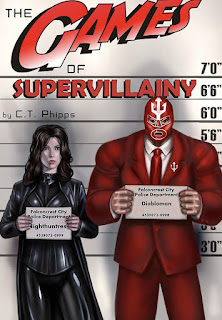
I had been aware of The Supervillainy Saga for a while. Several years ago, I listened to Confessions of a D-List Supervillain by Jim Bernheimer. The various books of The Supervillainy Saga were listed on the “You Might Also Like” section of Confessions of a D-List Supervillian’s page on Audible. The certainly did look intriguing. I’d like to take a moment to say that the covers for The Supervillainy Saga are absolutely amazing. Whoever designed them deserves a big raise. Though they looked intriguing, I felt I’d had my fill of superhero books for the moment, and moved on to other things. A few years passed, and I forgot about The Supervillainy Saga. Then, I shared my review SPR: Superhuman Public Radio. C.T. Phipps, author of the Supervillain Saga, saw my review of SPR and asked if I’d be interested in review the first three Supervillainy Saga books. I said yes, and here we are now.

C.T. Phipps gave me the audiobook for Volume 1 of The Supervillainy Saga. It contains the first three books of the series: The Rules of Supervillainy, The Games of Supervillainy, and The Secrets of Supervillainy. I’m going to review all three of them as a single unit in this review.

My initially impression was that I was rather reminded of Confessions of a D-List Supervillain. Both books involve first-person narrators, who are a bit of a smart-ass, who decide to go into supervillainy. Still, despite similar premises, they go in reasonably different directions. There’s enough differences in the execution to keep things interesting. And I suppose it is rather fitting, given that Supervillainy Saga is published with help from Jim Bernheimer.

One of the biggest differences is how the heroes and villains are presented. D-List Supervillain had a mostly original cast of characters without obvious inspiration. By contrast, most of the characters from Supervillainy Saga are clearly based upon preexisting comic book characters. Though, C.T. Phipps does mix and match various comic book heroes and villain to keep things interesting. I also want to clarify some terminology. When I say original, I mean characters that don’t have an obvious literary predecessor. It’s not meant as judgment of quality. Basing your own characters on preexisting ones isn’t an inherently bad thing. 


With all of that said, let’s get out our field guides and see how many we can spot. The world’s greatest hero is named Ultragod. He was just an normal African-American astronomer when he was imbued with cosmic energy known as the Ultraforce. He’s strong, he flies, he’s nearly invulnerable, and he can create energy constructs. So, basically Superman, but also with Green Lantern’s powers. The fact that he’s black and has Superman’s powers also brings Icon to mind. He has a daughter name Ultragoddess. She wears a nearly identical costume, but with a miniskirt rather than pants. Obviously, she’s Supergirl. The fact she’s Ultragod’s daughter brings to mind Superman & Batman: Generations. It was an Elseworld miniseries where the DC Universe progresses in real time. In it, Supergirl is Superman and Lois Lane’s daughter, rather than Superman’s cousin. Speaking of Lois Lane, Ultragod’s wife, civil right attorney Polly Pratchett, is a pretty clear stand-in for her. Tom Terror is a mad scientist who thinks Ultragod is nothing but trouble. That makes him the Lex Luthor analog, but he’s also a former Nazi, which brings Red Skull to mind.

Nightwalker is basically Batman, but with Specter’s powers and cloak. We later learn that there’s more than one Nightwalker cloak. One of these comes into possession of twenty-five year old Japanese-American woman. That makes her Batgirl, specifically Cassandra Cain, given that she’s Asian-American. Gary lost his brother to a gritty 1990s anti-hero named Shoot’em Up. He’s a former police officer who became a ruthless vigilante. In other words, basically Punisher. His name is also a reference to the song “Shoot’em Up” by Blue Stahli.

Most of the superheroes are part of the Society of Superheroes, which is like the Justice League, or maybe the Avengers. There’s a heroine named Guinevere. She’s a literal fairy princess warrior from the land of Avalon. She’s also known for her rather sexy costume, and forms a trinity of sorts with Ultragod and Nightwalker. All of this makes her Wonder Woman. There’s a minor character with a Robin Hood theme, which would make him Green Arrow. Backwoodsman is a like a stereotypically Canadian version of Wolverine. There’s also a Suicide Squad-esque special ops team of heroes and villains. One of its members, Red Schoolgirl, is like a straight-up villain version of Katana. Well, if she was also totally crazy, and cosplaying as Sailor Moon.

Etropicus is an evil space god like Darkseid and Thanos. There’s also a video game about the heroes turning evil. Clearly a stand-in for Injustice: Gods Among Us. Death is portrayed similarly to her depiction in Neil Gaiman’s Sandman series. She mentions having siblings who are clearly analogous to the other members of the Endless. Falconcrest City is Gotham, and is also Detroit in all but name. Atlas City is Metropolis, and is a nod to Atlas Comics, with merged with Timely Comics to form Marvel Comics. The streets of Falconcrest are named after famous comic book writers, such as Bob Kane and Bruce Timm.

There’s more, but we’d be here all day, and this has gone on for way too long. Time to move on. 


One thing I was surprised by is that, technically, The Supervillainy Saga is alternate history. Ultragod captured Hitler and Stalin and brought them to justice. Unfortunately, World War II still happened more or less like in our world. A villain named Phantom Leader, head of a HYDRA-esque organization, conquered most of Europe and Russia. Fortunately, the Allies still won. It’s also mentioned that there was a Second Vietnam War at some point. A robot named Android John become the first robot to be elected president in the 1990s. Despite of all this, the world is pretty much exactly the same as ours. Even the pop culture is almost identical. We know this because Gary seems, at times, incapable of going a chapter without making at least one pop culture reference. He also grumbles about how, despite all the magic and super science, nobody has cured cancer yet. This is all in keeping with comic books, which usually present a world more or less like our own, despite all the superheroes running around. Amusingly, Tom Terror has discovered an alternate universe completely devoid of superheroes and supervillains, but with near identical pop culture. In other words, he found our universe.

It’s also mentioned that the past itself is highly malleable and subject to change. Many things are really more suggestions than hard facts. This is a nod to the constantly shifting nature of comic book canon, and how the timeline gets shifted as the years move forward. We see that there is one universe where Gary is a plucky teenage reporter, and is best friends with Ultragod. This is clearly a reference to Superman’s Pal Jimmy Olson. Thought, I guess in this case it would be Ultragod’s Pal Gary Karkofsky. That particular universe is totally devoid of swearing, and is full of the casual sexism and racism that often plagued Silver Age comics.

I also noticed that there were quite a few references to the website TV Tropes. Gary will sometimes mention tropes by name. Other times, he will allude to the various tropes. It is eventually revealed that Gary is indeed an avid reader of TV Tropes. Before you ask, yes, the Supervillainy Saga does have its own TV Tropes page. There’s a page for the series as a whole, and each individual book also has its own page.

Now, let’s talk more in-depth about the characters. Gary is our snarky nerdy protagonist. Besides avenging his brother, he also dreams of turning the world into an anarcho-communist utopia. During college, he hacked into the college’s database to delete students’ debt. At the time, he was majoring in Unusual Criminology, which is basically Supervillainology. However, he had to drop out, and got a degree in history instead. It…was less than helpful when it came to finding a job. So, he turned to a life of crime. He claims that he was successful with women because he was charming and treated them with respect. Emphasis on claims. I’m just saying, even Gary’s saintly ex-girlfriend Gabrielle finds his near constant pop culture references to be extremely annoying after a while. Personally, I’m with Gabrielle on this one. Gary’s pop culture references weren’t too bad in the first couple books, but they reached a fever pitch by book three. At times, it felt like The Big Bang Theory on a bad day. It just felt like lazy writing after a certain point. It was like C.T. Phipps used the pop culture references as a crutch when he couldn’t think how to move a scene along.

There’s another scene where Gary angrily explains the theory of evolution, and debunks common misconception about how evolution works, to another supervillain. Now, the information is very good, and it can be argued that Gary did have a point about people’s misconceptions about evolution. However, it was also very clearly C.T. Phipps parking the plot so that he could monologue about his personal pet peeves. The scene just didn’t feel organic or natural, and the dialog was kind of tin-eared.

Then there’s the scene in book three where Gary robs a stock market, while dressed as a pirate, and spends the entire chapter monologging about the evils of capitalism. The writing and dialog were incredibly clunky. It felt like C.T. Phipps was using the scene to expound upon his personal political views. Thankfully, this was the only such scene in the entire collection. It just stood out more do to being paired with Gary at his worst pop culture referential. I’m not opposed to pop culture references, but I do prefer when it is done sparingly. 


Gabrielle is Gary’s ex-girlfriend. She’s good natured, easy going, incredibly beautiful, and shares Gary’s geeky interests. She also has the exact same facial features, voice, hair, and skin-tone as Ultragoddess. She also wears clothes that are gold and white, the same as Ultragoddess’ costume. Gary has never seen them in the same place, and Gabrielle often ran off right before Ultragoddess would appear. In case it wasn’t obvious, Gabrielle is Ultragoddess. She used her powers to keep Gary from connecting the dots. She broke up with him after he got kidnapped by one of her villains. Gabrielle’s mom, Polly Pratchett, got captured numerous times over the years, and that really got to Gabrielle. Polly also got killed a few times, but the Society of Superheroes has numerous means to restore the dead back to life. 

So, it was only a minor inconvenience, but it effected how Gabrielle approached relationships. Gabrielle is described as being Afro-Hispanic, and her general description brings Rosario Dawson to mind. The cover art does bare this out. Gary is in a loving relationship with his wife Mandy, but he still think about Gabrielle, and still has feeling for her. In fact, when he first meets Death, she appears to him as Mandy’s head on Gabrielle’s body.

Gary’s parents hoped that he would settle down with a nice Jewish girl someday. Instead, he married a bisexual half-Korean Wiccan gentile. Then again, Gary’s parents also didn’t want him to become a supervillain, and look how that turned out. Mandy seems to have almost exclusively dated women before marrying Gary. I liked that she was portrayed as a realistic example of a Wiccan. She doesn’t get any magical powers from Wicca, it is simply the religion that she follows. Though, it is mentioned that there are some Wiccans with magic powers, but they’re considered separate from religious Wiccans. Magik is considered a form of concentrated prayer in real Wicca. The K at the end is deliberate, so as to distinguish it from the concept of magic, as in the supernatural.

Gary’s childhood friend Cindy is a supervillain in a sexy Little Red Riding Hood costume. She was training as a doctor before turning to supervillainy. She had to deal with serious student loan, much like Gary. She wears her hair in pigtails, is very zany and energetic, and speaks in a New Jersey accent despite living in Michigan. Obviously, she’s the Harley Quinn analog. She later switches to a more conservative costume. The way it is described reminds me of Ruby Rose’s season 1-3 outfit on RWBY, but that might have been unintentional. There’s not really much to Cindy. She’s more of a comic relief character. She worked as a hench-wench for various supervillains before she joined Gary. Though, she prefer the gender-neutral term hench-person, as she finds it less demeaning. Cindy also refers to her self as looking like a cross between Sarah Michelle Gellar and Alyson Hannigan because of her strawberry blonde hair. Uh, Cindy, you know they’re both brunettes in real life, right?

Adonis from Greek Mythology is still active in the modern world as the supervillain Bright Eyes. It seems that C.T. Phipps got him mixed up with Narcissus, as Gary incorrectly claims that Adonis is the one who originated the term narcissism. Like, it’s right there in the name, just saying. Adonis also refers to himself as devoted to Aphrodite, but there’s nary a mention that he’s also devoted to Persephone. Aphrodite got him during the summer months, and Persephone got him in the winter months. However, C.T. Phipps tells me this is all deliberate, and apparently, the original idea for Adonis was even less accurate to the mythology. Adonis was going to be a son of Zeus. This is an homage to how some mythology inspired comics, like Wonder Woman and Thor, play fast and loose with mythological accuracy. However, C.T. Phipps’ editor vetoed the idea specifically due to it being untrue to Greek Mythology. 

Often, comics inspired by mythology will get basic things about mythology wrong. For example, Loki was Odin’s blood brother, not Thor’s adopted brother. Gary doesn’t like Adonis on principle. I’m not sure if that’s a reference to the Maccabean Revolt, or the general “don’t fool around with pagan gods” rule of Judaism. I’m going with the former. Gary, by his own admission, isn’t terribly devout. And let’s not forget that he did knowingly marry a Wiccan. 

Diabloman is a former big time supervillain, but he’s been forced to work as Gary’s villainous mentor. He was raised in a Satanic cult, but he’s a surprisingly nice guy. He wears a luchador mask and a red business suit. The final member of the core cast is the spirit within Gary’s cloak. He’s not to thrilled about having to team-up with a supervillain, but he doesn’t have much choice. And hey, he does eventually warm up to Gary. I won’t tell you who Cloak is, but I will say it wasn’t hard to figure out. In fact, you might very well have pieced it together yourself.

We have a colorful cast of characters, but I wonder if perhaps they needed more time to shine. That is, maybe the series should have taken an anthology approach, rather than having Gary be the protagonist of every book. How might book two and three have looked from Mandy or Gabrielle’s perspectives? For that matter, how would they look from Cloak’s point-of-view? Or what if we had one of the numerous memorable minor characters take center stage? I think the books might have benefited from having more points of view than just Gary.

Though even keeping Gary as the view point character is a source of missed opportunities. Gary time travels to kill Nazis and Hitler, but we never witness with happen on-screen, for want of a better term. Time traveling to kill Nazis? Sounds like a fun time to me. If you’re wondering, time travel can’t change the past. All Gary did, as a result of his time travel shenanigans, was create parallel timelines.

Obviously, I’m also going to take a moment to talk about the audiobook. The audiobooks are narrated by Jeffery Kafer. His narration overall wasn’t bad, I’ve certainly seen worse. That said, I also felt there was room for improvement. He does a really good job performing as Gary, but he makes the other characters sound rather interchangeable. This is most obvious in the first book. Among other things, Diabloman has no trace of the Mexican accent he ought to have. He does get a bit better in books two and three, but there was still room for improvement. I will say that Jeffery’s weaknesses as a narrator are hardly unique to him. I once listened to an audiobook of Huckleberry Finn, narrated by Elijah Wood, that has similar issues; despite Wood’s excellent performance as the title character. As did the audiobook of Tom Sawyer which was narrated by Nick Offerman.

Okay, so what’s the verdict on The Supervillainy Saga, Volume 1? Was it high art in any sense of the word? No, it most certainly not. Did it have it’s share of flaws? Yeah, I would say so. Was a reasonably entertaining? Yes. Was it a fun and enjoyable popcorn book? Also yes.

The Supervillainy Saga might not be revolutionary, but it has its charms. If you’re looking for some fun superhero books that don’t take themselves too seriously, then you might want to give it a try. It does deconstruct superheroes to an extent, but it never comes across as mean-spirited, or dark and gritty for the sake of being dark and gritty. You can really tell that C.T. Phipps genuinely does love superheroes and comic books. So, he used that love to make the Supervillainy Saga. If all of this sounds appealing to you, then give the Supervillainy Saga a try.

Well, I think that should do it from me for now. I will see you guys next time.