Showing posts with label C.T. Phipps. Show all posts

Monday, May 23, 2022

Book Review: Space Academy Dropouts by C.T. Phipps and Michael Suttkus

I'm more than willing to review any works of audio fiction that are requested. However, as I have stated many times before, I maintain a policy of strict honesty. Where there are things worthy of praise, I shall give praise. However, if anything doesn't work I will not hesitate to call it out. With all of that having been said, this brings us to the book that we're going to be reviewing today. We're taking a look at Space Academy Dropouts by C.T. Phipps and Michael Suttkus. 


Space Academy Dropouts takes places 300 years in the future. Humanity has taken to the stars and spread to countless worlds across the galaxy. Vance Turbo is a member of Space Fleet Academy. His Aunt Cathy is one of the galaxy’s greatest heroes, and Vance has much to measure up to. However, Vance has grown disillusioned with Space Fleet, and is doing what he can to get expelled from the academy. Ah, but fate has other plans for him. Vance is assigned to a highly classified mission into Neutral Space. A shipment of Sun Killer bombs has gone missing, and The Community need to covertly recover them. That is where Vance and his fellow misfits come in.

I had previously reviewed volume one of The Supervillainy Saga at the request of C.T. Phipps. He asked me if I’d be willing to review Space Academy Dropouts. I said yes, and here we are.

This is a C.T. Phipps books, so of course there’s going to be a lot of pop culture references. The biggest one is that Space Academy Dropout is one big Star Trek pastiche/homage, with a bit of Guardians of the Galaxy Thrown in. We’ve got an interplanetary federation that outwardly presents itself as utopian, and advocates for cross-cultural cooperation and understanding. There is an academy that trains cadets to explore strange new worlds, and boldly go where no one has gone before. Space Fleet is an obvious stand-in for Star Fleet. The Notha Empire oppose the Alliance, and build their society around uber-militarism and authoritarianism. This makes them stand-ins for the Klingons, but only in terms of function within the plot. Physically, the Notha look like a cross between lemurs and badgers. Though, their worldview isn’t too dissimilar to that of the Daleks from Doctor Who. Vance passed a supposedly unbeatable simulation test by hacking the simulation. This is a reference to how Captain Kirk beat the Kobayashi Maru simulation.

However, Star Trek isn’t the only source of pop culture references. Aunt Cathy’s physical description bares more than a passing resemblance to Honor Harrington, from the series of the same name. It is mentioned that Cathy once saved a planet named F-Sharp Bell. This a reference to the Green Lantern comics. One of the Lanterns is from a part of the universe that is totally devoid of light. So, they believe themselves to be part of the F-Sharp Bell Corps, because I guess that’s as close to the color green as they can imagine. There’s mention of a popular television series called Space Cadet Sally. It is aimed at adolescent girls, but is quite popular with men, to the point you can buy Space Cadet Sally sexbots. There’s some influences of My Little Pony: Friendship is Magic, and the Brony fandom. Sally’s catch praise is “Friendship is Space Fleet.” However, the main heroine getting sexualized by the fandom brings shades of Sailor Moon.

Some humans dislike the Community, and have struck out to found their own colonies in Neutral Space. Many of these colonies evoke the old west with their supposed rugged individualism. However, they’re also home to many extremist ideologies. You’ve got Neo-Confederates, Neo-Nazis, Neo-Apartheid Afrikaners, and Anarcho-Capitalist Libertarians, among other things. These lunatics loosely identify themselves as Independents. This is a reference to Firefly, and how Joss Whedon got the inspiration for Firefly after reading a book about Confederate veterans in the Old West. Granted, Firefly was actually pretty apolitical overall. Yeah, there is some anti-government messages, but that’s because it is part of Mal’s character. He’s a bitter former solider who fought against a government he considers evil…hmm. Well, actually, when you put it like that, it does kind of sound like the sort of thing Lost Causers would say. So, I guess you could see the Independents as a deconstruction of the Confederate subtext within Firefly.

Though, I still maintain that the lack of Asian characters with speaking roles was a far bigger problem for Firefly. And I say this as someone who is a huge Firefly fan. It never made sense from a worldbuilding perspective. Chinese influence is everywhere from language, to clothing, to entertainment, but where are all the Chinese people?

Most of the aliens are genuinely alien. Most of the humanoid characters are descended from humans who were subjected to genetic tinkering. Apparently, the Ancient Aliens people were right all along. Advanced aliens came to Earth in ancient times, abducted humans, and seeded them on other planets. These lost colonies consider Earth important from a historical perspective, but tend to look down on Earth humans. The planet Albion is one such seeded world. Based on the name, it’s humans must have come from Medieval England. There’s a point where it is mentioned they were founded 1000 years ago, but then it say they’re celebrating Centennial, which is a 100 year anniversary. Apparently, the Centennial was the celebration of Albion’s independence from the Elder Races, so that wasn’t a typo. Albion has a royal family, who conspiracy theorists claim are space lizards. So, yeah, that just makes it even clearer that they are Space Britain. Albion even somehow created their own version of the Star Trek television show, but Vance considers their version inferior.

The planet Thor is another seeded world. Thorians look like humans with blue skin. There’s a Thorian on Vance’s team, and he is somehow Jewish. Well, blue is a color traditionally associated with Judaism. There’s a lot of franchises that use the concept of aliens abducting humans and then seeded them on other planets. However, the one that sprang to my mind was Stargate. There’s another race of seeded humans called Etherials. They are basically space elves, and their Elder Race was actually nice to them, unlike the Elder Races of most other seeded humans. The Etherials are an obvious reference to The Eternals.

There’s also mention of a channel called The Geology Channel. Unfortunately, they hardly ever play anything relating to geology anymore. These days, its all reality shows and conspiracy theory shows. Obviously, this is a reference to channels like Discovery Channel and History Channel that have largely abandoned their original educational content. Such is life. On the other hand, considering that Ancient Aliens turned out to be correct, perhaps Vance shouldn’t be so quick to dismiss the conspiracy theory shows.

Okay, enough with the reference hunting. I’ve been putting this off for as long as I can, so I’ll get straight to the point. When I reviewed The Supervillainy Saga, I said that I liked it, but I felt that I got my fill. I bring this up because Space Academy Dropouts is basically just The Supervillainy Saga in Space. Let’s see, our main character gets in trouble by hacking into his university database. He’s very snarky, and very knowledgeable about pop culture. In fact, at times he practically speaks in nothing but pop culture references. Despite being dorky, and not all that special, numerous women are lining up to have sex with him. Well, they do rib him and poke fun at him, but they still want to have sex with him. Yeah, Vance is pretty much just Gary Karkofsky, but as a space cadet rather than a supervillain.

The pop culture references also got very grating. As I noted when I review The Supervillainy Saga, C.T. Phipps has a bad habit of going way overboard with pop culture references. It felt like, whenever he couldn’t think of how to move a scene along, he’d insert another pop culture reference. Moreover, as the filmography of Aaron Seltzer and Jason Friedberg demonstrates, pop culture references alone do not a plot make. They also didn’t make any sense. Space Academy Dropouts is set 300 years in the future, but Vance in obsessed with pop culture from the 20th and 21st Century. That would be like someone from the present day being obsessed with pop culture from the 18th Century.

As for the supporting cast, well, I don’t really have much to say. They range from one-note to, at best, two-dimensional. You got the horny robot girl, the blue Jewish guy, the literal-minded space lizard, the wise space elf, the cute and sexy catgirl, and the snarky scientist. I know it sounds like I’m being a jerk, but that really does encapsulate their entire personalities. I feel that the cast was too big, and as a result, none of the characters got properly fleshed out.

Well, there was one character who stood-out. Vance’s former girlfriend Leah is a snarky Eurasian woman who is described as cute, and wears thigh-length boots. So, basically Mandy from The Supervillainy Saga. You know, come to think of it, in retrospect, the characters from The Supervillainy Saga weren’t all that fleshed-out wither. The main difference is that, since the characters from Supervillainy Saga are based on preexisting characters, my mind kind of filled in the blanks. So, it was less noticeable in their case. In Space Academy Dropouts, however, the characters don’t have any preexisting templates, so their lack of depth is more readily apparent.

I didn’t want a rehash of The Supervillainy Saga, I wanted something different. Any differences that Space Academy Rejects has are ultimately purely aesthetic and only skin-deep, if that. This made Space Academy Rejects have a very cookie cutter feel to it.

There’s a lot of interesting ideas in this book, but they aren’t explored as much as they could be. One of the planets in Neutral Space is called Rand’s World. It is a planet founded on the principles and teaching of Ayn Rand. It even has its own Galt’s Gulch. Just what would a world founded on Objectivist ideas be like? Perhaps it could be deconstructed along the lines of what Bioshock did. Science fiction is the literature of big ideas. Unfortunately, the authors mostly just take potshots at their political opponents, and don’t provide any interesting insights. Their critique, if you can call it that, basically amounts to “LOL! Libertarians are a bunch of inbred, low IQ, redneck hick freaks!”

The concept of humans being seeded on alien planets is also interesting. What time periods and cultures do they come from? What are their cultures like? In what ways do they differ from Earth humans? What was their technological and scientific progress like? How does their religion work? In fact, what is their history in general? Well, beyond a few tantalizing off-hand remarks, we get no answers.

The voice in Space Academy Dropouts is very similar to that The Supervillainy Saga. Not just in that it is told in first-person, and Vance is pretty much Gary in all but name. You see, Jeffery Kafer returns as narrator for the audiobook of Space Academy Dropouts. He has previously narrated The Supervillainy Saga. Unfortunately, that made the similarities to The Supervillainy Saga all the more glaring. At times I had to reminds myself that I wasn’t listening to get another entry in The Supervillainy Saga.

Ultimately, your enjoyment of Space Academy Dropouts will come down to if you enjoy The Supervillainy Saga, and if you want more of the same. I did not want more of the same, so I was rather disappointed. But perhaps you will feel differently.

So, there you have it. Space Academy Dropouts aims for the stars, but crashes and burns on the launch pad. I didn’t care for it, but perhaps you’ll feel differently.

Well, I think that should do it from me for now. I will see you guys next time.

Friday, February 18, 2022

Book Review: The Supervillainy Saga, Volume 1 by C.T. Phipps

I have been asked to review audio dramas on numerous occasions. Less frequently, I’ve also been asked to review audiobooks. I’m always happy to oblige those who ask. Today’s review is one of the latter scenarios. We’re taking a look at The Supervillainy Saga, Volume 1 by C.T. Phipps. 


Gary Karkofsky lives in a world very much like ours, but filled with superheroes and supervillains. Gary has wanted to be a supervillain ever since his brother, the villain Stingray, was killed a gritty anti-hero in the 1990s. Fortunately, he’s recently come into possession of a cloak that used to belong to Nightwalker, the greatest hero of Falconcrest City. Gary now has access to all of Nightwalker’s power, and has big plans to become a new villain: Merciless, the Villain Without Mercy (TM). There’s plenty of action, adventure, laughs, and pop culture references as Gary tries, and frequently fails, to be the greatest supervillain the world has ever known. Look out world, this is the start of Gary’s supervillainy saga.

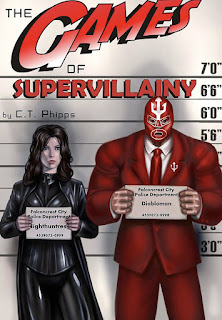
I had been aware of The Supervillainy Saga for a while. Several years ago, I listened to Confessions of a D-List Supervillain by Jim Bernheimer. The various books of The Supervillainy Saga were listed on the “You Might Also Like” section of Confessions of a D-List Supervillian’s page on Audible. The certainly did look intriguing. I’d like to take a moment to say that the covers for The Supervillainy Saga are absolutely amazing. Whoever designed them deserves a big raise. Though they looked intriguing, I felt I’d had my fill of superhero books for the moment, and moved on to other things. A few years passed, and I forgot about The Supervillainy Saga. Then, I shared my review SPR: Superhuman Public Radio. C.T. Phipps, author of the Supervillain Saga, saw my review of SPR and asked if I’d be interested in review the first three Supervillainy Saga books. I said yes, and here we are now.

C.T. Phipps gave me the audiobook for Volume 1 of The Supervillainy Saga. It contains the first three books of the series: The Rules of Supervillainy, The Games of Supervillainy, and The Secrets of Supervillainy. I’m going to review all three of them as a single unit in this review.

My initially impression was that I was rather reminded of Confessions of a D-List Supervillain. Both books involve first-person narrators, who are a bit of a smart-ass, who decide to go into supervillainy. Still, despite similar premises, they go in reasonably different directions. There’s enough differences in the execution to keep things interesting. And I suppose it is rather fitting, given that Supervillainy Saga is published with help from Jim Bernheimer.

One of the biggest differences is how the heroes and villains are presented. D-List Supervillain had a mostly original cast of characters without obvious inspiration. By contrast, most of the characters from Supervillainy Saga are clearly based upon preexisting comic book characters. Though, C.T. Phipps does mix and match various comic book heroes and villain to keep things interesting. I also want to clarify some terminology. When I say original, I mean characters that don’t have an obvious literary predecessor. It’s not meant as judgment of quality. Basing your own characters on preexisting ones isn’t an inherently bad thing. 


With all of that said, let’s get out our field guides and see how many we can spot. The world’s greatest hero is named Ultragod. He was just an normal African-American astronomer when he was imbued with cosmic energy known as the Ultraforce. He’s strong, he flies, he’s nearly invulnerable, and he can create energy constructs. So, basically Superman, but also with Green Lantern’s powers. The fact that he’s black and has Superman’s powers also brings Icon to mind. He has a daughter name Ultragoddess. She wears a nearly identical costume, but with a miniskirt rather than pants. Obviously, she’s Supergirl. The fact she’s Ultragod’s daughter brings to mind Superman & Batman: Generations. It was an Elseworld miniseries where the DC Universe progresses in real time. In it, Supergirl is Superman and Lois Lane’s daughter, rather than Superman’s cousin. Speaking of Lois Lane, Ultragod’s wife, civil right attorney Polly Pratchett, is a pretty clear stand-in for her. Tom Terror is a mad scientist who thinks Ultragod is nothing but trouble. That makes him the Lex Luthor analog, but he’s also a former Nazi, which brings Red Skull to mind.

Nightwalker is basically Batman, but with Specter’s powers and cloak. We later learn that there’s more than one Nightwalker cloak. One of these comes into possession of twenty-five year old Japanese-American woman. That makes her Batgirl, specifically Cassandra Cain, given that she’s Asian-American. Gary lost his brother to a gritty 1990s anti-hero named Shoot’em Up. He’s a former police officer who became a ruthless vigilante. In other words, basically Punisher. His name is also a reference to the song “Shoot’em Up” by Blue Stahli.

Most of the superheroes are part of the Society of Superheroes, which is like the Justice League, or maybe the Avengers. There’s a heroine named Guinevere. She’s a literal fairy princess warrior from the land of Avalon. She’s also known for her rather sexy costume, and forms a trinity of sorts with Ultragod and Nightwalker. All of this makes her Wonder Woman. There’s a minor character with a Robin Hood theme, which would make him Green Arrow. Backwoodsman is a like a stereotypically Canadian version of Wolverine. There’s also a Suicide Squad-esque special ops team of heroes and villains. One of its members, Red Schoolgirl, is like a straight-up villain version of Katana. Well, if she was also totally crazy, and cosplaying as Sailor Moon.

Etropicus is an evil space god like Darkseid and Thanos. There’s also a video game about the heroes turning evil. Clearly a stand-in for Injustice: Gods Among Us. Death is portrayed similarly to her depiction in Neil Gaiman’s Sandman series. She mentions having siblings who are clearly analogous to the other members of the Endless. Falconcrest City is Gotham, and is also Detroit in all but name. Atlas City is Metropolis, and is a nod to Atlas Comics, with merged with Timely Comics to form Marvel Comics. The streets of Falconcrest are named after famous comic book writers, such as Bob Kane and Bruce Timm.

There’s more, but we’d be here all day, and this has gone on for way too long. Time to move on. 


One thing I was surprised by is that, technically, The Supervillainy Saga is alternate history. Ultragod captured Hitler and Stalin and brought them to justice. Unfortunately, World War II still happened more or less like in our world. A villain named Phantom Leader, head of a HYDRA-esque organization, conquered most of Europe and Russia. Fortunately, the Allies still won. It’s also mentioned that there was a Second Vietnam War at some point. A robot named Android John become the first robot to be elected president in the 1990s. Despite of all this, the world is pretty much exactly the same as ours. Even the pop culture is almost identical. We know this because Gary seems, at times, incapable of going a chapter without making at least one pop culture reference. He also grumbles about how, despite all the magic and super science, nobody has cured cancer yet. This is all in keeping with comic books, which usually present a world more or less like our own, despite all the superheroes running around. Amusingly, Tom Terror has discovered an alternate universe completely devoid of superheroes and supervillains, but with near identical pop culture. In other words, he found our universe.

It’s also mentioned that the past itself is highly malleable and subject to change. Many things are really more suggestions than hard facts. This is a nod to the constantly shifting nature of comic book canon, and how the timeline gets shifted as the years move forward. We see that there is one universe where Gary is a plucky teenage reporter, and is best friends with Ultragod. This is clearly a reference to Superman’s Pal Jimmy Olson. Thought, I guess in this case it would be Ultragod’s Pal Gary Karkofsky. That particular universe is totally devoid of swearing, and is full of the casual sexism and racism that often plagued Silver Age comics.

I also noticed that there were quite a few references to the website TV Tropes. Gary will sometimes mention tropes by name. Other times, he will allude to the various tropes. It is eventually revealed that Gary is indeed an avid reader of TV Tropes. Before you ask, yes, the Supervillainy Saga does have its own TV Tropes page. There’s a page for the series as a whole, and each individual book also has its own page.

Now, let’s talk more in-depth about the characters. Gary is our snarky nerdy protagonist. Besides avenging his brother, he also dreams of turning the world into an anarcho-communist utopia. During college, he hacked into the college’s database to delete students’ debt. At the time, he was majoring in Unusual Criminology, which is basically Supervillainology. However, he had to drop out, and got a degree in history instead. It…was less than helpful when it came to finding a job. So, he turned to a life of crime. He claims that he was successful with women because he was charming and treated them with respect. Emphasis on claims. I’m just saying, even Gary’s saintly ex-girlfriend Gabrielle finds his near constant pop culture references to be extremely annoying after a while. Personally, I’m with Gabrielle on this one. Gary’s pop culture references weren’t too bad in the first couple books, but they reached a fever pitch by book three. At times, it felt like The Big Bang Theory on a bad day. It just felt like lazy writing after a certain point. It was like C.T. Phipps used the pop culture references as a crutch when he couldn’t think how to move a scene along.

There’s another scene where Gary angrily explains the theory of evolution, and debunks common misconception about how evolution works, to another supervillain. Now, the information is very good, and it can be argued that Gary did have a point about people’s misconceptions about evolution. However, it was also very clearly C.T. Phipps parking the plot so that he could monologue about his personal pet peeves. The scene just didn’t feel organic or natural, and the dialog was kind of tin-eared.

Then there’s the scene in book three where Gary robs a stock market, while dressed as a pirate, and spends the entire chapter monologging about the evils of capitalism. The writing and dialog were incredibly clunky. It felt like C.T. Phipps was using the scene to expound upon his personal political views. Thankfully, this was the only such scene in the entire collection. It just stood out more do to being paired with Gary at his worst pop culture referential. I’m not opposed to pop culture references, but I do prefer when it is done sparingly. 


Gabrielle is Gary’s ex-girlfriend. She’s good natured, easy going, incredibly beautiful, and shares Gary’s geeky interests. She also has the exact same facial features, voice, hair, and skin-tone as Ultragoddess. She also wears clothes that are gold and white, the same as Ultragoddess’ costume. Gary has never seen them in the same place, and Gabrielle often ran off right before Ultragoddess would appear. In case it wasn’t obvious, Gabrielle is Ultragoddess. She used her powers to keep Gary from connecting the dots. She broke up with him after he got kidnapped by one of her villains. Gabrielle’s mom, Polly Pratchett, got captured numerous times over the years, and that really got to Gabrielle. Polly also got killed a few times, but the Society of Superheroes has numerous means to restore the dead back to life. 

So, it was only a minor inconvenience, but it effected how Gabrielle approached relationships. Gabrielle is described as being Afro-Hispanic, and her general description brings Rosario Dawson to mind. The cover art does bare this out. Gary is in a loving relationship with his wife Mandy, but he still think about Gabrielle, and still has feeling for her. In fact, when he first meets Death, she appears to him as Mandy’s head on Gabrielle’s body.

Gary’s parents hoped that he would settle down with a nice Jewish girl someday. Instead, he married a bisexual half-Korean Wiccan gentile. Then again, Gary’s parents also didn’t want him to become a supervillain, and look how that turned out. Mandy seems to have almost exclusively dated women before marrying Gary. I liked that she was portrayed as a realistic example of a Wiccan. She doesn’t get any magical powers from Wicca, it is simply the religion that she follows. Though, it is mentioned that there are some Wiccans with magic powers, but they’re considered separate from religious Wiccans. Magik is considered a form of concentrated prayer in real Wicca. The K at the end is deliberate, so as to distinguish it from the concept of magic, as in the supernatural.

Gary’s childhood friend Cindy is a supervillain in a sexy Little Red Riding Hood costume. She was training as a doctor before turning to supervillainy. She had to deal with serious student loan, much like Gary. She wears her hair in pigtails, is very zany and energetic, and speaks in a New Jersey accent despite living in Michigan. Obviously, she’s the Harley Quinn analog. She later switches to a more conservative costume. The way it is described reminds me of Ruby Rose’s season 1-3 outfit on RWBY, but that might have been unintentional. There’s not really much to Cindy. She’s more of a comic relief character. She worked as a hench-wench for various supervillains before she joined Gary. Though, she prefer the gender-neutral term hench-person, as she finds it less demeaning. Cindy also refers to her self as looking like a cross between Sarah Michelle Gellar and Alyson Hannigan because of her strawberry blonde hair. Uh, Cindy, you know they’re both brunettes in real life, right?

Adonis from Greek Mythology is still active in the modern world as the supervillain Bright Eyes. It seems that C.T. Phipps got him mixed up with Narcissus, as Gary incorrectly claims that Adonis is the one who originated the term narcissism. Like, it’s right there in the name, just saying. Adonis also refers to himself as devoted to Aphrodite, but there’s nary a mention that he’s also devoted to Persephone. Aphrodite got him during the summer months, and Persephone got him in the winter months. However, C.T. Phipps tells me this is all deliberate, and apparently, the original idea for Adonis was even less accurate to the mythology. Adonis was going to be a son of Zeus. This is an homage to how some mythology inspired comics, like Wonder Woman and Thor, play fast and loose with mythological accuracy. However, C.T. Phipps’ editor vetoed the idea specifically due to it being untrue to Greek Mythology. 

Often, comics inspired by mythology will get basic things about mythology wrong. For example, Loki was Odin’s blood brother, not Thor’s adopted brother. Gary doesn’t like Adonis on principle. I’m not sure if that’s a reference to the Maccabean Revolt, or the general “don’t fool around with pagan gods” rule of Judaism. I’m going with the former. Gary, by his own admission, isn’t terribly devout. And let’s not forget that he did knowingly marry a Wiccan. 

Diabloman is a former big time supervillain, but he’s been forced to work as Gary’s villainous mentor. He was raised in a Satanic cult, but he’s a surprisingly nice guy. He wears a luchador mask and a red business suit. The final member of the core cast is the spirit within Gary’s cloak. He’s not to thrilled about having to team-up with a supervillain, but he doesn’t have much choice. And hey, he does eventually warm up to Gary. I won’t tell you who Cloak is, but I will say it wasn’t hard to figure out. In fact, you might very well have pieced it together yourself.

We have a colorful cast of characters, but I wonder if perhaps they needed more time to shine. That is, maybe the series should have taken an anthology approach, rather than having Gary be the protagonist of every book. How might book two and three have looked from Mandy or Gabrielle’s perspectives? For that matter, how would they look from Cloak’s point-of-view? Or what if we had one of the numerous memorable minor characters take center stage? I think the books might have benefited from having more points of view than just Gary.

Though even keeping Gary as the view point character is a source of missed opportunities. Gary time travels to kill Nazis and Hitler, but we never witness with happen on-screen, for want of a better term. Time traveling to kill Nazis? Sounds like a fun time to me. If you’re wondering, time travel can’t change the past. All Gary did, as a result of his time travel shenanigans, was create parallel timelines.

Obviously, I’m also going to take a moment to talk about the audiobook. The audiobooks are narrated by Jeffery Kafer. His narration overall wasn’t bad, I’ve certainly seen worse. That said, I also felt there was room for improvement. He does a really good job performing as Gary, but he makes the other characters sound rather interchangeable. This is most obvious in the first book. Among other things, Diabloman has no trace of the Mexican accent he ought to have. He does get a bit better in books two and three, but there was still room for improvement. I will say that Jeffery’s weaknesses as a narrator are hardly unique to him. I once listened to an audiobook of Huckleberry Finn, narrated by Elijah Wood, that has similar issues; despite Wood’s excellent performance as the title character. As did the audiobook of Tom Sawyer which was narrated by Nick Offerman.

Okay, so what’s the verdict on The Supervillainy Saga, Volume 1? Was it high art in any sense of the word? No, it most certainly not. Did it have it’s share of flaws? Yeah, I would say so. Was a reasonably entertaining? Yes. Was it a fun and enjoyable popcorn book? Also yes.

The Supervillainy Saga might not be revolutionary, but it has its charms. If you’re looking for some fun superhero books that don’t take themselves too seriously, then you might want to give it a try. It does deconstruct superheroes to an extent, but it never comes across as mean-spirited, or dark and gritty for the sake of being dark and gritty. You can really tell that C.T. Phipps genuinely does love superheroes and comic books. So, he used that love to make the Supervillainy Saga. If all of this sounds appealing to you, then give the Supervillainy Saga a try.

Well, I think that should do it from me for now. I will see you guys next time.