Showing posts with label audiobook review. Show all posts

Tuesday, April 11, 2023

The Alt-Hist File: Cthulhu in the Deep South by Kirk Battle

The world of audio fiction podcasts has gone through many changes over the years. The mid-2000s brought us short story podcasts such as Escape Pod, The Drabblecast, and Lightspeed Magazine. By the 2010s, the audio drama boom was in full swing, and isn’t showing any signs of slowing down. Earlier than either, however, were podiobooks. Podiobooks, as their name suggests, were serialized audiobooks made available as podcasts. Podiobooks aren’t as common these days, but you do see some new ones pop up from time to time. Such is the case with the podiobooks we’ll be reviewing today. We’re taking a look at Cthulhu in the Deep South by Kirk Battle.


Cthulhu in the Deep South is a series of books set in South Carolina between the 1830s and 1860s. Usually, the action is set in or around Charleston, but two mysterious islands, named Ryland and Carcosa, also play a major role in the plot. Another common thread is people from New England, more specifically Arkham, finding themselves in South Carolina. But above all, the core of the series is the way that the creatures of H.P. Lovecraft combine with real world historical events to produce some fine historical horror.

Okay, so I think I ought to be upfront about a few things before we move forward. Many of you come here for my audio drama reviews. However, Cthulhu in the Deep South is a podiobook. It is like a standard audiobook; no bells and whistles beyond that. I listen to a lot of audiobooks, so I’m good with that. But I know some people feel differently, some I’m giving you all the info upfront. If that sounds good to you, let’s press on. I should also note that all six books of Cthulhu in the Deep South are also available as eBooks

I was approached by Kirk Battle to review Cthulhu in the Deep South after he saw my review of Modes of Thought in Anterran Literature. Each season of Cthulhu in the Deep South is a book in the series. I’ll give general thoughts and remarks before we get into each individual book. I liked the way that Kirk Battle incorporates actual history into the story. Kirk includes a bonus episode at the end of each season. In the bonus episodes, he explains his thought process when crafting each book. Naturally, he talks about which works of H.P. Lovecraft he draws upon. However, he also talks about which primary historical sources he uses. He will also spends quite a bit of time discussing what those primary sources are, and what they’re about. As someone with a history degree, I very much appreciate all of this.

Okay, so let’s get into the individual stories. Book one begins in the 1830s. It follows a man from Arkham, Massachusetts. He was part of an ice harvesting crew. The crew have collected their ice from the Arctic, and now they’re bound for balmy South Carolina to sell the ice. However, strange things begin to happen. Our protagonist begins to wonder if, perhaps, the crew has brought more than just ice with them. Things get even stranger when our protagonist finds himself on a pair of twin islands, located just off the South Carolina coast, called Ryland and Carcosa. They are a strange otherworldly place where White planters seem to take orders from their own slaves. There is something strange about the people of Ryland and Carcosa. Almost as if they aren’t exactly human.

Okay, so Cthulhu in the Deep South starts out strong. Out of all the books in the series, this is the one that comes closest to mimicking Lovecraft’s writing style, and the general feel of a Lovecraft story. I don’t mean that as a slight against the other books in the series. Kirk Battle has stated that he wanted each of the books to have their own style, and to play into other genres. Overall, I would say he succeeded in that goal. But all of that is to say that the genre for the first book is straight Lovecraft.

That being said, and as previously noted, Kirk Battle also included quite a bit of historical research into this one. One detail is that a lot of the crew of the ice harvester are Black. A lot of free Blacks did indeed find work on sailing ships. Quite a few whaling ships had predominantly Black crews. I also liked the details the bonus episode gave about the history of ice selling. I’m alway fascinated how people were able to preserve ice in the days before refrigeration. Apparently, ice water wasn’t then instant hit you might think it would be. A lot of people didn’t like that it made their teeth hurt, and others were worried that ice water would be dirty. To be fair, that latter concern probably wasn’t totally unfounded. Not that room temperature water was much better, mind you. Still, ice salesmen often had to pay people to give ice water a try, and to sing its praises. A little underhanded, perhaps, be it certainly bore fruit in the long run.

Book one poses a question that crops up a lot throughout Cthulhu in the Deep South. That question is this: at what point is turning a blind eye towards something horrible the same as being complacent in it? Our protagonist comes from an abolitionist family, and considers himself on as well. However, he clearly holds deeply racist views of Blacks. True, he doesn’t own any slaves himself. However, he doesn’t really do much to oppose slavery, beyond some hollow words. This is, sadly, not to far removed from actual history. Many abolitionists were opposed to slavery on philosophical grounds. However, this didn’t mean they believed Blacks should be equal to Whites. The number of people who did was comparatively small. Many abolitionists proposed sending Blacks back to Africa. The nation of Liberia was the results of such attempts.

Okay, history is all well and good, but what about the Lovecraft? Book one takes inspiration from “The Shadow Out of Time.” So, unsurprisingly, the inhabitants of Ryland are members of the Great Race of Yith. I always thought that “The Shadow Out of Time” was one of the more underrated stories from the Lovecraft Mythos. I loved the way all of the different authors put their own signature styles into the story. I have also found the Great Race of Yith to be underrated, as far as Lovecraft creatures. It is mentioned briefly, but our protagonist attended Miskatonic University, which frequently pops-up in the works of Lovecraft.

There were a few minor anachronisms. For example, at one point, one of the Yith makes reference to dinosaurs and genetics. The term dinosaur didn’t come into common use until 1842, and Gregor Mendel was still a kid in the 1830s. Granted, the Yith are time travelers, but the protagonist should have been tripped up by such terms. Still, just a minor instance that I noticed. Overall, the historical research was extremely well-done.

Cthulhu in the Deep South comes out of the gate with a strong first book. Let’s see if it can mainline that momentum.

Book two takes place in Charleston, South Carolina only a few years before the outbreak of the American Civil War. The protagonist of book two is a woman from New England who married the son of a wealthy plantation owner. Her family has pretty much disowned her, as they are all abolitionists. Still, she was convinced that she can build a happy new life in the Deep South. She assumed that she could reform her husband’s plantation into a kinder gentler place. Oh how very wrong she was. Our heroine finds herself drawn into the casually, and not so casual, cruelty of plantation life. This tears her apart mentally, and it only gets worse when her young son Daniel dies. The protagonist begins to hear voices that sound an awful lot like Daniel. Has he returned from the dead? Our heroine teeters on the edge insanity and mental breakdown as South Caroline, and the South as a who, draws ever closer to secession.

Well, well, it would seem that Cthulhu in the Deep South was able to maintain that momentum quite well indeed. The main Lovecraft influence for this one is the Dreamlands Cycle. “The Yellow Wallpaper” by Charlotte Perkins Gilman was also a major influence on book two. However, the real horror from this one comes not from eldritch horrors, but from the all too real horrors of history. It is tempting to laugh at the protagonist’s naïvety. When you get down to it, there is no such thing as a truly benevolent slave owner. Slavery wasn’t horrible just because of the physical violence, but also the psychological violence that slaves endured. At any moment, you or your loved ones could be sold completely on a whim, and you’d never see them again. In fact, slave marriages often included the phrase “til death or distance do you part.” Slaves were property, not people, so slave marriages were not legally binding.

I’m reminded of something that Augustine of Hippo once wrote. He wrote about a friend of his who decided to go to a gladiator game. The friend assumed that, as a good Christian man, there was no way he’d get drawn into the violence and bloodshed of the arena. Well, suffice it to say, it didn’t take long for the friend to be jeering loudly for the gladiators to kill each other. The supposedly good Christian man had found himself drawn in by the arena.

It is in book two that we meet the most vile and despicable creature in all of Cthulhu in the Deep South: the heroine’s mother-in-law. Now, you might think I’m joking, but let me assure you that I’m not. On most plantations, it wasn’t the actual owner you had to watch out for. He’d usually be off playing sports, or hunting, or doing other rich people things. Oh, the overseers were certainly nasty, particularly to field slaves. However, it was the lady of the house you really had to watch out for. The wives and mothers of plantation owners were expected to run a tight ship. Many of them often took sadistic glee in the power they lorded over their slaves. They’d often do things like forcing slaves to whistle while they cooked, to ensure they slaves didn’t eat anything. Any slaves who failed to whistle would be hit with a wooden spoon. Kirk Battle drew upon the personal diaries of plantation owner’s wives for his historical research.

Our heroine is frequently tormented by her mother-in-law, who resents her for being a Yankee. Things only get worse when the protagonist’s husband becomes involved with the newly formed government of the Palmetto Republic. That was what South Carolina was called before the other Southern states formed the Confederate States of America. Kirk Battle mentioned that he wanted to tell a story where the protagonist is driven to insanity, per Lovecraft tradition. However, he wanted to depict that insanity as a means of escape and liberation, rather than a terrible fate. I won’t give away the ending, but Kirk certainly achieved that goal. Then again, given how horrible the main heroine’s life is, pretty much anything would be an improvement for her.

Book two of Cthulhu in the Deep South is a worthy follow-up to book one.

Book three takes place during the American Civil War. We follow a young Free Black man from Arkham. He felt the swell of patriotism and decided to enlist in the Union army. However, he soon finds himself facing discrimination from all sides. Many of his commanding officers assume that he’s trying to swindle money out of them. Most of his fellow Black soldiers are former slaves, and he has quite a bit of cultural difference with them. As for the Confederate soldiers he fights against, well, that goes without saying. Our protagonist is assigned to a dangerous mission to the islands of Ryland and Carcosa. It is a mission that will lead him straight into the heart of darkness.

I just didn’t enjoy this one as much as I thought that I would. Don’t get me wrong, book three had its moments, and it did have some interesting historical and literary influences. Still, I just feel like it never quite came together for me.

Let’s take a moment to talk about those influences. The main Lovecraft influence on book three is “The Shadow Over Innsmouth.” The big non-Lovecraft influence is Heart of Darkness by Joseph Conrad. Kirk Battle admits that he’s always had a certain fondness for that novel. Yeah, I guess I can see the influence. Our protagonist goes on a riverboat trip with a man who slowly looses his mind. Some people say that Heart of Darkness is racist. I wouldn’t say that, but I do feel it could have been a bit harsher towards the horrors of the Belgian Congo. On the other hand, it was one of the first novels to speak-out against the horrors of European colonialism in Africa. Ultimately, Heart of Darkness is a product of its time; take a bad with the good.

I did like the historical details. Many freed slaves did indeed join the Union army. Many slaves ran towards the Union army whenever they were nearby. However, many of these former slaves needed to be taught how things were going to work now. Many slaves developed several forms of passive resistance against overseers. They might pretend that they didn’t hear the instructions, or they might do their work as slowly as possible. However, once the slaves joined the Union army, they had to be taught that doing such things was now treason. The Harriet Tubman cameo was also fun. Still it just wasn’t enough to salvage book three for me.

So, unfortunately, book three was a bit of a misfire. Let’s see if Cthulhu in the Deep South can shake it off and recover.

Book four begins in the middle of the American Civil War, and ends not too long after Reconstruction begins. We follow a Christian missionary abolitionist from Arkham. She is heading to South Carolina as part of an effort to help newly freed slaves make better lives for themselves. She finds herself on Ryland and Carcosa, naturally. She becomes acquainted with a conjuring woman named Mam Ruth. Mam Ruth is the leader of the Black community on the isles. Mam Ruth is also privy to the many supernatural happenings on the isles.

Ah, it would seem that Cthulhu in the Deep South recovered quite well. Book four is our first introduction to Mam Ruth. She becomes a very important supporting character from this point forward. Mam Ruth is a root doctor, which were practitioners of folk magic common in Gullah communities. Kirk Battle said he wanted to take a root doctor character, and make her into a wise sorcerer type character, like Gandalf from Lord of the Rings. I liked that he drew from Gullah culture for inspiration. The Gullah are a very fascinating people group. They live in the Sea Isles, off the coast of South Carolina and Georgia. Unlike most other enslaved peoples, the Gullah managed to retain a fair bit of the ancestral African culture. They also have a very distinctive dialect.

Another fun bit of real history is one of the characters who is part of the main character’s group. He’s an anthropologist who is interviewing the newly freed slave about if their traditions have roots in African culture. He is heavily inspired by an actual anthropologist who did pretty much the same thing. This wasn’t necessarily bad in and of itself, but the Black people he interviewed wished that he would talk more about the racism and discrimination they were facing. The main character disparages him, but she’s not as different as she’d like to think. Sure, she is trying to give the former slaves an education, but she goes about it in a very White Man’s Burden kind of way. She tends to put most emphasis on teaching them the Bible, and her primary motivation for teaching them to read is so they can read the Bible.

Of course, later in the book, the protagonist runs into trouble trying to get charities in New England to help the former slaves. Most charities focus on helping Union soldiers and their families. Certainly an admirable cause, but it also highlights a major part of the North’s reaction to the Civil War. 

There are many reasons why Reconstruction failed. I would say the biggest was that the South was granted amnesty way sooner than it should have been. Thanks at lot, Andrew Johnson. Southerners, including several former Confederate generals, were able to fight Reconstruction from within Congress. That Confederate leaders never got hanged for treasons is, in my humble opinion, one of the biggest mistakes in American History.

All of that having been said, the second biggest reason Reconstruction failed was the apathy of Northerners. I would compare Reconstruction to the War in Afghanistan. It was a very controversial military operation, there were numerous calls to pull out, and everything went to hell when the troops actually did pull out. Northerners might have been willing to fight to end slavery, but weren’t necessarily going to invest in the Black community afterwards.

Cthulhu in the Deep South manages to dust itself off and stand proud once again with book four.

Book five is set in 1866. It follows a man from New England who has recently moved to Charleston. He’s a bit of a hustler and a conman, and is always looking for a get-rich-quick scheme. He has recently become part of a group of similar-minded men of fortune who are looking to strike it big by finding buried treasure.

I’m just going to be honest, this was probably the weakest book in the whole series. In fairness, Kirk Battle said that book five was where he struggled the most as a writer. He wanted to tell a story from the perspective of a Carpetbagger. Problem is, there aren’t really any primary sources to use. Carpetbagger was a pejorative used by Southerners against Northerners who moved to the South following Reconstruction. The Lost Cause Narrative painted Carpetbaggers as evil swindlers who swindled innocent Southerners. In reality, however, most “Carpetbaggers” were, basically, White Northerners who didn’t totally hate Black people. Same goes for Scalawags, who were viewed as basically like Carpetbaggers, but Southern rather than Northern in origin. Again, most “Scalawags” were simply White Southerners who didn’t totally hate Black people.

There were some fun ideas. I liked how book five drew parallels between the Plat-Eye of Gullah Folklore and the Shoggoth from the Lovecraft Mythos. And there’s a bit towards the end that draws upon “The Thing on the Doorstep” for inspiration. Unfortunately, on the whole, I just couldn’t get into book five. Oh well, maybe book six will improve things.

Book six takes place during the 1870s. We follow a young Black woman who managed to get sent up North to get an education. Unfortunately, the North didn’t prove to be the land of opportunity she was hoping for. So, she moved back to South Carolina to be with her sister. It is a very turbulent time for Charleston. There’s a lot of unrest and race riots. Still, our heroine has managed to land a job as a maid for a wealthy family. They’re very peculiar folks. In fact, at times they almost seem not quite human. Things only get strange when she discovers a mysterious metal box in the attic. The box introduces itself as Mam Ruth.

It has often been joked that the even number Star Trek movies tend to be better than the odd numbered ones. I’m not sure I’d agree with that; the only truly bad Star Trek movie was Final Frontier, though that was the fifth movie. I’m tempted to say that the same pattern holds true with Cthulhu in the Deep South. Book six was a significant improvement over book five.

Kirk Battle said that he wanted to write book six as maid fiction. Think like the parts of Downton Abby that focus on the servants. It is a genre that hasn’t been popular in decades, but I feel that Kirk Battle pulled it off pretty well. He also drew upon the novel Kindred by Octavia Butler. Well, not just in book six. Kindred informed Cthulhu in the Deep South in general. Kindred is a great book, so I’m glad to hear it was an inspiration. In terms of Lovecraftian influences, we’ve got “The Whisperer in Darkness.” The mi-go do appear, and their habit of putting brains into canisters plays a big role in the plot. We also get “The Thing on the Doorstep” once again.

We also get some insight into social dynamics. Our protagonist finds herself competing against another housekeeper named Maeve. Maeve is a recent immigrant from Ireland, and constantly tries to sabotage the protagonist. Maeve particularly resents that the protagonist got the coveted job of house cook, which pays better than being just a maid. Maeve can’t cook to save her life, but still resents loosing the position. Of course, our protagonist can give just as good as she gets. I’m reminded of something Chris Rock once said about how there’s nothing a White man who only has a penny hates more than a Black man who only has a nickel.

Our protagonist is presented with a tantalizing proposition. She could switch bodies with someone from 1968, and escape the horrors of her own time. Of course, to do that, she’d be condemning someone from 1968 to a life in the 1870s. And, as far as she knows, there’s no guarantee that 1968 will necessarily be much better. In fairness, while 1968 was better than Reconstruction, there was still plenty of racism and discrimination. Still, interesting plot to have someone from the past contemplate potentially escaping to a better future.

And with that, we’ve covered all six books that are part of Cthulhu in the Deep South. It is a series that combines Lovecraftian horrors with the real life historical horrors of the 19th Century South. There were a couple misfires along the way, but on the whole, it is an excellent series of novels. Kirk Battle is planning more entries in the series, however, he’s taking a break from Cthulhu in the Deep South. He’s currently working on a purely historical fiction novel set in the Reconstruction era South titled These Hallowed Halls. And yes, it is available both as an eBook and a podiobook. I wish Kirk Battle the best of luck with all his future endeavors. I’m sure they will be excellent.

Well, I think that should do it from me for now. I will see you guys next time.

Friday, October 21, 2022

Book Review: Suffer! by A.C. Sloan

I wasn’t always involved in the audio drama community. Before that, I used to write short stories and novels. In fact, I’ve got at least three or four unpublished book manuscripts. There are plenty of other people like me, but what about the reverse? That is, people who started in the realm of audio dramas, but then expanded into prose fiction? Well, we are going to discuss one such example in today’s review. We are taking a look at Suffer! by A.C. Sloan. 


Theo has a lot on her plate. She’s a part-time college student, she works various part-time gig to help make ends meet, and she helps look after her autistic sister Pris and their great-aunt Dottie. Still, every week she can get away from it all for one hour on Thursday night. That is the night the hit show Suffer comes on. It follows the adventure of Marcia Suffer. Played by Roxy DeVine, Marsha’s a victim rights attorney who also works as a vigilante. Marsha does whatever it takes to bring justice to her clients, even if it means going outside the law at times. Theo always watches with her best friend Sam, along with Pris and Dottie. They also have their own YouTube fan channel called The Suffragettes of Arleta. Theo enters a contest to meet Roxy DeVine not expecting much. To her surprise, however, she wins. Roxy is coming to Theo’s house to watch the Suffer season finale with Theo and the gang. It’s a dream come true. However, Theo and company will soon learn that all that glitters is not gold. For things are rarely what they seem in the land of Hollywood.

A.C. Sloan is better known as Ann Sloan. You might remember her as the creator of The Carlötta Beautox Chronicles and Who is Cam Candor? It was certainly exciting to hear that Ann was going to be publishing a novel. Doubly so when I discovered that it would have an audiobook adaption. So, I saw Ann giving out free review copies on Twitter. I asked if there were any audiobooks available for review. I’d previously reviewed the audiobook of The Supervillainy Saga Vol 1 at the request of author C.T. Phipps. Ann said that there were indeed, and I leapt at the opportunity. And here we are now.

So, first things first, are there any references to The Carlötta Beautox Chronicles. Well, Suffer! is an original work with no connections to Ann’s previous works. That said, there are a couple little nods and references to be found. At various points, the characters spray paint cheaper shoes red to make them look like Louboutins. This is something that Carlötta did at the end of season one, and she even left red footprints just like Sam does. There’s also one point in Suffer! where it is said that some news is best taken with loins girded. “Gird your loins” is pretty much Carlötta’s catchphrase.

In terms of style, Suffer! is a bit more grounded and down to earth than The Carlötta Beautox Chronicles. It still has Ann Sloan’s signature humor, but it tones down the wackiness a bit. This is certainly understandable. What works in an audio drama isn’t necessarily going to translate into book form. Books and audio dramas are different mediums, and they each have their own conventions. Suffer! also brings several moments of genuine seriousness and introspection. I think it is really great to see Ann Sloan branching out and trying new things. The more introspective and emotional scenes show that Ann is capable of writing more than just screwball comedies.

So, let’s talk about the characters. As previously stated, Theo has received a lot of hard knocks in life. Her dad died when she was young, her stepdad wanted nothing to do with her, and her mom sided with Theo’s stepdad. So, Theo was sent to live with Dottie, but that was okay. Dottie was a lot more fun, and actually gave her love and attention. Theo is absolutely devoted to being the best big sister possible to Pris. This is good, as Pris is autistic, and Theo is way more of a mother to her than their actual mother. In fact, a minor plot thread throughout the book involves Theo trying to find a way to become Pris’ legal guardian. Theo knows that the world is an often and cruel and unkind place, and she wants to help make it better. That’s why she aspires to be a victim’s rights attorney, just like her hero Marsha Suffer. Theo is the rock that the other characters rely on, and often serves as the voice of reason when things get especially crazy.

The major themes of Suffer! involve bullying, victims becoming bullies, the cycle of hurting, and how we break that cycle. Unsurprisingly, Theo has had to deal with a lot of bullies in her life. The part that really struck a chord with me was a flashback to when Theo was in third grade. Her class did that whole Secret Santa thing, and Theo got assigned to the mean girl who made her life living hell. They had to give a gift every day that week. First day, Theo got nothing, but then she got mean spirited gifts, like chewed gum or a shaken soda can. The teacher tried to get involved, but that just made things worse. And despite it all, Theo still did her best to give genuinely good gifts to the boy she was assigned. I mean, ouch, that all really hit home. I had several things like that happen to me in grade school. I really hope Theo got a hug a some point.

I looked up Arleta, as I wasn’t previously familiar with it. One of the pictures on the Wikipedia page for Arleta is a high school. But to be perfectly frank, it looks more like a prison. Of course, Theo and Sam would probably say that’s a pretty accurate description. And yet, despite all of this, the descriptions of daily life in Arleta, and the neighborhood Theo and Dottie live in, have a certain fondness to them. I wonder if Ann Sloan might be drawing from personal experience.

Dottie is Theo’s great-aunt. As previously stated, she’s the one who raised Theo for most of Theo’s life. Dottie always speaks her mind, and doesn’t hold back with sharp comments. Her generally approach to life can best be summarized as “Screw you, and up yours! I’m too damn old for this shit!” She reminds me a bit of my mother, who has a similar outlook on life. Theo has had help take care of Dottie more as she’s gotten older. Still, Dottie certainly doesn’t let old age, or needing an oxygen canister, slow her down.

Pris, short for Pristine, is Theo’s little sister. As previously noted, she is a high-functioning autistic. I would say that Pris is one of the best representations of an autistic person I’ve ever seen in media. I don’t know if Ann Sloan has anyone autistic in her life, but if not, she clearly did her research. Pris is also significant in that she’s half-Latina and a girl. Autistic girls and, autistic racial minorities, are still fairly rare in fiction. I also liked that one of Pris’ stims is that she flaps her hands. This is something I do myself, and Suffer! was the first time I actually encountered an autistic character in fiction who did that too. Stims are little respective behaviors autistic people do; often to help cope with stress. Pris has a good memory, but not to a superhuman degree. 

I also really appreciated how her dialog was written. A frustratingly common stereotype is that autistic people talk like robots. In reality, autistic people run the full spectrum when it comes to modes of speech. Pris’ dialog is deliberately stilted, but feels natural, and doesn’t come across as a caricature. As someone who is on the autism spectrum, I really appreciated how Pris was written.

Rounding out the main four is Sam Ruiz. He’s been Theo’s best friend since middle school. He’s tall, gay, flamboyant, and has a personality that is larger than life. He’s here, he’s queer, and he will not let your forget it. Sam works as a nurse by day, and likes it well enough, but he yearns for something more. He is an incredibly talented makeup artist, and quite knowledgeable about fashion. Sam’s also occasionally been known to cosplay as Marsha Suffer, and looks fabulous while doing so. And no, Sam was not named after me. Ann Sloan certainly liked my reviews of her shows, but I doubt it was that much. Also, I am neither tall, gay, Mexican, nor fabulously flamboyant.

And let us not forget Roxy DeVine, the actress who portrays Marcia Suffer. She has become incredibly wealthy thanks to her work on Suffer. However, she’s also very vain, high-strung, and is a general nightmare to work with. This can partially be traced back to her youth. Roxy had the stage mother from hell. Roxy’s mother was always quick to criticize and nitpick. Roxy didn’t have any friends growing up; her extremely good looks tended to make other girls jealous. Technically, all the pushing the Roxy’s mother did paid off. Roxy is a highly successful, and extremely wealthy actress. However, she’s managed to alienate pretty much everyone around her, and still feels unfulfilled. Roxy puts up a tough exterior because, deep down, very deep down, she’s still the same sad kid she was in grade school. Of course, as previously mentioned, a big theme of the novel is that having a rough childhood only gets you so much sympathy. Eventually, you have to move on from the past, and stop using your own misery as an excuse to hurt others. Theo got hit by several hard knocks in life, but she managed to not turn out like Roxy.

I’ll also make a few remarks about the way the entertainment industry is presented. So, Suffer is part of the big Thursday line-up of shows. I’m getting some hints of Shonda Rhimes, and all of the shows she’s made. Shonda Rhimes shows always air on Thursday, and have a devoted following. Though those shows air on ABC, but the network that Suffer airs on sounds more akin to The CW. The characters are all excited to attend a convention called DramaCon. It’s somewhat similar to ComicCon, or various anime conventions, but is aimed at a more mainstream crowd. Well, I would say ComicCon is pretty mainstream at this point. As are most stereotypical “nerd” properties like Star Wars and the MCU. I have to assume that mainstream means people who watch shows on network television. DramaCon is also, somehow, even bigger than ComicCon. Now, this is an Ann Sloan book, so the rules of reality are out to lunch, if a bit less so than in her previous works. So, I’m willing to suspend my disbelief that something like DramaCon could be that successful.

I’d also like to take a moment to talk about the audiobook. After all, it is the reason we are here. The audiobook is narrated by Chelsea Kwoka, who previously appeared on The Carlötta Beautox Chronicles. She does a wonderful job capturing all of the characters. She nails Sam’s larger-than-life personality and Dottie’s “I’m too old to give a damn” attitude. I especially like how she handled Pris’ dialogue. She made Pris sound a bit stilted, and overly formal, but it never felt like a caricature of an autistic person. Her performance sounded very believable and accurate. So, great performances all around from Chelsea Kwoka.

Okay, now we’re getting into the spoilers section. So, if you don’t want any of that, turn back now.

Last chance, you sure you want to continue?

If everyone who wants out is gone, then let’s get into it.

So, from reading various synopsis blurbs, and listening to the preview sample on Audible, I knew that Roxy would get kidnapped and held hostage. I assumed that Theo and company would have to save her, if only to keep Suffer on the air. Well, it turns out I was half-correct. Roxy did indeed get held against her will…except Theo and the gang are her captors. Roxy, during her disastrous visit to Theo and Dottie’s home, slips and hits her head. I briefly wondered if things were about to turn into Weekend at Bernie’s, and Theo would have to convince the world that Roxy was still alive. I also considered that maybe Roxy might get amnesia, and believe that she actually was Marcia Suffer. But no, turns out we got a comedic hostage situation.

In fairness, Roxy was a complete jerk to absolutely everyone up to that point. In particular, she was mean to Pris, and that is pretty much unforgivable. Well, I guess Roxy learned that, sometimes, karma comes at you hard and fast. It certainly was fun seeing her run through the wringer. Still, in keeping with the anti-bullying themes of the novel, the punishment must fit the crime. Roxy might have been a jerk, but Theo and the gang couldn’t keep her locked up forever. Why, if they did, Marcia Suffer would never make her triumphant return on Suffer. Oh, and holding someone against their will is wrong and immoral. That’s bad too, I guess.

Well, I do have a few minor points of criticism here. Theo eventually comes to realize that holding Roxy hostage makes her a bully. I suppose this is keeping with the anti-bullying themes, but holding someone hostage is a tad worse than bullying. I would be one thing if Theo was blackmailing Roxy, but holding Roxy hostage is straight-up criminal activity. In fairness, the book does acknowledge this, but there were probably better examples to go with for an anti-bullying message.

Theo and Roxy eventually bond by sharing experiences of their terrible mothers. Theo also explains how much Marcia Suffer means to her. Okay, all well and good. This was set up as a major turning point in Roxy’s extended stay with Theo and the gang. But that being said, I feel we could have used just a smidge more time to really make Roxy’s character development feel properly earned. It felt like we went from those bonding scenes, and then immediately to Roxy agreeing not to turn Theo over to the police. The plot was on the right track, but maybe needed just a tad longer to bake.

This next part isn’t a complaint, but more of an observation. The characters use a water gun they got at DramaCon to keep Roxy in-line. The water gun is modeled off of Marcia Suffer‘s gun, and is hyper-realistic. In real life, toy guns and water guns always have a bright red or orange cap at the end to identify them as such. These colorful caps are legally required. The requirement was made specifically because of people using toy guns to, among other things, rob banks and cash registers. That, and so the police didn’t accidentally shoot kids with toy guns. In fact, sawing-off the tip of a toy gun, or painting it, is actually a crime. So, a water gun as realistic as described in the book would land its manufactures in some seriously hot waters. Of course, this was another instance where I was willing to suspend my disbelief for the sake of the story.

I would like to emphasize that my critiques are, in the grand scheme of things, minor issues. Overall, I found Suffer! to be an incredibly enjoyable novel. I was in the mood for something fun and lighthearted, and it managed to scratch that itch. At the same time, it also managed to deliver some genuinely heartfelt and rather touching moments. This was actually what I would have expected from a debut novel written by Ann Sloan. I expected Suffer! to be excellent, and a lot of fun, and it certainly did not disappoint. It has Ann Sloan’s trademark humor, but also shows that she is capable of tackling more serious fare. Also, as an aside, I really love the cover art. Colorful, stylized, and understated. An excellent choice for a book cover.

If this is the start of a novel writing career, I for one can’t wait to see what comes next. So, if I haven’t made it clear by now, purchase a copy of Suffer! today.

I think that should do it from me for now. I will see you guys next time.

Monday, May 23, 2022

Book Review: Space Academy Dropouts by C.T. Phipps and Michael Suttkus

I'm more than willing to review any works of audio fiction that are requested. However, as I have stated many times before, I maintain a policy of strict honesty. Where there are things worthy of praise, I shall give praise. However, if anything doesn't work I will not hesitate to call it out. With all of that having been said, this brings us to the book that we're going to be reviewing today. We're taking a look at Space Academy Dropouts by C.T. Phipps and Michael Suttkus. 


Space Academy Dropouts takes places 300 years in the future. Humanity has taken to the stars and spread to countless worlds across the galaxy. Vance Turbo is a member of Space Fleet Academy. His Aunt Cathy is one of the galaxy’s greatest heroes, and Vance has much to measure up to. However, Vance has grown disillusioned with Space Fleet, and is doing what he can to get expelled from the academy. Ah, but fate has other plans for him. Vance is assigned to a highly classified mission into Neutral Space. A shipment of Sun Killer bombs has gone missing, and The Community need to covertly recover them. That is where Vance and his fellow misfits come in.

I had previously reviewed volume one of The Supervillainy Saga at the request of C.T. Phipps. He asked me if I’d be willing to review Space Academy Dropouts. I said yes, and here we are.

This is a C.T. Phipps books, so of course there’s going to be a lot of pop culture references. The biggest one is that Space Academy Dropout is one big Star Trek pastiche/homage, with a bit of Guardians of the Galaxy Thrown in. We’ve got an interplanetary federation that outwardly presents itself as utopian, and advocates for cross-cultural cooperation and understanding. There is an academy that trains cadets to explore strange new worlds, and boldly go where no one has gone before. Space Fleet is an obvious stand-in for Star Fleet. The Notha Empire oppose the Alliance, and build their society around uber-militarism and authoritarianism. This makes them stand-ins for the Klingons, but only in terms of function within the plot. Physically, the Notha look like a cross between lemurs and badgers. Though, their worldview isn’t too dissimilar to that of the Daleks from Doctor Who. Vance passed a supposedly unbeatable simulation test by hacking the simulation. This is a reference to how Captain Kirk beat the Kobayashi Maru simulation.

However, Star Trek isn’t the only source of pop culture references. Aunt Cathy’s physical description bares more than a passing resemblance to Honor Harrington, from the series of the same name. It is mentioned that Cathy once saved a planet named F-Sharp Bell. This a reference to the Green Lantern comics. One of the Lanterns is from a part of the universe that is totally devoid of light. So, they believe themselves to be part of the F-Sharp Bell Corps, because I guess that’s as close to the color green as they can imagine. There’s mention of a popular television series called Space Cadet Sally. It is aimed at adolescent girls, but is quite popular with men, to the point you can buy Space Cadet Sally sexbots. There’s some influences of My Little Pony: Friendship is Magic, and the Brony fandom. Sally’s catch praise is “Friendship is Space Fleet.” However, the main heroine getting sexualized by the fandom brings shades of Sailor Moon.

Some humans dislike the Community, and have struck out to found their own colonies in Neutral Space. Many of these colonies evoke the old west with their supposed rugged individualism. However, they’re also home to many extremist ideologies. You’ve got Neo-Confederates, Neo-Nazis, Neo-Apartheid Afrikaners, and Anarcho-Capitalist Libertarians, among other things. These lunatics loosely identify themselves as Independents. This is a reference to Firefly, and how Joss Whedon got the inspiration for Firefly after reading a book about Confederate veterans in the Old West. Granted, Firefly was actually pretty apolitical overall. Yeah, there is some anti-government messages, but that’s because it is part of Mal’s character. He’s a bitter former solider who fought against a government he considers evil…hmm. Well, actually, when you put it like that, it does kind of sound like the sort of thing Lost Causers would say. So, I guess you could see the Independents as a deconstruction of the Confederate subtext within Firefly.

Though, I still maintain that the lack of Asian characters with speaking roles was a far bigger problem for Firefly. And I say this as someone who is a huge Firefly fan. It never made sense from a worldbuilding perspective. Chinese influence is everywhere from language, to clothing, to entertainment, but where are all the Chinese people?

Most of the aliens are genuinely alien. Most of the humanoid characters are descended from humans who were subjected to genetic tinkering. Apparently, the Ancient Aliens people were right all along. Advanced aliens came to Earth in ancient times, abducted humans, and seeded them on other planets. These lost colonies consider Earth important from a historical perspective, but tend to look down on Earth humans. The planet Albion is one such seeded world. Based on the name, it’s humans must have come from Medieval England. There’s a point where it is mentioned they were founded 1000 years ago, but then it say they’re celebrating Centennial, which is a 100 year anniversary. Apparently, the Centennial was the celebration of Albion’s independence from the Elder Races, so that wasn’t a typo. Albion has a royal family, who conspiracy theorists claim are space lizards. So, yeah, that just makes it even clearer that they are Space Britain. Albion even somehow created their own version of the Star Trek television show, but Vance considers their version inferior.

The planet Thor is another seeded world. Thorians look like humans with blue skin. There’s a Thorian on Vance’s team, and he is somehow Jewish. Well, blue is a color traditionally associated with Judaism. There’s a lot of franchises that use the concept of aliens abducting humans and then seeded them on other planets. However, the one that sprang to my mind was Stargate. There’s another race of seeded humans called Etherials. They are basically space elves, and their Elder Race was actually nice to them, unlike the Elder Races of most other seeded humans. The Etherials are an obvious reference to The Eternals.

There’s also mention of a channel called The Geology Channel. Unfortunately, they hardly ever play anything relating to geology anymore. These days, its all reality shows and conspiracy theory shows. Obviously, this is a reference to channels like Discovery Channel and History Channel that have largely abandoned their original educational content. Such is life. On the other hand, considering that Ancient Aliens turned out to be correct, perhaps Vance shouldn’t be so quick to dismiss the conspiracy theory shows.

Okay, enough with the reference hunting. I’ve been putting this off for as long as I can, so I’ll get straight to the point. When I reviewed The Supervillainy Saga, I said that I liked it, but I felt that I got my fill. I bring this up because Space Academy Dropouts is basically just The Supervillainy Saga in Space. Let’s see, our main character gets in trouble by hacking into his university database. He’s very snarky, and very knowledgeable about pop culture. In fact, at times he practically speaks in nothing but pop culture references. Despite being dorky, and not all that special, numerous women are lining up to have sex with him. Well, they do rib him and poke fun at him, but they still want to have sex with him. Yeah, Vance is pretty much just Gary Karkofsky, but as a space cadet rather than a supervillain.

The pop culture references also got very grating. As I noted when I review The Supervillainy Saga, C.T. Phipps has a bad habit of going way overboard with pop culture references. It felt like, whenever he couldn’t think of how to move a scene along, he’d insert another pop culture reference. Moreover, as the filmography of Aaron Seltzer and Jason Friedberg demonstrates, pop culture references alone do not a plot make. They also didn’t make any sense. Space Academy Dropouts is set 300 years in the future, but Vance in obsessed with pop culture from the 20th and 21st Century. That would be like someone from the present day being obsessed with pop culture from the 18th Century.

As for the supporting cast, well, I don’t really have much to say. They range from one-note to, at best, two-dimensional. You got the horny robot girl, the blue Jewish guy, the literal-minded space lizard, the wise space elf, the cute and sexy catgirl, and the snarky scientist. I know it sounds like I’m being a jerk, but that really does encapsulate their entire personalities. I feel that the cast was too big, and as a result, none of the characters got properly fleshed out.

Well, there was one character who stood-out. Vance’s former girlfriend Leah is a snarky Eurasian woman who is described as cute, and wears thigh-length boots. So, basically Mandy from The Supervillainy Saga. You know, come to think of it, in retrospect, the characters from The Supervillainy Saga weren’t all that fleshed-out wither. The main difference is that, since the characters from Supervillainy Saga are based on preexisting characters, my mind kind of filled in the blanks. So, it was less noticeable in their case. In Space Academy Dropouts, however, the characters don’t have any preexisting templates, so their lack of depth is more readily apparent.

I didn’t want a rehash of The Supervillainy Saga, I wanted something different. Any differences that Space Academy Rejects has are ultimately purely aesthetic and only skin-deep, if that. This made Space Academy Rejects have a very cookie cutter feel to it.

There’s a lot of interesting ideas in this book, but they aren’t explored as much as they could be. One of the planets in Neutral Space is called Rand’s World. It is a planet founded on the principles and teaching of Ayn Rand. It even has its own Galt’s Gulch. Just what would a world founded on Objectivist ideas be like? Perhaps it could be deconstructed along the lines of what Bioshock did. Science fiction is the literature of big ideas. Unfortunately, the authors mostly just take potshots at their political opponents, and don’t provide any interesting insights. Their critique, if you can call it that, basically amounts to “LOL! Libertarians are a bunch of inbred, low IQ, redneck hick freaks!”

The concept of humans being seeded on alien planets is also interesting. What time periods and cultures do they come from? What are their cultures like? In what ways do they differ from Earth humans? What was their technological and scientific progress like? How does their religion work? In fact, what is their history in general? Well, beyond a few tantalizing off-hand remarks, we get no answers.

The voice in Space Academy Dropouts is very similar to that The Supervillainy Saga. Not just in that it is told in first-person, and Vance is pretty much Gary in all but name. You see, Jeffery Kafer returns as narrator for the audiobook of Space Academy Dropouts. He has previously narrated The Supervillainy Saga. Unfortunately, that made the similarities to The Supervillainy Saga all the more glaring. At times I had to reminds myself that I wasn’t listening to get another entry in The Supervillainy Saga.

Ultimately, your enjoyment of Space Academy Dropouts will come down to if you enjoy The Supervillainy Saga, and if you want more of the same. I did not want more of the same, so I was rather disappointed. But perhaps you will feel differently.

So, there you have it. Space Academy Dropouts aims for the stars, but crashes and burns on the launch pad. I didn’t care for it, but perhaps you’ll feel differently.

Well, I think that should do it from me for now. I will see you guys next time.

Friday, February 18, 2022

Book Review: The Supervillainy Saga, Volume 1 by C.T. Phipps

I have been asked to review audio dramas on numerous occasions. Less frequently, I’ve also been asked to review audiobooks. I’m always happy to oblige those who ask. Today’s review is one of the latter scenarios. We’re taking a look at The Supervillainy Saga, Volume 1 by C.T. Phipps. 


Gary Karkofsky lives in a world very much like ours, but filled with superheroes and supervillains. Gary has wanted to be a supervillain ever since his brother, the villain Stingray, was killed a gritty anti-hero in the 1990s. Fortunately, he’s recently come into possession of a cloak that used to belong to Nightwalker, the greatest hero of Falconcrest City. Gary now has access to all of Nightwalker’s power, and has big plans to become a new villain: Merciless, the Villain Without Mercy (TM). There’s plenty of action, adventure, laughs, and pop culture references as Gary tries, and frequently fails, to be the greatest supervillain the world has ever known. Look out world, this is the start of Gary’s supervillainy saga.

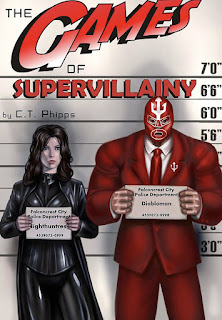
I had been aware of The Supervillainy Saga for a while. Several years ago, I listened to Confessions of a D-List Supervillain by Jim Bernheimer. The various books of The Supervillainy Saga were listed on the “You Might Also Like” section of Confessions of a D-List Supervillian’s page on Audible. The certainly did look intriguing. I’d like to take a moment to say that the covers for The Supervillainy Saga are absolutely amazing. Whoever designed them deserves a big raise. Though they looked intriguing, I felt I’d had my fill of superhero books for the moment, and moved on to other things. A few years passed, and I forgot about The Supervillainy Saga. Then, I shared my review SPR: Superhuman Public Radio. C.T. Phipps, author of the Supervillain Saga, saw my review of SPR and asked if I’d be interested in review the first three Supervillainy Saga books. I said yes, and here we are now.

C.T. Phipps gave me the audiobook for Volume 1 of The Supervillainy Saga. It contains the first three books of the series: The Rules of Supervillainy, The Games of Supervillainy, and The Secrets of Supervillainy. I’m going to review all three of them as a single unit in this review.

My initially impression was that I was rather reminded of Confessions of a D-List Supervillain. Both books involve first-person narrators, who are a bit of a smart-ass, who decide to go into supervillainy. Still, despite similar premises, they go in reasonably different directions. There’s enough differences in the execution to keep things interesting. And I suppose it is rather fitting, given that Supervillainy Saga is published with help from Jim Bernheimer.

One of the biggest differences is how the heroes and villains are presented. D-List Supervillain had a mostly original cast of characters without obvious inspiration. By contrast, most of the characters from Supervillainy Saga are clearly based upon preexisting comic book characters. Though, C.T. Phipps does mix and match various comic book heroes and villain to keep things interesting. I also want to clarify some terminology. When I say original, I mean characters that don’t have an obvious literary predecessor. It’s not meant as judgment of quality. Basing your own characters on preexisting ones isn’t an inherently bad thing. 


With all of that said, let’s get out our field guides and see how many we can spot. The world’s greatest hero is named Ultragod. He was just an normal African-American astronomer when he was imbued with cosmic energy known as the Ultraforce. He’s strong, he flies, he’s nearly invulnerable, and he can create energy constructs. So, basically Superman, but also with Green Lantern’s powers. The fact that he’s black and has Superman’s powers also brings Icon to mind. He has a daughter name Ultragoddess. She wears a nearly identical costume, but with a miniskirt rather than pants. Obviously, she’s Supergirl. The fact she’s Ultragod’s daughter brings to mind Superman & Batman: Generations. It was an Elseworld miniseries where the DC Universe progresses in real time. In it, Supergirl is Superman and Lois Lane’s daughter, rather than Superman’s cousin. Speaking of Lois Lane, Ultragod’s wife, civil right attorney Polly Pratchett, is a pretty clear stand-in for her. Tom Terror is a mad scientist who thinks Ultragod is nothing but trouble. That makes him the Lex Luthor analog, but he’s also a former Nazi, which brings Red Skull to mind.

Nightwalker is basically Batman, but with Specter’s powers and cloak. We later learn that there’s more than one Nightwalker cloak. One of these comes into possession of twenty-five year old Japanese-American woman. That makes her Batgirl, specifically Cassandra Cain, given that she’s Asian-American. Gary lost his brother to a gritty 1990s anti-hero named Shoot’em Up. He’s a former police officer who became a ruthless vigilante. In other words, basically Punisher. His name is also a reference to the song “Shoot’em Up” by Blue Stahli.

Most of the superheroes are part of the Society of Superheroes, which is like the Justice League, or maybe the Avengers. There’s a heroine named Guinevere. She’s a literal fairy princess warrior from the land of Avalon. She’s also known for her rather sexy costume, and forms a trinity of sorts with Ultragod and Nightwalker. All of this makes her Wonder Woman. There’s a minor character with a Robin Hood theme, which would make him Green Arrow. Backwoodsman is a like a stereotypically Canadian version of Wolverine. There’s also a Suicide Squad-esque special ops team of heroes and villains. One of its members, Red Schoolgirl, is like a straight-up villain version of Katana. Well, if she was also totally crazy, and cosplaying as Sailor Moon.

Etropicus is an evil space god like Darkseid and Thanos. There’s also a video game about the heroes turning evil. Clearly a stand-in for Injustice: Gods Among Us. Death is portrayed similarly to her depiction in Neil Gaiman’s Sandman series. She mentions having siblings who are clearly analogous to the other members of the Endless. Falconcrest City is Gotham, and is also Detroit in all but name. Atlas City is Metropolis, and is a nod to Atlas Comics, with merged with Timely Comics to form Marvel Comics. The streets of Falconcrest are named after famous comic book writers, such as Bob Kane and Bruce Timm.

There’s more, but we’d be here all day, and this has gone on for way too long. Time to move on. 


One thing I was surprised by is that, technically, The Supervillainy Saga is alternate history. Ultragod captured Hitler and Stalin and brought them to justice. Unfortunately, World War II still happened more or less like in our world. A villain named Phantom Leader, head of a HYDRA-esque organization, conquered most of Europe and Russia. Fortunately, the Allies still won. It’s also mentioned that there was a Second Vietnam War at some point. A robot named Android John become the first robot to be elected president in the 1990s. Despite of all this, the world is pretty much exactly the same as ours. Even the pop culture is almost identical. We know this because Gary seems, at times, incapable of going a chapter without making at least one pop culture reference. He also grumbles about how, despite all the magic and super science, nobody has cured cancer yet. This is all in keeping with comic books, which usually present a world more or less like our own, despite all the superheroes running around. Amusingly, Tom Terror has discovered an alternate universe completely devoid of superheroes and supervillains, but with near identical pop culture. In other words, he found our universe.

It’s also mentioned that the past itself is highly malleable and subject to change. Many things are really more suggestions than hard facts. This is a nod to the constantly shifting nature of comic book canon, and how the timeline gets shifted as the years move forward. We see that there is one universe where Gary is a plucky teenage reporter, and is best friends with Ultragod. This is clearly a reference to Superman’s Pal Jimmy Olson. Thought, I guess in this case it would be Ultragod’s Pal Gary Karkofsky. That particular universe is totally devoid of swearing, and is full of the casual sexism and racism that often plagued Silver Age comics.

I also noticed that there were quite a few references to the website TV Tropes. Gary will sometimes mention tropes by name. Other times, he will allude to the various tropes. It is eventually revealed that Gary is indeed an avid reader of TV Tropes. Before you ask, yes, the Supervillainy Saga does have its own TV Tropes page. There’s a page for the series as a whole, and each individual book also has its own page.

Now, let’s talk more in-depth about the characters. Gary is our snarky nerdy protagonist. Besides avenging his brother, he also dreams of turning the world into an anarcho-communist utopia. During college, he hacked into the college’s database to delete students’ debt. At the time, he was majoring in Unusual Criminology, which is basically Supervillainology. However, he had to drop out, and got a degree in history instead. It…was less than helpful when it came to finding a job. So, he turned to a life of crime. He claims that he was successful with women because he was charming and treated them with respect. Emphasis on claims. I’m just saying, even Gary’s saintly ex-girlfriend Gabrielle finds his near constant pop culture references to be extremely annoying after a while. Personally, I’m with Gabrielle on this one. Gary’s pop culture references weren’t too bad in the first couple books, but they reached a fever pitch by book three. At times, it felt like The Big Bang Theory on a bad day. It just felt like lazy writing after a certain point. It was like C.T. Phipps used the pop culture references as a crutch when he couldn’t think how to move a scene along.

There’s another scene where Gary angrily explains the theory of evolution, and debunks common misconception about how evolution works, to another supervillain. Now, the information is very good, and it can be argued that Gary did have a point about people’s misconceptions about evolution. However, it was also very clearly C.T. Phipps parking the plot so that he could monologue about his personal pet peeves. The scene just didn’t feel organic or natural, and the dialog was kind of tin-eared.

Then there’s the scene in book three where Gary robs a stock market, while dressed as a pirate, and spends the entire chapter monologging about the evils of capitalism. The writing and dialog were incredibly clunky. It felt like C.T. Phipps was using the scene to expound upon his personal political views. Thankfully, this was the only such scene in the entire collection. It just stood out more do to being paired with Gary at his worst pop culture referential. I’m not opposed to pop culture references, but I do prefer when it is done sparingly. 


Gabrielle is Gary’s ex-girlfriend. She’s good natured, easy going, incredibly beautiful, and shares Gary’s geeky interests. She also has the exact same facial features, voice, hair, and skin-tone as Ultragoddess. She also wears clothes that are gold and white, the same as Ultragoddess’ costume. Gary has never seen them in the same place, and Gabrielle often ran off right before Ultragoddess would appear. In case it wasn’t obvious, Gabrielle is Ultragoddess. She used her powers to keep Gary from connecting the dots. She broke up with him after he got kidnapped by one of her villains. Gabrielle’s mom, Polly Pratchett, got captured numerous times over the years, and that really got to Gabrielle. Polly also got killed a few times, but the Society of Superheroes has numerous means to restore the dead back to life. 

So, it was only a minor inconvenience, but it effected how Gabrielle approached relationships. Gabrielle is described as being Afro-Hispanic, and her general description brings Rosario Dawson to mind. The cover art does bare this out. Gary is in a loving relationship with his wife Mandy, but he still think about Gabrielle, and still has feeling for her. In fact, when he first meets Death, she appears to him as Mandy’s head on Gabrielle’s body.

Gary’s parents hoped that he would settle down with a nice Jewish girl someday. Instead, he married a bisexual half-Korean Wiccan gentile. Then again, Gary’s parents also didn’t want him to become a supervillain, and look how that turned out. Mandy seems to have almost exclusively dated women before marrying Gary. I liked that she was portrayed as a realistic example of a Wiccan. She doesn’t get any magical powers from Wicca, it is simply the religion that she follows. Though, it is mentioned that there are some Wiccans with magic powers, but they’re considered separate from religious Wiccans. Magik is considered a form of concentrated prayer in real Wicca. The K at the end is deliberate, so as to distinguish it from the concept of magic, as in the supernatural.

Gary’s childhood friend Cindy is a supervillain in a sexy Little Red Riding Hood costume. She was training as a doctor before turning to supervillainy. She had to deal with serious student loan, much like Gary. She wears her hair in pigtails, is very zany and energetic, and speaks in a New Jersey accent despite living in Michigan. Obviously, she’s the Harley Quinn analog. She later switches to a more conservative costume. The way it is described reminds me of Ruby Rose’s season 1-3 outfit on RWBY, but that might have been unintentional. There’s not really much to Cindy. She’s more of a comic relief character. She worked as a hench-wench for various supervillains before she joined Gary. Though, she prefer the gender-neutral term hench-person, as she finds it less demeaning. Cindy also refers to her self as looking like a cross between Sarah Michelle Gellar and Alyson Hannigan because of her strawberry blonde hair. Uh, Cindy, you know they’re both brunettes in real life, right?

Adonis from Greek Mythology is still active in the modern world as the supervillain Bright Eyes. It seems that C.T. Phipps got him mixed up with Narcissus, as Gary incorrectly claims that Adonis is the one who originated the term narcissism. Like, it’s right there in the name, just saying. Adonis also refers to himself as devoted to Aphrodite, but there’s nary a mention that he’s also devoted to Persephone. Aphrodite got him during the summer months, and Persephone got him in the winter months. However, C.T. Phipps tells me this is all deliberate, and apparently, the original idea for Adonis was even less accurate to the mythology. Adonis was going to be a son of Zeus. This is an homage to how some mythology inspired comics, like Wonder Woman and Thor, play fast and loose with mythological accuracy. However, C.T. Phipps’ editor vetoed the idea specifically due to it being untrue to Greek Mythology. 

Often, comics inspired by mythology will get basic things about mythology wrong. For example, Loki was Odin’s blood brother, not Thor’s adopted brother. Gary doesn’t like Adonis on principle. I’m not sure if that’s a reference to the Maccabean Revolt, or the general “don’t fool around with pagan gods” rule of Judaism. I’m going with the former. Gary, by his own admission, isn’t terribly devout. And let’s not forget that he did knowingly marry a Wiccan. 

Diabloman is a former big time supervillain, but he’s been forced to work as Gary’s villainous mentor. He was raised in a Satanic cult, but he’s a surprisingly nice guy. He wears a luchador mask and a red business suit. The final member of the core cast is the spirit within Gary’s cloak. He’s not to thrilled about having to team-up with a supervillain, but he doesn’t have much choice. And hey, he does eventually warm up to Gary. I won’t tell you who Cloak is, but I will say it wasn’t hard to figure out. In fact, you might very well have pieced it together yourself.

We have a colorful cast of characters, but I wonder if perhaps they needed more time to shine. That is, maybe the series should have taken an anthology approach, rather than having Gary be the protagonist of every book. How might book two and three have looked from Mandy or Gabrielle’s perspectives? For that matter, how would they look from Cloak’s point-of-view? Or what if we had one of the numerous memorable minor characters take center stage? I think the books might have benefited from having more points of view than just Gary.

Though even keeping Gary as the view point character is a source of missed opportunities. Gary time travels to kill Nazis and Hitler, but we never witness with happen on-screen, for want of a better term. Time traveling to kill Nazis? Sounds like a fun time to me. If you’re wondering, time travel can’t change the past. All Gary did, as a result of his time travel shenanigans, was create parallel timelines.

Obviously, I’m also going to take a moment to talk about the audiobook. The audiobooks are narrated by Jeffery Kafer. His narration overall wasn’t bad, I’ve certainly seen worse. That said, I also felt there was room for improvement. He does a really good job performing as Gary, but he makes the other characters sound rather interchangeable. This is most obvious in the first book. Among other things, Diabloman has no trace of the Mexican accent he ought to have. He does get a bit better in books two and three, but there was still room for improvement. I will say that Jeffery’s weaknesses as a narrator are hardly unique to him. I once listened to an audiobook of Huckleberry Finn, narrated by Elijah Wood, that has similar issues; despite Wood’s excellent performance as the title character. As did the audiobook of Tom Sawyer which was narrated by Nick Offerman.

Okay, so what’s the verdict on The Supervillainy Saga, Volume 1? Was it high art in any sense of the word? No, it most certainly not. Did it have it’s share of flaws? Yeah, I would say so. Was a reasonably entertaining? Yes. Was it a fun and enjoyable popcorn book? Also yes.

The Supervillainy Saga might not be revolutionary, but it has its charms. If you’re looking for some fun superhero books that don’t take themselves too seriously, then you might want to give it a try. It does deconstruct superheroes to an extent, but it never comes across as mean-spirited, or dark and gritty for the sake of being dark and gritty. You can really tell that C.T. Phipps genuinely does love superheroes and comic books. So, he used that love to make the Supervillainy Saga. If all of this sounds appealing to you, then give the Supervillainy Saga a try.

Well, I think that should do it from me for now. I will see you guys next time.

Tuesday, January 4, 2022

Book Review: Voyage by Stephen Baxter

As I have said many times before, good things often come to those who wait long enough. This is certainly true when it comes to audiobooks. Sometimes, if you’re very lucky, your patients is rewarded in a big way. Without further preamble, let’s get into it. We’re taking a look at Voyage by Stephen Baxter.


Voyage takes place in a world where John F. Kennedy survived his assassination attempt. Although, it did render him paraplegic, and Mrs. Kennedy got killed in the crossfire. The Apollo 11 landing is a success just like in our world. However, Kennedy challenges NASA to land a manned mission on Mars by the 1980s. The novel follows an ensemble cast of NASA employees as they work to meet Kennedy’s challenge.

This was another of those books I’d been hoping would become an audiobook. For a few years, I had to settle for the BBC radio adaption that came out in 1999. It is certainly excellent, and I do plan on reviewing it at some point. Well, I need to to come up with a name for the column. I want something that is consistent with The Audio File and The Alt-Hist File. The A-Ticket File? Ticketed Attractions? I’ll think of something eventually.

Still, I longed to listened to a straight-up audiobook adaptation of Voyage. Then, in 2021, Voyage finally came out as an audiobook. In fact, so did Stephen Baxter’s entire NASA Trilogy. The NASA Trilogy isn’t exactly a series per se. It is three standalone books that all involve NASA in some way. Voyage and Moonseed are alternate history. Titan was set in the near future, for the time it was published, but I guess it has retroactively become alternate history. I’m very pleased that all three books have finally become audiobooks.

To start, let’s talk about the audiobook. Voyage is narrated by Kevin Kenerly. Initially, I wasn’t sure how I felt about Kevin as a narrator. But remember, I listened to the full cast BBC radio adaption first. So, I guess I was, consciously or not, comparing Kevin to the full cast version. That wasn’t fair to Kevin, and I did get past this thinking eventually. All things considered, I did enjoy Kevin’s narration. He reminds me of the sort of narrator you hear narrating science fiction books from the 1990s and/or 1980s. Which is fitting, because Voyage was published in 1996. So, no complaints as far as narration goes.

Okay, now lets talk about the plot itself. I should begin by discussing the structure of the novel. It alternates between two points in time. One section begins with the launch of the Ares 1 mission in 1985, and follows its voyage to Mars. The second section begins in 1969 with the Apollo 11 landing, and follows all of the work that went into creating the Ares mission. Eventually, the second section gets to the launch of Ares 1 in 1985, thus bringing the two segments together. We know that Ares will ultimately fly, but it is the journey, not the destination, that really counts. Baxter certainly manages to keep things interesting. What sacrifices will have to be made, and what challenges must be overcome, so that Ares can fly?

Like I said, this book is very much an ensemble cast, and doesn’t really have a main character. The closest it has is Natalie York. She is a geologist who is obsessed with Mars, and all the potential geological discoveries it has to offer. She helps to train astronauts for the Ares mission, but isn’t a big fan of astronauts. Too much dumb fighter jock stuff, as she phrases it. NASA’s astronauts were initially selected from members of the Air Force, and it appears the practice lasted even longer in the world of Voyage. Ironically, Natalie is initially opposed to sending humans to Mars. She feels that far more science could be achieved using unmanned robotic probes. Unmanned probes would also be cheaper, and more probes means more science. Despite this, as the years go on, she becomes a prime candidate for the Ares mission.

The closest thing to a secondary protagonist would be Joe Muldoon. He was the second man to walk on the Moon, and goes on to become a director at NASA. He’s pretty clearly a thinly-veiled stand-in for Buzz Aldrin. I’m not entirely sure why Baxter didn’t just use Aldrin. Maybe using a fictional character gave more flexibility in characterization and storytelling? Of course, Aldrin is still alive, so maybe Baxter had to worry about slander and libel laws? But the threshold for that is pretty high when it comes to public figures, which Aldrin certainly is.

This isn’t the only time Baxter uses a fictional stand-in for a real person. There’s also the character Hans Udet. He is a former Nazi rocket scientist, but that’s hardly unusual. Project Paperclip brought several German scientists, most famously Werner von Braun, to America. Many of them found work at NASA. Unfortunately, Udet used to be in charge of Mittelwerk. It was a Nazi rocket factory that used slave labor. Eventually, Udet’s past catches up with him. This is a clear parallel to Arthur Rudolph, who had a nearly identical backstory. The American government agreed to drop the charges against Rudolph, provided that he renounced his American citizenship and return to West Germany. Something similar happens to Udet.

In other characters we have Ralph Gershon. He’s a black Air Force pilot, and a Vietnam War veteran. He’s not based on any real figures, but he does provide an interesting parallel. In our world, Robert Henry Lawrence Jr. was also a black Air Force pilot. He was under serious consideration to be part of the Apollo program. Unfortunately, he died when an experimental aircraft he was testing crashed. Ed Dwight Jr. was also a black Air Force pilot who was under serious consideration for Apollo, but never made the cut. Thankfully, Gershon does get selected to be part of Ares. You could also see Gershon as somewhat similar to Guion Bluford, the first African-American astronaut from our timeline.

There are other characters, but I’ll leave them for you to discover. Now, it is clear to me that Stephen Baxter wishes that manned spaceflight was more advanced than it is. He also wishes that NASA was better funded, and that it had already sent a manned mission to Mars. However, he also realizes that, in order for that to be possible, it would require some serious sacrifices. And just what are these sacrifices? Allow me to ask you a question: what is the most important part of a space mission?

I’ll save you the trouble. Money is the most important part of a space mission. The money has to come from somewhere if you want to get to Mars by the 1980s. That means you’ll have to start making cuts and canceling programs to free-up funds. Right off the bat, Apollo 16 and Apollo 17 are canceled. Apollo 15 is also canceled, but the crew of Apollo 15 fly on Apollo 14. So, its almost like Apollo 14 got canceled, but not Apollo 15. Apollo 13 has an accident exactly like our world, so no science happened on that mission. Apollo 17 getting canceled was a particular blow, because that was the only mission where scientists got to go to the Moon. The Space Shuttle is also cancel in favor of reusing Apollo tech. Though, Skylab lasts longer than in our world, and another space station called Moonlab, which orbits the Moon, is constructed. Albeit, Skylab and Moonlab are well past their prime when they’re decommissioned.

Oh, but we’re just getting started. The Viking landers are canceled, and this is a particular sore spot for Natalie. In our world, Viking taught us a lot about the composition of Martian soil. Later, Mariner 10, Pioneer 10 and Pioneer 11, Pioneer Venus, and the Voyager probes are all canceled. Let’s go through the list, shall we? Mariner 10 went on a flyby to Venus and Mercury, and was the only probe to visit Mercury until the MESSENGER probe in 2004. Pioneer 10 and Pioneer 11 were the first probes to visit Jupiter and Saturn. They also famously carried the Pioneer Plaques, which serve as messages to any aliens who find the probes after they’ve left our solar system. 

The Voyager probes famously went on a grand tour of the Outer Planets. In fact, some of the most famous pictures of the Outer Planets, and their moons, were taken by the Voyager probes. Voyager 2 is thus far the only probe to visit Uranus and Neptune. Both of the Voyager probes also contain the Golden Records. They are recordings of sounds and music from Earth, including messages in several languages. Like the Pioneer Plaques, they’re for if aliens find the probes.

This has a rather unfortunate side-effect for the world of Voyage. Yes, humans walk on Mars by 1985. However, humanity’s knowledge of the solar system, including Mars, is far less than in the 1985 of our world. Be careful what you wish for indeed. But it isn’t just the lack of knowledge and science regarding the solar system. Who among us hasn’t been in awe at the images brought back by probes such as Voyager 1 and Voyager 2? How many people were inspired to go into science because of those images? Who hasn’t been moved by how the Pioneer Plaque attempts to reach other to other intelligent life forms? All of that would be lost in the world of Voyage.

Natalie frequently complains about how much more data could be obtained with unmanned probes. Ares 1 does a flyby of Venus to use the planet’s gravity to slingshot to Mars. They drop an unmanned probe to the planet’s surface. Natalie should be in awe of actually orbiting another world, but all she can think is about how little science they’re getting out of the probe. She’s a geologist at heart, and is frustrated at how the little probe can’t expand upon the tantalizing glimpse of Venus’ geology it offers. Rather ironically, scientists become some of NASA’s biggest critics. They feel that NASA is too laser-forced on the manned Mars mission. They feel that the money would be better spent on scientific research. For her part, Natalie strongly agrees.

Voyage essentially extends the Apollo era mentality of NASA into the 1970s and 1980s. Science wasn’t neglected during Apollo, but it wasn’t the primary focus. The main goal was simply to go places for the sake of going to them. In our world, after Apollo, NASA put more emphasis on scientific work, both via probes and via manned missions to orbit. It wasn’t as glamorous as Apollo, but it did produce a lot of projects that did benefit people back on Earth. 

Speaking of probes, the Soviet Union does slightly better with it unmanned Mars probes. In our world, almost every Soviet probe sent to Mars ended in complete failure. The probes were named the Mars series. The Soviets were very creative when it came to names. For example, Mars 2 and Mars 3 attempted to map the Martian surface from orbit. Unfortunately, the area they mapped was covered by a massive dust storm, and their trajectories couldn’t be reprogrammed. They had landers, but the Mars 2 lander crashed, and the Mars 3 lander stopped transmitting after ninety seconds.

Mars 7 had a rover, but its computer malfunctioned, and the lander was launch prematurely, completely missing the planet Mars. In the world of Voyage, however, the Mars 7 lander successfully makes it to the Martian surface. Perhaps the butterfly effect is at work? Then again, outside of the space program, history doesn’t seem to change very much. All of the American presidents occur in order, Watergate still happens, no big dramatic differences.

Well, there are a few minor changes. Gene Roddenberry, inspired by the Ares 1 mission, scraps his plans for Star Trek: The Next Generation. Instead, he comes up with an idea for a crew on a smaller ship exploring uncharted space. He plans to call it Star Trek: Explorer. Damn, if only it had been called Discovery instead, that would have been very amusing. There is a short story set in the same world as Voyage called “Prospero One.” It follows an alternate British Space Program, which actually manages to launch an astronaut into orbit and return him to Earth safely.

Interestingly, the scenes in Venus orbit make no mention of the Venera probes that the Soviet Union sent to Venus. Yet there’s no mention of any further Soviet Mars probes, so the money didn’t get diverted or anything.

Baxter does make a strong case that it might have been for the best that things turned out the way they did in our world. And yet, wouldn’t it be something if humans had already walked on Mars? There would be serious downsides and sacrifices, but at the end of the day, it would still be quite the spectacle. It would be one of those moments that would go down as a major milestone in human history. There’s a brief afterword where Baxter explains his thought process, and way he made the changes to history the he did. He concludes more or less what I’ve stated.

Even the naysayers are in complete awe when Ares 1 finally launches. I have heard that rocket launches are quite the spectacle to behold. There’s only one chapter actually set on the surface of Mars; most of it is devoted to preparation for setting foot outside the lander. I know some people didn’t like that, but it makes sense from a thematic perspective. It’s right there in the title. This is a book about the journey, not the destination. Not just the interplanetary voyage of Ares 1, but all the work that happened back on Earth to make it possible. And none of it ever feels boring or dry. We see political dealings, negotiations for production contracts, and other behind the scenes details. We also get very detailed descriptions of how the various spacecrafts work. Baxter makes it all sound quite interesting. I’ll also add that Mangala Valles was a nice choice for a landing site. You don’t see it in fiction too often compared to other locations on Mars.

So, there you have it. Voyage imagines a manned Mars mission, in 1985, launched an alternate NASA. It truly is a novel about the journey, not the destination, and all the better for it. I love alternate history that involves manned spaceflight, and this did not disappoint. I’m glad that my patience has been rewarded once again, and you certainly shouldn’t wait to give Voyage a try.


Well, I think that should do it from me for now. I will see you guys next time.

Sunday, December 26, 2021

Book Review: The Plot Against America by Philip Roth

 I have a bit of a habit about putting books that are popular or widely praised. I don't consciously avoid them, it just kind of happens that way. Still, I get around to them eventually. Occasionally they're underwhelming, but more often than not, I do genuinely enjoy them. Such is the case with the book we'll be reviewing today. We're taking a look at The Plot Against America by Philip Roth.


The Plot Against America begins in an alternate 1940. Celebrity aviator Charles Lindbergh has been elected President of the United States in a landslide victory over incumbent president Franklin Delano Roosevelt. Lindbergh has pledged to keep America out of the war in Europe and the Pacific. In fact, he's signed a non-aggression treaty with Germany and Japan. Still, many Americans, particularly Jewish American, worry that Lindbergh is getting a little too chummy with the Axis Powers. The story follows the turbulent years of the Lindbergh Administration through the eyes of young Philip Roth and his family.

This was one of those books that wasn't too high on my reading list until it was. I can't say what exactly prompted me to give this one a try. Maybe it was the miniseries adaption that HBO put out. I have watched the miniseries, did so not only after I wrote this review. I might get around to give a review of it at some point.

Maybe it was the various alternate history Facebook groups I take part in. Maybe it was something else entirely. Honestly, I can't really say. I will say that this book being part of the Audible Plus Catalogue was a nice bonus. Audible Plus is a new thing that Audible is doing. It's like Netflix, but with audiobooks.

Whatever the reason, I finally gave The Plot Against America a try, and I loved it. You will occasionally see literary fiction authors dip their toes into speculative fiction. However, this is the first time I've seen a literary fiction author try their hand at alternate history. Philip Roth ruffled some feathers when he made some comments that seemed to imply that he believed that he had invented the concept of alternate history. I haven't seen exactly where that went down, so I won't really comment on that.

I will say that Roth does an excellent job of combining his signature style with the alternate history setting. I took a look at some of Roth's other books in order to compare the writing style, and The Plot Against America defiantly fits the mold. There are segments of the book that almost feel weirdly nostalgic at times. Roth describes daily life in 1940s New Jersey in such loving detail, it can be easy to forget that you're reading an alternate history novel. And yes, this is a Philip Roth book, so it is pretty much required to take place in New Jersey.

One aspect I liked is that Jewish Americans are not a united front against Lindbergh. Sure, there are plenty, like the Roth family, who are weary of his policies, and actively push back against him. However, there are also Jews who are supportive of Lindbergh, or at least, believe he isn't that bad and can be reasoned with. A rabbi named Lionel Bengelsdorf becomes, essentially, Lindbergh's spokesman from within the Jewish community. Bengelsdorf is from Charleston, but that isn't as crazy as it might sound. Prior to the American Civil War, Charleston had the highest Jewish population in America. Indeed, many Southern Jews owned slaves, and fought for the Confederacy to preserve slavery. In fact, Confederate Secretary of State Judah P. Benjamin was the first Jew elects to public office in North America.

Philip’s socialite aunt Evelyn also tries her best to worm her way into Lindbergh's good graces. At one point, she event attends a gala where Nazi officials are on the guest list. Other characters become unwitting pawns of Lindbergh and his schemes. One of Lindbergh's new social programs is called Just Folks. It involves Jewish boys spending the summer with gentile families, often in rural areas. Phillip's brother Sandy always wanted to spend time on a farm, and leaps at the opportunity to sign up. To everyone's collective dismay, Sandy had a wonderful time working on a tobacco farm in Kentucky. Worse, he'd gladly go again, and even becomes a spokesman for the program. In doing so, he becomes a useful idiot for the Lindbergh Administration.

Another of Lindbergh's policies is called Homestead 42. It encourages Jews to move to more rural areas. That way, Jews would be spread thin, and politicians won't have to pander to Jewish voters. Being in rural areas also means Jews would be more likely to bump into white supremacist groups, such as the Ku Klux Klan. Part of me wonders if that was a deliberate aspect of the plan. Lindbergh probably wouldn't object to Klansmen murdering Jews. Homestead 42, as it is public ally presented, would give him plausible deniability in that regard.

Of course, other Jews push back again Lindbergh's policies. Philip’s cousin Alvin volunteers in the Canadian army to directly fight the forces of fascism in Europe. Lindbergh canceled the Lend-Lease programs. As such, things could be better for Britain’s war effort. In our world, several Americans volunteered in the British and Canadian armies before America officially entered the war. They were known as Eagle Squadron. In fact, many of the planes from when America first joined the war were actually RAF planes that had been repainted. Obviously, this changed after the American war effort really kicked into gear, and America began rolling out its own planes.

Interestingly, Alvin isn't shown to be honorable or flawless as you might expect. In fact, he's shown to be a bit of a shiftless ne'er-do-well who takes advantage of the Roths after he arrives back home. Volunteering for service was certain admirable, but there's a strong sense that Alvin was in way over his head. His decision was spur of the moment, and he didn't think enough about the long-term consequences of his choice.

Meanwhile, the journalist/commentator Walter Winchell uses his program to critique Lindbergh. Winchell was a real historical figure, and was one of the first America journalist to speak out against Hitler and the Nazis. He also criticized America's isolationist stance, and criticized those who pushed for it, such as Charles Lindbergh. At one point in the book he even attempts to run for president. Unfortunately, the campaign hits a minor snag after Winchell is stuck by an incurable state of writers block known as death.

I know I might get flack for saying this, but maybe that was for the best. Let me elaborate a bit. In our world, following World War II, Walter Winchell gave his full-throated support to Joseph McCarthy's anti-communist witch hunts. In doing so, Winchell firmly placed himself on the wrong side of history, and seriously tarnished his legacy. So, at least the book's version of Winchell got to die a hero, rather than living to see himself become a villain.

Now, let's talk about Charles Lindbergh himself. Lindbergh's policy of isolationism, and the support it receives, is fairly realistic. Both the Democrats and the Republicans were pro-isolationism at the start of World War II. The general American public also favored isolationism. It wasn't until Pearl Harbor that public opinion about the war began to shift. America getting pulled into the orbit of Nazi Germany also isn't as unbelievable as it might seem. There were a surprisingly high number of Americans who sympathized with the Nazis. Jack Kirby received quite a bit of hate mail when he drew Captain America punching Hitler in the very first issue of Captain America. There were also several Pro-Nazi organizations, such as the German American Bund. In fact, the Bund appears several times in The Plot Against America.

Lindbergh was indeed an antisemite, and his antisemitism was fairly well-known. The Plot Against America portrays Lindbergh as having complicated views about Jewish people. He does not seem to like them, but he knows he can't say that out loud. He's actually worse in this regard than the Lindbergh of our world. For example, at one point Lindbergh receives a medal from the Germany government, and refuses to return it even after the events of Kristallnacht, aka the Night of Broken Glass.

By contrast, and quite surprising given his antisemitism, Lindbergh spoke out against the Nazis' persecution of Jews. He also specifically spoke out against the events of Kristallnacht. He was also horrified when he learn the extent of the concentration camps. Lindbergh was staunchly isolationist, but he served in the Pacific after America committed to World War II. Now, I'm not criticizing Roth's portrayal of Lindbergh. Given the right circumstances, Lindbergh could very well have gone down a darker path. I'm just saying that people are complicated. Honestly, the depiction of Lindbergh's vice president, Burton K. Wheeler, was far more questionable. However, we'll get into that in the spoilers section.

For what it's worth, the characters speculate on Lindbergh's true motives. There are rumors that the Nazis have kidnapped his child, and he implemented the antisemitic programs to appease them. His heart not being in it would explain why he didn't go too crazy. Well, that and the American government has safeguards against the president having too much power. However, we don't get any definitive answers, and this all remains pure speculation. Personally, I think Lindbergh was acting of his own volition, and wasn't being coerced by anyone.


Before we get into the spoilers, I'll take a minute to mention the audiobook. It is narrated by Ron Silver. I felt that he was absolutely perfect as a narrator, and I have no complaints there. However, I do have to ding points for the cover. It looks the same as the physical book save one key feature. The stamp on the physical book has a swastika on it, but the stamp on the audiobook has an X on it. This is a reference to a dream that Philip has. He dreams that his collection of national parks stamps become covered in swastikas. This represents the fearing the creeping fascism with the coming of the Lindbergh Administration. Why did the audiobook censor it? What was the point of that? It really undermines the impact that the non-censored cover has. But I suppose it is a minor issue in the grand scheme of things.

Okay, now it is time for the spoilers. So, if you don't want any of that, turn back now.

Last chance. You sure you want to continue?

Okay, if everyone who wants out is gone, let's get into it.

So, a plane that Lindbergh is flying disappears under mysterious circumstances. As such, Vice President Burton K. Wheeler takes over as Acting President. America proceeds to go to hell in a hand-basket. Antisemitic riots break out in several major cities, Martial Law is declared, and Wheeler drops all pretense that Lindbergh had. This is quite at odds with how Wheeler was in our world. In our world, Wheeler was actually quite progressive. He supported labor unions and workers' rights, he supported the New Deal, and he helped expose the Teapot Dome scandal. He supported isolationism, but he enthusiastically supported the war effort following Pearl Harbor. Sure, he did hang around Lindbergh, but there is nothing which suggest that he was a bigot or pro-fascist.

But wait, just as everything as at its grimmest, and emergency election is called by Congress. FDR wins in a landslide, and undoes all of Lindbergh's policies. Japan commits a surprise attack on Pearl Harbor, and America formally joins World War II. It's a little weird that Pearl Harbor happened pretty much exactly like it did in our world, albeit one year later, but it guess it isn't totally outside the realm of possibility. Hopefully, seeing what Lindbergh did to Jewish Americans will make FDR more sympathetic to the plight of Japanese-Americans, and he won't throw them in interment camps.

Things certainly could have been worse for Jewish Americans, but they won't be able to say "it can't happen here" anymore. Jewish Americans will always be a bit wary of the government, and for good reason. I think back to how the Jewish community of New Jersey. Most of them can't read of write Hebrew or Yiddish; they celebrate the Jewish holidays more for cultural, rather than religious, reasons; many don't even keep kosher very strictly. The kids all do typical American kid things like playing baseball and getting into mischief. These Jews are thoroughly assimilated, and are as American as it comes. And yet, in spite of all that, Lindbergh couldn't see them as fellow Americans. He only saw them as Jews, and nothing more. But this does tie into the major theme of the novel: every American, regardless of background, is a true American. It behooves us all to remember that.

And so that was The Plot Against America by Philip Roth. It goes to show that you can still do interesting things with World War II alternate history besides the usual Nazi Victory scenarios. It provided at look at America under the presidency of Charles Lindbergh as only Phillip Roth could tell it. I can't believe I waited as long as it did to check this one out. You should not wait like I did. Check it out today, and you'll be glad that you did.

Well, that should do it from me for now. I will see you guys next time.