Showing posts with label alternate history. Show all posts

Friday, December 8, 2023

Flag of the Union of Sovereign Republics

This is the flag of the Union of Sovereign Republics. It comes from a world where the government of the Soviet Union discovered the plot by hardline Communist Party members to stage a coup. The leaders of the planned coup were arrested, and this meant that the New Union Treaty was signed into law. The Soviet Union reorganized itself into the Union of Soviet Sovereign Republics. The first wave of reforms were somewhat modest, but they allowed for capitalism, and investments from foreign businesses, to make inroads to the USSR. This provided a much needed shot in the arm to the Soviet economy. This led to a weakening of the independence movements among the constituent republics of the USSR.

Economic reforms soon lead to political reforms. Genuine opposition parties were allowed to run starting in the late 1990s. This led to a weakening of the Supreme Soviet, and by the mid 2000s, the USSR had transitioned into a full democracy. Its name officially changed to the Union of Sovereign Republic to better reflect this new nature. Thus, the Cold War came to a somewhat anticlimactic end.

The Union of Sovereign Republics emphasizes devolution of powers. The national government handles matters of international diplomacy and national defense. Meanwhile, the constituent republics are given considerable leeway. They can declare their own official languages, establish their own educational systems, establish their own legislative assemblies, and pass their own internal laws. The national constitution also holds all constituent republics to be equal, and protects the rights of minority groups. The USR is working towards redressing the grievances the Soviet Union committed against non-Russian ethnic groups.

Relations between the USR and the USA are fairly friendly and cordial. The two nations have increasingly collaborated over the years. For example, they collaborated on a joint manned mission to the Moon in 2015. Surprisingly, there’s even talk have having the USR join NATO. However, that’s on hold at the moment.

China has not fared well in the 21st Century. The Chinese economy is in shambles. Western businesses never really invested in China. Most international production facilities are instead located in the USR and India. China is plagued by political unrest, and government crackdowns are increasingly common. China relied on Russia to keep America in check. However, the increasing closeness of the USR to America has sent Chinese leaders into a panic. The USR and USA are watching China with increased wariness, particularly after China’s invasion of Vietnam in 2019.

Time will tell what becomes of this. For now, however, the Union of Sovereign Republic enjoys economic prosperity and a high standard of living. For the first time in a long while, things are looking up for the peoples of Russia and Central Asia.

The blue doesn’t have any official meaning. Though, some take it to mean that the same blue sky is shared by all members of the Union of Sovereign Republics. It also contrasts with the red of the old Soviet flag. The eight bent poles represent the equality of all the constituent republics of the USR. The white is to offset the blue, and make the flag look a bit less like the old Soviet flag.


Tuesday, November 21, 2023

The Books of Thoth: My First Foray into Audio Drama Production

I’m back with another update post, and this one is an especially big update. You see, I’ve finally done it. I have officially launched my audio drama anthology podcast The Books of Thoth.


We’re kicking things off with “Paleontology Conference.” million years in the future. Humans are extinct and squids rule the Earth. They only know us from the fossils we leave behind. What will the squids make of us?

As you might guess, The Future is Wild was a big inspiration for this episode. I blame that show for igniting my love of terrestrial cephalopods. The part where the narrator speculates about the Squibbons developing their own civilization always sparked my imagination. The All Todays segment of the book All Yesterdays was another big inspiration. I love the way it pokes fun at how our notions of prehistoric animals sometimes turn out to be very wrong. You do get some references to how our views on prehistoric animals have changed. The part where the professor mentions chordates used to be viewed as slow and lumbering, but then were viewed as active and dynamic? That was almost word-for-word how our views of dinosaurs changed over the years. And there’s a few more in-jokes if you’re paying attention for them.

A bit about where the title for the podcast came from. Thoth is the god of wisdom, writing, and magic in Egyptian Mythology. He possessed an ultimate book of spells known as the Book of Thoth. Among other things, it had spells that could enable you to speak the language of animals, restore the dead to life, and peer through the layers of reality and gaze upon the gods themselves. Thoth acted as scribe of the gods, and he’s probably written quite a few scrolls in his time. And those scrolls are bound to have some pretty good stories within them.

The Books of Thoth has been a long time coming. I’m both nervous and excited. I admit that maybe there were a few things I could have tweaked. But after a certain point, perfect becomes the enemy of good. And so, I decided to release my audio drama into the wild for all to enjoy.

A big thank you to everyone who made this episode possible. Thank you to Marnie Warner, Amy Young, Faye Holliday, Juan Cruz III, Tiffany Perdue, and Melissa Bowens for providing the voices. As well as my thanks to Geno Samuel for providing the opening narration. And to Nadine Trollip, aka Stardust-Phantom, for providing the series cover art.

The Books of Thoth is hosted on RedCricle, and you can find it on all major podcast platforms. Including, but not limited to, Spotify, Apple Podcasts, iHeart, Podcast Addict, Amazon Music, Player.FM, Audible, TuneIn, RadioPublic, Apollo Podcasts, and Goodpods. And yes, I do have transcripts available.

It hopefully won’t be too long before I have more episodes for your listening pleasure. But in the meantime, I do hope that you enjoy the inaugural episode of The Books of Thoth.

Monday, August 14, 2023

AlloAmericana, Sea Lion Press Interview, and Kill FM 2

It has been a while since I’ve done one of these life update posts. However, I’ve had many major developments happen. Several of these are well overdue. So, let’s get straight into it.


The first item on the agenda. I have had a short story published in an alternate history anthology. So, I’m in the Alternate History Online group on Facebook. I saw a post by my pal Alexander Wallace. He was calling for submission for an anthology he was putting together for Sea Lion Press. They are an independent publishing house specializing in alternate history. The collection is called AlloAmericana, and it focuses on folklore and legends from alternate versions of America. You better believe I jumped at the opportunity to be part of something like that.

My story is called “Coyote and the Great Sturgeon.” It takes place in a world where Japan colonized California in the 17th Century. My inspiration was a Japanese folktale about why Japan has earthquakes. According to legend, there is a giant catfish that lives beneath Japan. It is being held in place by a water god. However, occasionally the god will lose his grip, and that catfish is able to wiggle. And that is why earthquakes happen in Japan, so the legend goes. California is also prone to earthquakes. So, I thought about the myths and legends the Japanese settlers would bring with them. Specifically, how they would change and evolve to fit their new homeland. Shinto and Buddhism are highly syncretic religions that happily adopt deities from across cultures. So, I figured it wouldn’t be unreasonable to assume they might appropriate figures from Native American spirituality; such as the trickster Coyote.

Coyote is an interesting figure. He is a trickers, but he often winds up being the one who gets outwitted in his stories. The way I approach the story was to think of what I did with the stories I wrote for The Moonlit Road. “Irwin Tarheel and the Fair Folk” was an adaption of the Japanese folktale of Urashima Taro, and “Golem of the Gullah” was an adaption the Jewish folktale The Golem of Prague. So, I basically tried to imagine the story of stories I’d be retelling in this alternate world.

By all accounts, “Coyote and the Great Sturgeon” has been a great success. Reviews of AlloAmericana frequently signal it out as one of the best stories in the anthology. You can buy AlloAmericana for $7.81 on Amazon. If it is any consolation, I didn’t get a complimentary copy. I had to pay for my own copy just like the rest of you. I must also shout-out a few of the other stories in the collection. “Hear That Cold Steel Cling” by Josiah Depaoli is a really great take on the story of John Henry, but set in a world where the South won the American Civil War. Josiah had some very nice things to say about my story. “Bunyan’s Progress” by Jared Kavanagh is a fun take on Paul Bunyan. “Honest and Loyal” by Alexander Wallace retells the story of George Washington and the cherry tree, but in a world where Washington fought for the British during the Revolutionary War. Really, I could keep going, but suffice it to say, the who collection is absolutely fantastic.

Alex also booked us all some interviews on a couple of podcasts he’s been on in the past. This was to help promote the collection, and let us all explain our process for crafting the stories. We were on episode 9 of The Alternate History Show with Ben Kearns. Our segment begins at 1:09:44. We were also on Living a Life Through Books with Dr. Shaznaz Ahmed. The episode was devoted entirely to all of us talking about our stories, and alternate history in general. Dr. Ahmed was really nice. I had a lot of fun. My only regret is that I couldn’t find the mute button when my dog Wolfie decided to sound the alarm because the scary UPS man rang the doorbell. Thankfully, nobody seemed to mind.

Speaking of interviews, I got interviewed by Sea Lion Press. Alex Wallace put in a good word for me. Sea Lion Press loved interviewing prominent figures within the online alternate history community. This blog of mine is moving on up in the world. Gary Oswald and I chatted about my experience as an audio drama critic, some of my favorite alternate history audio dramas, what I’ve got going on in the future, and, of course, AlloAmerica. It was a really great interview. I’m very proud of it.

I’ve also starting expanding into the world of voice acting. I got to play a small role in 19 Nocturne Boulevard’s segment on Kill FM 2: Fortune’s Favors [Side A]. For those who don’t know, Kill FM is an annual event where several audio drama creators unite to make a weird fiction variety show. The 19 Nocturne Boulevard segment begins at 38:25 and I’m the announcer guy who says “The North Star!” I also provided some crowd chants. A big thank you to Julie Hoverson for letting me be part of the 19 Nocturne Boulevard segment. I loved the concept of a dystopian future with genetically engineered mutant gladiators duking it out. And also, shout-out to Project Gnosis for their awesome segment at 27:45.

19 Nocturne Boulevard is an anthology show created by Julie Hoverson. She also hosts a voice acting cold reads group. The cold read group is very laid-back and non-serious. It’s a great way to practice your voice acting skills in a fun and relaxing environment. Usually, we read scripts from 19 Nocturne Boulevard, but sometimes we read scripts from other audio dramas. For example, we read from Life With Althaar. I’ve had the pleasure of playing the title character, and Althaar has been my absolute favorite role in the group. Not to brag, but everyone always seems to find my take on Althaar to be pretty hilarious. 

The group meets on Wednesday at 6 PM Pacific time, and Sunday at 1 PM Pacific time. I’m usually too busy to join the Wednesday meeting, and my day job at the Shreveport Aquarium often means I can’t make Sundays lately. Still, I try to come whenever I can manage. There’s no commitments, so feel free to join us for whenever, and for however long, you want. You can join the group with this link.

There is one other major voice acting role I’ve had. I’m particularly proud of this one. However, I’m not going to tell you what it is just yet. If you want to find out, you’ll have to wait for my next blog post. My next post is going to be an audio drama review. That’s the only clue you get.

And with that, I’ll see you all next time.


Thursday, May 11, 2023

Flag of Buddhist India

This is the flag of Buddhist India. It comes from a world where Buddhism remained the dominate religion of India. It began during the reign of Ashoka the Great. As in our world, Ashoka converted to Buddhism after spending much of his life as a warlord who united much of India. Unlike our world, however, Ashoka formalized the relationship between the Sangha and the secular government. Ashoka’s system can be thought of as similar to the role the Catholic Church played in Medieval Europe in our world. Buddhist monasteries received funding via taxes, and the monks often involved themselves in the affairs of the state.

Another result of Ashoka’s reforms was that the Maurya Empire lasted several centuries longer than it did in our world. The empire covered almost all of the Indian Subcontinent, and its continued existence lead to a sense of Pan-Indian identity. In fact, the Maurya Empire would come to hold the same cultural significance in India as the Roman Empire does in the West, and the Han Dynasty does in China. All future Indian empires would, to varying degrees, attempt to emulate the glories of the Maurya Empire.

The changes resulting from Ashoka’s reforms ultimately meant that Vedantic Hinduism never came to be. However, life for the average Indian didn’t really change all that much under Buddhism. Most people continued to worship the same local gods they always had. The old traditions mixed freely with the new. For example, you might go to the Buddhist temple to pray for enlightenment and contemplate philosophy. However, if your child got sick, you would pray to whoever the local healer deity happened to be. The caste system never came to be, but there was a still a strict social hierarchy within Indian society.

In time, several Buddhist monks began to study the natural world, and developed natural philosophy of a sort. This led to several discoveries and innovation, the most significant of which was the discovery of gunpowder. India went on several campaigns of expansion. Several of these were nominally to spread Buddhism, but in practice, were really about expanding India’s political and cultural power. India conquered Persia, and even managed to push as far west as Egypt and the Levant. However, holding these lands proved harder. The empire shrank to only the Indian Subcontinent in a little over 100 years. However, this brief period of expansion did lead to Buddhism spreading further. Iran follows a combination of Zoroastrianism and Buddhism, and Central Asia is majority Buddhist. Southeast Asia is also majority Buddhist. It also helps that Islam was never found in this world.

Buddhist remain a significant minority in the Near East. Unfortunately, there have also been numerous conflicts between Buddhists and Christians in these lands. Buddhism never made major in-roads in Europe, barring a few minor communities in the Balkans. There were some Buddhist communities in Spain and Southern France, but they were whipped-out by Christian forces. Unlike our world, most Westerners do not stereotype Buddhists as being pacifists. In fact, due to a misunderstanding about Buddhist belief in reincarnation, many Christians stereotyped Buddhists as being violent, and having an incredibly cavalier attitude towards human life. However, during this world’s equivalent of the Enlightenment, several European scholars began to re-examine and reevaluate Buddhism. Though, they also often viewed it through a heavily Orientalist lens.

The flag is orange and maroon in reference to the colors of Buddhist monk robes. The white is to offset the orange and maroon. The Wheel of Samsara, also known as the Wheel of Rebirth, is displayed prominently in the center of the flag.


Saturday, April 29, 2023

Flag of the Commonwealth of New England

This is the flag of the Commonwealth of New England. It comes from a world where the Huron won the Huron-Iroquois War of 1648-1650. This resulted in the complete destruction of the Iroquois Confederacy. Some Iroquois were absorbed into other tribes, including the Huron themselves. The Huron’s victory meant that their vast trading network was never disrupted. This meant that Europeans weapons were able to make their way towards the interior tribes of North America. This made Native American tribes better able to resist European colonialism. New England remained involved in the fur trade longer than it did in our world. Meanwhile, the Huron largely cut France out of the fur trade. 

Another result of all this was that King Philip's War never happened. There were still armed conflicts between the English colonists and Native Americans, but they were part of the larger English-French rivalry. New England never got drained economically by King Philip's War and remained financially self-sufficient. Before long, many in New England began to question if they needed to remain part of England. The Commonwealth of New England formally declared its independence in the early 1700s. It initially included the New England Colonies plus New York and New Jersey, but later expanded to include Pennsylvania, Maryland, and Virginia. The Middle Colonies faced competition and raids from tribes allied with the Hurons.

By the present day, North America is a patchwork of nations. There are several Native American tribes who were able to maintain their independence and carve out nationstates. Canada has remained largely French, while to the south, the Republic of Grand Florida also includes what would have been the Carolinas. Towards the west lies the nation of Caddo, a result of English and French settlement in Texas.

The New England government takes inspiration from the Roman Republic. It is a bicameral legislature composed of a People’s Council and a Senate. The Council is directly voted on by citizens of New England, and serves as the lower house. The citizens also elect the two praetors, who serve as the co-heads of the executive branch. The Senate is the upper house, and is composed of experts in various fields, as well as former governors and praetors. Praetors serve a single term of six years, while members of the Senate serve for life. Elections for the Council happen every four years. All political parties receive proportional representation within the Council. Praetors are not required to share the same political party. In fact, many people feel it is better when they don’t, as they will keep each other in check.

New England isn’t a major world power like the United States in our world. It is more comparable to Japan or the United Kingdom of our world in terms of international influence. However, New England is quite wealthy, and quite involved in international trade and commerce.

This is reflected in the design of the flag. A golden New England clipper ship is proudly emblazoned in the center of the flag. The green references the forests of New England, and the white recalls snowy New England winters.


Friday, April 21, 2023

Flag of the Neo-Hanseatic Republic of Welserland

This is the flag of the Neo-Hanseatic Republic of Welserland. It comes from a world where German settlers established a colony on the northern coast of Venezuela. The initial agreement was that the German settlers would help settle the interior of Venezuela, and produce goods and resources. Settlement would, in theory, be administered by all the kingdoms of Germany. It was hoped that the colony would help give rise to a new Hanseatic League. Unfortunately, this did not come to pass. However, people from all different parts of Germany began to flood into the colony. This gave the colony a very eclectic flavor. It was named Welserland as a reference to Klein-Venedig, the previous attempt by Germany to colonize Venezuela.

The interior mountains have a temperate climate, and allow for the production of crops such as crops such as peaches, strawberries, cabbage, carrots, beets, cauliflower, and lettuce. In fact, the interior mountains wouldn’t be out of place in Bavaria. The coastal regions have a more tropical climate, and allow for the production of crops such as bananas, mangos, oranges, and coffee. Coffee production formed the backbone of Welserland’s economy during its early days. On paper, Welserland was considered part of Venezuela, and merely leased to the kingdoms of Germany. As time went on, however, the Germans exerted greater control over Welserland. Venezuela made various attempts to get Germany to back down, but these never amounted to much. This came to a head following the unification of Germany in 1871. Germany formally purchased Welserland from Venezuela to establish a foothold in the Caribbean and South America.

Welserland enjoyed several decades as a province of the German Empire. Then the First World War broke out. Welserland found itself in the crosshairs of Britain and France’s Caribbean colonies. As the war dragged on, and the odds of a German victory diminished, many in Welserland began to worry about their future. It was decided that independence would be the best course of action. Welserland officially declare independence from Germany in 1917. Welserland added the titled Neo-Hanseatic to its name in reference to its roots as an attempt to revive the Hanseatic League. Welserland survived by playing Britain and France off of each other. It also courted a powerful new ally in the form of the United States. The United States helped ensure that Venezuela didn’t attempt to re-annex Welserland.

Against all odds, Welserland has managed to survive to the present day. It has become a popular destination for German tourists, but they are far from the microstate’s only visitors. Tourists from around the world come to visit the little slice of Germany on the coast of South America. Tourism makes up a big part of Welserland’s economy, and it is also home to many casinos and resorts. It is generally agreed that, of all the nations in the Western Hemisphere, Welserland makes the best beer. In fact, several Welserland breweries have won major awards for their beers. In the past, money laundering, offshore banking, and the illegal drugs trade also formed major contributions to Welserland’s economy. However, they have put all of that behind them…for the most part.

The flag includes the traditional German colors of black, red, and gold. A Lutheran Rose Seal sits in the middle of a St. Andrew’s Cross. Lutherans are the largest religious group in Welserland, but Catholics form a sizable minority. Welserland also has decent-sized communities of Orthodox Christians and Jews.

The flag has caused some controversy with American tourists, due to its superficial similarity to the Confederate Battle Flag. Welserlanders find this rather annoying. They are frequently quick to remind Americans that Welserland sent non-combative volunteer regiments to help fight against Nazi Germany during World War II. Welserland also welcomed Jewish refugees with open-arms during World War II. In fact, most of Welserland’s Jewish community is descended from these refugees.

Some Catholic and secular-minded Welserlanders dislike the inclusion of the Lutheran seal on the flag, and have been known to cut it out. Of course, this also leads to the flag looking even more like the Confederate Battle Flag, so many support keeping it, if only so the American tourists will shut up.


Saturday, February 11, 2023

The Alt-Hist File: Brave New Frontiersman

I’ve encountered a lot of very friendly and helpful people within the audio drama community. This has only increased since I have begun work on my own audio drama. So, with that in mind, I thought I’d give back to an audio drama that offered its help to me. And by give back, I mean write a review. We’re taking a look at Brave New Frontiersman


Brave New Frontiersman is set in an alternate version of 18th Century Colonial America. This version of North America is a land filled with magic and mythical creatures. You have creatures from the Old World, such as banshees and trolls, but also creatures from the New World, such as Sasquatch and Raven Mockers. Our hero is simply known as The Frontiersman. He travels across the frontier to aid those in need of help. He is joined by his old fur trapping companion Coyote. Along the way, they pick up a noble named Jame Byron, who has an aptitude for magic. Our three heroes will travel the frontier and encounter many strange creatures and strange magics.

I had known about Brave New Frontiersman for a while. Recently, however, I was contacted by the Brave New Frontiersman Twitter account. They had seen my casting call for my upcoming audio dram The Books of Thoth, and wanted to know if I needed people sent my way. I already cast the roles for the first three episodes, but I’ll certainly keep them in mind for future episodes. I also figured it would be nice if I gave them a review.

Now, normally I prefer an audio drama to have at least one complete season before I write a review. However, given that there tends to be a bit of a gap between episodes of Brave New Frontiersman, I am waving my usual requirement.

I’ve always found America to be a place with a look of potential to be a fantasy setting. I like to think that American folklore and history are just as rich and varied as the lore of any fantasy world. That our landscapes could rival any fantasy geography. I’m always happy to find more American-inspired fantasy. So, big point in Brave New Frontiersmen’s favor. Being set in the 18th Century, and dealing with the frontier, I was immediately reminded of the Leatherstocking Tales by James Fenimore Cooper. The most famous book in the series being The Last of the Mohicans.

The frontier has always had a special place in the mythology of America. I’m reminded of when Thomas Jefferson sent Lewis and Clark on their famous expedition. He asked them to bring back a wooly mammoth, as many people believed that mammoths still roamed the lands of the Louisiana Purchase. Well, obviously, they didn’t have much luck finding a live mammoth. However, they did find a fossilized mammoth tusk. Hmm, I wonder if there are mammoths in Brave New Frontiersman. None have appeared so far, but they could always pop-up later.

Point being, frontier has often been mythologized as a land of adventure and discovery. A land completely unknown, well, except for the numerous Indigenous tribes that were already living there. The point I’m trying to make is that Brave New Frontiersman taps into that mythologized notion of the frontier as “here be dragons” territory.

As previously mentioned, Brave New Frontiersman is alternate history. Obviously, there’s the magic and mythical creatures bit, but there’s other aspects as well. One episode begins with the characters reading a newspaper. From this, we learn that the Aztec Empire still fell to Spanish Conquest. However, it did so in the 18th Century, rather than the 16th Century, and rather recently in terms of when the story takes place. The Inca Empire remains independent, at least for the moment. Also, the mythical king Prester John is apparently real, and his kingdom has recently been discovered. 

We also learn that the Seven Years War, known to Americans as the French and Indian War, lasted twenty years in the world of Brave New Frontiersman. I guess it will be called the Twenty Years War instead. I do wonder what effect that will have on the American Revolution. We’re already getting hints of friction between the colonists and the British. It is mentioned that nobles have an affinity for magic, but what does that mean? Do nobles have a greater aptitude for magic? Or can anyone learn magic with enough time and practice, and nobles are just more likely to have better training? It is repeatedly mentioned that lead cancels out the effects of magic, so an anti-monarchist rebellion could still work.

Another interesting point is the depiction of religion. So far, we’ve only seen Catholic priests. Now, the first time was in a town populated by Irish settlers, so that was understandable. As for the second time, it made me wonder whether the Protestant Reformation still happened in the world of Brave New Frontiersman. Granted, settlements of English Catholics weren’t unheard of. Maryland was founded so that English Catholics would have somewhere to freely practice their religion. There is, eventually, mention of Martin Luther being viewed as a heretic by the Catholic Church. So, clearly there was a Reformation in this world. What the exact details were, however, remain to be seen. 

Now, let’s talk a bit about the voice acting. The first couple episodes were a bit rough at times. It was clear that the Brave New Frontiersman team hadn’t quite found their footing yet, and were still trying to figure out how the characters should sound. However, as the series progresses, the casts gets more of a handle on their characters, and the performances get stronger. I see more improvement with each new episode. I’ve also noticed that sometimes the sound levels will be a tad uneven. Again, this is improving, but it is important to make sure all the dialogue is equalized. That way, it helps create the illusion that everyone is together in the same place. Also, this is a minor point, the characters pronounce New Orleans as New Or-Leans. I’m from Louisiana, as many of you know, and we pronounce it as New Or-Lens. I realize this doesn’t make a lot of sense to people who aren’t from Louisiana. However, pronouncing it as Or-Leans is a goo way to mark yourself as someone who isn’t from Louisiana.

Let’s shift gears and talk about the bestiary. One episode had our heroes facing off against a dullahan, a type of headless horseman from Irish Folklore. It makes for a clever reference to “The Legend of Sleepy Hollow” by Washington Irving. In fact, one of the twists in the episodes has its roots in the twist of “Sleepy Hollow.” Very nice use of literary allusions. Another episode see the heroes deal with a Raven Mocker. It is a creature from Cherokee Mythology. They’re shapeshifting spirits who target the dead and dying, and eat their victims’ hearts to extend their own lives. They can only be seen by an experienced medicine man, and usually his presence will be enough to keep them at bay. I always enjoy when I get to learn about a new mythical creature.

There are only seven episodes of Brave New Frontiersman out so far. That means there’s still a lot of places for the story to go. Obviously, I’m very interested in the alternate history aspects of the setting. I’m also hoping that we’ll get to meet some Native Americans at some point. Native Americans aren’t very common in pop culture, which is a real shame. I did raise my eyebrow a bit when it was mentioned that all Indigenous spirits are vulnerable to tobacco. That felt like it was playing into the unfortunate trope where all Native American cultures are lumped together into a single category. Though, thankfully, the Raven Mocker was specifically identified as a creature from Cherokee Mythology. So, I have hope that Brave New Frontiersman will be able to handle Native Americans with tact.

I’m also hoping we learn a bit more about the backstories of the Frontiersman and Coyote. At the moment, we don’t know too much. Going by the cover art, the Frontiersman does look vaguely similar to Natty Bumppo, the protagonist of the Leatherstocking Tales. So, I wonder if he might have a similar backstory. The way Coyote talks kind of reminds me of Tonto from The Lone Ranger. Though, I don’t think Coyote is suppose to be Native American. On the other hand, the Coyote is a trickster spirit common to many Native American tribes. So, I guess we’ll have to wait and see.

The keyword with Brave New Frontiersman is potential. There is a lot of potential in the characters and the setting. We’ve got seven episodes so far, and I feel a clear sense of improvement and progress as the episodes go on. I feel confident that Brave New Frontiersman will be able to keep up the momentum, and spread its wings even further in the future. And I certainly can’t wait to see where the adventure takes us next.

So, there you have it. Brave New Frontiersman is an audio drama set upon the frontier of an 18th Century America filled with magic and mythical creatures. Only seven episodes out so far, but it improves with every episode, and has a lot of potential.

Well, I think that should do it from me for now. I will see you guys next time.

Saturday, February 4, 2023

Flag of the Federation of Patagonia

This is the flag of the Federation of Patagonia. It comes from a world where Britain conquered Argentina and Uruguay in the early 19th Century. Patagonia is a highly developed nation, and is often referred to as the Canada of the Southern Hemisphere. Patagonia also includes part of southern Chile. Chile has never forgiven Patagonia for annexing this land. Though, this occurred during the days of direct British rule. The Falkland Islands are considered indisputably Patagonian territory. 

Like Canada, Patagonia is the result of the bending of two European peoples. In this case, British and Spanish. However, also like Canada, said people have historically had their tensions.

Northern Patagonia has historically been the heart of Hispanic culture. Meanwhile, Southern Patagonia has historically been majority Anglo. The name Patagonia used to refer to the region that became the southern provinces, but grew to refer to the nation as a whole. The ruling Anglos felt that Argentina and Plata were too Spanish for their taste. Hispanic Patagonians were pushed further and further north for much of the 19th Century. In fact, Buenos Aires and Montevideo used to be majority English-speaking cities. Though, Spanish speakers still accounted for a healthy forty percent of Buenos Aires and Montevideo’s population. Patagonia also experienced far less Italian immigration than Argentina did in our world. Catholic Italians weren’t eager to move to a colony of Protestant Britain. Subsequently, Patagonian Spanish has much less Italian influence than Argentina Spanish of our world. The northern provinces, initially, tended to be poorer than their southern counterparts.

Things would begin to shift starting in the 20th Century. Industry began to invest in the northern provinces of Patagonia. The influx of industry lead to an increase in wealth among Hispanic Patagonians. Several baby booms occurred during this time, ensuring that Hispanic culture would survive in Patagonia. Hispanic Patagonians made major political gains in the Patagonian parliament. Bilingualism became official government policy starting in the 1950s. Packaging is required to be printed in both English and Spanish, signs are printed in both languages, and all government documents are printed in both of the official languages. There are also numerous Spanish-language schools and universities, though most are located in the Hispanic-majority northern provinces.

Patagonia remains culturally divided among geographic lines. However, tensions have relaxed between Anglo Patagonians and Hispanic Patagonians. Patagonia is also home to immigrants from throughout the world, and prides itself on being a refuge for those seeking better lives. Patagonia has a friendly rivalry with Canada. Canada is referred to by Patagonians, with tongue planted firmly in cheek, as the Patagonia of the Northern Hemisphere.

The flag was officially adopted in the 1970s. Prior to that, Patagonia used a British Red Ensign. Care had to be taken, when designing the new flag, not to favor Anglos or Hispanics. The colors evoke the landscape of Patagonia. The white represents the snow-capped mountains, while the ice blue represents the glaciers. The shape is meant to evoke the textile work of Indigenous Patagonians. The three guanacos were chosen as a symbol beloved by Patagonians of all cultures. In fact, the guanaco is the official mammal of Patagonia.


Tuesday, June 14, 2022

Flag of the Pueblo Sultanate

This is the flag of the Pueblo Sultanate. It comes from a world where the Ottoman Empire established colonies in the New World. The Ottomans began in the Caribbean, and soon went on to conquer Mexico. Eventually, the Ottomans made their way to the American Southwest, and subjugated the Pueblo peoples. Life was harsh for the Pueblo people under Ottoman colonialism. Pueblo people were forced to toil away in silver mines to feed the Ottomans’ hunger for precious metals. Several madrasas were established with the intent to convert the Pueblo peoples to Islam. In theory, the madrasas would provide aid, education, and social services to the Pueblo people. In practice, however, the imams often subjected their charges to horrific abuse. Despite this, Islam did manage to spread among the Pueblo peoples. The Pueblo peoples begged for a savior. But where could he be? 

The Pueblo people received their answer in the form of a charismatic preacher named Po’Pay. Despite the similar name, he is a separate individual from the Po’Pay of our world. This Po’Pay preached the highly syncretic religion that combined indigenous Pueblo beliefs with Islamic liberation theology. This was in sharp contrast to the Islam of the Ottomans, which frowned upon syncretism, and suppressed indigenous beliefs. Po’Pay teachings began to spread, and soon Po’Pay a revolt against the Ottomans. Though the fight was hard, at last the Pueblo peoples were free from the Ottoman yoke. The Pueblo peoples began to think of themselves not as a collection of disparate tribes, but as a united people sharing in a common destiny. 

 Po’Pay organized the tribes into a sultanate, with himself as the first sultan. However, the sultan would not rule alone. An assembly of tribes was created. Representatives of each tribe could voice the opinions and concerns of the tribe to the assembly. Thus, the Pueblo Sultanate became the first representative monarchy in the New World. The Pueblo Sultanate stretches over much of what would be he American Southwest.

The Pueblo Sultanate is famous for begin very tolerant, open-minded, and accepting of peoples with different beliefs. Most citizens practice Pueblo Islam, but don’t try to push it on other people. Most women do not veil, and most Pueblo citizen wear traditional indigenous-style clothing. to Po’Pay developed a written script based upon Arabic, and the Pueblo Sultanate is home to several libraries and other centers of learning. In fact, the Great Pueblo Library is world renown for its expansive collection of books. Qurans are written in the Pueblo script, and the call to prayer to announced in the various Pueblo languages. The Pueblo Sultanate is also quite famous for its cooking. Pueblo cuisine combines cooking techniques from the Eastern Mediterranean with spices and ingredients of the American Southwest. The Pueblo Sultanate has a noticeable minority of Greeks, Serbians, Bulgarians, and Amazighs. They are mostly descended from slaves brought over during the days of Ottoman colonialism. 

Also, the Pueblo Sultanate isn’t actually called the Pueblo Sultanate in-universe, but I couldn’t think of a better name.

The flag includes the sun symbol of the Zia people, and the crescent moon of Islam. This is a reference to the Sultanate’s mixed indigenous and Islamic heritage. The blue band represents turquoise, an important stone to many Pueblo peoples. The green band represents prosperity, and green is a color associated with Islam. The yellow band is there because it goes well with everything else.


Thursday, June 2, 2022

Flag of the Federation of China

This is the flag of the Federation of China. It comes from a world where the Long March failed, and Chinese Communist forces got completely massacred by the Kuomintang. This was a crippling blow to Chinese Communist. Things only got worse once Japan invaded China. The Japanese managed almost completely eradicate the remaining Communist forces. World War II still ended in an Allied victory. However, the Nationalists now stood as the uncontested rulers of the now liberated China. 

China, fervently anti-communist, sided with America during the Cold War. China intervened during the Korean War rand the Vietnam War, resulting in Vietnam and Korea being united under the governments of South Korea and South Vietnam respectively. China remained a one-party authoritarian dictatorship for the first few decades of the Cold War. Starting in the 1970s and early 1980s, following the death of Chiang Kai-shek, China began to reform and liberalize. Genuine opposition parties were allowed to run in elections, and the Kuomintang no long held sole power. It was during this time that China’s economy took-off in earnest. China became a Tiger Economy along side other East Asian nations such as Japan, Korea, Vietnam, Thailand, and Singapore.

By the late 1980s and early 1990s China had transitioned into a full democracy. China is a federation that allows considerable autonomy for ethnic minorities. The Federation of China comprises the territory of China, Mongolia, and Taiwan in our world. Tibet, Mongolia, Xinjiang, Guangdong, and Taiwan are semi-autonomous republics within the Chinese Federation. They are allowed to use their own constitutions, rather than the Chinese constitution. They’re also allowed to use languages other than Mandarin as their official language. However, the federal government of China handles matters of national defense, international relations, and diplomacy. Hong Kong and Macau were returned to China slightly earlier than in our timeline. They’re currently designated as semi-autonomous territories to ensure things go smoothly as they integrate into the Chinese Federation.

America remains one of China’s closest allies. This is not merely an alliance of convenience, but an alliance of genuine friendship. There is less racism against Asian-Americans as a result of the Sino-American Alliance. Traditional Chinese Culture has both survived and thrived in the absence in the Cultural Revolution. China also maintains good relations with the other nations of East Asia. There’s currently talk of a join Chinese-American mission to Mars, with possibly a few astronauts from other East Asian nations as well. China is projected to overtake America economically, but most Americans aren’t concerned. The future looks bright for China, and East Asia in general.

The flag came about during the early 1990s. Most Chinese people decided that you can’t beat the classics. So, they combined first flag and seal of the Republic of China. The five bands represent the five major races of China: Han (Red), Manchus (Yellow), Mongols (Blue), Uyghurs (White), and Tibetans (Black). The dragon and phoenix are traditional symbols of China. They also symbolize Yin (Phoenix) and Yang (Dragon). They are equal and opposite, a subtle reference to the opportunities women have in the new China. The seal also includes other references to good fortune and prosperity.


Wednesday, May 25, 2022

Flag of the Dominion of Manchukuo

This is the flag of the Dominion of Manchukuo. It comes from a world where the World Wars never happened. There were still tension between the major colonial powers, and occasional flare-ups, but no major wars ever occurred. Thought, it wasn’t all fun and games. The Austro -Hungarian Empire suffered a rather nasty collapse. Russia still suffered a civil war, and the royal family were executed, but the Whites came out on top. Still, a major worldwide war thankfully remains only a hypothetical scenario.

Japan sought to expand its empire much as it did in our world. Korea still became a Japanese colony, as in our world, but Japan didn’t try to suppress Korean culture to the extent that it did in our world. In fact, forced assignation programs were officially ended by the late 1920s. As in our timeline, the Qing Dynasty of China was overthrown and replaced by a republic. However, Japan acted as a peacekeeping force to ensure stability within the fledgling Republic of China. Japan also invested money into joint economic ventures within China. However, in return, Japan requested preferential treatment in all trade agreements with China. Japan also requested that Manchuria be ceded to them, which China readily agreed to. Thus, the province of Manchukuo was born.

Manchukuo provided raw materials for Japan’s growth and expansion, as well as new living space for Japanese citizens. Manchukuo provided a launch pad for the next phase of Japan’s expansion. Japan would not just expand outwards across East Asia, but also upwards into space itself. However, this could not be a task that Japan could accomplish on its own. Japan courted the United States of America as a partner by appealing to the economic opportunities a space program would create. Manchukuo served as the heart of Japan’s rocket production and launch facilities. The other major colonial powers initially didn’t pay the Japanese-American space program much mind. Then the first artificial satellite was launched, and then the first manned space flight. The nations of Europe really sat-up when Japan and America made major advances towards the Moon. Japan and American intended to set-up settlements to mine resources from the Moon. Britain, France, and Germany soon established their own joint space program to compete with Japan and America.

The 20th Century was marked not by wars and totalitarianism, but by progress and optimism. The major powers of the world achieved major advances in spaceflight and technological innovation. America and Japan added other nations to their space alliance. China was first, but Mexico and Cuba followed soon as well. Mexico and Cuba enjoy a standard of living equal to that of America, and are largely free of corruption. The Philippines, upon receiving their independence, also joined the alliance, and enjoys economic prosperity equal to that of Japan and America.

By the present day, numerous permeant colonies have been established across the solar system. The nations of the Pan-Pacific Co-Prosperity Sphere are particularly well represented. Still, the members of the London-Berlin-Paris-Rome Axis are certainly no slouches when it comes to space colonization. Nuclear fusion reactors, running on helium-3 from the lunar mines, provides clean and cheap power for much of the world. Advances have also been made in the efficiency of solar panels, and floating wind turbine balloons capture the strong breezes of the upper atmosphere. Artificial intelligence and the Internet are even more advanced than in our own timeline. Decolonization still occurred, but the former colonial powers made sure to invest in the economies and infrastructure of their former colonies. Most former colonies still have strong ties to their former rulers. Some colonies opted to become incorporated into their parent nations. For example, Gabon opted to become part of the French metropole.

Japan allowed Manchukuo to receive increased autonomy over the years. Eventually, Manchukuo became a self-governing dominion of the Japanese Empire. Manchukuo even has its own royal family, via a cadet branch of the Qing royal family. Manchukuo is reasonably happy with its relationship to Japan. Recently, however, several revelations have shaken this good will. It has come to light the Japan used slave labor from Manchukuo and Korea at several of its rocket facilities during the early days of the space program. These slave laborers were typically poltical dissidents, and those deemed undesirable by the Japanese government. The 21st Century has a general feeling of optimism. And yet, many wonder what other skeletons Japan is hiding in its closet.

The flag features the color gold, a traditional symbol of Manchuria. It features the imperial seal of Manchukuo in the center. The white is to offset the gold bands, and pairs well with the gold. The flag ratio is a Canadian Pale, though in the world of the flag, the term is instead known as the Manchukuo Pale.


Tuesday, May 17, 2022

Flag of the Cherokee Confederacy

This is the flag of the Cherokee Confederacy. It comes from a world where the Spanish Armada successfully conquered England in 1588. While England did eventually regain its independence, the Spanish conquest severely stunted England’s growth as a world power, and lead to greater political instability. As a result, England never became a demographic juggernaut during the colonization of North America. The lands that would have become the Thirteen Colonies are a patchwork of nations and colonies founded by numerous European nations. There are also several independent indigenous nations, such as the Cherokee Confederacy.

The Cherokee Confederacy also includes the Muskogee, Chickasaw, and Choctaw tribes. The Cherokee, as reflected by the name, were the founding tribe of the confederacy. The Cherokee Confederacy was one of the first indigenous nations of North America to implement westernization and industrialization programs. Today, most Cherokee dress in European-style clothing, but do wear traditional clothing on special occasions. Like most southern nations in eastern North America, the Cherokee historically practiced slavery. Slavery was formally abolished in 1885 as part of the modernization efforts. Racial divides and tensions still remain, but the Cherokee government has, in recent years, implement programs to help blacks integrate into Cherokee society.

The Cherokee legislature, known as the Tribal Council, is organized into a semi-parliamentary democracy, with a prime minister as the Head of Government, and a president as Head of State. The Cherokee Tribal Council is closer in style to the French National Assmbly, rather than to the English Parliament. The Cherokee Confederacy is centered around what would be western North Carolina, Tennessee, and the northern bits of Alabama, Mississippi, and Georgia. The indigenous republics of North America, being sovereign nations, did not suffer an equivalent of the Indian Removal Act.

Historically, the Cherokee Confederacy has been rivals with the Haudenosaunee Federation. However, in recent times the two nations have been putting their rivalries behind them. In terms of good relations, the Cherokee Confederacy has historically been an ally of New Neatherlands, which in located in Virginia. The various nations of North America have formed a European Union-style economic union, and there are hopes that this will eventually leads to a federation. There is a general spirit of good will and optimism. That said, North America still has a ways to go before its nation states become united.

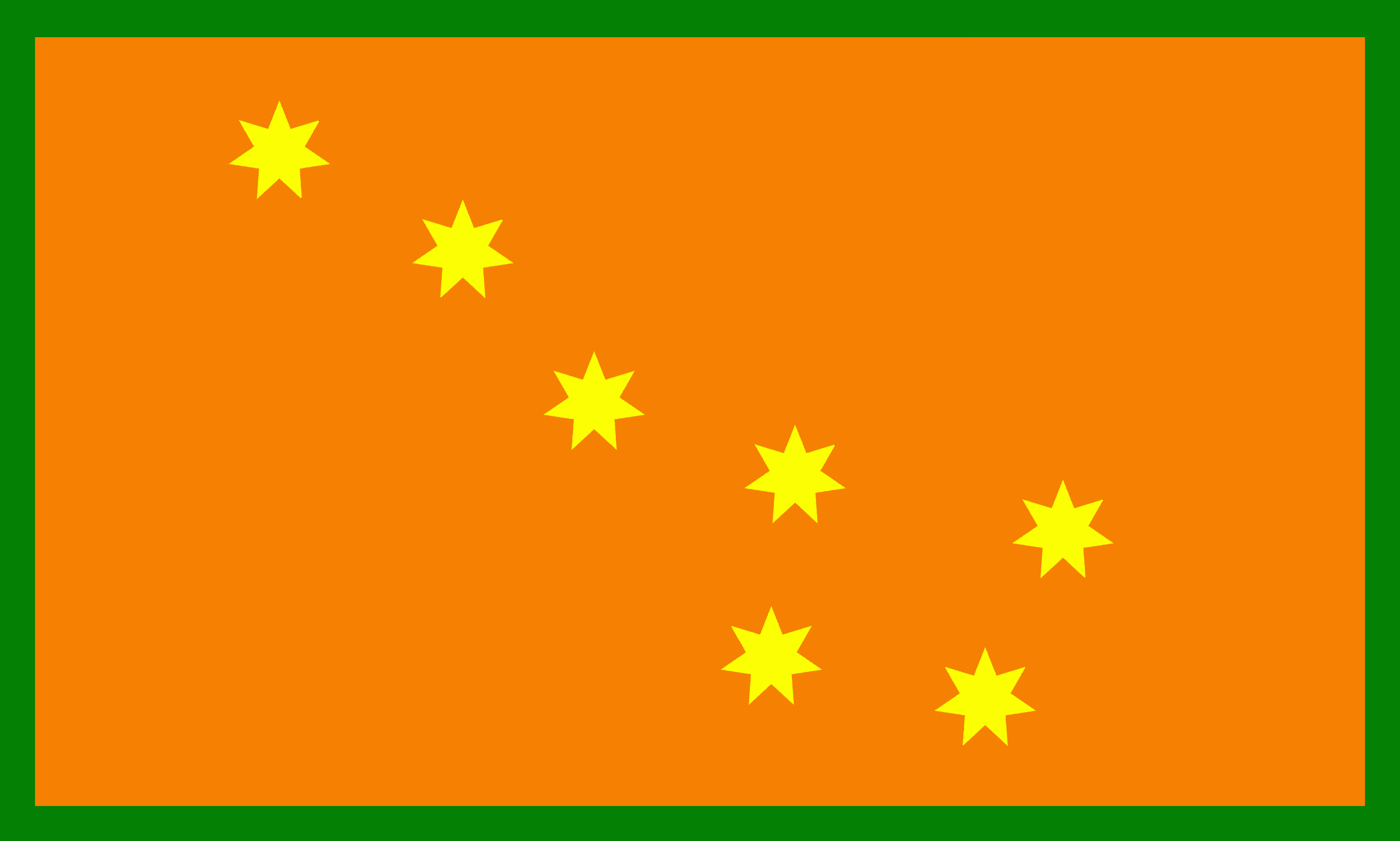
The flag contains seven gold stars in the shape of the Big Dipper, or Ursa Major, on an orange field with a green border. Ursa Major is an important constellation to several tribes within the Cherokee Confederacy. It also symbolizes how the same night sky shine over the entire Cherokee Confederacy. Blue would seem a natural color choice, but the Cherokee picked orange instead. There is some debate about why this is. Popular belief says that it symbolizes the Cherokee Confederacy’s ties to New Netherlands. However, the Cherokee actually picked orange to contrast with the blue flags several other North American nations use. The green border is to offset the orange.


Tuesday, May 10, 2022

Flag of the United Provinces of Markland

This is the flag of the United Provinces of Markland. It comes from a world in which the Norse colonization of North America was more successful. The Norse expanded into mainland North America. Most of the settlements were founded by Christians. However, some pagans also established colonies in hopes of escaping persecution in the Old World. Unfortunately, Christians had a numeric advantage, and forced the Pagans further into the interior of North America. Still, the Pagans made the best of things, and there was some trade between pagan and Christian settlements. Christian settlements tended to be based around agriculture and fishing, while Pagan settlements placed emphasis on fur trapping and hunting. 

Knowledge of the Americas eventually spread to the rest of Europe, and other nations began to send their own expeditions. The indigenous peoples were exposed Old World diseases, but managed to recover their numbers by the time Europeans arrived in earnest. There are several independent indigenous nations, such as the Haudenosaunee and Lenape nations. Both nations are close allies of Markland. Christian Marklanders traditionally had a tense relationship with the indigenous peoples. By contrast, Pagan Marklanders were generally on more amicable terms with the Native Marklanders, and intermarriage wasn’t uncommon. This lead to a creation of a new culture of mixed race Marklanders. We might consider them akin to the Métis of our world.

In time, Markland began to view itself as separate from Scandinavia. This ultimately culminated in a war of independence. The Markland War of Independence saw Christians and Pagans fighting side-by-side to defend their homeland. This caused Christians and Pagans to view each other not as separate cultures, but as a single people sharing in a common destiny. The United Provinces of Markland includes most of what would have been the eastern provinces of Canada, as well as the New England states, Long Island, and New York City.

The United Province of Markland is governed by a bicameral legislature known as the Althing. The head of state known as the Speaker of the Althing. The Speaker is voted on by the people and serves a term of six years, and can be re-elected for only one more term afterward.

The Constitution of Markland places emphasis on protecting the rights of minorities, such a pagans. All provinces can declare an official religion, but they cannot penalize other religions, or lack there of. However, Pagan majority provinces are granted more leeway with what they are allowed to do, in accordance with the Constitution. Some conservative Marklanders grumble about this. They feel that pagans wield a disproportionate amount of influence in the Althing; especially given that Pagans only comprise about twenty percent of Markland’s population. However, most Christian Marklanders are perfectly willing to give small concessions to the Pagans.

Marklander Christianity is highly syncretic. Pagan Marklanders might bless a field by pulling a wagon with a statue of Freyr or Thor around it. Christian Marklanders would preform pretty much the exact same ritual, but with a statue of St. Olaf instead. The raven, rather than the dove, is consider the symbol of the Holy Spirit in Marklander Christianity.

This symbolism extends to the flag. The flag is based upon the famous Raven Banner. It is a grey triangle pennon with two ravens. The ravens represent both Christians and Pagans, and symbolize how Markland is the product of both cultures. Some conservative Christians, however, note that two raven could also symbolize Huginn and Muninn, the ravens of Odin. Conservative Christians have tried, unsuccessfully, to get the flag changed to include only a single raven. However, most Christin Marklanders are perfectly happy with the flag just the way it is, and think it look very nice.


Wednesday, May 4, 2022

Flag of the Gallic League

This is the flag of the Gallic League. It comes from a world where Carthage won the Punic Wars and crushed Rome. Carthage and Greece did establish some colonies across the Mediterranean, and even sent expeditions up the major rivers of Europe. However, neither created a vast spanning empire the way Rome would have. Gaul remained divided between numerous tribes and city-states. The southern regions saw lots of influence from Carthage and Greece as a result of trading ports. Greco-Carthaginian influence begins to tapper off the further north one travels. Over time, the city-states of Gaul began to establish a series of trading alliances with one another, and this would eventually lead to a political alliance. Thus, the Gallic League was born.

The thinking was that the city-states of Gaul could do more by pooling their resources than any of them could individually. The city-states are divided into a series of cantons, each of which has a high degree of autonomy. The cantons administer to their personal affairs, while the League government deals with diplomacy and international relations. The League capital constantly moves around. This way, no one canton can wield more influence than the others. The Gallic League has proven to be quite successful, and can easily stand as an equal to major powers such as Carthage, Greece, and Egypt.

The Gauls have developed a written language using a modified form of the Greek alphabet. Several Greek philosophers have opened schools on the southern coast of Gaul. The Gauls also learned shipwright technics from Carthage, and the first expedition across the Atlantic was lead by Gauls. Gaul established a few colonies in the New World, but the indigenous people were largely able to resist colonization. That said, many indigenous peoples of the Americas did become valuable trading partners for Gaul. Gaul gained considerable wealth by acting as the middle man to the products of the New World. On the whole, the Gallic League is one of the biggest success stories of the world created by Carthage’s victory in the Punic Wars.

The flag is a green pennon with a gold boar on it. The boar is consider the most important animal to the Gauls, and the green references to the lush forests and fields of Gaul.


Sunday, April 24, 2022

Flag of the Inca Empire

This is the flag of the Inca Empire. It comes from a world where the Inca were able to defeat Pizarro and his troops, and resisted Spanish conquest. The naturally mountainous terrain of the Andes helped give the Inca a considerable boost in self-defense against other European powers. The Inca played the various European powers off of each other to preserve their independence. The Inca initially considered a policy of isolationism, but this would prove untenable. Though, initially, the Inca limited their interactions with the Europeans as much as possible. 

As time went on, the Inca began to study and replicate European technology and ideas. The first major change being the introduction of gunpowder weaponry, and the establishment of permeant standing army. The Inca also established a formal written language; with its alphabet largely based on the Latin Alphabet, but with some unique flourishes. The Inca had been ravaged by smallpox, and other Europeans diseases, though not quite to the extent they were in our world. Naturally, the Inca sought out the vaccine for smallpox as soon as it became available in the 18th Century.

The 19th Century saw the next major wave of reforms. The Incan government reformed into a parliamentary democracy, with limits set on the Sapa Inca’s powers. The first stages of industrialization also began at this time. The Inca adopted Western styles of clothing, but mixed in their own designs and color choices. Indeed, to this day, the Incan clothing is known for its unique mix of Western and Indigenous designs. However, more traditional style clothing can be found at important events, such as major religious festivals, or the crowning of a new Sapa Inca.

Today, the Inca Empire is a prosperous modern nation. Cusco, the nation capital, is a true global city. It is home to several universities, museums and art galleries, restaurants, and temples that are the envy of the world. The Quechua people are the largest ethnic group within the empire. However, the empire is home to many other ethnic groups including, among others, Aymara, Mapuche, Wayuu, Het, Polynesians, and even Amazonian tribes. The Inca Empire also receives many immigrants from around the world.

Incan citizens enjoy a very generous social safety net. Government-funded healthcare is provided to all citizens, though private insurance also exists. The Department of Employment provides jobs to all citizens who find themselves unemployed. In the event that a citizen cannot fulfill any available jobs, they are instead given a welfare payment until new jobs become available. The Department of Culture helps provide funding for the arts. Some citizens, of course, cannot attend performances of the arts due to their financial circumstances. In this case, they can apply for free vouchers from the Department of Culture. This all means that most Inca citizens have fairly high taxes, but most consider the trade-off worth it.

The flag includes a stylized depiction of the sun god Inti. The Inca still largely follow their traditional religion; though secularism is on the rise. The blue symbolizes how the same blue sky stretches over all parts of the empire. In the corners of the flag are four chakana; a common geometric shape found in art across various Andes Civilizations. They are in the four corners of the flag in reference to the Inca Empire’s official name, Tawantinsuyu, which means Land of the Four Corners.


Saturday, April 23, 2022

The Alt-Hist File: Prototype World of Tomorrow: The Infinite Journey

I’ve been on a roll reviewing the latest seasons of several audio dramas. We find ourselves once again at Prototype World of Tomorrow, a show I utterly adore. Not much more to add, so let get on to the main event. We’ve taking a look at season three of Prototype World of Tomorrow: The Infinite Journey


Just to recap, Prototype World of Tomorrow is set in a world where Walt Disney’s dream to build an Experimental Prototype Community of Tomorrow became a reality. Everyone in Progress City is gearing up for the Eleusinian Tournament. It is a competitive video game tournament, and Tim E. Less is determined to win with a little help from his friends. This year, the players will be dematerialized, and reassembled within the game itself. It might seem like fun and games, but lurks around every corner within the digital world. Tim’s fellow private investigator, Eve R. Moore, wants him to help her investigate the companies behind the Eleusinian Tournament from within. Hold on tight, Tim and the gang are about to take a journey beyond their wildest imagination.

I think by know that it should be obvious that I absolutely adore Prototype World of Tomorrow. It started off strong with season one, and continued the momentum with season two. So, how does season three do? Quite well indeed. As usual, there are numerous references to Disney Park attractions. Specifically, there are numerous references to all three incarnations of Journey into Imagination. Contestants exit the game through a rainbow tunnel, as a nod to how Journey into Imagination featured a rainbow tunnel. Fun fact, the Journey into Imagination tunnel also appears in one of Michael Jackson’s music videos. At one point, Tim and company meet a computer program that takes the form of a purple dragon. Obviously, this is meant to be Figment, and I shall refer to him as such from here on out. Figment mentions that he used to have a friend, but hasn’t seen said friend in a while. This is a reference to Dreamfinder, and how he was absent from both the Journey into Your Imagination and Journey into Imagination with Figment incarnations of the ride. Speaking of which, Ron Schneider, who played Dreamfinder, once again returns as one of the computer voices.

This segue’s nice into my next point. The game for this years tournament is partially powered by the players’ own imaginations. Oh, there are servers, very powerful ones, but part of the computing power is offset by utilizing the players’ own minds. For example, when Tim and his teammates look at a berry, it looks different to all of them, because everyone has their own mental image of how a berry should look. Though as mentioned, the servers do play some role. For example, all of the trees share the exact same four designs. Honestly, using the contestants’ own minds to generate the game was actually kind of brilliant. I haven’t really seen anything quite like that in fiction about virtual reality. I especially liked some aspects of the game being subjective based on the players’ own imaginations. Let it never be said that Ben Lancaster is lacking in creativity and imagination. Also, the part where the announcer says “right now there’s not a whole lot going on in your imaginations” was a nod to Journey Into Your Imagination, when Eric Idle says the same thing.

Oh, and one more reference. In the first episode, Tim is excited that his friends got handwiches. Handwitches were a short lived Disney food item. They were billed as the sandwiches of the future by then Disney CEO Michael Eisner. Handwiches were bread cones which held a variety of both sweet and savory fillings. Unfortunately, pretty much only Michael Eisner thought they were a good idea. Even the people working the handwich stands were skeptical of them, and handwiches died a swift death. Still, handwiches developed a minor cult following. In fact, they became a minor meme after Defunctland made a video about them. It also occurs to me that Bonnie, the waitress at Tim’s favorite greasy spoon, might possibly be a reference to Bonnie Appetite from Kitchen Kabaret.

Now, lets talk about the new characters. Tim’s team is down a player, so they take on Pauline, who works at the same company as Tim’s girlfriend Annie. At first, Tim doesn’t want Pauline on the team, and it was at this point I worried that this season was going to become one of those preachy “gamers are sexists” stories. Thankfully, that turned out not to be the case. Tim just wants to have a chance to play alongside his buddies, and proudly admits to having lost to numerous all-female teams in the past. Pauline has a true passion for retrogames, but Tim and his team initially dismiss her because of this. And yet, not too long after this, they mention that past Eleusinian Tournaments have incorporated elements of retrogames. So, one would think that they wouldn’t be so quick to brush her off. Initially, Pauline comes across as introverted, shy, and slightly dorky. In fact, at first I wondered if perhaps she might have autism. You don’t often see women with autism depicted in fiction. However, once everyone gets into the game, she becomes far more confident and in her element.

I also really liked Tim’s friend Morris. He’s a huge paleontology nerd, and is very excited that this year’s game has a dinosaur theme. He can name all of the dinosaurs, and other prehistoric animals, and rattles of a list of facts about each of them. He must be really good at the game right? Yeah, no. He get’s killed in the tutorial of the game, but he emerges from the game with little more than a bruised ego. Yeah, that would be me in that scenario. I also have a deep love of prehistoric animals, and with my luck, I’d probably get killed in the tutorial as well.

There is an obvious comparison to TRON with this season taking place in the digital world. However, while the programs interact with humans, their appearance isn’t as anthropomorphized as programs are in TRON. It is explain that the processing power of the severs is far faster than that of a human mind. I looked it up, and that does check out. As such, a human mind can’t be plugged directly into the computer mainframe. Thus, programs are rendered as series of geometric shapes.

Well, mostly. We do meet a program who looks suspiciously similar to Eve’s supposedly dead fiancé. We don’t get confirmation as to whether or not it really was him. That having been said, many strange things have been shown to happen in Progress. Personally, if I was the gambling sort, I’d put money on it actually being him. I’ll be genuinely surprised if it turns out it wasn’t actually him. But I guess we’ll have to wait and see what future seasons have in store for us.

The virtual world setting does provide some humorous moments as well. At one point, Eve hacks into the game, and enters via the microphone she gave Tim. However, because Tim swallowed the mic, Tim winds-up vomiting Eve into the game. This is one of those time that it is good that Prototype World of Tomorrow has no visual component. That scene would probably be pretty terrifying in a visual medium. There were points were it seemed that something would go wrong, and the characters might get mutated or glitched somehow. My personal speculations was that somehow everyone would switch bodies. It would be interesting to see the actors portray each other’s characters. But it would seem that I was wrong.

I liked the part where Tim and company muse on the fact that the game contains temple ruins. Does this mean that humans and dinosaurs coexist in the game? Or did the dinosaurs develop their own religion? My take? Probably a nod to how early video games often featured ruins that often seemed to have no function beyond being ruins. There’s also a scene at a digital circus where Pauline eats some peanuts, and notes that she’s a allergic to peanuts in the real world. She finds them to be okay. 

Series creator Benjamin Lancaster has a deep love for the original EPCOT theme park. That loves really shines through in this season, even more so than usual. 

And so there you have it. The Infinite Journey, season three of Prototype World of Tomorrow, keeps up the momentum of its predecessors. Prototype World of Tomorrow has bowled a turkey; three-for-three for great seasons of alternate history science fiction goodness. I can’t wait to see what surprise season four will have for us. From the looks of it, some exciting stuff is on the way.

Speaking of exciting stuff, I’d like to take a moment to talk about one of the projects Brian Ballance, the voice of Tim, is up to. He has recently started a podcast called The Interesting Podcast. As the title says, he interviews people he thinks are interesting. For example, he interviewed, Callie Wills, the voice of Eve. I would encourage everyone to go checkout Brain’s podcast.

Well, I think that should do it from me for now. I will see you guys next time. 

Wednesday, February 9, 2022

The Alt-Hist File: Age of Confusion: Season 2

We’re already over a month into the new year, and that means I need to get around following up on my reviews. Today’s review is the first step in that direction. There isn’t much more to add, so let’s get straight to it. We’re taking a look at season 2 of Age of Confusion


To recap, Age of Confusion is an alternate history podcast, but told in the style of an non-fiction history podcast. It imagines a world where John. F. Kennedy survived his assassination attempt, and examines how history changes from there. Last time, we left off with the election of George Romney in 1968. Romney takes office in a time of change and turmoil. The Counterculture Movement is in full swing, and will bring big changes to the American cultural landscape. Meanwhile, Soviet Premier Alexander Shelepin is gaging Romney’s character. Shelepin, and his counterparts in East Germany, have been eyeing West Berlin hungrily. Back in America, both political parties are already focusing on the 1972 Election. It is an age of wonders, it is an age of terrors, but above all else, it is an Age of Confusion.

For those who have missed my review of season 1, you can find that over here. I thought that season 1 of Age of Confusion was absolutely fantastic. Season 2 not only matched its predecessor in terms of quality, but also exceeded it. Sean Munger built upon the groundwork he laid in season 1 to great effect. This was a season where a lot of shoes dropped. The intro to each episode lets us know that three things are going to happen: West Berlin will be invaded by East Germany, Robert F. Kennedy will be elected President, and something is going differently for the Apollo program.

First, let’s talk about President George Romney. Sean portrays Romney as a good man at heart, and someone who genuinely wants what is best for the America. However, that goodness is also Romany’s biggest weakness. Romney simply doesn’t know how to play the game of politics, and quickly finds himself way over his head. Romney doesn’t get as much flack for his Mormonism as you might think, but I think this makes sense. Most Americans had never heard of Mormons in the late 1960/early 1970s. Romney also specifically speaks of his strong Christian faith, but not specifically his Mormonism. In other views, Romney is a strong supporter of civil rights for African-Americans and Native Americans.

The one true success of Romney’s presidency is that he gets Medicare passed. JFK was unable to do this, as he did in our world, due to focusing on getting the Comprehensive Civil Rights Act passed. Romney takes office in the middle of a recession, and he argues that Medicare will help take financial burdens off of the American people. He also allows individuals age twenty-five and under to be covered by Medicare. Medicare is a big hit with the American people, but Republicans are absolutely furious. Many claim than Romney isn’t a true Republican. Romney winds up pretty much destroying the moderate wing of the Republican Party. The 1960s and 1970s were when the Democrats and Republicans solidified into their current forms. Before that, both parties had members from across the political spectrum. Kennedy, was a Democrat, and supported Civl Rights, but he also had to fight against members of his own party who opposed the Civil Rights Act.

I liked that this season also took time to focus on alternate history related to pop culture. A band called Refraction becomes America’s answer to The Beatles. Sean says that he had this happen because he was unsatisfied with how America never produced a band capable of rivaling The Beatles. The members of Refraction collaborates with director Frank Perry to make a movie adaption of the novel On the Road. Said adaptation is a massive hit, and wins a bunch of Academy Awards.

Meanwhile, Elvis Presley’s wife introduces him to L. Ron Hubbard. Elvis becomes very close to Hubbard, converts to Scientology, and donates a bunch of money to the Church of Scientology. I’m not sure if I can see this happening. Elvis was an extremely devout Christian in our world. In fact, he refused to be called The King because he thought it was blasphemous. Priscilla Beaulieu Presley did become a Scientologist in our world, but that was after Elvis’ death in 1977. Though, I guess anything is theoretically possible.

The outcome of the Moon Race is…underwhelming. Sean said that the Space Race wouldn’t be getting much focus, but it feels like it was tacked on almost as an afterthought. Romney guts NASA’s budget at a critical moment, and this allows the Soviets to get their act together and land a manned mission on the Moon first. There were a lot of politicians in our world who wanted to defund NASA on the grounds that the money could be better spent on programs on Earth. Walter Mondale is one example that comes to mind. It is also theoretically possible that the N1 rocket could have gotten a Soyuz craft to the Moon. So, this is a reasonably believable scenario. Still, it could easily have been an episode in and of itself. Actually, it could potentially be multiple episodes. I can’t help but feel that there was a massive missed opportunity here.

Let’s move onto something that was most certainly not a missed opportunity. East Germany is concerned about the brain drain they suffer thanks to West Berlin. Alexander Shelepin agrees, and decides that the time is right to finally invade West Berlin. Shelepin deemed Romney to be a weak-willed pushover, and didn’t expect any serious consequences. The war machine springs to life, and both West and East are on high alert. Soviet and East German troops move into West Berlin, while NATO forces mobilize to counter them. Citizens on the East Coast of America are told to head for the bomb shelters and prepare for the worst. The military is at DEFCON 1, and President Romney must decide if he should push the button or not.

Oh, and wouldn’t you know it, pretty much the entire presidential cabinet is away on various trips. Romney takes some time to pray and makes his choice. He knows that Shelepin is a madman who will make good on his threats of retaliation. Romney decides he will let the Soviets have West Berlin, but American forces will evacuate anyone, regardless of nationality, who wants to be evacuated. Hundreds of thousands of citizens are evacuated from both halves of Berlin. More importantly, all of the intellectuals and educated workers are successfully evacuated. And so the Berlin Wall falls twenty years ahead of schedule. Unfortunately, it falls because Berlin is united under communist rule.

Shelepin technically succeeded, as now Berlin is united under East German rule, but the brain drain is even worse than if he’d done nothing. A victory, but a rather pyrrhic one. On the other hand, relations between the NATO nations are seriously strained. West Germany is furious that America threw them under the bus. Britain and France also fear that America may betray them to the Soviets.

Still, Shelepin does find other bits of success. He manages to pretty much completely reverse the Sino-Soviet Split. Shelepin also enacts a new wave of political purges, but not quite to the extent that Stalin did. He doesn’t have enough charisma, and isn’t enough of a people person, to start a cult of personality like Stalin did. The Chinese Cultural Revolution goes pretty much exactly as it did in our world. The biggest difference is that Mao dies about five years ahead of schedule. That’s definitely going to have an impacts on future seasons of Age of Confusion.

As you might imagine, the events of the Berlin Crisis play a major role in the 1972 Presidential Election. It comes down to Ronald Reagan vs. Robert F. Kennedy. As for how that line-up come to be, I’ll leave that for you to discover. Obviously, we know from the intro that Kennedy wins. Ultimately, it was the war scare that swing things. Americans wanted someone who was going to deescalate things with the Soviets, not ramp them up. George Wallace also ran again, but only managed to win three states this time round. Of course, the real fun is going to start next season, when RFK officially takes office.

That covers all of the major points I wanted to discuss. There’s still several bits that I didn’t mention, but I’ll leave those for you to discover. Season 1 of Age of Confusion was amazing, but it was just the warm up act. Season 2 is where the fun really starts. Sean has said he wants to take some time off to rest before working on season 3. I can respect that. It is import to avoid overexerting yourself in your creative endeavors. There’s no shame in taking time off to rest and recuperate. And hey, based on how season 2 turned out, I know that season 3 and 4 will be absolutely amazing. I can’t wait to listen to them whenever they come out.

Well, I think that should do it from me for now. I will see you guys next time.