Showing posts with label flags. Show all posts

Friday, December 8, 2023

Flag of the Union of Sovereign Republics

This is the flag of the Union of Sovereign Republics. It comes from a world where the government of the Soviet Union discovered the plot by hardline Communist Party members to stage a coup. The leaders of the planned coup were arrested, and this meant that the New Union Treaty was signed into law. The Soviet Union reorganized itself into the Union of Soviet Sovereign Republics. The first wave of reforms were somewhat modest, but they allowed for capitalism, and investments from foreign businesses, to make inroads to the USSR. This provided a much needed shot in the arm to the Soviet economy. This led to a weakening of the independence movements among the constituent republics of the USSR.

Economic reforms soon lead to political reforms. Genuine opposition parties were allowed to run starting in the late 1990s. This led to a weakening of the Supreme Soviet, and by the mid 2000s, the USSR had transitioned into a full democracy. Its name officially changed to the Union of Sovereign Republic to better reflect this new nature. Thus, the Cold War came to a somewhat anticlimactic end.

The Union of Sovereign Republics emphasizes devolution of powers. The national government handles matters of international diplomacy and national defense. Meanwhile, the constituent republics are given considerable leeway. They can declare their own official languages, establish their own educational systems, establish their own legislative assemblies, and pass their own internal laws. The national constitution also holds all constituent republics to be equal, and protects the rights of minority groups. The USR is working towards redressing the grievances the Soviet Union committed against non-Russian ethnic groups.

Relations between the USR and the USA are fairly friendly and cordial. The two nations have increasingly collaborated over the years. For example, they collaborated on a joint manned mission to the Moon in 2015. Surprisingly, there’s even talk have having the USR join NATO. However, that’s on hold at the moment.

China has not fared well in the 21st Century. The Chinese economy is in shambles. Western businesses never really invested in China. Most international production facilities are instead located in the USR and India. China is plagued by political unrest, and government crackdowns are increasingly common. China relied on Russia to keep America in check. However, the increasing closeness of the USR to America has sent Chinese leaders into a panic. The USR and USA are watching China with increased wariness, particularly after China’s invasion of Vietnam in 2019.

Time will tell what becomes of this. For now, however, the Union of Sovereign Republic enjoys economic prosperity and a high standard of living. For the first time in a long while, things are looking up for the peoples of Russia and Central Asia.

The blue doesn’t have any official meaning. Though, some take it to mean that the same blue sky is shared by all members of the Union of Sovereign Republics. It also contrasts with the red of the old Soviet flag. The eight bent poles represent the equality of all the constituent republics of the USR. The white is to offset the blue, and make the flag look a bit less like the old Soviet flag.


Thursday, May 11, 2023

Flag of Buddhist India

This is the flag of Buddhist India. It comes from a world where Buddhism remained the dominate religion of India. It began during the reign of Ashoka the Great. As in our world, Ashoka converted to Buddhism after spending much of his life as a warlord who united much of India. Unlike our world, however, Ashoka formalized the relationship between the Sangha and the secular government. Ashoka’s system can be thought of as similar to the role the Catholic Church played in Medieval Europe in our world. Buddhist monasteries received funding via taxes, and the monks often involved themselves in the affairs of the state.

Another result of Ashoka’s reforms was that the Maurya Empire lasted several centuries longer than it did in our world. The empire covered almost all of the Indian Subcontinent, and its continued existence lead to a sense of Pan-Indian identity. In fact, the Maurya Empire would come to hold the same cultural significance in India as the Roman Empire does in the West, and the Han Dynasty does in China. All future Indian empires would, to varying degrees, attempt to emulate the glories of the Maurya Empire.

The changes resulting from Ashoka’s reforms ultimately meant that Vedantic Hinduism never came to be. However, life for the average Indian didn’t really change all that much under Buddhism. Most people continued to worship the same local gods they always had. The old traditions mixed freely with the new. For example, you might go to the Buddhist temple to pray for enlightenment and contemplate philosophy. However, if your child got sick, you would pray to whoever the local healer deity happened to be. The caste system never came to be, but there was a still a strict social hierarchy within Indian society.

In time, several Buddhist monks began to study the natural world, and developed natural philosophy of a sort. This led to several discoveries and innovation, the most significant of which was the discovery of gunpowder. India went on several campaigns of expansion. Several of these were nominally to spread Buddhism, but in practice, were really about expanding India’s political and cultural power. India conquered Persia, and even managed to push as far west as Egypt and the Levant. However, holding these lands proved harder. The empire shrank to only the Indian Subcontinent in a little over 100 years. However, this brief period of expansion did lead to Buddhism spreading further. Iran follows a combination of Zoroastrianism and Buddhism, and Central Asia is majority Buddhist. Southeast Asia is also majority Buddhist. It also helps that Islam was never found in this world.

Buddhist remain a significant minority in the Near East. Unfortunately, there have also been numerous conflicts between Buddhists and Christians in these lands. Buddhism never made major in-roads in Europe, barring a few minor communities in the Balkans. There were some Buddhist communities in Spain and Southern France, but they were whipped-out by Christian forces. Unlike our world, most Westerners do not stereotype Buddhists as being pacifists. In fact, due to a misunderstanding about Buddhist belief in reincarnation, many Christians stereotyped Buddhists as being violent, and having an incredibly cavalier attitude towards human life. However, during this world’s equivalent of the Enlightenment, several European scholars began to re-examine and reevaluate Buddhism. Though, they also often viewed it through a heavily Orientalist lens.

The flag is orange and maroon in reference to the colors of Buddhist monk robes. The white is to offset the orange and maroon. The Wheel of Samsara, also known as the Wheel of Rebirth, is displayed prominently in the center of the flag.


Saturday, April 29, 2023

Flag of the Commonwealth of New England

This is the flag of the Commonwealth of New England. It comes from a world where the Huron won the Huron-Iroquois War of 1648-1650. This resulted in the complete destruction of the Iroquois Confederacy. Some Iroquois were absorbed into other tribes, including the Huron themselves. The Huron’s victory meant that their vast trading network was never disrupted. This meant that Europeans weapons were able to make their way towards the interior tribes of North America. This made Native American tribes better able to resist European colonialism. New England remained involved in the fur trade longer than it did in our world. Meanwhile, the Huron largely cut France out of the fur trade. 

Another result of all this was that King Philip's War never happened. There were still armed conflicts between the English colonists and Native Americans, but they were part of the larger English-French rivalry. New England never got drained economically by King Philip's War and remained financially self-sufficient. Before long, many in New England began to question if they needed to remain part of England. The Commonwealth of New England formally declared its independence in the early 1700s. It initially included the New England Colonies plus New York and New Jersey, but later expanded to include Pennsylvania, Maryland, and Virginia. The Middle Colonies faced competition and raids from tribes allied with the Hurons.

By the present day, North America is a patchwork of nations. There are several Native American tribes who were able to maintain their independence and carve out nationstates. Canada has remained largely French, while to the south, the Republic of Grand Florida also includes what would have been the Carolinas. Towards the west lies the nation of Caddo, a result of English and French settlement in Texas.

The New England government takes inspiration from the Roman Republic. It is a bicameral legislature composed of a People’s Council and a Senate. The Council is directly voted on by citizens of New England, and serves as the lower house. The citizens also elect the two praetors, who serve as the co-heads of the executive branch. The Senate is the upper house, and is composed of experts in various fields, as well as former governors and praetors. Praetors serve a single term of six years, while members of the Senate serve for life. Elections for the Council happen every four years. All political parties receive proportional representation within the Council. Praetors are not required to share the same political party. In fact, many people feel it is better when they don’t, as they will keep each other in check.

New England isn’t a major world power like the United States in our world. It is more comparable to Japan or the United Kingdom of our world in terms of international influence. However, New England is quite wealthy, and quite involved in international trade and commerce.

This is reflected in the design of the flag. A golden New England clipper ship is proudly emblazoned in the center of the flag. The green references the forests of New England, and the white recalls snowy New England winters.


Friday, April 21, 2023

Flag of the Neo-Hanseatic Republic of Welserland

This is the flag of the Neo-Hanseatic Republic of Welserland. It comes from a world where German settlers established a colony on the northern coast of Venezuela. The initial agreement was that the German settlers would help settle the interior of Venezuela, and produce goods and resources. Settlement would, in theory, be administered by all the kingdoms of Germany. It was hoped that the colony would help give rise to a new Hanseatic League. Unfortunately, this did not come to pass. However, people from all different parts of Germany began to flood into the colony. This gave the colony a very eclectic flavor. It was named Welserland as a reference to Klein-Venedig, the previous attempt by Germany to colonize Venezuela.

The interior mountains have a temperate climate, and allow for the production of crops such as crops such as peaches, strawberries, cabbage, carrots, beets, cauliflower, and lettuce. In fact, the interior mountains wouldn’t be out of place in Bavaria. The coastal regions have a more tropical climate, and allow for the production of crops such as bananas, mangos, oranges, and coffee. Coffee production formed the backbone of Welserland’s economy during its early days. On paper, Welserland was considered part of Venezuela, and merely leased to the kingdoms of Germany. As time went on, however, the Germans exerted greater control over Welserland. Venezuela made various attempts to get Germany to back down, but these never amounted to much. This came to a head following the unification of Germany in 1871. Germany formally purchased Welserland from Venezuela to establish a foothold in the Caribbean and South America.

Welserland enjoyed several decades as a province of the German Empire. Then the First World War broke out. Welserland found itself in the crosshairs of Britain and France’s Caribbean colonies. As the war dragged on, and the odds of a German victory diminished, many in Welserland began to worry about their future. It was decided that independence would be the best course of action. Welserland officially declare independence from Germany in 1917. Welserland added the titled Neo-Hanseatic to its name in reference to its roots as an attempt to revive the Hanseatic League. Welserland survived by playing Britain and France off of each other. It also courted a powerful new ally in the form of the United States. The United States helped ensure that Venezuela didn’t attempt to re-annex Welserland.

Against all odds, Welserland has managed to survive to the present day. It has become a popular destination for German tourists, but they are far from the microstate’s only visitors. Tourists from around the world come to visit the little slice of Germany on the coast of South America. Tourism makes up a big part of Welserland’s economy, and it is also home to many casinos and resorts. It is generally agreed that, of all the nations in the Western Hemisphere, Welserland makes the best beer. In fact, several Welserland breweries have won major awards for their beers. In the past, money laundering, offshore banking, and the illegal drugs trade also formed major contributions to Welserland’s economy. However, they have put all of that behind them…for the most part.

The flag includes the traditional German colors of black, red, and gold. A Lutheran Rose Seal sits in the middle of a St. Andrew’s Cross. Lutherans are the largest religious group in Welserland, but Catholics form a sizable minority. Welserland also has decent-sized communities of Orthodox Christians and Jews.

The flag has caused some controversy with American tourists, due to its superficial similarity to the Confederate Battle Flag. Welserlanders find this rather annoying. They are frequently quick to remind Americans that Welserland sent non-combative volunteer regiments to help fight against Nazi Germany during World War II. Welserland also welcomed Jewish refugees with open-arms during World War II. In fact, most of Welserland’s Jewish community is descended from these refugees.

Some Catholic and secular-minded Welserlanders dislike the inclusion of the Lutheran seal on the flag, and have been known to cut it out. Of course, this also leads to the flag looking even more like the Confederate Battle Flag, so many support keeping it, if only so the American tourists will shut up.


Saturday, February 4, 2023

Flag of the Federation of Patagonia

This is the flag of the Federation of Patagonia. It comes from a world where Britain conquered Argentina and Uruguay in the early 19th Century. Patagonia is a highly developed nation, and is often referred to as the Canada of the Southern Hemisphere. Patagonia also includes part of southern Chile. Chile has never forgiven Patagonia for annexing this land. Though, this occurred during the days of direct British rule. The Falkland Islands are considered indisputably Patagonian territory. 

Like Canada, Patagonia is the result of the bending of two European peoples. In this case, British and Spanish. However, also like Canada, said people have historically had their tensions.

Northern Patagonia has historically been the heart of Hispanic culture. Meanwhile, Southern Patagonia has historically been majority Anglo. The name Patagonia used to refer to the region that became the southern provinces, but grew to refer to the nation as a whole. The ruling Anglos felt that Argentina and Plata were too Spanish for their taste. Hispanic Patagonians were pushed further and further north for much of the 19th Century. In fact, Buenos Aires and Montevideo used to be majority English-speaking cities. Though, Spanish speakers still accounted for a healthy forty percent of Buenos Aires and Montevideo’s population. Patagonia also experienced far less Italian immigration than Argentina did in our world. Catholic Italians weren’t eager to move to a colony of Protestant Britain. Subsequently, Patagonian Spanish has much less Italian influence than Argentina Spanish of our world. The northern provinces, initially, tended to be poorer than their southern counterparts.

Things would begin to shift starting in the 20th Century. Industry began to invest in the northern provinces of Patagonia. The influx of industry lead to an increase in wealth among Hispanic Patagonians. Several baby booms occurred during this time, ensuring that Hispanic culture would survive in Patagonia. Hispanic Patagonians made major political gains in the Patagonian parliament. Bilingualism became official government policy starting in the 1950s. Packaging is required to be printed in both English and Spanish, signs are printed in both languages, and all government documents are printed in both of the official languages. There are also numerous Spanish-language schools and universities, though most are located in the Hispanic-majority northern provinces.

Patagonia remains culturally divided among geographic lines. However, tensions have relaxed between Anglo Patagonians and Hispanic Patagonians. Patagonia is also home to immigrants from throughout the world, and prides itself on being a refuge for those seeking better lives. Patagonia has a friendly rivalry with Canada. Canada is referred to by Patagonians, with tongue planted firmly in cheek, as the Patagonia of the Northern Hemisphere.

The flag was officially adopted in the 1970s. Prior to that, Patagonia used a British Red Ensign. Care had to be taken, when designing the new flag, not to favor Anglos or Hispanics. The colors evoke the landscape of Patagonia. The white represents the snow-capped mountains, while the ice blue represents the glaciers. The shape is meant to evoke the textile work of Indigenous Patagonians. The three guanacos were chosen as a symbol beloved by Patagonians of all cultures. In fact, the guanaco is the official mammal of Patagonia.


Tuesday, June 14, 2022

Flag of the Pueblo Sultanate

This is the flag of the Pueblo Sultanate. It comes from a world where the Ottoman Empire established colonies in the New World. The Ottomans began in the Caribbean, and soon went on to conquer Mexico. Eventually, the Ottomans made their way to the American Southwest, and subjugated the Pueblo peoples. Life was harsh for the Pueblo people under Ottoman colonialism. Pueblo people were forced to toil away in silver mines to feed the Ottomans’ hunger for precious metals. Several madrasas were established with the intent to convert the Pueblo peoples to Islam. In theory, the madrasas would provide aid, education, and social services to the Pueblo people. In practice, however, the imams often subjected their charges to horrific abuse. Despite this, Islam did manage to spread among the Pueblo peoples. The Pueblo peoples begged for a savior. But where could he be? 

The Pueblo people received their answer in the form of a charismatic preacher named Po’Pay. Despite the similar name, he is a separate individual from the Po’Pay of our world. This Po’Pay preached the highly syncretic religion that combined indigenous Pueblo beliefs with Islamic liberation theology. This was in sharp contrast to the Islam of the Ottomans, which frowned upon syncretism, and suppressed indigenous beliefs. Po’Pay teachings began to spread, and soon Po’Pay a revolt against the Ottomans. Though the fight was hard, at last the Pueblo peoples were free from the Ottoman yoke. The Pueblo peoples began to think of themselves not as a collection of disparate tribes, but as a united people sharing in a common destiny. 

 Po’Pay organized the tribes into a sultanate, with himself as the first sultan. However, the sultan would not rule alone. An assembly of tribes was created. Representatives of each tribe could voice the opinions and concerns of the tribe to the assembly. Thus, the Pueblo Sultanate became the first representative monarchy in the New World. The Pueblo Sultanate stretches over much of what would be he American Southwest.

The Pueblo Sultanate is famous for begin very tolerant, open-minded, and accepting of peoples with different beliefs. Most citizens practice Pueblo Islam, but don’t try to push it on other people. Most women do not veil, and most Pueblo citizen wear traditional indigenous-style clothing. to Po’Pay developed a written script based upon Arabic, and the Pueblo Sultanate is home to several libraries and other centers of learning. In fact, the Great Pueblo Library is world renown for its expansive collection of books. Qurans are written in the Pueblo script, and the call to prayer to announced in the various Pueblo languages. The Pueblo Sultanate is also quite famous for its cooking. Pueblo cuisine combines cooking techniques from the Eastern Mediterranean with spices and ingredients of the American Southwest. The Pueblo Sultanate has a noticeable minority of Greeks, Serbians, Bulgarians, and Amazighs. They are mostly descended from slaves brought over during the days of Ottoman colonialism. 

Also, the Pueblo Sultanate isn’t actually called the Pueblo Sultanate in-universe, but I couldn’t think of a better name.

The flag includes the sun symbol of the Zia people, and the crescent moon of Islam. This is a reference to the Sultanate’s mixed indigenous and Islamic heritage. The blue band represents turquoise, an important stone to many Pueblo peoples. The green band represents prosperity, and green is a color associated with Islam. The yellow band is there because it goes well with everything else.


Thursday, June 2, 2022

Flag of the Federation of China

This is the flag of the Federation of China. It comes from a world where the Long March failed, and Chinese Communist forces got completely massacred by the Kuomintang. This was a crippling blow to Chinese Communist. Things only got worse once Japan invaded China. The Japanese managed almost completely eradicate the remaining Communist forces. World War II still ended in an Allied victory. However, the Nationalists now stood as the uncontested rulers of the now liberated China. 

China, fervently anti-communist, sided with America during the Cold War. China intervened during the Korean War rand the Vietnam War, resulting in Vietnam and Korea being united under the governments of South Korea and South Vietnam respectively. China remained a one-party authoritarian dictatorship for the first few decades of the Cold War. Starting in the 1970s and early 1980s, following the death of Chiang Kai-shek, China began to reform and liberalize. Genuine opposition parties were allowed to run in elections, and the Kuomintang no long held sole power. It was during this time that China’s economy took-off in earnest. China became a Tiger Economy along side other East Asian nations such as Japan, Korea, Vietnam, Thailand, and Singapore.

By the late 1980s and early 1990s China had transitioned into a full democracy. China is a federation that allows considerable autonomy for ethnic minorities. The Federation of China comprises the territory of China, Mongolia, and Taiwan in our world. Tibet, Mongolia, Xinjiang, Guangdong, and Taiwan are semi-autonomous republics within the Chinese Federation. They are allowed to use their own constitutions, rather than the Chinese constitution. They’re also allowed to use languages other than Mandarin as their official language. However, the federal government of China handles matters of national defense, international relations, and diplomacy. Hong Kong and Macau were returned to China slightly earlier than in our timeline. They’re currently designated as semi-autonomous territories to ensure things go smoothly as they integrate into the Chinese Federation.

America remains one of China’s closest allies. This is not merely an alliance of convenience, but an alliance of genuine friendship. There is less racism against Asian-Americans as a result of the Sino-American Alliance. Traditional Chinese Culture has both survived and thrived in the absence in the Cultural Revolution. China also maintains good relations with the other nations of East Asia. There’s currently talk of a join Chinese-American mission to Mars, with possibly a few astronauts from other East Asian nations as well. China is projected to overtake America economically, but most Americans aren’t concerned. The future looks bright for China, and East Asia in general.

The flag came about during the early 1990s. Most Chinese people decided that you can’t beat the classics. So, they combined first flag and seal of the Republic of China. The five bands represent the five major races of China: Han (Red), Manchus (Yellow), Mongols (Blue), Uyghurs (White), and Tibetans (Black). The dragon and phoenix are traditional symbols of China. They also symbolize Yin (Phoenix) and Yang (Dragon). They are equal and opposite, a subtle reference to the opportunities women have in the new China. The seal also includes other references to good fortune and prosperity.


Wednesday, May 25, 2022

Flag of the Dominion of Manchukuo

This is the flag of the Dominion of Manchukuo. It comes from a world where the World Wars never happened. There were still tension between the major colonial powers, and occasional flare-ups, but no major wars ever occurred. Thought, it wasn’t all fun and games. The Austro -Hungarian Empire suffered a rather nasty collapse. Russia still suffered a civil war, and the royal family were executed, but the Whites came out on top. Still, a major worldwide war thankfully remains only a hypothetical scenario.

Japan sought to expand its empire much as it did in our world. Korea still became a Japanese colony, as in our world, but Japan didn’t try to suppress Korean culture to the extent that it did in our world. In fact, forced assignation programs were officially ended by the late 1920s. As in our timeline, the Qing Dynasty of China was overthrown and replaced by a republic. However, Japan acted as a peacekeeping force to ensure stability within the fledgling Republic of China. Japan also invested money into joint economic ventures within China. However, in return, Japan requested preferential treatment in all trade agreements with China. Japan also requested that Manchuria be ceded to them, which China readily agreed to. Thus, the province of Manchukuo was born.

Manchukuo provided raw materials for Japan’s growth and expansion, as well as new living space for Japanese citizens. Manchukuo provided a launch pad for the next phase of Japan’s expansion. Japan would not just expand outwards across East Asia, but also upwards into space itself. However, this could not be a task that Japan could accomplish on its own. Japan courted the United States of America as a partner by appealing to the economic opportunities a space program would create. Manchukuo served as the heart of Japan’s rocket production and launch facilities. The other major colonial powers initially didn’t pay the Japanese-American space program much mind. Then the first artificial satellite was launched, and then the first manned space flight. The nations of Europe really sat-up when Japan and America made major advances towards the Moon. Japan and American intended to set-up settlements to mine resources from the Moon. Britain, France, and Germany soon established their own joint space program to compete with Japan and America.

The 20th Century was marked not by wars and totalitarianism, but by progress and optimism. The major powers of the world achieved major advances in spaceflight and technological innovation. America and Japan added other nations to their space alliance. China was first, but Mexico and Cuba followed soon as well. Mexico and Cuba enjoy a standard of living equal to that of America, and are largely free of corruption. The Philippines, upon receiving their independence, also joined the alliance, and enjoys economic prosperity equal to that of Japan and America.

By the present day, numerous permeant colonies have been established across the solar system. The nations of the Pan-Pacific Co-Prosperity Sphere are particularly well represented. Still, the members of the London-Berlin-Paris-Rome Axis are certainly no slouches when it comes to space colonization. Nuclear fusion reactors, running on helium-3 from the lunar mines, provides clean and cheap power for much of the world. Advances have also been made in the efficiency of solar panels, and floating wind turbine balloons capture the strong breezes of the upper atmosphere. Artificial intelligence and the Internet are even more advanced than in our own timeline. Decolonization still occurred, but the former colonial powers made sure to invest in the economies and infrastructure of their former colonies. Most former colonies still have strong ties to their former rulers. Some colonies opted to become incorporated into their parent nations. For example, Gabon opted to become part of the French metropole.

Japan allowed Manchukuo to receive increased autonomy over the years. Eventually, Manchukuo became a self-governing dominion of the Japanese Empire. Manchukuo even has its own royal family, via a cadet branch of the Qing royal family. Manchukuo is reasonably happy with its relationship to Japan. Recently, however, several revelations have shaken this good will. It has come to light the Japan used slave labor from Manchukuo and Korea at several of its rocket facilities during the early days of the space program. These slave laborers were typically poltical dissidents, and those deemed undesirable by the Japanese government. The 21st Century has a general feeling of optimism. And yet, many wonder what other skeletons Japan is hiding in its closet.

The flag features the color gold, a traditional symbol of Manchuria. It features the imperial seal of Manchukuo in the center. The white is to offset the gold bands, and pairs well with the gold. The flag ratio is a Canadian Pale, though in the world of the flag, the term is instead known as the Manchukuo Pale.


Tuesday, May 17, 2022

Flag of the Cherokee Confederacy

This is the flag of the Cherokee Confederacy. It comes from a world where the Spanish Armada successfully conquered England in 1588. While England did eventually regain its independence, the Spanish conquest severely stunted England’s growth as a world power, and lead to greater political instability. As a result, England never became a demographic juggernaut during the colonization of North America. The lands that would have become the Thirteen Colonies are a patchwork of nations and colonies founded by numerous European nations. There are also several independent indigenous nations, such as the Cherokee Confederacy.

The Cherokee Confederacy also includes the Muskogee, Chickasaw, and Choctaw tribes. The Cherokee, as reflected by the name, were the founding tribe of the confederacy. The Cherokee Confederacy was one of the first indigenous nations of North America to implement westernization and industrialization programs. Today, most Cherokee dress in European-style clothing, but do wear traditional clothing on special occasions. Like most southern nations in eastern North America, the Cherokee historically practiced slavery. Slavery was formally abolished in 1885 as part of the modernization efforts. Racial divides and tensions still remain, but the Cherokee government has, in recent years, implement programs to help blacks integrate into Cherokee society.

The Cherokee legislature, known as the Tribal Council, is organized into a semi-parliamentary democracy, with a prime minister as the Head of Government, and a president as Head of State. The Cherokee Tribal Council is closer in style to the French National Assmbly, rather than to the English Parliament. The Cherokee Confederacy is centered around what would be western North Carolina, Tennessee, and the northern bits of Alabama, Mississippi, and Georgia. The indigenous republics of North America, being sovereign nations, did not suffer an equivalent of the Indian Removal Act.

Historically, the Cherokee Confederacy has been rivals with the Haudenosaunee Federation. However, in recent times the two nations have been putting their rivalries behind them. In terms of good relations, the Cherokee Confederacy has historically been an ally of New Neatherlands, which in located in Virginia. The various nations of North America have formed a European Union-style economic union, and there are hopes that this will eventually leads to a federation. There is a general spirit of good will and optimism. That said, North America still has a ways to go before its nation states become united.

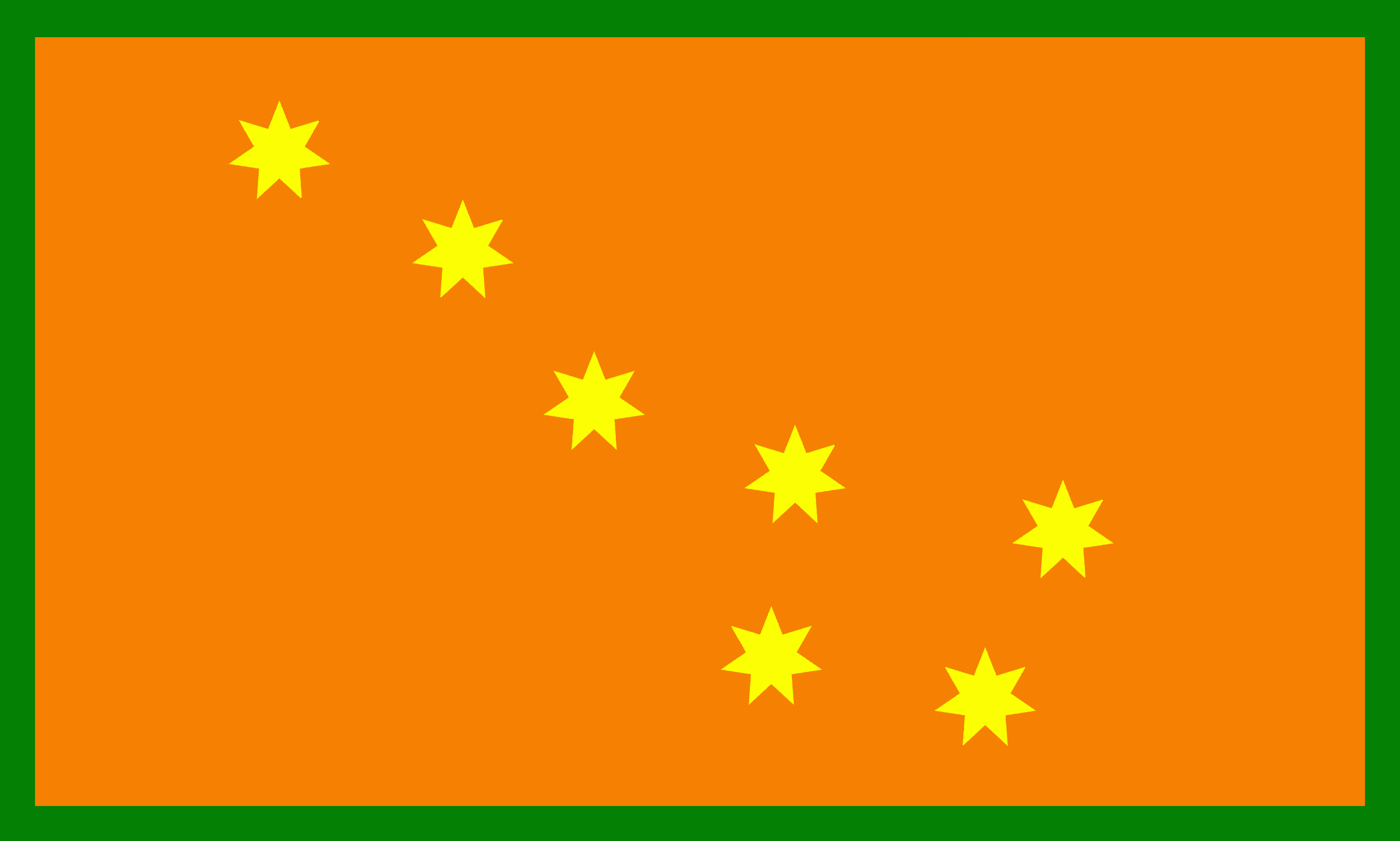
The flag contains seven gold stars in the shape of the Big Dipper, or Ursa Major, on an orange field with a green border. Ursa Major is an important constellation to several tribes within the Cherokee Confederacy. It also symbolizes how the same night sky shine over the entire Cherokee Confederacy. Blue would seem a natural color choice, but the Cherokee picked orange instead. There is some debate about why this is. Popular belief says that it symbolizes the Cherokee Confederacy’s ties to New Netherlands. However, the Cherokee actually picked orange to contrast with the blue flags several other North American nations use. The green border is to offset the orange.


Tuesday, May 10, 2022

Flag of the United Provinces of Markland

This is the flag of the United Provinces of Markland. It comes from a world in which the Norse colonization of North America was more successful. The Norse expanded into mainland North America. Most of the settlements were founded by Christians. However, some pagans also established colonies in hopes of escaping persecution in the Old World. Unfortunately, Christians had a numeric advantage, and forced the Pagans further into the interior of North America. Still, the Pagans made the best of things, and there was some trade between pagan and Christian settlements. Christian settlements tended to be based around agriculture and fishing, while Pagan settlements placed emphasis on fur trapping and hunting. 

Knowledge of the Americas eventually spread to the rest of Europe, and other nations began to send their own expeditions. The indigenous peoples were exposed Old World diseases, but managed to recover their numbers by the time Europeans arrived in earnest. There are several independent indigenous nations, such as the Haudenosaunee and Lenape nations. Both nations are close allies of Markland. Christian Marklanders traditionally had a tense relationship with the indigenous peoples. By contrast, Pagan Marklanders were generally on more amicable terms with the Native Marklanders, and intermarriage wasn’t uncommon. This lead to a creation of a new culture of mixed race Marklanders. We might consider them akin to the Métis of our world.

In time, Markland began to view itself as separate from Scandinavia. This ultimately culminated in a war of independence. The Markland War of Independence saw Christians and Pagans fighting side-by-side to defend their homeland. This caused Christians and Pagans to view each other not as separate cultures, but as a single people sharing in a common destiny. The United Provinces of Markland includes most of what would have been the eastern provinces of Canada, as well as the New England states, Long Island, and New York City.

The United Province of Markland is governed by a bicameral legislature known as the Althing. The head of state known as the Speaker of the Althing. The Speaker is voted on by the people and serves a term of six years, and can be re-elected for only one more term afterward.

The Constitution of Markland places emphasis on protecting the rights of minorities, such a pagans. All provinces can declare an official religion, but they cannot penalize other religions, or lack there of. However, Pagan majority provinces are granted more leeway with what they are allowed to do, in accordance with the Constitution. Some conservative Marklanders grumble about this. They feel that pagans wield a disproportionate amount of influence in the Althing; especially given that Pagans only comprise about twenty percent of Markland’s population. However, most Christian Marklanders are perfectly willing to give small concessions to the Pagans.

Marklander Christianity is highly syncretic. Pagan Marklanders might bless a field by pulling a wagon with a statue of Freyr or Thor around it. Christian Marklanders would preform pretty much the exact same ritual, but with a statue of St. Olaf instead. The raven, rather than the dove, is consider the symbol of the Holy Spirit in Marklander Christianity.

This symbolism extends to the flag. The flag is based upon the famous Raven Banner. It is a grey triangle pennon with two ravens. The ravens represent both Christians and Pagans, and symbolize how Markland is the product of both cultures. Some conservative Christians, however, note that two raven could also symbolize Huginn and Muninn, the ravens of Odin. Conservative Christians have tried, unsuccessfully, to get the flag changed to include only a single raven. However, most Christin Marklanders are perfectly happy with the flag just the way it is, and think it look very nice.


Wednesday, May 4, 2022

Flag of the Gallic League

This is the flag of the Gallic League. It comes from a world where Carthage won the Punic Wars and crushed Rome. Carthage and Greece did establish some colonies across the Mediterranean, and even sent expeditions up the major rivers of Europe. However, neither created a vast spanning empire the way Rome would have. Gaul remained divided between numerous tribes and city-states. The southern regions saw lots of influence from Carthage and Greece as a result of trading ports. Greco-Carthaginian influence begins to tapper off the further north one travels. Over time, the city-states of Gaul began to establish a series of trading alliances with one another, and this would eventually lead to a political alliance. Thus, the Gallic League was born.

The thinking was that the city-states of Gaul could do more by pooling their resources than any of them could individually. The city-states are divided into a series of cantons, each of which has a high degree of autonomy. The cantons administer to their personal affairs, while the League government deals with diplomacy and international relations. The League capital constantly moves around. This way, no one canton can wield more influence than the others. The Gallic League has proven to be quite successful, and can easily stand as an equal to major powers such as Carthage, Greece, and Egypt.

The Gauls have developed a written language using a modified form of the Greek alphabet. Several Greek philosophers have opened schools on the southern coast of Gaul. The Gauls also learned shipwright technics from Carthage, and the first expedition across the Atlantic was lead by Gauls. Gaul established a few colonies in the New World, but the indigenous people were largely able to resist colonization. That said, many indigenous peoples of the Americas did become valuable trading partners for Gaul. Gaul gained considerable wealth by acting as the middle man to the products of the New World. On the whole, the Gallic League is one of the biggest success stories of the world created by Carthage’s victory in the Punic Wars.

The flag is a green pennon with a gold boar on it. The boar is consider the most important animal to the Gauls, and the green references to the lush forests and fields of Gaul.


Sunday, April 24, 2022

Flag of the Inca Empire

This is the flag of the Inca Empire. It comes from a world where the Inca were able to defeat Pizarro and his troops, and resisted Spanish conquest. The naturally mountainous terrain of the Andes helped give the Inca a considerable boost in self-defense against other European powers. The Inca played the various European powers off of each other to preserve their independence. The Inca initially considered a policy of isolationism, but this would prove untenable. Though, initially, the Inca limited their interactions with the Europeans as much as possible. 

As time went on, the Inca began to study and replicate European technology and ideas. The first major change being the introduction of gunpowder weaponry, and the establishment of permeant standing army. The Inca also established a formal written language; with its alphabet largely based on the Latin Alphabet, but with some unique flourishes. The Inca had been ravaged by smallpox, and other Europeans diseases, though not quite to the extent they were in our world. Naturally, the Inca sought out the vaccine for smallpox as soon as it became available in the 18th Century.

The 19th Century saw the next major wave of reforms. The Incan government reformed into a parliamentary democracy, with limits set on the Sapa Inca’s powers. The first stages of industrialization also began at this time. The Inca adopted Western styles of clothing, but mixed in their own designs and color choices. Indeed, to this day, the Incan clothing is known for its unique mix of Western and Indigenous designs. However, more traditional style clothing can be found at important events, such as major religious festivals, or the crowning of a new Sapa Inca.

Today, the Inca Empire is a prosperous modern nation. Cusco, the nation capital, is a true global city. It is home to several universities, museums and art galleries, restaurants, and temples that are the envy of the world. The Quechua people are the largest ethnic group within the empire. However, the empire is home to many other ethnic groups including, among others, Aymara, Mapuche, Wayuu, Het, Polynesians, and even Amazonian tribes. The Inca Empire also receives many immigrants from around the world.

Incan citizens enjoy a very generous social safety net. Government-funded healthcare is provided to all citizens, though private insurance also exists. The Department of Employment provides jobs to all citizens who find themselves unemployed. In the event that a citizen cannot fulfill any available jobs, they are instead given a welfare payment until new jobs become available. The Department of Culture helps provide funding for the arts. Some citizens, of course, cannot attend performances of the arts due to their financial circumstances. In this case, they can apply for free vouchers from the Department of Culture. This all means that most Inca citizens have fairly high taxes, but most consider the trade-off worth it.

The flag includes a stylized depiction of the sun god Inti. The Inca still largely follow their traditional religion; though secularism is on the rise. The blue symbolizes how the same blue sky stretches over all parts of the empire. In the corners of the flag are four chakana; a common geometric shape found in art across various Andes Civilizations. They are in the four corners of the flag in reference to the Inca Empire’s official name, Tawantinsuyu, which means Land of the Four Corners.


Saturday, February 5, 2022

Flag of the United Republic of Great Britain

This is the flag of the United Republic of Great Britain. It comes from a world where Britain, France, and the Ottomans lost the Crimean War. Things first diverged from our world when Russia convinced Austria to ally with them. Russia and Austria quickly routed the Ottomans in the Balkans. From there, it was a straight shot to Istanbul. Britain and France did their best to defend the city, but it soon fell to Russian and Austrian forces. This was the major turning point for the war. It wasn’t long after this that Britain and France sued for peace with Russia.

Russia gained Istanbul, which it renamed Constantinople. The influx of wealth following the war meant that Russia never sold Alaska to America. Winning the war also meant the Russia now had direct access to the Black Sea and the Mediterranean Sea. Austria now stood as the dominate power in Central Europe. Among other things, this meant that Germany and Italy never unified.

Things were not good for Britain following the war. The British public had never been supportive of the war, and the humiliating defeat only solidified that resolve. So many had needlessly died, and for what? British citizens began to wonder if they might be better off without the monarchy. Whispers of revolution and revolt filled the streets. The government began to crack down on dissenters, but that just made things worse. Before long, a second civil war had broken out in Britain. Queen Victoria and Prince Albert, along with several of their supporters, fled to Australia when it became clear that the Republicans were gaining the upper hand. Canada had been ruled out due to its proximity to the United States. The monarchy feared that the United States might sympathize with the revolutionaries, and the possibility of an American invasion of Canada was considered too great a risk.

Once the dust settled, the United Kingdom of Great Britain and Ireland no longer existed. In its place now stood the United Republic of Great Britain. Ireland had used the chaos of the second civil war to declare independence from Britain. Several provinces of India had also used the political turmoil in Britain to gain their independence. Still, the United Republic remained optimistic about its future.

America did indeed become a staunch ally of the United Republic. The United Republic intervened on behalf of the Union during the American Civil War. The United Republic has formed an alliance with France to combat the Holy Alliance. It is an alliance of Russia and Austria, with Greece as a minor member, that aims to stop the spread of liberalism and secularism.

The United Republic prides itself on promoting democracy and liberalism throughout the world. However, that doesn’t mean they’re averse to colonialism. In fact, the United Republic often justifies its colonial ambition by claiming to spread these ideals to other nations. Early on, they did get into scuffles with the United Kingdom-in-Exile over the remnants of the British colonial empire. However, at present, both nations have come to an agreement over where the colonial boarders lie. The United Republic naturally got the lion’s share of the colonies.

The flag contains the red, white, and green bands of the British Republic flag. It also contains a coat of arms with representation of the three constituent nations. The St. George’s Cross of England, the St. Andrew’s Cross of Scotland, and the St. David’s Cross of Wales.


Monday, March 4, 2019

Flag of the Kingdom of Mongolia


This is the flag of the Kingdom of Mongolia.  It comes from a world where China successfully repelled the Mongols early on.  As a result, the Mongol Empire never came to be.  The Mongols continued to be pushed farther and farther west until they arrived in Eastern Europe.  Eventually, they settled around where Romania and southern Poland are in our world.  Thus, the Kingdom of Mongolia was born.  The Mongols were frequently visited by Byzantine missionaries, and the Mongolian Orthodox Church is the official state religion.  The Byzantine Empire also remains a major trading partner for Mongolia.  In more peculiar alliances, Mongolia is also a major ally of the tiny mountainous nation of Neo Hellas, the final remnant of pagan Greece.  

The coming of the Mongols altered the migration patterns of several other peoples.  For example, the Bulgars settled in Russia, establishing the Czardom of Bulgaria.  Meanwhile, several Germanic tribes invaded Greece, and Byzantium is currently ruled by a Germanic dynasty.  Islam was still founded, but it never expanded beyond the Arabian Peninsula.  

In terms of bad relations, Mongolia has always had a very tense relationship with the Franco-Saxon Kingdom.  Throughout the years the Franco-Saxons have repeatedly attempted to conquer the Mongolians.  Even after all these years, Mongolia remains bitter about the Franco-Saxon invasion that occurred during the Second Great Patriotic War.  Despite this, in more recent times there has been increasing emphasis on moving on and letting go of the past.  Younger generations in particular are more likely to support reconciliation between the two nations.  

Mongolia takes pride in its dual mature of East Asian heritage and Eastern European culture.  The flag reflects this dual heritage.  The blue recalls both the cloak of the Virgin Mary and the eternal blue sky of the Tengrism.  The horse symbolizes the nomadic past of the Mongolian people, before they settled in Eastern Europe.  The cross represents the Mongolian Orthodox Church, with the flame representing the flames of Pentecost.  The interlocking circles halves represent the dual nature of the Mongolian people.  The golden bands represent the hope that the Mongolian people will always prosper no matter what life throws at them.  They also help to offset the blue on the main body of the flag.  


Tuesday, August 28, 2018

Flag of the Kingdom of Leon

This is the flag of the Kingdom of Leon.  It comes from a world where the Reconquista failed and most of Spain remained under Islamic rule.  For many years Leon was forced to pay protection money to Al-Andalus.  However, after a while they were able to appeal to their powerful Christian neighbors for support.  For many years, the boarder of Western Europe was considered to stop at the Pyrenees Mountains.  The Iberian Peninsula was lumped in with the rest of the Islamic World.  This somewhat miffed Leon, as they were often lumped in with the rest of Iberia, when anyone remembered that they existed, that is.   

The discovery of the Americas was delayed by a few decades, but it still happened.  Albeit, it was by the English-funded John Cabot, rather than Christopher Columbus.  The colonization of the New World occurred rather differently than in our world.  For example, Al-Andalus colonized Mexico.  This resulted in a new form of Islam that combined Sunni Islam with tradition Aztec beliefs.  The native converts proved particularly zealous, and more than willing to wage jihad upon their neighbors.  Meanwhile, England colonized Brazil and France proved more successful in its colonization of Canada, among other developments. 

Leon got into the colonization game as well, though a bit later than the other powers.  Their first successful colony was Nova Asturias, located in what would have been the Southeastern United States.  Nova Asturias became a major producer of tobacco, cotton, lumber and other raw materials.  This allowed Leon to slowly build up its economy, rather than blowing through a bunch of money like Al-Andalus' did.  Leon also established colonies in Patagonia, Southern Africa, and even a few islands of Indonesia.  

What Leon lacks in sizes it makes up for in economic prowess.  Recently, despite years of resentment and conflict, relations with Al-Andalus have begun to improve considerably.  Leon is a nation that truly lives up its motto Sub Umbra Floreo, which is Latin for "I Prosper in the Shade".  This is a reference to Leon's historical existence in the shadow of Al-Andalus.

The flag is a simple crimson background with a golden and bejeweled Asturias Cross in the center. 


Tuesday, July 31, 2018

Flag of Buddhist Vandalia

It's been a while since I posted one of my flags.  Let's do something about that:


This is the flag of Buddhist Vandalia.  It comes from a world where Buddhist missionaries made their way to Europe during the days of the Roman Empire. The Buddhist quickly won converts among the poor and the disadvantaged, and spread throughout Rome like wildfire.  Christianity still developed, but it's growth was considerably stunted, and it remained a somewhat minor religion. Christianity's failure to become a major religion meant that Islam was never established.  

As in our world, the Roman Empire eventually collapsed, though the Western half managed to hold out for slightly longer.  The Western Empire split into a series of Germanic kingdoms.  By now, most of the former Roman Empire had embraced Buddhism.  However, due to Buddhism's penchant for syncretism, the people of these new kingdoms still worshiped many of their old gods.  The Eastern Empire continued on as usual, but unlike our world, it didn't attempt to rapidly reconquer the lands of the former Western Empire.  

That brings us to Vandalia.  It managed to survive due to a combination of the Eastern Roman Empire's more prudent approach to expansion, and the lack of any Islamic conquest.  The Vandals were able to expand into Spain, and a bit of Southern France, but North Africa remains the heart of their territory.  Over the years, it has become a major hub of trade and commerce, and in more recent times, it has become a leader in technological innovations. Vandalia's closest allies are the Ostrogothic Kingdom of Italica and the Kingdom of Angleland.  

Vandalia is a major destination for Buddhist pilgrims from across the Mediterranean and beyond.  The nation contains several stupas that claim to possess several items that belong to The Buddha himself.  Due to the flexible nature of Vandalian Buddhism, temples and shrines to gods ranging from Woden to Ba'al can also be found in Vandalia.  This is in stark contrast to Byzantine Buddhism, which is much stricter and only focuses on the veneration of Buddha and his teachings.  Thankfully, the two nations manage to get along...for now.

Vandalia is a land where modern universities and centers of technology exist side-by-side with centuries-old Buddhist monasteries.  It is a deeply spiritual nations where the past collides with the present.

The main body of the flag a dark blue square surrounded by lighter blue borders with slight stylization.  Within the center of the flag is a rainbow-colored Wheel of Rebirth, an important Buddhist symbol.  Buddhist symbolism is also present on the multi-colored tails on the side of the flag.  They are miniature Buddhist prayer flags, and are said to carry the hopes and prayers of the Vandalian people on the winds.


Wednesday, February 7, 2018

Flag of the Kingdom of New France

This is the Flag of the Kingdom of New France.  It comes from a world where France actually put effort into colonizing the New World.  The French government provided monetary incentives for families to settle in France's North American holdings.  The thinking was that this investment would eventually be paid back by production of goods from the colonies.  Families were given priority because of their importance to sustaining the colonies in the long term.  France frequently got involved in boarder scuffles with the British, and this, among other reasons, led to something of an alternate French and Indian War. 

Britain gained the Ohio River Valley, and a few other small bits of land, but New France survived the war more or less intact.  During the war, the British also managed to capture Cuba.  Cuba provided raw materials for Britain's North American colonies which, along with the fact that they were hemmed in by the Mississippi River, meant that the colonies stayed loyal to Britain.  Thus, there was no American Revolution in this world.

The same, however, could not be said of the French Revolution.  France's colonies had help relieve the pressure on its citizens a bit, but overtaxation, combined with a bad harvest, ensured that the revolution came to pass.  However, when it became apparent the revolutionaries were going to gain the upper hand, the French monarchy fled to New France. 

Originally, this government-in-exile was known as France-d'outre-mer.  However, when it became apparent that retaking European France was unfeasible, the monarchy declared New France independent from France.  Thus, the Kingdom of New France was founded.  Eventually, things calmed down in Europe, but France remained staunchly republican.  

New France is an economic and cultural powerhouse of North America.  Over the years, it has to cede some of its southern territories to the Dominion of North America, but these days the two are on friendly terms with each other.  The two nations compete with one another for immigrants from around the world.  People of all races are given protection under the law of New France.  Recently, a First Nations man was elected governor of the province of Canada.  New France has been trying to convince nations, such as the Empire of Mexico and the Empire of Brazil, to create a league of New World monarchies. 

The flag has as three-tailed banner design and feature blue and white, traditional colors of New France.  An enlarged royal seal is displayed prominently on the flag.

Sunday, January 7, 2018

Flag of Isla Blanca

This is the flag of Isla Blanca.  It comes from a world where the Spanish Armada was slightly more successful than in our world.  Though it failed to conquer England, the armada to manage to capture the Isle of Wight.  Due to a mistranslation, the island was renamed Isla Blanca, or White Island in English.  Isla Blanca proved to be an invaluable strategic location for the Spanish.  Owing to its close proximity to the British Isles, the Spanish were able to use Isla Blanca to keep the British in check.  As a result of this, Gibraltar remains firmly under Spanish control. 

Over the years, the Britain has made many attempts to regain Isla Blanca from Spain.  For example, when Isla Blanca's constitution was being written in the late 20th Century, it was stated that it could not seek independence from both Britain and Spain.  Shortly after that, a referendum was held to decide Isla Blanca fate.  The options were continued union with Spain, union with Britain, or having both nations share joint custody of Isla Blanca.  The people of Isla Blanca overwhelmingly voted to remain part of Spain.  Several other referendums have been held over the years, but the result is always the same, much to Britain's chagrin.

In terms of culture, it is often said that the people of Isla Blanca are more Spanish than even the Spanish themselves.  Recently, following Spain's decision to leave the European Union, some have wondered if Isla Blanca might waver in its loyalty.  For now, however, Isla Blanca remains fiercely loyal to Spain and proud of its Spanish culture and heritage. 

The waves on the flag represent Spain's control of the wave, and a nod to its former world-spanning empire.  Above the waves is a maroon field, representing royalty and the Spanish monarchy.  The monarchy is also referenced in the crown atop the coat of arms.  The coat of arms contains a stylization image of Isla Blanca set against a soft blue sea, as well as two fish.  The fish represent fishing, unsurprisingly, a historically important industry on Isla Blanca. 


Sunday, October 22, 2017

Flag of the Republic of Ezo

This is the flag of the Republic of Ezo.  It comes from a world where the Boshin War went slightly more favorably for the Shogunate forces.  As a result, the Meiji government was forced to, at least temporarily, recognize the Republic of Ezo.  It wasn't long before the Japanese declared war on Ezo once again.  However, the Satsuma Rebellion still happened and was a lot more widespread, emboldened by Ezo's success.  The Meiji government was forced to focus on quelling the Satsuma Rebellion.  Ezo was able to find support from France and Russia to help protect them from the Japanese.  Eventually, Japan had no choice but to formally recognize the Ezo government.

In response to Ezo's alliance with France and Russia, Japan strengthened its ties to Britain and Germany.  Following their failure to capture Hokkaido, the Japanese turned their attention to Korea.  Ezo, under the command of the recently defected Saigo Takamori, also sent an expedition to conquer Korea.  Korea was able to play Japan and Ezo off of each other, and was able to maintain its independence.  In time, Korea was able to modernize and industrialize like Japan had.  Japan was humbled by its failure in Korea, and the Japanese were forced to focus more on domestic policy than foreign conquest.

Ezo also pursued a policy of isolationism following the failed expedition to Korea.  Some industrialization was a necessary evil, but on the whole Ezo strived to maintain as much of its traditional culture and way of life as possible.  As time went on, however, Ezo began to increasingly fall under French influence.  In many way, it could be said that Ezo had become a French protectorate. 

World War I started off around the same time, and with very similar circumstances, as our world.  However, in this world Japan fought for the Central Powers.  The Japanese were bitter at the British for selling weapons to Ezo, resentful growing opposition to the creeping British influence on Japanese society, and their alliance with Germany was as strong as ever.  Ezo initially tried to remain neutral, but a surprise Japanese attack prompted Ezo to join the Entente Powers.  The war ended in an Entente victory.  Japan was placed under crushing reparations to Ezo, and was forced to cease land in northern Japan to Ezo.

Japan began to grow resentful against Ezo, and began to rearm for another war.  Ezo and Korea were subjected to a series of harsh bombing campaigns. It wasn't long before Ezo and Korea were forced to surrender and formerly occupied by Japan.  The Japanese continued to expand their influence across East Asia and the Pacific.  It wasn't long, however, before they found themselves in conflict with the United States.  Like in our world, the war ended in an American victory. 

Ezo regained its independence following the war.  Though there is still bad blood between Ezo and Japan, the two nations are slowly putting their past behind them.  There is a movement to reunify Ezo and Japan into a single nation, but it doesn't have much support at the moment.  Still, you never know what the future might hold.

The flag is black and white in reference to the flag of the Tokugawa Shogunate, and the seven-pointed star stands for the spirit of the Ezo people.


Monday, October 2, 2017

Flag of Ecotopia

This is the flag of Ecotopia.  It comes from a world where man-made climate change were not reversed.  Rising sea levels and changing weather patterns took their toll on many nations, but in particular the United States.  Climate change, resource wars, civil unrest and general strife strained America's resources to their limits.  Eventually, it got to the point where various regions began to declare independence, with the federal government being powerless to stop them.  A rump United States still exists, and some regions still claim to recognize its authority.  However, these regions are mostly self-governing and are independent in all but name.  

That brings us to Ecotopia.  It was one of the first nations to declare independence.  It comprises Northern California, Oregon, Washington state, British Columbia and the Alaskan panhandle.  As its name would suggest, it was founded to be a more sustainable and environmentally minded society.  Almost all of Ecotopia's energy is produced by sustainable and renewable resources; such as solar, wind, geothermal and hydro-electric.  It's capital city, also named Ecotopia, was built to serve as an example of the sustainable cities of tomorrow.  

Ecotopians eat a largely pescatarian diet, with meat being reserved as more of a luxury and treat.  Insects are also a staple of the Ecotopian cuisine.  Hunting is allowed, though tightly regulated, and cattle drives have made something of a comeback.  Most buildings have rooftop gardens and poultry roosts built into them.  Those that don't usually have solar panels or wind turbines instead.  Most cities have plenty of parks and other green spaces.  The prevailing architectural philosophy is to work with nature, not against it.  Most Ecotopians drive electric cars, though most cities have plenty of public transportation options.  Cities are also built with walkability and biking in mind.


Secularism is rather prevalent, but Buddhism remains the most practiced religion.  However, Ecotopian Buddhism tends to place more emphasis on environmentalism than it does on breaking free from the cycle of reincarnation.  There's also a rapidly growing neopagan movement underway.  In fact, all religions are legal in Ecotopia...within reason, that is. For example, Christianity is legal, but the Bible has been banned due to promoting violence and bigotry.  Recently, the Koran has also been put on the list of banned books.  

Ecotopia has a thriving art scene, but all works of art and literature must be submitted to government boards for approval.  After all, wouldn't want any "problematic" themes infiltrating the artistic world and corrupting the youths.  Hate speech is considered a serious crime, and there are harsh penalties for any caught perpetuating bigoted opinions.  There have been grumbling about the definitions of hate speech getting broader and broader.  Though, officially, the Ecotopian government maintains that it supports free speech...within certain boundaries.  

It's not all fun and games, however.  Ecotopia has a large standing army, and they're certainly not afraid to use it.  In their early days, they got into quite a few skirmished with the Mormon Republic of Deseret.  These days, both nations have something of an uneasy truce with each other.  Ecotopia's biggest foreign intervention, however, hardly required any military action.  The Republic of SoCal gets most of its water from North California.  Therefore, whenever SoCal gives them trouble, Ecotopia just has to turn off the tap until they come around.  SoCal, much to its chagrin, is also quite dependent on Ecotopia to supplement its food supply.  This has, effectively, turned SoCal into an Ecotopian colony. 

The SoCalians are splits about what to do.  Some favor formally joining Ecotopia, while others suggest going to war over the former Northern California.  Still others suggest slowly working to find solutions, such as desalinization plants, that would reduce their need for Ecotopia.  In more friendly relations, the Republic of Hawaii is quite close diplomatically with Ecotopia.  The two nations share similar philosophies, and there is talk of a possible merger of the two nations.  Admittedly, many are skeptical that it will get off the ground, but hope springs eternal. 

Despite these problems, Ecotopia is looking towards a brighter future.  Despite their isolationist beginnings, in more recent times Ecotopia has begun to open itself to the wider world.  Trade relations have been established with several nations of East Asia.  Ecotopia is quickly become a hub of trade, bringing to goods of Asia to the North American continent.  A sea wall project is currently underway to reclaim coastal lands lost to rising sea levels.  Ecotopia hopes to learn from the mistakes of the past to build a better tomorrow.  Let's just hope they don't become the monsters they seek to fight.  

The flag reflects Ecotopia's environmentalist philosophy.  The brown stands for earth, the blue stands for water and the green stand for plant life and sustainability.  The phoenix represents Ecotopia rising out of the ashes of the old world to build a better tomorrow.