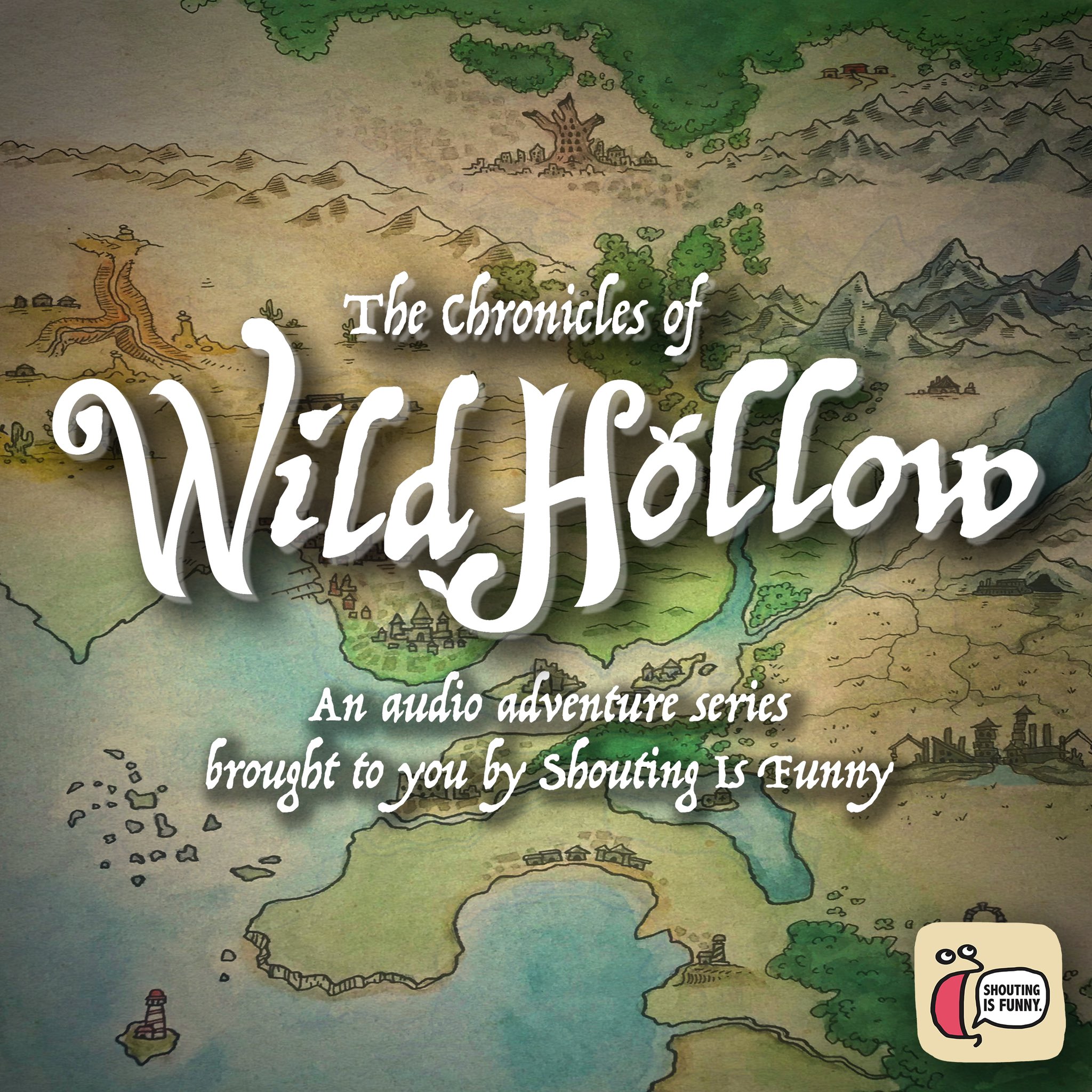
In a far off place, an endless forest grows; sprawling, barren, impenetrable. But beyond the tree line…creatures roam free. A land where adventure lurks around every corner. A land where legends are made. A land called Wild Hollow. Wild Hollow is home to a veritable menagerie of talking animals. The series chronicles the adventures of the various denizens of Wild Hollow.
I’d been vaguely aware of The Chronicles of Wild Hollow for a while. I think I might have seen it over on the r/audiodrama subreddit, or possibly on Twitter at various points. However, it didn’t really get on my radar until recently. Not long ago, I become part of a podcast critics group that meets on Slack. We share our reviews, discuss various podcast related things, and just enjoy each other’s company. We also trying to help each other out and raise our collective profile. One persistent myth is that there are no podcast critics. The fact that your reading this proves that isn’t true at all. So, to combat that, Arielle Nissenblatt (rhymes with this-and-that) did a Twitter tread introducing all of us to everyone on Twitter. Naturally, I was included, and got several audio dramas asking me to review them. The Chronicles of Wild Hollow, produced by Shouting is Funny, was one such show, and here we are now.
As previously stated, The Chronicles of Wild Hollow features talking animals that do human things. It is a bit like Redwall or Zootopia, but in the style of Discworld. Wild Hollow is a deliberately anachronistic land. 18th Century pirates, Wild West gunslingers, and gangsters from somewhere between 1920 and 1950 all exists side-by-side. Basically, if it could potentially make for a good story, it can be found in Wild Hollow. The stories are meant to be adventure tales, but with a humorous bent. In terms of demographic, The Chronicles of Wild Hollow is an all ages affair; fun that the whole family can enjoy. There’s usually about two or three songs per episode. They usually help move the plot along, or reveal something about the characters. The website for The Chronicles of Wild Hollow includes an interactive map of Wild Hollow itself.
The Chronicles of Wild Hollow doesn’t really have many episodes available so far. As of this writing, it has six episodes, which are divided into two trilogies, plus one Christmas episode. The first trilogy follows a mouse named Fandango Boursin, and he is also the protagonist of the Christmas Special. Shouting is Funny recommended that I start with the Grey Trilogy; named after its title character Artemis Grey. In hindsight, I should have listened to that advise.
I need to briefly talk about what the Boursin Trilogy did wrong. That way, it will be easier to appreciate what the Grey Trilogy did right. The first strike was the voice acting. Fandango is a mouse who sounds a bit like Clint Eastwood…if he gargled cigarettes and razor blades. It got very irritating very quickly. The rest of the voice cast were generally decent, but not really anything to write home about. Though, I will say that I enjoyed the songs at the Lillypad Lounge. The tone was incredibly disjointed to the point of being schizophrenic. The episodes would be dead serious one minute, only to be downright parodic the next minute. The jokes always fell flat, were too self-referential, and I wasn’t a fan of the repeated fourth wall breaking. I also just didn’t find Fandango to be as interesting or as compelling of a character as I found Artemis to be. So, yeah, don’t make the mistake I did. I suggest skipping the Boursin Trilogy.
The Christmas Special is slightly better. Being a thirty minute standalone episode certainly made things more bearable. And I will concede that a few jokes managed to get a chuckle out of me. However, it still suffers from many of the same problems that the Boursin Trilogy does. So, I’d recommend skipping it as well. Start with the Grey Trilogy instead.
Now that we’ve got that out of the way. Let’s talk about the Grey Trilogy. Artemis Grey is a fox who works as a smuggler. She’s very quick witted a resourceful, as a fox must be. Artemis has recently attempted to stowaway aboard a pirate ship. Unfortunately, the pirates found out, but Artemis convinced them not to kill her. The pirates are in search of a Whale Song. It is an artifact created by Primus, the first whale. The Whale Song can grant great knowledge to those who know how to use it. Artemis forms an uneasy alliance with the pirates, and soon they’re off to find the Whale Song, and the secrets it contains.
I should begin by mentioning that you can listen to the Grey trilogy with having listened to the Boursin Trilogy. It appears that The Chronicles of Wild Hollow is aiming to be an anthology of stories set in the same world. The Grey Trilogy was a marked improvement over the Boursin Trilogy in every conceivable way. There was a proper balance between humor and seriousness. The voice acting was significantly stronger this time around. There wasn’t a single bad performance among the cast. You could tell the cast were more experienced this time around. I also appreciated that the fourth wall stayed firmly in place.
I also found Artemis to be a far mor interesting and compelling character than Fandango. I like foxes, so that helps. At first, Artemis seems like a typical, if still highly entertaining, roguish thief character. However, she’s shown to have a honorable streak, and she has good reason for wanting to find the Whale Song. Artemis was separated from her mother when she was just a kit. What she really wants, more than anything else, is to find her mom, and to have a family again. I liked that Artemis’ mom is named Freya, and thus, they’re both named after mythological goddesses. Poor Artemis has been on her own since she was about seven or so. Certain animals experience prejudice and discrimination from other animals in Wild Hollow. I would assume that includes foxes. Artemis probably turned to a life of crime because nobody was willing to help her, or take her in.
The legend of Primus added some much needed worldbuilding to Wild Hollow. Legend says that Primus was the first whale ever. He came into being when the world was first created. Primus swam the world singing his song of truth to all who would listen. But people grew greedy and kept demanding new knowledge from him. One of his teeth got knocked out by a rock, but Primus imbued it was his song. It is said whoever finds the tooth will also find the truth they seek. I liked how the legend gave a sense of lore and history to Wild Hollow. It makes it feel more like a real place, rather than just “our world, but with talking animals.”
I also greatly enjoyed the new friends Artemis makes along the way. Osric is an otter who dreams of becoming King of the Pirates someday. He’s an interesting take on an otter character. Usually, otters are portrayed as mischievous and playful. Osric, by contrast, is a fairly serious no-nonsense character. He doesn’t like Artemis initially, but comes to see her as a friend. Osric is joined by a penguin named Salami. Yes, that’s really her name. She’s dumb as a brick, but a good person at heart, and very happy-go-lucky. Salami doesn’t have a single mean bone in her body. Over the course of the trilogy, Osric and Salami become like family to Artemis.
I must also give praise to the sheer imagination that went into all of the settings for the Grey Trilogy. So, we start of having an adventure with pirates. Our first port of call is an island inhabited by dodo birds who wear togas and all have very Roman-sounding names. Then, our heroes ride inside of a whale to get to a city located within the fossilized remains of Primus. Then, Artemis has to travel to a forest who’s tree produce pollen that makes people act stupid. It all sounds absolutely insane, but it works. The bits in the city within the remains of Primus was my favorite bit. The Grey Trilogy felt weirdly nostalgic at times. It feels like a story, or a cartoon, I would have encountered as a kid. But don’t worry, adults can easily enjoy it as well.
Transcipts were originally only available for the Boursin Trilogy. However, Shouting is Funny has since corrected this. I want to take a moment to take them for that. I will reiterate what I said in my reviews of Seen and Not Heard and Main Street Mythology. Transcripts are very important for providing accessibility; especially to listeners with hearing difficulties. They are also very handy for people who write reviews.
Now that we’ve got that out of the way. Let’s talk about the Grey Trilogy. Artemis Grey is a fox who works as a smuggler. She’s very quick witted a resourceful, as a fox must be. Artemis has recently attempted to stowaway aboard a pirate ship. Unfortunately, the pirates found out, but Artemis convinced them not to kill her. The pirates are in search of a Whale Song. It is an artifact created by Primus, the first whale. The Whale Song can grant great knowledge to those who know how to use it. Artemis forms an uneasy alliance with the pirates, and soon they’re off to find the Whale Song, and the secrets it contains.
I should begin by mentioning that you can listen to the Grey trilogy with having listened to the Boursin Trilogy. It appears that The Chronicles of Wild Hollow is aiming to be an anthology of stories set in the same world. The Grey Trilogy was a marked improvement over the Boursin Trilogy in every conceivable way. There was a proper balance between humor and seriousness. The voice acting was significantly stronger this time around. There wasn’t a single bad performance among the cast. You could tell the cast were more experienced this time around. I also appreciated that the fourth wall stayed firmly in place.
I also found Artemis to be a far mor interesting and compelling character than Fandango. I like foxes, so that helps. At first, Artemis seems like a typical, if still highly entertaining, roguish thief character. However, she’s shown to have a honorable streak, and she has good reason for wanting to find the Whale Song. Artemis was separated from her mother when she was just a kit. What she really wants, more than anything else, is to find her mom, and to have a family again. I liked that Artemis’ mom is named Freya, and thus, they’re both named after mythological goddesses. Poor Artemis has been on her own since she was about seven or so. Certain animals experience prejudice and discrimination from other animals in Wild Hollow. I would assume that includes foxes. Artemis probably turned to a life of crime because nobody was willing to help her, or take her in.
The legend of Primus added some much needed worldbuilding to Wild Hollow. Legend says that Primus was the first whale ever. He came into being when the world was first created. Primus swam the world singing his song of truth to all who would listen. But people grew greedy and kept demanding new knowledge from him. One of his teeth got knocked out by a rock, but Primus imbued it was his song. It is said whoever finds the tooth will also find the truth they seek. I liked how the legend gave a sense of lore and history to Wild Hollow. It makes it feel more like a real place, rather than just “our world, but with talking animals.”
I also greatly enjoyed the new friends Artemis makes along the way. Osric is an otter who dreams of becoming King of the Pirates someday. He’s an interesting take on an otter character. Usually, otters are portrayed as mischievous and playful. Osric, by contrast, is a fairly serious no-nonsense character. He doesn’t like Artemis initially, but comes to see her as a friend. Osric is joined by a penguin named Salami. Yes, that’s really her name. She’s dumb as a brick, but a good person at heart, and very happy-go-lucky. Salami doesn’t have a single mean bone in her body. Over the course of the trilogy, Osric and Salami become like family to Artemis.
I must also give praise to the sheer imagination that went into all of the settings for the Grey Trilogy. So, we start of having an adventure with pirates. Our first port of call is an island inhabited by dodo birds who wear togas and all have very Roman-sounding names. Then, our heroes ride inside of a whale to get to a city located within the fossilized remains of Primus. Then, Artemis has to travel to a forest who’s tree produce pollen that makes people act stupid. It all sounds absolutely insane, but it works. The bits in the city within the remains of Primus was my favorite bit. The Grey Trilogy felt weirdly nostalgic at times. It feels like a story, or a cartoon, I would have encountered as a kid. But don’t worry, adults can easily enjoy it as well.
Transcipts were originally only available for the Boursin Trilogy. However, Shouting is Funny has since corrected this. I want to take a moment to take them for that. I will reiterate what I said in my reviews of Seen and Not Heard and Main Street Mythology. Transcripts are very important for providing accessibility; especially to listeners with hearing difficulties. They are also very handy for people who write reviews.
My only real quibble, and this is more minor, is that Fandango appears at the end of the Grey Trilogy. This means he’ll be coming along for Artemis’ next adventure. However, I’m cautiously optimistic that Shouting is Funny will take what they learned from the Grey Trilogy, and apply it to this next adventure.
And I certainly hope I get to go on more adventures with The Chronicles of Wild Hollow soon. They don’t have much now, but I’ll happily review whatever new episodes come out. I did something similar with my review of Poe Theatre on the Air. The next plan is to do a series of shorter one-off episodes. That sounds like it could be fun, and a great way to add more characters to the cast.
And I certainly hope I get to go on more adventures with The Chronicles of Wild Hollow soon. They don’t have much now, but I’ll happily review whatever new episodes come out. I did something similar with my review of Poe Theatre on the Air. The next plan is to do a series of shorter one-off episodes. That sounds like it could be fun, and a great way to add more characters to the cast.
The first of these mini-episodes is called “The Ballad of Little Mollusk.” Little Mollusk was a minor character from the Grey Trilogy. They tried to stop Caine the Horney Toad from starting a coup, but got thrown into the sea. As Little Mollusk drift upon the waves, they think about their early life. Little Mollusk used to be part of a family of famous singers. They entered a singing contest to bring honor and glory to her family. But fate had other plans for Little Mollusk.
It would seem that my faith in Shouting is Funny was not misplaced. We start in familiar territory with a character from the Grey Trilogy. Wasn’t expecting Little Mollusk to be the focus character, but I’m not about to argue with the results. I thought that it was utterly brilliant to have the singing contest be Simon Cowell, who is a cow. It worked a lot better than the Christmas special having Macaulay Culkin inexplicably exist in the world of Wild Hollow exactly as he does in our world. I guess the theme of this mini-episode is that, as one door closes, another door opens. Your life won’t always go as planned, but sometimes that means you find new opportunities. I certainly didn’t think I’d be reviewing audio dramas on a highly successful blog. And yet, here we are.
I only have one minor nitpick. At one point, the narrator refers to Little Mollusk as a cephalopod. However, the way that Little Mollusk is described indicates that they are a sea snail. Snails are gastropods, not cephalopods. However, gastropods, cephalopods, and bivalves are all mollusks. Like I said, minor nitpick, not really that big of a deal.
“The Ballad of Little Mollusk” is an excellent start to the mini-episodes.
Our next mini-episode is a Halloween special. It is called “The House with the Glass Eyes.” It follows two raccoons who are very happy, and very much in love. They are pretty much the picture of a happy loving couple. They have won a stay at the creepy old mansion at the edge of town. The butler is an equally creepy crow, the walls are hung with mysterious portraits, and their are many strange sounds the happen in the middle of the night. Still, it does have a certain rustic charm. And really, what’s the worst that could happen?
Well, this was certainly unexpected. I knew that this was going to be a Halloween special, but I didn't expect The Chronicles of Wild Hollow to go full-on horror. True, there are some humorous moments. For example, our protagonists are incredibly naive and ignore the numerous red flags all around them. This is obviously a rib at how horror movie protagonists tend not to be very bright. Still, this mini-episode does a surprisingly good job of building atmosphere and suspense.
The main villains are a cult. Cults certainly do seem to pop-up a bit more in British Horror, compared to American Horror. Britain is a lot older than America, so an ancient cult makes more sense in Britain. By contrast, a monster and/or alien randomly appearing, and remaining largely hidden, works a bit better in America. As the saying goes, 100 years is a long time to an American, but 100 miles is a long distance to a European.
Anyway, the cult worships the concept of love, and likes to…taxidermy loving couples that they come across. Oh, and that crow butler? He doesn’t believe in the cult’s teachings, but he loves to eat all of the internal organs that the cult has leftover. I mean, wow, that’s pretty brutal for a show that’s usually pretty lighthearted, and somewhat silly. And to think the last mini-episode was about a singing contest. I suppose it makes sense that the crow turned out to be evil. After all, a group of crows in called a murder.
Personally, I’m all in favor of The Chronicles of Wild Hollow trying their hand at something darker. They clearly like to experiment with different genres and styles, and it is clear that the writers are pretty competent at writing horror. In fact, my one real complaint was that I wish the episode had been longer. I realize that this was a mini-episode, but I see potential here for a full-sized episode or two. I won’t tell you how it ends, but I just loved how dark things got.
“The House with the Glass Eyes” is an excellent Halloween Special. I certainly hope we’ll see more horror stories from The Chronicles of Wild Hollow.
The Chronicles of Wild Hollow makes a second crack at a Christmas episode for our third mini-episode. It is titled “Salami Saves Christmas.” We return to the pirate crew that we met in the Grey Trilogy. Christmas time is here, but the pirates aren’t in a very festive mood. They’re still mourning the death of Pirate King Lesley. The pirates need a little Christmas right this very minute, and Salami is determined to bring it to them. She’s got the plan for perfect Christmas. What could possibly go wrong?
This marks second time that The Chronicles of Wild Hollow has attempted a Christmas Special. It also lightyears better. I’m quite fond of the pirates from the Grey Trilogy. I’m also pleased to see Salami getting to take center stage for the episode. It really is family and friends, not presents, that make Christmas a special time. I’ve come to appreciate that more as I’ve gotten older. This episode shows The Chronicles of Wild Hollow at its best. Heartwarming and sentimental, but with a few jokes and laughs as well. Much better than being a straight-up farce, like the last Christmas Special.
We also learn that roasted swampworm is considered a delicacy in Wild Hollow. This raises an interesting point I hadn’t considered until now. What do the carnivores of Wild Hollow eat? Mammals, birds, reptiles, and amphibians are all sentient in Wild Hollow. Certain invertebrates, such as mollusks, are as well. Maybe they eat fish and insects? Though, Salami’s name being what it is raises…interesting implications.
We also have Harvey Badger taking over as narrator. Angus Maxwell, who formerly played the narrator, decided to leave Shouting is Funny. Also, despite his name, Harvey Badger is a human…I think. I mean, never seen any photos, but I’m pretty certain that Harvey is a human.
Well, anyway, this mini-episode was really sweet, and is another example of The Chronicles of Wild Hollow at its best. And that means we’re three for three. The Chronicles of Wild Hollow bowls a turkey for excellent mini-episodes.
This marks second time that The Chronicles of Wild Hollow has attempted a Christmas Special. It also lightyears better. I’m quite fond of the pirates from the Grey Trilogy. I’m also pleased to see Salami getting to take center stage for the episode. It really is family and friends, not presents, that make Christmas a special time. I’ve come to appreciate that more as I’ve gotten older. This episode shows The Chronicles of Wild Hollow at its best. Heartwarming and sentimental, but with a few jokes and laughs as well. Much better than being a straight-up farce, like the last Christmas Special.
We also learn that roasted swampworm is considered a delicacy in Wild Hollow. This raises an interesting point I hadn’t considered until now. What do the carnivores of Wild Hollow eat? Mammals, birds, reptiles, and amphibians are all sentient in Wild Hollow. Certain invertebrates, such as mollusks, are as well. Maybe they eat fish and insects? Though, Salami’s name being what it is raises…interesting implications.
We also have Harvey Badger taking over as narrator. Angus Maxwell, who formerly played the narrator, decided to leave Shouting is Funny. Also, despite his name, Harvey Badger is a human…I think. I mean, never seen any photos, but I’m pretty certain that Harvey is a human.
Well, anyway, this mini-episode was really sweet, and is another example of The Chronicles of Wild Hollow at its best. And that means we’re three for three. The Chronicles of Wild Hollow bowls a turkey for excellent mini-episodes.
Our next mini-morsel is “Bing and Crosby Make a Cake.” We return to the Stupid Woods where we meet a beaver and a praying mantis named Bing and Crosby. They host their own cooking shows where they make quite tasty meals. Except, not really. In reality, they’re both under the effects of the Idiot Pollen. The two have remained blissfully unaware of this, but Bing has begun hearing strange voices. Almost like memories of another life.
One of my guilty pleasure television shows is Worst Cooks in America on Food Network. As the name suggests, it is a cooking competition show where some of the worst home cooks in America compete, and hope to improve their cooking skills, for a cash prize. Over the years, it seems as though the contestants have gotten progressively stupider. However, even the dumbest contestants on Worst Cooks look like rocket surgeons compared to Bing and Crosby. But we see darkness amidst the silliness. It’s a pretty horrible scenario to think of. You have family and friends, an entire life, waiting for you outside the forest. But, thanks to the pollen, you can only kind of remember it. What must it be like for Bing’s loved ones, I wonder? Are they looking for him, or have they given up all hope? This short almost feels like an allegory of Alzheimer’s or Dementia.
Wild Hollow has once again decided to dabble in darker material. And once again, they have given us a quality short.
One of my guilty pleasure television shows is Worst Cooks in America on Food Network. As the name suggests, it is a cooking competition show where some of the worst home cooks in America compete, and hope to improve their cooking skills, for a cash prize. Over the years, it seems as though the contestants have gotten progressively stupider. However, even the dumbest contestants on Worst Cooks look like rocket surgeons compared to Bing and Crosby. But we see darkness amidst the silliness. It’s a pretty horrible scenario to think of. You have family and friends, an entire life, waiting for you outside the forest. But, thanks to the pollen, you can only kind of remember it. What must it be like for Bing’s loved ones, I wonder? Are they looking for him, or have they given up all hope? This short almost feels like an allegory of Alzheimer’s or Dementia.
Wild Hollow has once again decided to dabble in darker material. And once again, they have given us a quality short.
The next mini-episode is “Hollow Herald Archive - Entry no.402.” We begin with a framing device. The archivist for the Hollow Herald Archive, the top newspaper in Wild Hollow. The archivist is listening to a recording from an investigative reporter who disappeared under mysterious circumstances. The reporter was covering stories about unusual homes. His search led him to the city of Primus. But what started as a simple trip will uncover corruption and lies within the leadership of Primus.
I was a little hesitant when I first started listening to this mini-episode. The episode title and framing device seemed to be inspired by The Magnus Archives. I realize that a lot of people love The Magnus Archives, but I could never get into it. Out of Place was more along the lines of what I was hoping for from The Magnus Archives. Though, it probably helps that Out of Place has a strong emphasis on alternate history.
I was a little hesitant when I first started listening to this mini-episode. The episode title and framing device seemed to be inspired by The Magnus Archives. I realize that a lot of people love The Magnus Archives, but I could never get into it. Out of Place was more along the lines of what I was hoping for from The Magnus Archives. Though, it probably helps that Out of Place has a strong emphasis on alternate history.
However, turns out that it was just coincidence. The writers wanted to try their hand at found recording horror with this one. Unfortunately, as perviously noted, I’ve never really been able to get into that genre. Though, I will say I liked the bits where the archivist fast-forwards because he doesn’t want to hear the singing and exposition.
So, we get another look at the city of Primus. Specifically, we get to see the seedier and more corrupt side. All well and good, but personally, I didn’t feel there was any more territory to cover with Primus. Uh, metaphorically speaking, that is. I felt the story of Primus had already been pretty well covered in the Gray Trilogy. Don’t get me wrong, this was not a bad mini-episode by any stretch of the imagination. That said, I sense we can do a bit better here. Not really anything to write home about with this one.
So, we get another look at the city of Primus. Specifically, we get to see the seedier and more corrupt side. All well and good, but personally, I didn’t feel there was any more territory to cover with Primus. Uh, metaphorically speaking, that is. I felt the story of Primus had already been pretty well covered in the Gray Trilogy. Don’t get me wrong, this was not a bad mini-episode by any stretch of the imagination. That said, I sense we can do a bit better here. Not really anything to write home about with this one.
I know The Chronicles of Wild Hollow can do better, because it has been for all of the other mini-episode up until this point. So, I’m still confident in what the future holds for these mini-episodes.
Our final mini-episode, at least for this season, is “The Stork and the King.” We begin with a framing device. Young Artemis Grey is being read a bedtime story by her mother Freya. Mrs. Grey weaves a tale of the founding and early days of Wild Hollow. She speaks of a people who voyaged from a distant land in hopes of finding a new home. These people were led by a king, and he befriended a stork who could perform fantastic miracles when called upon. However, the king grew greedy, and began to rely on the stork’s miracles more and more. The once benevolent monarch had allowed a great darkness to grow within him. His people began to question his rule, and ask if they should once again seek new homes.
Ah, it would seem that my trust was not misplaced. We get another in-universe legend that expands upon the worldbuilding of Wild Hollow. This time, we get an origin story for the people of Wild Hollow. I’m all for more in-universe legends. We see a lot of typical fairytale tropes with this one. We have the mysterious stranger who performs fantastic feats, and a greedy king who abuses those miracles. I had wondered about what the government of Wild Hollow was like. There doesn’t really appear to be much in the way of government in Wild Hollow. Or maybe it just never factors into the plot? Either way, it seems that the peoples of Wild Hollow decided that monarchies are overrated. On an unrelated note, the interactions between Artemis and Freya were really cute, and very sweet.
And so this is the last of the mini-episodes, at least for now. It has been a great ride. We got to explore all sorts of different sides of Wild Hollow. The writers got to play with many different genres, and it was awesome. I do hope they expand upon some of the ideas. Maybe try their hand at horror again, or maybe do a series set in the early days of Wild Hollow. But whatever the future holds for The Chronicles of Wild Hollow, I can’t wait to find out. The writers clearly have a lot of ideas for more great stories. I’m confident that they’ll give us something amazing before long.
So, there you have it. The Chronicles of Wild Hollow got off to a rocky start, but it redeemed itself with the Grey Trilogy, and stuck the landing. Then it took a victory lap with the mini-episodes. It is a fun all-age affair set in a world of talking animals. There’s laughs, adventure, and even a bit of music to be had along the way. I cannot recommend the Grey Trilogy enough, and I can’t wait to see what other adventures the future holds.
Well, I think that should do it from me for now. I will see you guys next time.
Well, I think that should do it from me for now. I will see you guys next time.

