Wednesday, September 19, 2018

Book Review: American Gods by Neil Gaiman


There are some books that I put off reading for a while, but when I finally do, I'm really glad that I did.  It's not that I didn't want to read these books, just that I've got other books and things competing for my attention, so sometimes it takes time to get to them.  Of course, when I do get to these special books, I always wish I'd read them sooner.  One such book is the book that we're taking a look at today.  We're reviewing American Gods by Neil Gaiman. 


American Gods follows a man named Shadow.  He's just gotten out of prison, and he's looking forward to reuniting with his wife Laura.  Unfortunately, she died in a car accident while he was locked up.  Shadow find himself lost and adrift in the world.  That is, until he meets that mysterious Mr. Wednesday.  Wednesday reveals to Shadow that the gods and goddesses of ancient mythology are very much alive in the modern-day United States of America.  There's a war coming, and Wednesday needs Shadow to help him gather the Old Gods for a fight against the New Gods, the gods of modern day life.  Shadow's about to embark on a mythological adventure through modern day America.

Like I said, it took a long time for me to get around to this one, but it was well worth the wait.  A lot of people say they don't like this book because they think it's slow and meanders.  I, however, love it for exactly those reasons.  American Gods is a meditation on the nature of America, and on what it means to be American.  I enjoyed that the book took a laid-back and relaxed sort of way it.  It added to the overall meditative quality the book had for me.  

To me, this is a very 1990s book.  Not in the sense that it constantly references 1990s pop culture, current events or anything like that.  The closest we get to that is a brief mention of Xena the Warrior Princess and the Disney Hercules movie.  No, what makes this a 1990s book is the way it captures the zeitgeist of the 1990s.  During that time, America had just won its decades long Cold War against the Soviet Union, and now stood as the sole remaining superpower in the world.  Everyone was happy, but there was also the a linger feeling of "well, now what?"  American Gods really taps into that feeling of uncertainty, and uses that as a springboard for the meditation on the nature of America.  

Neil Gaiman himself notes this in the introduction to the 10th Anniversary edition.  He says that if he ever writes a sequel it's going to be different just because of how much America has changed since American Gods was first published.  In particular, he notes about how surreal it is to think that a bookstore in New York City where he promoted the book was destroyed in the September 11th attacks less than a year later.  

The novel is set almost entirely in Flyover Country.  There are a few brief scenes set in the coastal metropolises here and there, but for the most part, the vast majority of the action takes place in Middle America.  The summer before I began Middle School I took a road trip with my maternal grandparents and my sister across the Great Plains and Rocky Mountain states.  It was one of those trips I'll never forget.  As such, the setting of this book, and it's road trip plot, gave it a nostalgic feel to me.  I should point out that not all of the places mentioned are real, though many of them are.  For example, would you believe me if I told you that The House on the Rock is a real place?  It's mentioned that a lot of the places in America where magic is strongest are these out-of-the-way roadside attractions.  Throughout the book you get a sense that there's magic to be found even in mundane everyday life.  

There are several instances where a god won't be directly identified, but if you know your mythology, you'll be able to figure out who they are.  For example, at one point Shadow meets Whisky Jack, better known as the Algonquin god Wisakedjak.  During that scene we meet Johnny Appleseed, but he's different than the historical John Chapman.  I liked the nod to Paul Bunyan probably being fakelore, as well as the importance of mythology to a nation, during the at scene.  There's also a cameo the Welsh trickster god Gwydion fab Don; he works at a grocery store these days, and could be doing better.  

I enjoyed meeting all of the different gods and spirits, and learning how they've adjusted to life in America.  I should clarify that these aren't the original versions of the gods.  The original versions are still in their home countries.  It's explained that, whenever someone who believes in a god goes to a new country for the first time, it creates a new version of that god unique to that country.  So, by extension, this means all of these stories and hypotheses about various peoples making it to the New World before Columbus are true.  For example, the Egyptian gods came over when Ancient Egypt sent a expedition to America in ancient times.  

I also loved the shear variety of gods.  We have gods from Norse Mythology, Slavic Mythology, Egyptian Mythology, West African Mythology, and so much more.  There is a rather notable absence of the Greek and Roman gods.  Well, Medusa had a brief cameo in Rhode Island, but that's about it.  Gaiman has stated that he couldn't find any evidence, however sketchy, of the Greeks or Romans making it to the New World.  That, and he felt that Greco-Roman Mythology had been done to death, and he didn't think he could add anything new.  

If you're at all familiar with Norse Mythology, you'll figure out quickly that Mr. Wednesday is the American version of Odin.  Wednesday is named after Woden, the Germanic version of Odin.  Now, some people might find the way Mr. Wednesday beds numerous women and is generally a bit of a conman to be odd.  However, that's actually very true to the original myths.  In Norse Mythology, Odin and Loki are actually very similar to one another.  Both were very crafty and very much tricksters with a thing for bedding beautiful women.  Odin frequently disguised himself in a grey coat and hat and wandered around Midgard play tricks on morals.  

Chernobog pretty much stole every scene he was in.  He's just so loud, bombastic and over-the-top that he was hilariously awesome.  I also liked the way he adjusted to life in America.  It's repeatedly emphasized that the gods need sacrifices to maintain their strength, and that there is power in blood.  Chernobog maintained himself by working in the Chicago stockyards and dedicating the killings of the livestock to himself.  There's also a nod to the theory that Chernobog and his brother, the god Belobog, might have been the same god.  Belobog was god of light, and Chernobog get noticeably nicer during the spring, when light gives way to dark, and he does mention he can't remember when he last saw Belobog.  

Chernobog lives with the Zorya sisters, Slavic star goddesses, which leads to a slight deviation in the mythology.  In Slavic Mythology there are two Zorya, Zorya Utrennyaya and Zorya Vechernyaya, the morning and evening stars respectively. However, Gaiman adds a third Zorya sister, Zorya Polunochnaya, the midnight star.  Polunochnaya has no counterpart in Slavic Mythology, and was completely created by Gaiman.  Still, for the brief scenes we get of her, she's a nice addition to the story.

I enjoyed that the Egyptian gods played such a big role in the story.  I'm especially happy that Thoth and Anubis, my two favorite Egyptian gods, played such an important role.  They live in Cairo (pronounced kay-roe) Illinois because that's where the Ancient Egyptians sent their expeditions to all those years ago.  It's a joke because that part of Illinois is called Little Egypt.  Fittingly enough, they run a funeral parlor, and are referred to as Mr. Ibis and Mr. Jackal.  Bast is there too, as their pet cat, and Horus has gone a bit nutty due to spending too much time as a hawk.  Mr. Ibis mentions that there used to be more gods, but over the years they disappear for various reasons.  For example, Set took a trip to San Francisco, and was never heard from again.  

Yeah, even the gods can die, especially is they're low on power from lack of worship and sacrifice.  It's mentioned that there used to be an American version of Thor, but he committed suicide in the 1930s.  That's particularly tragic because, had he held on for a few more decades, he would have lived to see Marvel's Mighty Thor comics.  Of course, it's questionable if that would have helped.

There's a scene where Shadow and Wednesday are in San Francisco trying to get the goddess Easter to join the coming battle.  Easter insist that people still love her, so Wednesday ask a neopagan what she knows about the holiday Easter.  The neopagan wrongly assumes that it originated as a purely Christian holiday, and is shown to have very hazy beliefs about gods and goddesses.  The whole thing nearly gives Easter a heart attack.  The point being that, without traditional rituals and well-defined beliefs, neopagans might as well be atheists or agnostics as far as the Old Gods are concerned.  Some of you might object to the way the neopagans are presented, but I've known many of them that actually are kind of like that. 

Alright, so all of this is going on, but what about Jesus?  American Jesus never appears, and it's implied he considered himself above the coming war, probably because of all the legitimate worship he gets.  Amusingly, there is a deleted scene where Shadow meets American Jesus, and the way he's described sounds kind of like Steven Spielberg.  Wednesday mentions that he once met the Afghanistan Jesus, who is almost completely powerless. 

Throughout the books we also get flashbacks that explain how the various gods got to America.  We see the Norse gods come over with Viking explorers.  We see the Fair Folk thrive as people still tell their stories and leave them offerings.  The gods of West Africa come over with slaves from Africa, and we even see a now forgotten Mammoth god cross the Bering Strait with the ancestors of the Native Americans.  We also get brief vignettes of gods and spirits across America.  We follow a jinn working as a taxi driver in New York, and we briefly follow Bilquis, whom you probably know better as the Queen of Sheba.  

Now let's talk about Hinzelmann.  I already knew what the twist was with him, even before I read this book.  Even then, that arguably made the reveal even more effective.  He comes across as one of those jolly old men who tells funny stories; the kind you can find in most small towns.  Well, if you ignore the fact that he's a kobold who murders children to sustain himself, and make the town such a nice place to live.  It feels like Gaiman was using Hinzelmann to make a commentary on Americana.  As though he was saying that a quintessential small town like Lakeside, Wisconsin could only exist if something horrible was keeping it floating.  

There were occasionally mentions of gods and goddesses I wished had been elaborated on.  For example, we see that the Chinese and Japanese gods are active in America.  Do they get legitimate worship?  Maybe it would matter all that much.  The American version of Kali is joining the war because there aren't very many Hindus in America.  


Now let's talk about the audiobook version that I listened to.  I listened to the 10th Anniversary full cast edition of the American Gods audiobook.  A lot of people say they don't like, but frankly, I can't understand why that is.  All of the voice actors are very talented, and they perfectly capture their characters.  Even Neil Gaiman gets in on the action, narrating the Coming to America sections.  Full cast narrations almost always have leg up on single narrations, and that is certainly the case here.  As far as I'm concerned, the 10th Anniversary full cast edition is the definitive American Gods audiobook.  About the only negative is that, yet again, Audible changed the cover to the television tie-in edition.  They did that for both version of this audiobook, and I really wish they wouldn't.  Of course, the fear of this happening was the fire under my ass that I needed to finally listen to this book, which I did just in time.  

Well, I think it's quite obvious by now that I love this book very much.  I can't believe that it took me this long to listen to it, but I'm so glad that I finally did.  Do yourself a favor and check it out today.  You'll be glad that you did.

Well, I think that should do it from me for now.  I will see you guys next time.   


Friday, September 14, 2018

Comic Review: Uncle Sam

At one point or another every American has pondered a fundamental question: what does it mean to be American? Relatedly, what is the nature of America? What are we to make of America's history? These questions are at the heart of the comic we're going to be reviewing today. We're reviewing the comic Uncle Sam by Alex Ross and Steve Darnall. 


The comic follows a man named Sam. His clothes have grown tattered and faded, he spouts out quotes and slogans like a madman, but Sam is no ordinary man. He is Uncle Sam, the living embodiment of the United States of America. Sam is confused and disoriented; he is plagued by memories and images of horrors and hypocrisy that have occurred throughout American History. Sam is about to embark on a journey to find the answer to who he, and by extension America, really is.

So, a bit of clarification before we really begin. If you're a fan of DC Comics then you might be familiar with the DC universe's version of Uncle Sam, as created by comics pioneers Will Eisner. That version of Uncle Sam was a muscular man of action who fight in World War II against Nazi Germany and Imperial Japan. He, along with his super team The Freedom Fighters, would continue the action on a parallel universe version of Earth called Earth X, where World War II lasted way longer than in our world.

Well, all of that having been said, the Uncle Sam in the comic we're discussing is not that Uncle Sam. In fact, this comic is not published by DC Comics, it's published by Vertigo. Vertigo is a subsidiary of DC Comics. Technically, DC and Vertigo take place in the same universe, but they keep to themselves and rarely interact. Vertigo stories tend to be a bit more mature, and in some cases, especially the horror comics, darker, than your typical DC fare. They're keep separate so that Vertigo stories can maintain a sense of drama and tension, without superheroes swooping in to save the day, and in some cases ruin the realism.

Okay, now that we've established all of that, let's talk about Uncle Sam. This story really captures the zeitgeist of the 1990s. Not so much in that it features any 1990s pop culture or tends as major plot points, but it really captures the feeling and spirit of that moment in time. Around the time this comic was written, back in 1997, America was dealing with a lot of major issues. Following the collapse of the Soviet Union in 1991, America found itself the sole remaining global superpower. There was a lot of joy, but also a lot of fear and uncertain for what the 21st Century would bring the nation.

In 1992, the Rodney King trails and the LA Race Riots made national news, and it sure felt like America was trying to commit suicide. In 1995, Timothy McVeigh and Terry Nichols bombed a federal building in Oklahoma City. A mere year or so after this comic was written, President Bill Clinton would face impeachment by Congress, in part because of his infamous scandal with Monica Lewinsky. Keep in mind, I was born on New Years Eve of 1992, so I only knew about all of this several years after the fact. My mother tells me that the Oklahoma City Bombing particularly chilled her because there was a daycare located very close to the building that was bombed.

The point is, America was reeling from a lot of shock, and a lot of people were questioning just what it meant to be American. Keep in mind, it was also around this time that historians began to turn a much more critical eye toward the events of American History.

Uncle Sam is divided into two issues. The first issue is an incredibly brutal deconstruction of the American Dream. Sam gets a firsthand of many of the tragedies and atrocities of American History. He witnesses the Trail of Tears and the Indian Wars. He is with Union soldiers in a Confederate POW camp. He witnesses the horror of a black man being lynched in the pre-Civil Rights South. There a particularly powerful scene where a lawn jockey, who also provides commentary for the lynching, calls Sam out on the ways that America has failed to deliver on its promises to Black Americans. An equally powerful scene is, when at the POW camp, a Union solider ask Sam if the war will be worth it. Sam can't bring himself to say if it will be. Throughout the first part of the comic, Sam's disheveled look brings to mind the famous "I Want Out" poster that was popular among protesters during the Vietnam War.

The second half of the comic, however, is a reconstruction of the American Dream. Throughout the first half of the comic, Sam has encountered a mysterious woman named Bea. Turns out that she's Columbia, the other personification of the United States of America. Columbia teaches Sam to view his history in a more nuanced way. For example, Sam is haunted by the vision of himself participating the suppression of Shay's Rebellion. However, Columbia points out that this resulted in the scrapping of the Articles of Confederation, and the adopted of the Constitution. The Constitution lead the strengthening of America's government, and the also ensured greater protection of rights and liberties for all Americans. Columbia shows him that, though the execution didn't always live up, there was never anything wrong with the idea of America, or the American Dream.

Sam also has conversations with Britannia, Marianne, and a Russian Bear; the personifications of Britain, France and Russia. With renewed vigor, Sam faces off against his greatest foe: a shadowy double of himself. The other Sam is bright, shiny and pretty much embodies the 1990s Republican view of America mixed with a heavy dose of reality television and consumerism. Sam defeats him by owning up to the mistakes throughout America History, but promising to learn from them and make sure that America becomes a better place for all people. Unlike his doppelgänger, Sam expresses a sincere and genuine view of the American Dream.

At the end of the comic we find Sam back on the same street he began on. Only this time he has the hat he's been missing throughout the comic, and his colors are just a bit less faded. He now looks a bit more like the famous "I want you" version of Uncle Sam. He picks himself up, dusts himself off and marches down the street singing "Yankee Doodle" with a renewed sense of purpose and direction.

The artwork is absolutely gorgeous. Alex Ross is famous for his photorealistic watercolor art style, and it is on full display in this comic. There is a section in the back of the comic that briefly explains the history of Uncle Sam the character; from his first incarnations as Brother Jonathan to the form we all know and love today.

One of the great ironies about America is that the same nation that, at its founding, denied women the right to vote and only count blacks as 3/5 of a human being wound up becoming one of the greatest forces for freedom, liberty and democracy in the world. America isn't perfect, but we are getting better. Hey, we got rid of slavery and twice elected a black president, that's got to count for something.

All too often people tend to look at history, especially American History, in a very black and white sort of way. The truth is for more nuanced, and painted in far more shades of grey. I think that's one of the big takeaways from this comic. As I've said, America isn't perfect, but we are getting better with each passing day.

This is a really special comic, and I think I'm made it clear that I love it very much. It was the product of a specific moment in history, and I don't think it could have been made today. Uncle Sam is, as of this writing, almost thirty years old, but it's just as relevant today as it was when it was first written. I cannot recommend Uncle Sam enough. It's another one of those top-of-the-line comics to me.

Well, I think that should do it for now. I will see you guys next time.


Monday, September 10, 2018

Riordan Retrospective: The Serpent's Shadow


Welcome once again to the Riordan Retrospective.  For those of you just joining the fun, this is my look back at the works of Rick Riordan.  That means we're taking a look at Percy Jackson, its sequel series and its spin-off series. This is less of a formal review, and more of a look back, along with my thoughts and observations.  Last time we took a look back at the short story collection The Demigod Diaries.  This time, we're finishing our look back at The Kane Chronicles.  We're taking a look back at The Serpent's Shadow, The Kane Chronicles book 3.


This is the moment everything has been building up to.  The final showdown with Apophis is at hand, and the House of Life is about to make its last stand against the forces of chaos.  There isn't really much more I can add, so let's jump directly to my thoughts.  Also, as usual, there's going to be plenty of spoilers.  Turn back now if you want to avoid that sort of thing. 

Before we get any further, I'd like to address something I should have brought up in previous retrospectives: where Mr. and Mrs. Kane married?  We know that after Mrs. Kane died her parents fought Mr. Kane for custody of Carter and Sadie.  The only way that would be even remotely possible is if Julius and Ruby hadn't been married; if you don't get married, and your spouse dies, then their parents can fight you for custody of your kids.  The only other scenario is if the parent is severely negligent and/or abusive, and that's certainly not the case here.

It only gets more complicated when you consider that Ruby's parents are British, and now your dragging international law into it.  And they couldn't expect to just say "Julius is unfit to be a parent because his lifestyle as a magician who fights gods and monsters puts these children at risk" without the judge laughing them out of court.  Also, why did they only get Sadie, and Mr. Kane only got Carter?  Wouldn't the judge want to keep the siblings together? 

The whole affair always just never made sense to me.  Speaking of familial relations, let's talk about Setne.  He is bound to Carter and Sadie's service as punishment for his crimes against the gods.  This, along with the fact that he later betrays them, is rather odd.  Setne was an actual historical figure, specifically he was the son of Ramses the Great.  He was beloved by the people of Ancient Egypt, a faithful servant of the gods and considered a hero. Granted, you could argue that he did so in a chaotic way, which the gods wouldn't approve of, but it is still rather odd for him to be portrayed as a villain. 

As I've previously mentioned, I kind of figured that Sadie's love triangle would be resolved by Walt becoming the host of Anubis.  Walt will be the Eye of Anubis, and Anubis will be a living god like the pharaohs of old.  Apparently, the more time they spend like that the more their personalities will merge together.  I guess it's kind of like the end of the second Rosario+Vampire manga where Inner Moka and Outer Moka combine to form a composite Moka.  Alternatively, it's kind of like how Mr. Kane and Osiris are pretty much one and the same.  Does that mean Carter and Sadie are, technically, children of Osiris?   

On that topic, back in the first book Rick tried to dance around the fact that Isis and Osiris were brother and sister, but also husband and wife.  It was explained as one time a brother and sister hosted them, and then a husband and wife hosted them.  Yeah, that didn't happen in the original myths, but I understand why he did that.  Egyptian Mythology is...kind of full of incest, which isn't a very family-friendly topic, so yeah.  

We finally get an answer to a question I'd been wondering for a while: what happens to atheists when they die in the Riordanverse?  Apparently, they don't see anything, at least if they default to the Egyptian afterlife.  We are told this, and yet it's contradicted by the text itself.  We see a man being judged who didn't believe in any gods, but had a love of Ancient Egypt, and he can see everything perfectly fine.  That was my personal take on the matter; if you don't have any strong convictions you ought to default to whatever the dominant pantheon is wherever you happen to be.  

So, moving to lighter subjects, during Sadie and friends' dance we get a surprise cameo by Drew Tanaka and Lacy from The Heroes of Olympus.  The Kane Chronicles does take places in the same universe as Percy Jackson/The Heroes of Olympus, but I gotta admit, I wasn't expecting characters from the other series to appear.  Then, of course, there were the official crossovers, but that's a topic for another time.  As previously mentioned, I liked Set's reasoning for fighting with the other gods.  He may be the god of chaos, but he views himself as someone who shakes things up and breaks old patterns.  Apophis, by contrast, just wants to destroy everything.

As with the previous installment, the series takes a more international approach than Percy Jackson does.  Besides some early scenes in Dallas and Brooklyn, almost all of the scenes on Earth take place in Egypt.  By sear coincidence, this part of the series came out not too long after the Arab Spring happened.  I wonder if, in the Riordanverse, Apophis had a hand in all of that. Good thing the series came out when it did; any later and it would have been pretty difficult to have scenes set in Egypt.  Hmm, I wonder if Apophis also had a hand in creating the Islamic State in Syria and Iraq.  Did he convince them to pick that name in order to defame the goddess Isis?  

Also, it's mentioned that Dallas Museum of Art was hosting a King Tut exhibit.  A few years before this book came out, it really did.  In fact, my family took a trip to Dallas to see it.  King Tut, however, was not actually at the exhibit, which was mildly disappointing.  Still, it was great to see all of the Egyptian artifacts, many of which I'd only seen in books before that.  Kind of cool to think my counterpart in the Riordanverse might have bumped into Carter and Sadie.  Well, Apophis did kill all of the magicians at the Dallas nome, meaning I might have wound up as collateral damage so...yeah.  

While we're speculating, let's talk about Thoth.  We know that he was the only god the House of Life didn't banish in ancient times.  It is said that they did this because he's the god of magic, and thus their patron and founder.  What if there's more to it than just that?  Without the other gods around he'd get all of the prayers and offerings, and potentially more power, so what if he was behind the banishment of all the other gods?  The Riordanverse version of Thoth might act silly and scatterbrained, but maybe, just maybe, he just might be the biggest chess master in the entire Riordanverse. 

I gotta admit, when the series started off I really wasn't sure about Sadie, but she grew on me.  I honestly feel like I witnessed her grow as a character.  At the start of the series she's very rude and brash, but does so as a coping mechanism to hide her insecurities.  By series end she's calmed down and matured a bit.  She accept that her life won't ever be normal, but that's okay, because she's a magician of the House of Life.  I really like how she embraced the magical and otherworldly part of her life, rather than pining after a "normal" teenage life.  She also finally got around to using polytheistic swearing.  

As was prophesied at the start of the series, Carter becomes the first pharaoh in over 2000 years, but leaves most of the day to day affairs to Uncle Amos.  Carter has never loved the spotlight, in large part because of his upbringing.  He never got to do typical kid things because he was always traveling with his dad.  Unlike many other Riordanverse characters, he didn't really ever have a taste of "normal" life.  I like to think that eventually he'll learn to accept his life as it is like Sadie did.  

So we all knew Apophis was going to be defeated, but it was a fun ride to get there.  Unfortunately, since order cannot exist without chaos, the gods will be withdrawing from the world as well.  That is rather sad, especially given how nice, for the most part, they tend to be.  Still, at least Carter and Sadie can visit them in the Duat.  And hey, Anubis gets to say because Walt is hosting him as his eye.  

As I've previously mentioned, one of the drawbacks to The Kane Chronicles only being three-books-long is that the minor characters don't get as much time to shine.  For example, in this book we meet a young Russian magician named Leonid who learn the Path of Shu, god of the wind, against the wishes of his nome.  He felt a bit underutilized.  On a more positive note, Felix finally found his magic: ice magic!  That combined with his love of penguins, will probably make him the only magician who actually wants to be assigned to the Antarctica nome.  The Egyptian Pantheon doesn't have a snow deity, so I don't know which Path of the Gods he'll be taking.

The book ends with Sadie mentioning that mysterious magical activity has been discovered on Long Island, and that an investigation will be commencing soon.  Obviously, this is setting things up for the crossover short stories collection Demigods and Magicians.  

Speaking of audiobooks, for one final time, I'm going to plug the audiobook version of The Serpent's Shadow. 

Well, I think it's time I gave my overall thoughts on The Kane Chronicles.  Like I said in the Red Pyramid retrospective, not a perfect series, and I admit some of my objections are unique to me, but overall not a bad series.  It doesn't quite have the charm of Percy Jackson and the Olympians, but it is still well worth reading.  Who knows, you just might learn something new about Egyptian Mythology and/or Ancient Egyptian History.  

For one final times, let's analyze the cover.  We see Carter and Sadie deep within the Duat.  They're admits the primordial sea of chaos and are making their way to the very first land, where Ma'at, given form by the obelisk, shines bright.  Apophis looms ominously in the clouds. 


The new cover is...actually, it's not half bad.  We see Carter and Sadie standing in front of the Pyramids of Giza as Apophis rises out of the sands.  Easily the best of the new covers, even if it doesn't quite have the charm of the original.

With that we've come to the end of our retrospective of The Kane Chronicles.  Thus, the Riordan Retrospective hits another major milestone.  We'll be continuing on, uninterrupted, with out look back at The Heroes of Olympus.  That is, unless Demigods and Magicians comes out in audiobook form in the near future.  I hope you've all been enjoying these retrospectives as much as I have.

Join me again next time when we take a look back at The Mark of Athena.  I will see you all next time. 


Friday, September 7, 2018

Comic Review: Three

I love to explore the potential of comic books and graphic novels as a medium. Yes, note that I said medium, not genre. Comics are medium in the same way that television, movies and books are a medium. If I hear another person refer to comics as a genre I will be very tempted to scream my head off. Nine times out of ten, when people refer to comics as a genre what they're really talking about are superhero comics. I love superhero comics as much as the next guy, and I do plan on reviewing some here, but comics can be about more than just superheroes. They can tell a story in any genre you can imagine. Such as, for example, historical fiction. 

Case in point, the comic we're going to be taking a look at today. We're reviewing the comic Three by Kieron Gillen and Ryan Kelly. 


Three takes place in Ancient Sparta in the year 364 BC. It follows three helots names Klaros, Damar and Trepander. They manage to survive as well as three helots can; each day's being its own small blessing. One night, their master, Eurytos, forces them and their fellow helots to get drunk and dance for his amusement. The trio kill Eurytos and his Spartiates in revenge for massacring their fellow helots. Now the three helots are on the run. Danger lurks around every corner as they are pursued by their master's son, Nestos, and a band of 300 Spartan warriors.

So yeah, this comic is, in many ways, intended to be the antithesis to Frank Miller's (in)famous comic-turned-movie 300. Kieron Gillen said that he was inspired to write this comic because he found 300 to be hypocritical, with how the Spartans bragged about fighting for freedom, and yet kept slaves. From the very first pages we get a sense of this. We begin with some helots picking olives, but then they're massacred by Spartans as part of the Krypteia. Krypteia was an annual festival where Spartans were allowed to kill helots just for fun. The Spartans did this to cull the helots, and prevent and slave revolts or other uprisings. It also did a lovely job of keeping the helots in constant fear.

I suppose I ought to explain what helots are. Helots were slaves who did all of the agricultural work, and other undesirable jobs, in Sparta. To say that it sucked to be a helot would be a massive understatement. Besides the Krypteia, there were several other ways to be killed. For example, when young Spartans trained to be warriors they had a final exam to take. However, if they successfully murdered a helot they automatically passed the final exam. We'll talk more about the helots in just a minute, but for now, let's talk about the comics as a whole.

You don't really see many historical fiction comics, at least in America; it's a different story in France and Japan. So, this comic was quite a treat, and there's a very strong commitment to historical accuracy. At the end of the comic there are several pages devoted to explaining the reasoning behind different panels of the comic, and the historical research behind them. There's also an extended conversation with a professor of Classical Antiquity who specializes in the study of Sparta.

Even without all of that you can just feel that there was a lot of time, love and research put into this comic. For example, at one point our trio of helots stop by a statue of Aphrodite, who is carrying a spear, and Trepander remarks that even the gods follow the insane way of life in Sparta. The Spartans did indeed worship Aphrodite. Ares was, unsurprisingly, Sparta's favorite god, but they did worship other gods. Aphrodite is often depicted as Ares' lover, and you could make an argument that love and war spring from the same sorts of passions and emotions. Also, all of the statues are depicted as fully painted in full color, just as they would have been in Ancient Greece.

Another point of note is when we met Nestos' mother Gyrtias. She's shown to clearly be the one in charge of the family plantation, especially after Eurytos is killed. Women in Sparta enjoyed quite a bit more freedom than most of the other city-states of Ancient Greece. They managed the farms and estates while the men were off fighting wars and waging battles.

Then there's the armor the Spartans wear. Nine times out of ten, when you see Ancient Greek helmets they tend to be Corinthian helmets. Corinthian helmets were the ones that covered almost all of the face, and often had plumes on the top. Those appear here, but they're always shown to be older, more antiqued armor inherited from previous generations. The overwhelming majority of the Spartan warriors wear opened-face conical pilos helmets; which is what most Spartans wore at the time of the story.

Overall, the way that Sparta feels in this comic is a nation past its prime. It's been almost 100 years since the famous Battle of Thermopylae. Sparta's glory days are behind it, and everyone in positions of power are keenly aware of this. That's why 300 warriors are sent after the three helots. Even a rebellion that small could have major ramifications for Sparta's waning way of life.

The artwork is absolutely gorgeous; I could start at the drawings all days. It is exactly the kind of quality you would expect from something created by Image Comics. Three clocks in at a total of five issues, and that's one of the few criticisms I have with this comic. It's so good, and I wish there had been more. Now, don't get me wrong, those five issues tell are complete story, and a pretty much perfect just the way they are. Still, I would maybe have liked to spend slightly longer with these characters. Kieron Gillen really should write mor historical fiction comics. If this is what he can do with the history of Sparta, imagine what he could do with other eras of history.

Now, let's talk about the characters themselves. I should warn you that there will be a few spoilers as we continue on past this point. I may wish to turn away if you'd rather avoid those.

Klaros is stoical and reserved. He keeps his head down and does his best to be average in everything he does, at least at the start of the comic. He does this a survival tactic to avoid being killed during the Krypteia. The strongest helots are always killed during the Krypteia. He also pretends to be crippled as part of this, but it turns out there's another, darker reason he does this.

To talk about what that is, we have to discuss the Messenian Wars. Messene was a rival city-state to Sparta, and they got into a war in 743 BC. Sparta won the war, and the Messenians were forced to became helots. In 685 BC the helots attempted a revolt, but they were crushed by the Spartans. In 371 Sparta got into a war with the city-state of Thebes, and the helots of Messene revolted again. This time, however, Sparta was defeated and Thebes emerged victorious. Thebes liberated Messene from Spartan rule, and re-established it as a free city once more. As you can imagine, Messene became a very popular destination for runaway helots.

Alright, so what's this got to do with Klaros? Well, during the war with Thebes some Messenians took refuge in a sacred grove. The Spartans were afraid they'd anger the gods if they went in, so they had their helots burn it down. Klaros was one of the helots who set the grove on fire. Also, turns out Klaros isn't his real name. The grove was in Stenyklaros, so he took the name Klaros so that he would never forget what he did that day. Klaros feels deep shame for what he did, and he's spent his life looking for a way to atone for his actions.

Damar is somewhat similar to Klaros in terms of personality. She lost her husband to the Krypteia a few years before the comic begins. In fact, he's one of the helots we see get killed in the opening pages of the comic. The biggest difference between Damar and Klaros is that, where Klaros has resigned himself to death's eventual embrace, Damar is determined to live and survive. She shows Klaros that, despite the tragedy of his past, he still has things to live for in the present.

Trepander, unlike his comrades, is known for his wit and has a flair for the dramatic. Of course, his tongue is what kicks off the plot. Eurytos didn't like what Trepander had to say while drunk, and that led to the slaughterer of the helots. Still, he is shown to be a loyal friend, and sticks by Klaros and Damar even in the darkest of times. It's implied that his constant joking and sharp remarks is the way he copes with the harsh realities of life as a helot.

I think it's clear by now that I absolutely love Three. Not just one of the best historical comics, but one of the best comics out there in general. Do yourself a favor and pick up a copy today.

That should do it for now. I will see you guys next time.

Wednesday, September 5, 2018

Book Review: The Peshawar Lancers by S.M. Stirling

There are plenty of books I want to listen to, but they just aren't available in audio form.  It frustrating, but it is what it is.  Sometimes, however, my patience is rewarded in a big way.  Case in point, the book we're reviewing today.  We're reviewing the alternate history novel The Peshawar Lancers by S.M. Stirling. 


The Peshawar Lancers takes place in a world where, in 1878, the Earth was bombarded by a series of asteroids.  This event would later become known as The Fall.  In addition to the chaos of the impacts, there were massive tsunamis and five years of endless of winter.  The European powers fled south to their colonies in warmer climates.  The novel takes place in the year 2025.  The climate has long since stabilized, but the world has been forever changed.  The British Empire, now known as The Angrezi Raj, is centered India and has its capital in Delhi.  They've rather thoroughly gone native and the extended exile has produced a unique Anglo-Indian hybrid culture. 

The novel follows several characters from across the Angrezi Raj, and their plots do intertwine and intersect.  First, we have Athelstan King, and his right-hand man Narayan Singh, of the Peshawar Lancers; an elite military team who guard the frontier of the Viceroyalty of India.  We also follow Athelstan's twin sister Cassandra, a highly respected astronomer who is reaching a way to prevent a second Fall.  We also follow Prince Charles and Princess Sita of the British Royal Family.  Finally, there is Yasmini, a psychic girl on the run from the sworn enemy of the Angrezi Raj, the Russian Empire.  Oh, did I mention that Russia is ruled by satanic cannibals?  

I can say without a shadow of a doubt that this novel was worth the wait.  This is one of the best alternate history novels I've read in quite some time.  S.M. Stirling has long been hailed as a master of worldbuilding, and those skills are on full display here.  The world of The Peshawar Lancers is rich, vibrant and detailed.  I could practically smell the spices on the streets of Delhi, feel the rush the wind on a soaring airship, and overall just really felt like I was going on a swashbuckling alternate history British-Indian adventure.  

Let's delve into the specifics of the worldbuilding.  The Angrezi Raj is divided into three primary parts: the viceroyalties of India, Australia and the Cape.  The Viceroyalty of India comprises India, Pakistan, Bangladesh, Sri Lanka, Myanmar, Malaysia and a bit of Thailand.  It is the one we get to see the most of, and it appears to be where the Anglo-Indian hybrid culture is strongest.  It is the cultural and political heart of the empire.  Each of the viceroyalties operates its own colonies across the globe, and India is in-charge of managing the British home isles.  Oh, how the tables have turned indeed.  For extra irony, the British of the home isles closely follow Indian standards of fashion and the India's spin on English.

I suppose I should elaborate on that bit.  English has gone through a few changes since The Fall.  Several lone-words from a smattering of Indian languages have crept in.  Thus, the Angrezi are prone to say things such as "The Kunwar must fulfill his rajadharma for the good of the Angrezi Raj".  Also, the "Th" sound has been replaced by "Dee" and W has been supplanted by V.  Despite all of this, the Angrezi insist that they are speaking the exact same English as Queen Victoria I. 

The Church of England has pretty much become Hinduism in all but name; though it is mentioned a more conservative version, closer to the original thing, exists as well.  Characters frequently swear in the name of various Hindu deities.  Though it was also mentioned that Benjamin Disraeli, who lead the evacuation efforts during The Fall, has become a saint.  Perhaps in the biggest bit of irony, the Angrezi consider beef-eating to be extremely taboo, and Angrezi cuisine has fully embraced Indian ingredients.  Charles and Sita shudder at the thought that their ancestors ate cows.  There's a particularly amusing scene where Henri de Vascogne, a visiting French diplomat, is amazed at how flavorful and tasty Angrezi cuisine is; noting the old stories about British cuisine being bland must have false.  In fact, he finds Angrezi breakfast foods to be a bit over spiced for his taste. 

Most of Britain's colonies in Southern Africa, plus a few Portuguese and would-have-been German colonies, have become the Viceroyalty of the Cape.   They're pretty much Apartheid Era South Africa, but bigger and with a steampunk-lite level of technology.  There's talk of them breaking away from the Raj, but they're still loyal...for the moment.  Afrikaans has become a dead language, but it, along with Bantu, still managed to contribute several words to the Kapenaar dialect.  

Australia and New Zealand form the Viceroyalty of Australia.  Out of all of the viceroyalties it is probably closest to the version from our world.  Fiercely loyal to the Raj, but culturally more conservative, meaning closer to what we'd recognize as Victorian culture.  Their English is the closest to our own, to the point that Athelstan can't understand an Australian member of the Peshawar Lancers.  Australia has a colony in the Pacific Northwest of North America. 

Speaking of which, what happened to America?  It got hit hard by The Fall, and the resulting tsunamis.  The less effected region couldn't handle the influx of refugees, and America collapsed into Neo-Barbarism and tribalism.  There are a few civilized places; Texas has a semi-civilized tribal confederation, California is home to a series of theocratic city-states, and the Mormons are doing pretty well in Utah.  The Angrezi have a few outposts at the major rivers, but no serious settlements.  

Now let's talk about the rest of the world.  France, which is now known as France-outre-mer, evacuated to its North African colonies.  They've held onto Marseilles and a few other places in Southern France, and have retained most of their original culture.  They've also begun resettling Italy and the Iberian Peninsula, though that's being slightly complicated by the Caliphate of Damascus, the successor to the Ottoman Empire.  Egypt has managed to become independent, and acts as a buffer state between France and the Caliphate.  It's also mentioned that Brazil is doing fairly well for itself, albeit they also happen to be members of the caudillo of the month club.  The Dutch evacuated to Indonesia and exist as a client state of the Raj as the Republic of Batavia.  They've got a hybrid culture with Indonesia like the British do with India.  

The Raj's main rival for power is Dai-Nippon.  They're a union of China and Japan, and by that I mean Japan invaded China during The Fall.  They control the Japanese home isles, China, a good chunk of Eastern Asia and they have a colony on the west coast of North America.  They are ruled by a Mikado who, these days, spends just as much time, if not more, in Peking as he does in Edo.  And yeah, Beijing and Tokyo are still called Peking and Edo.  From what we glimpse it appears the Westernization has slightly reversed, with the Nippiness favoring traditional clothing, and samurai still play a role in society. 

By far the most notable resident of the post-Fall world, other than the Angrezi themselves, is the Russian Empire.  The Fall has a massive impact on the Russian psyche.  As a result, they turned their backs on Christianity and embraced Satanism.  Nobody know how exactly this happened, but it is speculated that it might be a very corrupted version the Yazidi belief in Melek Taus, the peacock angel.  Indeed, the Russians often refer to Satan as Melek Taus; though they also associate him with the Slavic god Chernobog.  

Russia retreated to their Central Asian territories, and their capital is Samarkand.  Russia makes a point of keeping its Kazakh and Uzbek subjects terrified and in-line by, among other things, eating them.  At one point Count Ignatieff, the main villain of the book, looks forward to getting home to Samarkand to enjoy a delicious suckling Uzbek.  So yeah, the Russians literally eat babies. 

The one of the most notable features of the Russian Empire are the Sisters of the True Dreamer.  They're descended from a nun who had psychic powers, which they all inherited.  Boys go mad around puberty, but girls keep for several years before their madness sets in.  The madness can be averted with sex, but that also removes their powers, so the Russians make a point of ensuring that doesn't happen.  You might wonder why they never try to run away, but there could be several reason for this.  If the girls never see themselves getting away in their dream, they won't try, and thus you get a self-fulfilling prophecy.  Alternatively, they do try, but their sisters rat them out.  The Sisters are the one true fantasy element in an otherwise mostly steampunk-lite sort of novel.  There is one particularly amusing scene where Yasmini gets a glimpse of several alternate worlds, including our world. 

So, how is this story for realism?  Well, perhaps not the most realistic, but that's not necessarily a bad thing.  The asteroid that killed the dinosaurs was about the size of Mount Everest, so I'm not sure if humanity could have realistically survived The Fall.  Of course, that depends on how much total mass those asteroids amounted to.  Stirling has said that he wrote The Peshawar Lancers because he want to write something that like the adventures stories of Rudyard Kipling, which you can't really do in the modern explored world; but he also wanted to avoid the disappointment of historical fiction. 

He knew what he wanted to happen, built the story around that, and the book is all the better for that.  As you may have guess, I adore the worldbuilding Sterling put into this book.  This book is often described as being steampunk, but I'm not sure if I entirely sure if I agree with that label.  It is certainly true that the book includes several things often found in steampunk works, such as airships and Babbage Engines, but for the most part the technology is typical Victorian and Edwardian stuff. Of course, in the grand scheme of things, the exact labeling is fairly inconsequential.  At the end of the book there is a very large appendix that really fleshes out the details of the history of this alternate world.  

It was kind of amazing to think that Athelstan and Cassandra, both in their mid-twenties, were about the same age as me when I was reading this book.  I felt the same way about Jazz Bashara when I read Artemis, which I will get around to reviewing at some point.  Prince Charles was, I would say, probably different from the Prince Charles of our world.  He certainly sounds younger and more handsome than the Prince Charles of our world.  Well, that and he's the son of King-Emperor John II, who has no analogue in our world that I can think of.  One touch I liked is that the British Royal Family is still called Saxe-Coburg Gotha.  Germany was destroyed during The Fall, and thus World War I never happened, so they never changed their name to Windsor.  

Cassandra's romantic struggles give us insight into the society of the Raj.  It's mentioned that women have made considerable strides and advances, but they still lack the vote.  Cassandra is attracted to Charles, but if she marries him, she'll have to give up her hard-won position at the university.  So it seems that, beneath the adventure and exoticism, the Raj still has its share of issues to sort out.  Of course, for me personally, the lack of air conditioning would be a real killer.   

I haven't really been talking about the characters.  That not because I thought they were bad, or that I didn't enjoy them.  I did, very much so, but when I think of The Peshawar Lancers I always think first and foremost about the amazing worldbuilding.  Hey, if nothing else, it gives you something to discover when you read this book. 


I would also like to take a moment to plug the awesome audiobook version.  The audiobook version is, of course, the whole reason we're having this review.  It is narrated by Shaun Grindell, who perfectly captures the story.  I'm very happy that this amazing work of alternate history is available in audiobook form at long last.  

Well, there you have it.  I've been waiting for The Peshawar Lancers to come out in audio for quite some time, and it was well worth the wait.  Easily one of the best alternate history novels I've read in a while.  Well, I think that should do it for now.  I will see you guys next time. 

Saturday, September 1, 2018

Riordan Retrospective: The Demigod Diaries


Welcome once again to the Riordan Retrospective.  For those of you just joining the fun, this is my look back at the works of Rick Riordan.  That means we're taking a look at Percy Jackson, its sequel series and its spin-off series. This is less of a formal review, and more of a look back, along with my thoughts and observations.  Last time we took a look back at The Son of Neptune.  This time we're taking a look at the short stories collection The Demigod Diaries. 


As per usual there will be spoilers, so turn back now if you don't like that sort of thing.  Everyone who wants out gone?  Good, then let's begin.

The first story is called "The Diary of Luke Castellan".  It takes place several years before The Lightning Thief and follows Luke, Thalia and Annabeth before they came to Camp Half-Blood.  In fact, it takes place not too long before Luke and Thalia met Annabeth for the first time.  Before that, however, they must meet with a son of Apollo named Halcyon Green.  He has the power to see into the future, but what will he say about Luke and Thalia's futures?

A lot of people had been asking Rick to write a story about Luke, Thalia and Annabeth's adventures before they arrived at Camp Half-Blood.  As such, I'm sure this story made many people very happy.  Can't say I was exactly one of those people, but overall I enjoyed this story.  One of the first things that stuck out to me about this story was the tone.  Even at its darkest moments, the Riordanverse always had an undercurrent of wonder and awe at all of the mythical things going on.  That feeling is completely absent here.  There's a much more ominous and sinister tone.  This story almost feels more like a horror story than a fantasy story. 
  
We see the seeds that would lead Luke down his path to try to overthrow the gods.  We also get to find out just where the knife Luke gave to Annabeth came from.  I get the feeling that this isn't the last we'll see of Halcyon Green.  He's just too good of a character for Rick to not being back in some capacity in The Trials of Apollo.  This story was a great way to provide a sympathetic look of one of the Riordanverse's most tragic villains.  All in all, "The Diary of Luke Castellan" was a great way to start off the collection.   

Our next story is "Percy Jackson and the Staff of Hermes".  This story takes place between The Last Olympian and The Lost Hero.  In fact, it takes place about a month after the end of The Last Olympian.  Percy and Annabeth are celebrating their one month anniversary when the god Hermes ask for their help.  His caduceus has been stolen by the giant Cacus, and it's up to Percy and Annabeth to get it back. 

This one was probably my favorite story of the bunch.  It's another story that shows that Percy and the gang are having adventures even when it isn't the summer.  Cacus serves as some great foreshadowing about how Roman Mythology is going to start playing a bigger role in Percy and Annabeth's lives.  At one point he brags about the time he stole all the cattle in Rome.  Well, he serves as foreshadowing to Percy and Annabeth, at any rate.  By this point, we already knew about the Roman demigods and their corner of the world.  My only really criticism is that it seemed like Percy forgot about his Curse of Achilles.  For that matter, Rick Riordan also seems to have forgotten, given that Percy gets minor injuries even though he shouldn't have. 

Hermes rewards our heroes with a romantic dinner in Paris.  That was awfully nice of him.  Of course, going back to The Sea of Monsters, Hermes has always been one of the nicest and friendliest gods Percy and the gang have encountered.  The scene where Percy turns on the caduceus' laser function was fun, and George and Martha, are always fun.  "Staff of Hermes" is a really great story that helps to expand the Riordanverse.

 Our third story is "Leo Valdez and Quest for Buford".  It takes place between The Lost Hero/The Son of Neptune and The Mark of Athena.  Jason, Piper and Leo are scrambling to find a mechanical table Leo made before the chemicals it contains blows the woods up.  Also, said chemicals are vital for the construction of the Argo II.  If they want to get to Buford they're going to have to put up with some very crazy Maenads.

This was probably my least favorite story of the bunch.  The first problem it had is that it stars Jason, Piper and Leo.  I think I've already made it quite clear that I don't find them to be compelling characters in the slightest.  The second, and by far the greater issue, is that it didn't develop them as characters.  Leo is the same annoying Leo, and Jason and Piper are just as bland and uninteresting as ever.  It would have been better if the story had been set at Camp Jupiter before the events of The Lost Hero.  It would have been a great opportunity to get insight into Jason's character, and to develop him as a character.  Also, the Camp Jupiter characters are much more fun to read about than Piper and Leo; just saying.

For the life of me, I just don't understand why Riordan seems to love Jason, Piper and Leo so much.  Well, I suppose I ought to throw this story at least one bone or two.  I did enjoy the Maenads; I had been wondering when they were going to show up.  They claimed they were drinking kid-friendly non-alcoholic eggnog, but they sure did seem awfully buzzed.  While we're on the subject, same goes for Dakota, a son of Bacchus from Camp Jupiter.  He claims that he only drinks kool-aid, but I've got my suspicions about that.  Also, this story claims Camp Half-Blood doesn't celebrate Christmas, but this is contradicted by what we saw in The Titan's Curse.  Well, anyway, let's move on to the last story.
  
Our final story is "Son of Magic".  It follows Dr. Howard Claymore, a leading researcher into the study of death.  During one of his talks he is approached by a boy named Alabaster C. Torrington.  Alabaster wants to know if there is a way to stop death.  Dr. Claymore is hesitant at first, but agrees to follow up with Alabaster.  Before long, Dr. Claymore finds himself drawn into a world of gods, monsters and things he can't even begin to fathom. 

This story is unique compared to the other three because it is not written by Rick Riordan.  Instead, it is written by Rick's son, Haley Riordan.  The first thing that stuck me about this story is the tone.  It's dark, ominous and there is a strong sense of foreboding.  That goes hand-in-hand with the second way this story sticks out: the protagonist is both an adult and a bog-standard mortal.  This is a first on both of those counts.  Dr. Claymore' reaction to discovering the world of demigods and monsters is, I would say, pretty realistic.  We all might fantasize about visiting the Riordanverse, but without magic powers or special training, it would probably be a downright terrifying place to live in.  At times this felt very much like a horror story.

Now let's talk about Alabaster, son of Hecate.  He was one of the demigods who fought for Kronos.  Even after the war ended, he wanted to keep fighting, and refused to accept the armistice.  The gods worried that he might cause an uprising, but Hecate convinced them to spare Alabaster, in exchange for him being exiled from Camp Half-Blood.  He is the first, and thus far only, demigod this has ever happened to.  Chalk another one up for how dark this story is.  I actually had wondered if there were demigods who wanted to keep fighting after the war was officially over, and now I have my answer. 

We also finally get an answer for why monsters can smell demigods so easily. Lamia, the mother of monsters, did it after Hera killed her children in retaliation for Zeus trying to court Lamia.  This was back before Lamia was turned into a monster.  Anyway, due to being a daughter of Hecate, Lamia cast a spell so that monsters could find demigods easily.  She did this so that Hera would know what it's like to lose a child.  Unfortunately, Hera's feelings for demigods ranges from indifferent to downright antagonistic...unless they're Jason Grace, for some reason.  So yeah, thanks a lot Hera. 

Though, I suppose she did throw them one bone.  Well, besides the whole bringing the camps together to fight Gaea the giants thing.  Argus, the hundred-eyed giant, was Hera's faithful body guard.  She loaned him out to Camp Half-Blood as the head of security.  I always thought it was kind of a shame that Argus didn't play a bigger role in the stories, but I digress.

Hecate overall was reasonably well written, though this depiction seems at bit at odds with how Hecate appears in The House of Hades.  However, my biggest issue with this story also involves Hecate.  There are several times that Dr. Claymore has visions/conversations with Hecate where she is sitting in a church and praying.  The implication being that the Judeo-Christian god is real, and all of the polytheistic gods are subservient to him.  The biggest problem I have with this is that it just doesn't fit with the established universe. 

We've seen multiple times that the afterlife is radically different than what Christians say.  Back in The Lightning Thief we even saw a corrupt televangelist burning in Tartarus.  Why would the Judeo-Christian god let people go to pagan afterlives?  It just makes no sense.  Rick has hinted that maybe the Judeo-Christian god does exists somewhere out there, but given the afterlife problem, it feels like red herrings more than anything else.
  
Still, despite these hiccups, overall this story was quite well written.  I'm still partial to "Staff of Hermes" but "Son of Magic" can certainly give it a run for its money.  I see a bright future for Haley Riordan and his writing career.  A very bright future indeed. 

I'll also take a moment to plug the audiobook version of this short story collection.  Each story is narrated by a different narrator.  "Diary of Luke Castellan" is narrated by Nick Chamian, "Staff of Hermes" is narrated by Jesse Bernstein, "Quest for Burford" is narrated by Joshua Swanson, and "Son of Magic" is narrated by Aaron Groben. 

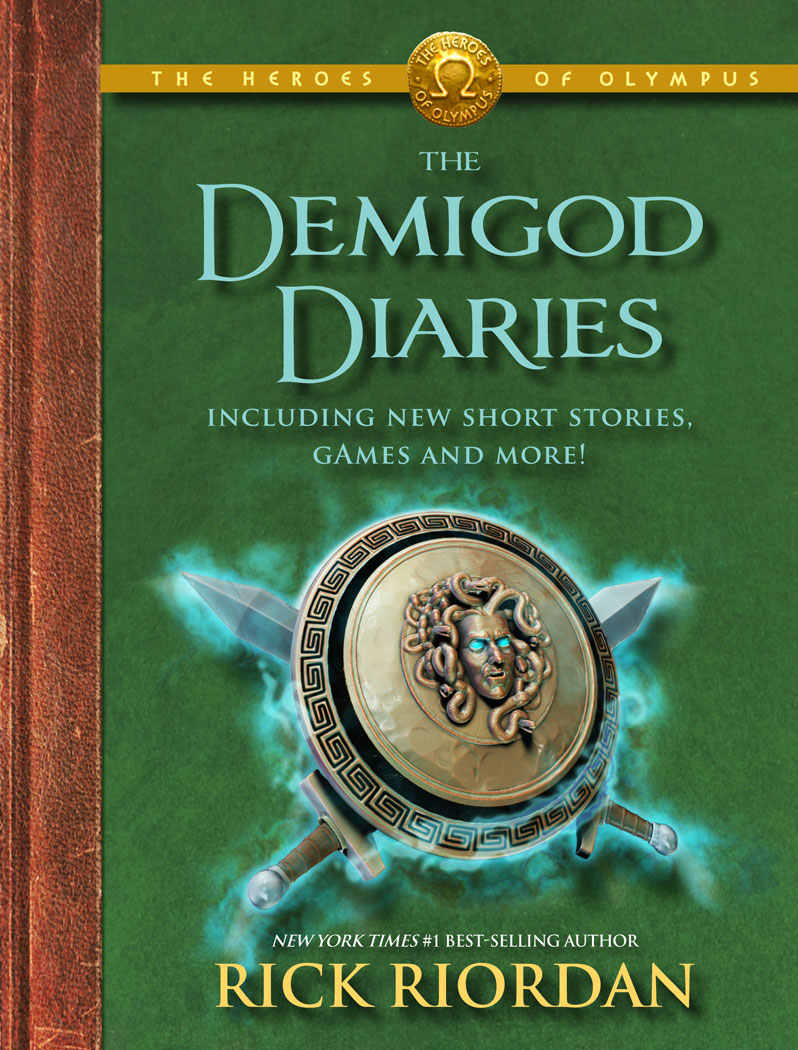
There isn't really much to analyze on the cover.  We have a green background, along with a brown spine, with the shield Aegis and two swords all glowing.  Simple, but I would say still reasonably effective. 

Well, I think that wraps up this retrospective.  Next time we're returning to the world of Egyptian Mythology to finish our adventure with the Kane siblings.  Join me again next time when we take a look back at The Serpent's Shadow.  I will see you then.