Saturday, October 29, 2022

The Audio File: Uncanny Robot

Artificial intelligence has made major advances over the last few years. We’ve seen the rise of predictive text algorithms and even AIs that can generate artwork. But these leaps in technology have many people asking some serious questions. But perhaps the most pressing question of them all is this: can you use an AI to write the script for an audio drama? The audio drama we’re reviewing today aims to answer that question. We’re taking a look at Uncanny Robot


Uncanny Robot is an anthology audio drama created by Theresa Matsuura and Rich Pav. The start by taking a story prompt, and feeding them into different predictive text AIs. They then allow the AI to keep going, occasionally stepping in when it gets stuck in a rut, or if they otherwise don’t like the direction things are going. Then, Theresa and Rich record and narrate the insuring story. What laughs, insanity, and even touching moments, can an AI come up with? Uncanny Robot is here to find out.

This was another audio drama where I was requested to review by the creators. I was contacted over Reddit asking if I’d give Uncanny Robot a review. This was right around the time Arielle Nissenblatt (rhymes with this-and-that) did that Twitter tread introducing my fellow podcast critics and I to everyone on Twitter. I said yes, and here we are now.

So, a few things to discuss before we go forward. The first couple episodes were almost entirely AI driven, with minimal input from the humans. The primary AI used is Novel AI. Theresa and Rich originally wanted Uncanny Robot to be something that listeners could unwind and relax to. The AI insanity of the stories would be like an ASMR video, but in podcast form. However, they soon decided that this would prove too limiting for what they wanted Uncanny Robot to be. So, they started taking a more hands-on approach to the stories. I’m not sure what the exact percentage of human contributions to the later stories are, but defiantly much more than in the first two episodes. Each episode also includes an accompanying commentary episode. The first two episodes include the commentary along with the stories.

The use of AI also extends to other aspects of Uncanny Robot. All of the images and art work that accompany the episodes are all AI generated. Even the music is AI generated. Apparently, there’s some AI that can generate music scores, but it is very tricky to get something worthwhile out of it. Rich is quite adept at this, but it is certainly no small task.

I must also give a shout out to another podcast that Theresa and Rich work on. Uncanny Japan explores all that is weird from old Japan. Strange superstitions, folktales, cultural oddities, and interesting language quirks, and whatever else Theresa digs-up while researching for her novels and short stories. It is hosted by Theresa, who also does the research, while Rich handles the audio engineering and soundscaping. It isn’t an audio drama, or audio fiction per se, but I still greatly enjoy it. I would encourage everyone to give Uncanny Japan a listen. Well, after you listen to Uncanny Robot, of course. I should probably also mention that Theresa is a Bram Stoker Award nominated author. She has published short story collections such as The Carp-Faced Boy and Other Tales and A Robe of Feathers and Other Stories.

Okay, now that we’ve discussed all of that, let’s get into the episodes. Our first episode is a cheery little starter. You see, the theme of this episode is death. Oh, don’t worry, it is more lighthearted than it might sound. In our first story, titled “Memories of Death” a ghost recounts his childhood experiences with death. His parents died when he was only twelve, and his sister and cousin died not long after that. He began to contemplate his inevitable demise, and how death comes for us all sooner or later. Then, he took a faithful trip to his grandma’s house. He hears about murder on the radio, and in songs, and on television. The protagonist became obsessed with thinking about murder, and talking to everyone about murder, and he began to fear that he might be a murderer.

Some people wonder if it might only be a matter of time before AI get into the story writing business. Some people fear this might lead to human writers getting edged out of the market. Personally, I’m not losing any sleep over the matter. If these episodes are anything to go off of, AI has a long, long way to go before it can seriously challenge human writers. Still, AI are capable of producing some unintentionally hilarious results. I’ve certainly played around with enough predictive text algorithms. My favorite is InferKit. I learned about it, back when it was called Talk to Transformer, from the YouTube channel GrayStillPlays. He did a video where he made it write articles about Florida Man. I once made it attempt to recreate Percy Jackson’s Wikipedia article. I posted the result on the r/camphalfblood subreddit, if you are curious. I also had it try to recreate stories from Thomas the Tank Engine, and I’m still kicking myself for not saving the results.

I thought that “Memories of Death” was an excellent start for Uncanny Robot. We start off with a scene that is evocative of Spoon River Anthology. Then we get to the visit with Grandma, and the story goes completely off the rails. Of course, going off the rails is when the real fun starts. Let’s see, our protagonist is obsessed with murder, consumes large amounts of media centered around murder, constantly talks about murder, and fears that he might be a murderer? Well, I think that the answer is pretty obvious. The protagonist became a member of the true crime fandom. Though, it seems he got a little too into it, if he feared that he might be a murderer. Wait, he started worrying that he was a murderer when he was twelve, which was the age his parents, sister, and cousin died at…uh oh! That’s not good! There are some errors, continuity and otherwise, but that just adds to the charm and hilarity. For example, a man jumping off of a building is described as a murder. Uh, Mr. Robot, ever heard of suicide? Also, the protagonist hears about this on the radio, but then the story says that he and Grandma saw it on television.

“Memories of Death” is a great first offering from Uncanny Robot.

The second story is called “ You Remind Me of Someone.” Jake has recently become a vampire. It is cold and raining in the cemetery, and he is all alone. Then he sees his sister Rachel. She invites him into a nearby chapel. They talk about life and afterlife. Rachel reminds Jake of someone, but he can’t quite think who.

We all know that AI is capable of creating some great comedy stories. However, can I create something a bit more serious? It would seem that the answer is a tentative yes. Now, this story wasn’t anything groundbreaking or revolutionary. Still, for a story that was primarily written by an AI, it’s not half bad. Sure, there were a few goofs, as is to be expected from an AI-generated story. For example, Jake says that his sister Rachel reminds him of his sister Rachel. Not long after this we learn that Rachel is dead. It was almost like the story was trying to have this be a twist, but it didn’t quite know how to properly pull it off. Still, it could have been a lot worse, so I’m still impressed with how this story turned out. “You Remind Me of Someone” is a great second part for Uncanny Robot’s first episode.

Our second episode features the biographies of famous musicians, as written by AIs. The first story is titled “Elvis Lives.” As the title says, it takes place in a world where Elvis did not die in 1977 at the age of forty-two. We get to learn all sorts of fun facts about Elvis. For example, apparently, his birth name was Ralston Oliver Jones. He was named after his mother’s favorite singer, Billie Holiday. Speaking of his mother, she worked as a dancer at a strip club. Elvis changed his name to Elvis Aaron Presley when he was eight. His family moved to California when he was a teenager, and he attended UCLA. Elvis had a total of twenty-six marriages, and was divorced several times. In 1969, he got a sex change and became known as Pricilla Presley. This probably caused some confusion, as Elvis’ first wife was also named Pricilla.

I could go on, but this doesn’t even begin to scratch the surface of the sheer insanity of this story. The rules of reality really are out to lunch with this one. I loved absolutely every minute of this hilarious insanity. Oh, but we aren’t done yet. You see, our protagonist gets to meet Elvis in the present day. Elvis is a philanthropist who likes to help Black people. In fact, he plans to sell all White people into slavery to help Black people. He also wants to turn the protagonist into a Black genius. I guess Elvis is a reverse Clayton Bigsby; a White Black Supremacist, if you will. And he threatens to whip the protagonist if they don’t agree to become a Black genius. Kind of sending mixed signals there, Elvis. Also, I’m pretty sure that gender reassignment surgery is the correct term for what the story called a sex change. And come to think of it, the AI deadnamed Elvis, or should I say Pricilla, quite a bit. Of course, things would get a bit confusing if, among other things, the AI talked about how Pricilla Presley was the ex-wife of Pricilla Presley.

“Elvis Lives” is my absolute favorite story from Uncanny Robot. With “Memories of Death” in a respectable second place. Absolutely hilarious from start to finish. I loved every minute of it.

The second story in the episode is “Whatever Happened to Mr. Mojo Risin?” It follows an interview with the musician Jim Morrison. I’m less familiar with him than I am with Elvis. This story also had the misfortune of having to follow “Elvis Lives.” It was pretty much impossibly to top the insanity of its predecessor. So, I couldn’t really get into “Whatever Happened to Mr. Mojo Risin?” AI stories as always a mixed bag, and this on just didn’t click with me.

While we’re on the subject, the third episode is titled “Valentines Day with the Revenant Squad.” It is a love story set in a dystopian future. Unfortunately, I just couldn’t get into it. It wasn’t really bad, but just kind of meh. As such, we shall move right along.

Our fourth port of call is titled “Asteroid Arnie and the Mushiblooms.” The protagonist of this story gets to go on an adventure with the great space hero Asteroid Arnie. They must travel to an alternate version of Earth to save the Mushiblooms. Mushiblooms are cute little fuzzballs, and Asteroid Arnie is their only hope. So, grab your nucleic phaser, and hold on tight.

I was intrigued when I heard that this story would involve alternate universes. As many of you will know, alternate history is a big source of bread and butter for this blog. So, I was eager to see what the AI would come up with. Well, it’s turned out the AI wasn’t all that interested in alternate history. It seems that it wanted to write an episode of Rick and Morty instead. Still, we did get some fun alternate history tidbits. For example, the protagonist isn’t from our universe. They come from a world where Earth was destroyed in 1876 as a result of the American Civil War. We must presume that space travel, and space colonization, was invented much sooner than in our universe. 

I should also note that this episode marks the point that Theresa and Rich started taking a more hands-on approach to the stories. I can definitely see that. The story was noticeably more cohesive than its predecessors. It still managed to still feel like it was written by an AI, which, of course, it was. This episode certainly had its moments, but I felt that everything didn’t quite come together as well as it could have.

The fifth episode is “Peppers and the Screaming Yoof: A True Crime Parody.” It begins in April of 1969. Four meddling kids, and their dog, are on their way back from Woodstock. They soon find themselves on a mysterious farm called the Screaming Yoof. As meddling kids are wont to do, they decide to snoop around and investigate the mystery.

This episode was released on April Fools’ Day. As such, I spent most of the episode trying to figure out what the trick was going to be. I thought that maybe it would turn out to have been written completely by the humans, with no AI input. This was before I listened to the companion episode, and learned about the change in how episodes are made. So, I kept waiting for the other shoe to drop the whole time. I suppose the effect was a bit like Horse eBooks. It was this Twitter account that, as the name suggests, spammed quotes from various Russian ebooks about horses. Everyone assumed that it was an automated bot account. The quotes, non sequiturs that they were, almost worked as dada poetry. It was kind of amusing to think that a bot account had inadvertently created art. Well, as it turns out, it was not a bot account, there was a human running the Horse eBooks account the entire time.

Anyway, if you’ve ever wondered what Scooby-Doo would be like if it had swearing, overt drug references, and if Scooby was the antichrist, well, here you go. The Scooby analog is mentioned to have been raised by a cult called The Devil Dogs, but this doesn’t have much bearing on the plot. There’s one point where the characters encounter a turntable from the 1980s, which apparently happened before 1969. Theresa and Rich have said they intended this story to be a parody of true crime podcasts. I do get some hints of that, but Scooby-Doo is definitely the dominant flavor here. I admit that true crime podcasts aren’t really my area of expertise.

This one wasn’t bad, but maybe I would have enjoyed it more if I hadn’t been looking for signs of trickery.

The sixth episode is “Asteroid Annie and the Mushiblooms.” This episode is an alternate universe version of the previous episode “Asteroid Arnie and the Mushiblooms.” Once again, we have a protagonist going on an adventure with a space hero; in this case, Asteroid Annie. However, there are some differences this time round. Chief among them is that the Mushiblooms are evil, and Asteroid Annie is the only person who can stop their diabolical plot.

I think I like this episode a bit more than “Asteroid Arnie.” It just felt like the plot was better constructed this time round. There was a part where Annie said that it is important to remember three things: shake the jar, open the jar, and be kind to the babies. I assumed that this was simply AI-generated gibberish. However, it turns out that Theresa was the one who wrote that particular line. In fairness, it does have plot reverence. There’s a jar of seeds that is important to defeating the Mushiblooms. The part about being kind to the babies is because, apparently, the Mushiblooms will be reborn from the seeds, and there is a chance that they will be good. Okay, I’m just going to be real here, I got none of that from the story. I wouldn’t have known that if I hadn’t listened to the companion episode. Still, overall I found “Asteroid Annie” to be a bit of a step-up over “Asteroid Arnie.”

Our final episode is “Singer Boy and the Trip to the Moon.” Our protagonist is a clown who works for a circus. They’ve been feeling a bit blue lately, and they just need to get away from it all. So, they team up with another member of the circus named Singer Boy. Together, the two depart in a hot air balloon. The Moon is their destination, and they intend to leave their troubles millions of miles away.

This story had a number of surprisingly introspective, and dare I say, even touching moments. There’s a strong sense of melancholy throughout the story, but also a sense of hope and cautious optimism. It’s like the story is saying that, yeah, bad things happen, but they can be overcome. There is a light at the end of the tunnel. A surprisingly competent effort at a serious story for something written by an AI. Granted, this is all a bit undercut when you consider that Theresa was guiding the path the story took. Still, even with that in mind, this story wasn’t half bad. Sometimes, I wish I could get away from all of my troubles, if only for a bit. Maybe not in a hot air balloon bound for the Moon, but something along those lines, perhaps.

I’m reminded a bit of Today is Spaceship Day by Austin McConnell. It is also a story that was created via a predictive text algorithm. Austin creator turned it into an animated YouTube video using Plotagon, back before Plotagon implemented a subscription model. In fact, he even randomized the way the characters were generated. Very humorous, as you might expect, but also surprisingly touching at times. Definitely give it a watch, if you haven’t already.

And with that, we have covered all of the episodes currently available from Uncanny Robot. It was a bit of a mixed bag, and it certainly had its ups and downs. As is to be expected for something involving AI and predictive text algorithms. Still, it managed to produce some genuine laughs, and some surprisingly competent attempts at more serious material. So, overall, I’m pretty satisfied with my listening experience with Uncanny Robot. I’d recommend everyone else give it a listen. AI probably won’t be the future of audio drama, but it can make some surprisingly entraining stories, when given the right nudges.

I think that should do it from me for now. I will see you guys next time.

Friday, October 21, 2022

Book Review: Suffer! by A.C. Sloan

I wasn’t always involved in the audio drama community. Before that, I used to write short stories and novels. In fact, I’ve got at least three or four unpublished book manuscripts. There are plenty of other people like me, but what about the reverse? That is, people who started in the realm of audio dramas, but then expanded into prose fiction? Well, we are going to discuss one such example in today’s review. We are taking a look at Suffer! by A.C. Sloan. 


Theo has a lot on her plate. She’s a part-time college student, she works various part-time gig to help make ends meet, and she helps look after her autistic sister Pris and their great-aunt Dottie. Still, every week she can get away from it all for one hour on Thursday night. That is the night the hit show Suffer comes on. It follows the adventure of Marcia Suffer. Played by Roxy DeVine, Marsha’s a victim rights attorney who also works as a vigilante. Marsha does whatever it takes to bring justice to her clients, even if it means going outside the law at times. Theo always watches with her best friend Sam, along with Pris and Dottie. They also have their own YouTube fan channel called The Suffragettes of Arleta. Theo enters a contest to meet Roxy DeVine not expecting much. To her surprise, however, she wins. Roxy is coming to Theo’s house to watch the Suffer season finale with Theo and the gang. It’s a dream come true. However, Theo and company will soon learn that all that glitters is not gold. For things are rarely what they seem in the land of Hollywood.

A.C. Sloan is better known as Ann Sloan. You might remember her as the creator of The Carlötta Beautox Chronicles and Who is Cam Candor? It was certainly exciting to hear that Ann was going to be publishing a novel. Doubly so when I discovered that it would have an audiobook adaption. So, I saw Ann giving out free review copies on Twitter. I asked if there were any audiobooks available for review. I’d previously reviewed the audiobook of The Supervillainy Saga Vol 1 at the request of author C.T. Phipps. Ann said that there were indeed, and I leapt at the opportunity. And here we are now.

So, first things first, are there any references to The Carlötta Beautox Chronicles. Well, Suffer! is an original work with no connections to Ann’s previous works. That said, there are a couple little nods and references to be found. At various points, the characters spray paint cheaper shoes red to make them look like Louboutins. This is something that Carlötta did at the end of season one, and she even left red footprints just like Sam does. There’s also one point in Suffer! where it is said that some news is best taken with loins girded. “Gird your loins” is pretty much Carlötta’s catchphrase.

In terms of style, Suffer! is a bit more grounded and down to earth than The Carlötta Beautox Chronicles. It still has Ann Sloan’s signature humor, but it tones down the wackiness a bit. This is certainly understandable. What works in an audio drama isn’t necessarily going to translate into book form. Books and audio dramas are different mediums, and they each have their own conventions. Suffer! also brings several moments of genuine seriousness and introspection. I think it is really great to see Ann Sloan branching out and trying new things. The more introspective and emotional scenes show that Ann is capable of writing more than just screwball comedies.

So, let’s talk about the characters. As previously stated, Theo has received a lot of hard knocks in life. Her dad died when she was young, her stepdad wanted nothing to do with her, and her mom sided with Theo’s stepdad. So, Theo was sent to live with Dottie, but that was okay. Dottie was a lot more fun, and actually gave her love and attention. Theo is absolutely devoted to being the best big sister possible to Pris. This is good, as Pris is autistic, and Theo is way more of a mother to her than their actual mother. In fact, a minor plot thread throughout the book involves Theo trying to find a way to become Pris’ legal guardian. Theo knows that the world is an often and cruel and unkind place, and she wants to help make it better. That’s why she aspires to be a victim’s rights attorney, just like her hero Marsha Suffer. Theo is the rock that the other characters rely on, and often serves as the voice of reason when things get especially crazy.

The major themes of Suffer! involve bullying, victims becoming bullies, the cycle of hurting, and how we break that cycle. Unsurprisingly, Theo has had to deal with a lot of bullies in her life. The part that really struck a chord with me was a flashback to when Theo was in third grade. Her class did that whole Secret Santa thing, and Theo got assigned to the mean girl who made her life living hell. They had to give a gift every day that week. First day, Theo got nothing, but then she got mean spirited gifts, like chewed gum or a shaken soda can. The teacher tried to get involved, but that just made things worse. And despite it all, Theo still did her best to give genuinely good gifts to the boy she was assigned. I mean, ouch, that all really hit home. I had several things like that happen to me in grade school. I really hope Theo got a hug a some point.

I looked up Arleta, as I wasn’t previously familiar with it. One of the pictures on the Wikipedia page for Arleta is a high school. But to be perfectly frank, it looks more like a prison. Of course, Theo and Sam would probably say that’s a pretty accurate description. And yet, despite all of this, the descriptions of daily life in Arleta, and the neighborhood Theo and Dottie live in, have a certain fondness to them. I wonder if Ann Sloan might be drawing from personal experience.

Dottie is Theo’s great-aunt. As previously stated, she’s the one who raised Theo for most of Theo’s life. Dottie always speaks her mind, and doesn’t hold back with sharp comments. Her generally approach to life can best be summarized as “Screw you, and up yours! I’m too damn old for this shit!” She reminds me a bit of my mother, who has a similar outlook on life. Theo has had help take care of Dottie more as she’s gotten older. Still, Dottie certainly doesn’t let old age, or needing an oxygen canister, slow her down.

Pris, short for Pristine, is Theo’s little sister. As previously noted, she is a high-functioning autistic. I would say that Pris is one of the best representations of an autistic person I’ve ever seen in media. I don’t know if Ann Sloan has anyone autistic in her life, but if not, she clearly did her research. Pris is also significant in that she’s half-Latina and a girl. Autistic girls and, autistic racial minorities, are still fairly rare in fiction. I also liked that one of Pris’ stims is that she flaps her hands. This is something I do myself, and Suffer! was the first time I actually encountered an autistic character in fiction who did that too. Stims are little respective behaviors autistic people do; often to help cope with stress. Pris has a good memory, but not to a superhuman degree. 

I also really appreciated how her dialog was written. A frustratingly common stereotype is that autistic people talk like robots. In reality, autistic people run the full spectrum when it comes to modes of speech. Pris’ dialog is deliberately stilted, but feels natural, and doesn’t come across as a caricature. As someone who is on the autism spectrum, I really appreciated how Pris was written.

Rounding out the main four is Sam Ruiz. He’s been Theo’s best friend since middle school. He’s tall, gay, flamboyant, and has a personality that is larger than life. He’s here, he’s queer, and he will not let your forget it. Sam works as a nurse by day, and likes it well enough, but he yearns for something more. He is an incredibly talented makeup artist, and quite knowledgeable about fashion. Sam’s also occasionally been known to cosplay as Marsha Suffer, and looks fabulous while doing so. And no, Sam was not named after me. Ann Sloan certainly liked my reviews of her shows, but I doubt it was that much. Also, I am neither tall, gay, Mexican, nor fabulously flamboyant.

And let us not forget Roxy DeVine, the actress who portrays Marcia Suffer. She has become incredibly wealthy thanks to her work on Suffer. However, she’s also very vain, high-strung, and is a general nightmare to work with. This can partially be traced back to her youth. Roxy had the stage mother from hell. Roxy’s mother was always quick to criticize and nitpick. Roxy didn’t have any friends growing up; her extremely good looks tended to make other girls jealous. Technically, all the pushing the Roxy’s mother did paid off. Roxy is a highly successful, and extremely wealthy actress. However, she’s managed to alienate pretty much everyone around her, and still feels unfulfilled. Roxy puts up a tough exterior because, deep down, very deep down, she’s still the same sad kid she was in grade school. Of course, as previously mentioned, a big theme of the novel is that having a rough childhood only gets you so much sympathy. Eventually, you have to move on from the past, and stop using your own misery as an excuse to hurt others. Theo got hit by several hard knocks in life, but she managed to not turn out like Roxy.

I’ll also make a few remarks about the way the entertainment industry is presented. So, Suffer is part of the big Thursday line-up of shows. I’m getting some hints of Shonda Rhimes, and all of the shows she’s made. Shonda Rhimes shows always air on Thursday, and have a devoted following. Though those shows air on ABC, but the network that Suffer airs on sounds more akin to The CW. The characters are all excited to attend a convention called DramaCon. It’s somewhat similar to ComicCon, or various anime conventions, but is aimed at a more mainstream crowd. Well, I would say ComicCon is pretty mainstream at this point. As are most stereotypical “nerd” properties like Star Wars and the MCU. I have to assume that mainstream means people who watch shows on network television. DramaCon is also, somehow, even bigger than ComicCon. Now, this is an Ann Sloan book, so the rules of reality are out to lunch, if a bit less so than in her previous works. So, I’m willing to suspend my disbelief that something like DramaCon could be that successful.

I’d also like to take a moment to talk about the audiobook. After all, it is the reason we are here. The audiobook is narrated by Chelsea Kwoka, who previously appeared on The Carlötta Beautox Chronicles. She does a wonderful job capturing all of the characters. She nails Sam’s larger-than-life personality and Dottie’s “I’m too old to give a damn” attitude. I especially like how she handled Pris’ dialogue. She made Pris sound a bit stilted, and overly formal, but it never felt like a caricature of an autistic person. Her performance sounded very believable and accurate. So, great performances all around from Chelsea Kwoka.

Okay, now we’re getting into the spoilers section. So, if you don’t want any of that, turn back now.

Last chance, you sure you want to continue?

If everyone who wants out is gone, then let’s get into it.

So, from reading various synopsis blurbs, and listening to the preview sample on Audible, I knew that Roxy would get kidnapped and held hostage. I assumed that Theo and company would have to save her, if only to keep Suffer on the air. Well, it turns out I was half-correct. Roxy did indeed get held against her will…except Theo and the gang are her captors. Roxy, during her disastrous visit to Theo and Dottie’s home, slips and hits her head. I briefly wondered if things were about to turn into Weekend at Bernie’s, and Theo would have to convince the world that Roxy was still alive. I also considered that maybe Roxy might get amnesia, and believe that she actually was Marcia Suffer. But no, turns out we got a comedic hostage situation.

In fairness, Roxy was a complete jerk to absolutely everyone up to that point. In particular, she was mean to Pris, and that is pretty much unforgivable. Well, I guess Roxy learned that, sometimes, karma comes at you hard and fast. It certainly was fun seeing her run through the wringer. Still, in keeping with the anti-bullying themes of the novel, the punishment must fit the crime. Roxy might have been a jerk, but Theo and the gang couldn’t keep her locked up forever. Why, if they did, Marcia Suffer would never make her triumphant return on Suffer. Oh, and holding someone against their will is wrong and immoral. That’s bad too, I guess.

Well, I do have a few minor points of criticism here. Theo eventually comes to realize that holding Roxy hostage makes her a bully. I suppose this is keeping with the anti-bullying themes, but holding someone hostage is a tad worse than bullying. I would be one thing if Theo was blackmailing Roxy, but holding Roxy hostage is straight-up criminal activity. In fairness, the book does acknowledge this, but there were probably better examples to go with for an anti-bullying message.

Theo and Roxy eventually bond by sharing experiences of their terrible mothers. Theo also explains how much Marcia Suffer means to her. Okay, all well and good. This was set up as a major turning point in Roxy’s extended stay with Theo and the gang. But that being said, I feel we could have used just a smidge more time to really make Roxy’s character development feel properly earned. It felt like we went from those bonding scenes, and then immediately to Roxy agreeing not to turn Theo over to the police. The plot was on the right track, but maybe needed just a tad longer to bake.

This next part isn’t a complaint, but more of an observation. The characters use a water gun they got at DramaCon to keep Roxy in-line. The water gun is modeled off of Marcia Suffer‘s gun, and is hyper-realistic. In real life, toy guns and water guns always have a bright red or orange cap at the end to identify them as such. These colorful caps are legally required. The requirement was made specifically because of people using toy guns to, among other things, rob banks and cash registers. That, and so the police didn’t accidentally shoot kids with toy guns. In fact, sawing-off the tip of a toy gun, or painting it, is actually a crime. So, a water gun as realistic as described in the book would land its manufactures in some seriously hot waters. Of course, this was another instance where I was willing to suspend my disbelief for the sake of the story.

I would like to emphasize that my critiques are, in the grand scheme of things, minor issues. Overall, I found Suffer! to be an incredibly enjoyable novel. I was in the mood for something fun and lighthearted, and it managed to scratch that itch. At the same time, it also managed to deliver some genuinely heartfelt and rather touching moments. This was actually what I would have expected from a debut novel written by Ann Sloan. I expected Suffer! to be excellent, and a lot of fun, and it certainly did not disappoint. It has Ann Sloan’s trademark humor, but also shows that she is capable of tackling more serious fare. Also, as an aside, I really love the cover art. Colorful, stylized, and understated. An excellent choice for a book cover.

If this is the start of a novel writing career, I for one can’t wait to see what comes next. So, if I haven’t made it clear by now, purchase a copy of Suffer! today.

I think that should do it from me for now. I will see you guys next time.

Wednesday, September 28, 2022

The Audio File: Untrue Stories

I’m happy to review any audio drama that is asked of me. I certainly hope that is obvious by now. However, I also hope it is obvious that I won’t hesitate to critique anything I find lacking. With that in mind, let’s get right to today’s review. We’re taking a look at Untrue Stories.


Untrue Stories begins in the Outer Hebrides of Scotland in 1948. The writers H.G. Wells and George Orwell have both booked the same cottage for a vacation. The two men cannot stand each other, as they have very different views of the future. However, Wells has an ace up his sleeve. He has invented a bicycle with the ability to travel through time. Wells is determined to settled the debate once and for all. He accidentally travels to the year 1984 after taking a wrong turn. Wells discovers a future of totalitarianism and oppression. A boot to the face forever. Wells befriends a young woman named Julia. She is none other than Orwell’s granddaughter. Together, they conspire to change history for the better. But the Thought Police are hot on their tail, and are determined to ensure that the future of Oceania comes to pass.

This is another review where I was asked by the creator to review it. Series creator Robin Johnson contacted me on Reddit. He said that he had enjoyed my previous reviews, and seen on Twitter that I review audio dramas. I assume he was referring to the Twitter thread that Arielle Nissenblatt (rhymes with this and that) made to showcase several podcast critics, including me. I said yes, and here we are now.

There have been times in my life where I briefly pondered whether H.G. Wells and George Orwell ever met each other. It was merely idle curiosity due to their similar names. Well, as it turns out, they did indeed meet in real life. George Orwell invited H.G. Wells to his London apartment for dinner, and they had a lively discussion about whether or not alone science would create a better world. Wells had full confidence that science would inevitably create a utopia. Orwell, by contrast, believed that science was certainly useful, but that it was necessarily for society to be guided by more than just science alone. The two men vehemently disagreed, and parted on less than amicable terms. Quite ironic, as they both democratic socialists, and otherwise had rather similar political views.

There is the minor issue that H.G. Wells died in 1946, but the audio drama takes place in 1948. But I’m willing to let that slide. We can chalk it up to time travel shenanigans. Speaking of which, it appears that Wells never published his famous novella The Time Machine in the world of Untrue Stories. He never makes reference to the novel. Or maybe he’ll go back in time and inspire his younger self at some point?

Wells also travels to the year 802,701 at one point, and encounters a Morlock, but he doesn’t know what it is. I liked how the Morlock was portrayed as being quite intelligent. I mean, the Morlock aren’t just dumb brutes. They build and maintain machines and clothing. And let’s not forget that they’re the ones keeping the Eloi as cattle, not the other way around. The way the Morlock is described is evocative of the 1960 movie adaption of The Time Machine. Wells says that exiting the time bike’s chrono bubble mid-journey will cause you to age into dust. This is probably a nod to the 2002 movie adaption of The Time Machine. On the one hand, the 2002 movie wasn’t very accurate to the novel, but I did love it when I was a kid.

George Orwell’s depiction as a bit of a jerk might strike some people as odd, but it has some basis in reality. Orwell once compiled a list of suspected communist for the British Intelligence Forces. Among other things, he considered Charlie Chaplin suspicious for being a Jew, and deemed Paul Robeson to be “anti-white.” For reference, Paul Robeson was a black American musician who was also involved in civil rights activism. Oh, and during Orwell’s boarding school day, he was a prefect. He used his position of authority to rat-out any boys he suspected of being gay. Well, they often say to write what you know. It would seem Orwell put quite a bit of himself into Nineteen Eighty-Four.

On a lighter note, the original plans for Nineteen Eighty-Four were also slightly different. For starters, it was going to be called The Last Man in Europe. It was also going to be set in the year 1948. So, I guess that would have made it an early example of alternate history. This is highly amusing, as Nineteen Eighty-Four is quite popular within the alternate history community. However, Orwell’s publisher deemed this too confusing, and convinced him to set the novel in the future. He thought about 1980 or 1982, but then he flipped the last two digits of the current year, and got 1984. Of course, in Untrue Stories, the joke is that the initial version that Orwell comes up with is basically what the year 1984 was actually like. He predicts a world of aviator sunglasses, neon-colored clothing, Rubik’s Cubes, and unrestrained capitalism. Though, to a socialist like Orwell, that would all probably sound pretty dystopian.

Okay, I’ve put it off for as long as I can. I’m just going to be brutally honest here. I did not enjoy Untrue Stories. Let’s get into the full postmortem.

The first strike was the theme music. I’ve listened to many wonderful audio drama themes over the years. The theme music for Untrue Stories, however, is not one of those cases. It reminds me of those toys that are supposed to play music, but what they actually play is basically just electronic screeching. I always tried to fast forward through the theme music whenever possible. Okay, so how was the voice acting? In contrast to the theme music, the voice acting wasn’t bad. Overall I found the performances to be fairly decent. I found Orwell’s voice to be a bit irritating, but I think that might have been deliberate.

Untrue Stories features cameos from numerous 20th Century science fiction authors. Unfortunately, these appearances are little more than cameos, and Untrue Stories doesn’t really do anything creative with them. They basically amount to “Hey, look, it’s Issac Asimov! He wrote I, Robot! Boy, he sure likes to talk about robots!” or “Over there! It’s Ursula K. Le Guin! Ooh, she’s got a secret message codenamed Omelas! Just like the short story she wrote! How wacky is that?!”

These scenes felt like a cutaway gag from an episode of Family Guy. On that topic, I found the humor to be incredibly lowbrow, and at times bordering on sophomoric. The main attempt at humor was making historical figures act like jerks. Almost all of the jokes failed to get even the slightest chuckle out of me.

We learn that Orwell is destined to become Big Brother himself in the dystopian future of Oceania. Orwell finds out, and thinks that this sounds swell. So, he recruits a team of dystopia writers, such as Ray Bradbury and Margaret Atwood, to help make the future as dystopian as possible. If nothing else, they’ll be able to brag about how they tried to warn everyone, but nobody listened. Now, this could have been potentially funny. Have them all act like over-the-top Saturday Morning Cartoon villains, or something similar. Unfortunately, the actors playing the dystopia authors all gave very subdued performances. They all seemed to be under the impression that they were in a completely different audio drama than Untrue Stories. Bit of a missed opportunity there.

Now, I do have to give some moments of praise to Untrue Stories. There is a bonus episode that takes the form of an in-universe television program about how to speak Newspeak. I found this bonus episode to be genuinely funny and clever. I also liked the episode where Wells and Julia change the future into the 1984 of our world. However, they don’t actually travel to the future to see it for themselves. Julia’s clothing changes to a punk style. She and Wells assume, based on this, that they’ve turned the future into an irradiated post-apocalyptic nightmare. Wells then places a computer chip into a Sony Walkman. Said chip is from the far future, and any machine it is placed into turns sentient. The Walkman can only communicate using songs from the 1980s mixtape that it has in it. This leads to several amusing moments. As an aside, I agree with Wells, tea always goes in the cup before milk. That way, you can better control how much milk you add.

So, the team behind Untrue Stories are capable of being legitimately funny when they put their minds to it. I feel, perhaps, that Untrue Stories could have benefited from some more edits and revisions before it launched.

Now, comedy is a highly subjective genre. One of the most subjective, in fact. Untrue Stories had its moments, but overall, I just didn’t care for it. It failed to make the most of a potentially interesting premise. So, unfortunately, I cannot say that I recommend it. But perhaps you feel differently. If this all sounds entertaining, and something you’d like to try, then good for you.

Well, I think that should do it from me for now. I will see you guys next time.

Monday, September 19, 2022

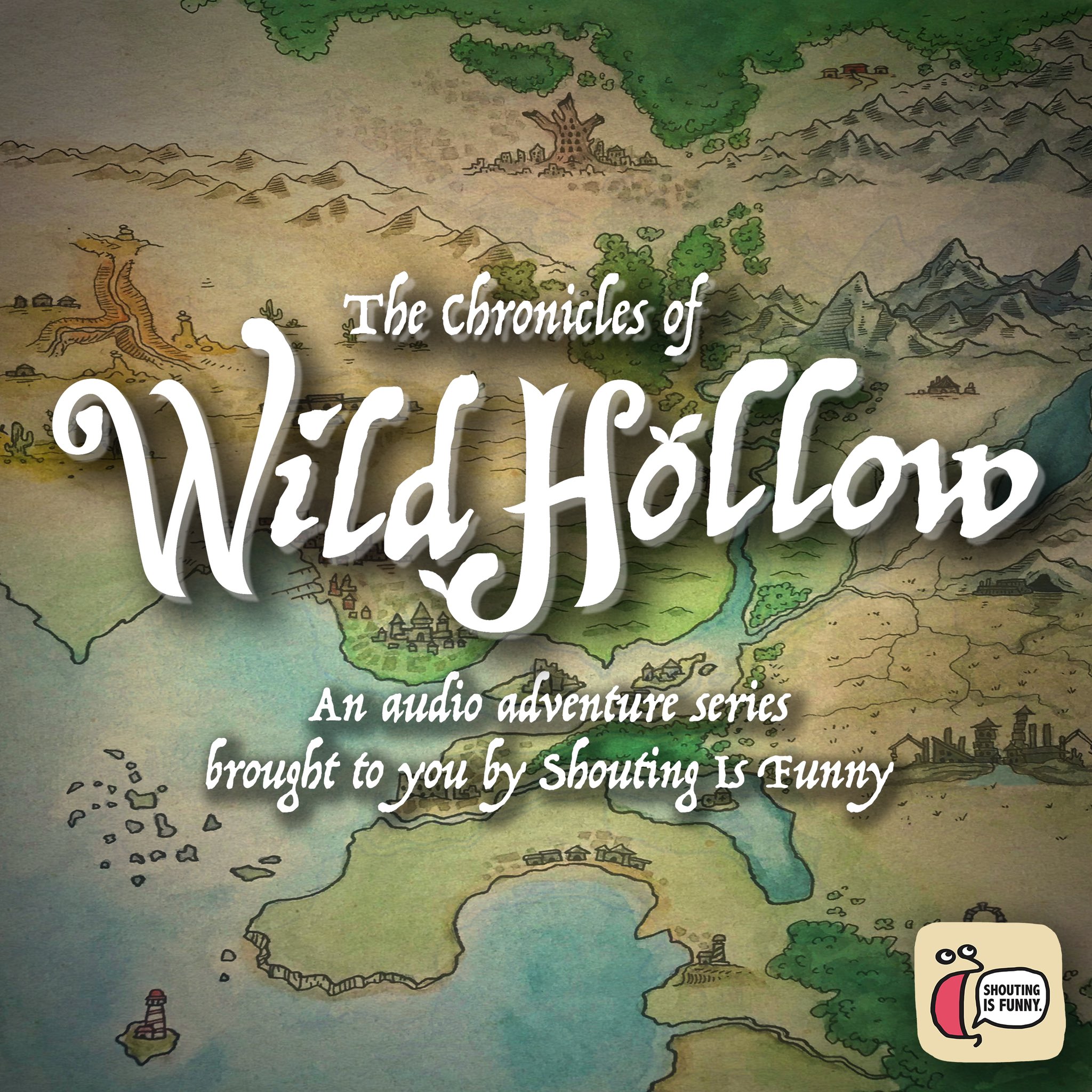
The Audio File: The Chronicles of Wild Hollow

This year has brought many new opportunities for me as an audio drama critic. I’m connecting more with other podcast critics, and that is bringing about new opportunities. This has also meant that more audio drama creators have been asking me to review their shows as of late. Speaking of which, that brings us to the audio drama we’ll be reviewing today. We’re taking a look at The Chronicles of Wild Hollow


In a far off place, an endless forest grows; sprawling, barren, impenetrable. But beyond the tree line…creatures roam free. A land where adventure lurks around every corner. A land where legends are made. A land called Wild Hollow. Wild Hollow is home to a veritable menagerie of talking animals. The series chronicles the adventures of the various denizens of Wild Hollow.

I’d been vaguely aware of The Chronicles of Wild Hollow for a while. I think I might have seen it over on the r/audiodrama subreddit, or possibly on Twitter at various points. However, it didn’t really get on my radar until recently. Not long ago, I become part of a podcast critics group that meets on Slack. We share our reviews, discuss various podcast related things, and just enjoy each other’s company. We also trying to help each other out and raise our collective profile. One persistent myth is that there are no podcast critics. The fact that your reading this proves that isn’t true at all. So, to combat that, Arielle Nissenblatt (rhymes with this-and-that) did a Twitter tread introducing all of us to everyone on Twitter. Naturally, I was included, and got several audio dramas asking me to review them. The Chronicles of Wild Hollow, produced by Shouting is Funny, was one such show, and here we are now.

As previously stated, The Chronicles of Wild Hollow features talking animals that do human things. It is a bit like Redwall or Zootopia, but in the style of Discworld. Wild Hollow is a deliberately anachronistic land. 18th Century pirates, Wild West gunslingers, and gangsters from somewhere between 1920 and 1950 all exists side-by-side. Basically, if it could potentially make for a good story, it can be found in Wild Hollow. The stories are meant to be adventure tales, but with a humorous bent. In terms of demographic, The Chronicles of Wild Hollow is an all ages affair; fun that the whole family can enjoy. There’s usually about two or three songs per episode. They usually help move the plot along, or reveal something about the characters. The website for The Chronicles of Wild Hollow includes an interactive map of Wild Hollow itself.

The Chronicles of Wild Hollow doesn’t really have many episodes available so far. As of this writing, it has six episodes, which are divided into two trilogies, plus one Christmas episode. The first trilogy follows a mouse named Fandango Boursin, and he is also the protagonist of the Christmas Special. Shouting is Funny recommended that I start with the Grey Trilogy; named after its title character Artemis Grey. In hindsight, I should have listened to that advise. 

I need to briefly talk about what the Boursin Trilogy did wrong. That way, it will be easier to appreciate what the Grey Trilogy did right. The first strike was the voice acting. Fandango is a mouse who sounds a bit like Clint Eastwood…if he gargled cigarettes and razor blades. It got very irritating very quickly. The rest of the voice cast were generally decent, but not really anything to write home about. Though, I will say that I enjoyed the songs at the Lillypad Lounge. The tone was incredibly disjointed to the point of being schizophrenic. The episodes would be dead serious one minute, only to be downright parodic the next minute. The jokes always fell flat, were too self-referential, and I wasn’t a fan of the repeated fourth wall breaking. I also just didn’t find Fandango to be as interesting or as compelling of a character as I found Artemis to be. So, yeah, don’t make the mistake I did. I suggest skipping the Boursin Trilogy. 

The Christmas Special is slightly better. Being a thirty minute standalone episode certainly made things more bearable. And I will concede that a few jokes managed to get a chuckle out of me. However, it still suffers from many of the same problems that the Boursin Trilogy does. So, I’d recommend skipping it as well. Start with the Grey Trilogy instead. 

Now that we’ve got that out of the way. Let’s talk about the Grey Trilogy. Artemis Grey is a fox who works as a smuggler. She’s very quick witted a resourceful, as a fox must be. Artemis has recently attempted to stowaway aboard a pirate ship. Unfortunately, the pirates found out, but Artemis convinced them not to kill her. The pirates are in search of a Whale Song. It is an artifact created by Primus, the first whale. The Whale Song can grant great knowledge to those who know how to use it. Artemis forms an uneasy alliance with the pirates, and soon they’re off to find the Whale Song, and the secrets it contains.

I should begin by mentioning that you can listen to the Grey trilogy with having listened to the Boursin Trilogy. It appears that The Chronicles of Wild Hollow is aiming to be an anthology of stories set in the same world. The Grey Trilogy was a marked improvement over the Boursin Trilogy in every conceivable way. There was a proper balance between humor and seriousness. The voice acting was significantly stronger this time around. There wasn’t a single bad performance among the cast. You could tell the cast were more experienced this time around. I also appreciated that the fourth wall stayed firmly in place.

I also found Artemis to be a far mor interesting and compelling character than Fandango. I like foxes, so that helps. At first, Artemis seems like a typical, if still highly entertaining, roguish thief character. However, she’s shown to have a honorable streak, and she has good reason for wanting to find the Whale Song. Artemis was separated from her mother when she was just a kit. What she really wants, more than anything else, is to find her mom, and to have a family again. I liked that Artemis’ mom is named Freya, and thus, they’re both named after mythological goddesses. Poor Artemis has been on her own since she was about seven or so. Certain animals experience prejudice and discrimination from other animals in Wild Hollow. I would assume that includes foxes. Artemis probably turned to a life of crime because nobody was willing to help her, or take her in.

The legend of Primus added some much needed worldbuilding to Wild Hollow. Legend says that Primus was the first whale ever. He came into being when the world was first created. Primus swam the world singing his song of truth to all who would listen. But people grew greedy and kept demanding new knowledge from him. One of his teeth got knocked out by a rock, but Primus imbued it was his song. It is said whoever finds the tooth will also find the truth they seek. I liked how the legend gave a sense of lore and history to Wild Hollow. It makes it feel more like a real place, rather than just “our world, but with talking animals.”

I also greatly enjoyed the new friends Artemis makes along the way. Osric is an otter who dreams of becoming King of the Pirates someday. He’s an interesting take on an otter character. Usually, otters are portrayed as mischievous and playful. Osric, by contrast, is a fairly serious no-nonsense character. He doesn’t like Artemis initially, but comes to see her as a friend. Osric is joined by a penguin named Salami. Yes, that’s really her name. She’s dumb as a brick, but a good person at heart, and very happy-go-lucky. Salami doesn’t have a single mean bone in her body. Over the course of the trilogy, Osric and Salami become like family to Artemis.

I must also give praise to the sheer imagination that went into all of the settings for the Grey Trilogy. So, we start of having an adventure with pirates. Our first port of call is an island inhabited by dodo birds who wear togas and all have very Roman-sounding names. Then, our heroes ride inside of a whale to get to a city located within the fossilized remains of Primus. Then, Artemis has to travel to a forest who’s tree produce pollen that makes people act stupid. It all sounds absolutely insane, but it works. The bits in the city within the remains of Primus was my favorite bit. The Grey Trilogy felt weirdly nostalgic at times. It feels like a story, or a cartoon, I would have encountered as a kid. But don’t worry, adults can easily enjoy it as well.

Transcipts were originally only available for the Boursin Trilogy. However, Shouting is Funny has since corrected this. I want to take a moment to take them for that. I will reiterate what I said in my reviews of Seen and Not Heard and Main Street Mythology. Transcripts are very important for providing accessibility; especially to listeners with hearing difficulties. They are also very handy for people who write reviews. 

My only real quibble, and this is more minor, is that Fandango appears at the end of the Grey Trilogy. This means he’ll be coming along for Artemis’ next adventure. However, I’m cautiously optimistic that Shouting is Funny will take what they learned from the Grey Trilogy, and apply it to this next adventure.

And I certainly hope I get to go on more adventures with The Chronicles of Wild Hollow soon. They don’t have much now, but I’ll happily review whatever new episodes come out. I did something similar with my review of Poe Theatre on the Air. The next plan is to do a series of shorter one-off episodes. That sounds like it could be fun, and a great way to add more characters to the cast. 

The first of these mini-episodes is called “The Ballad of Little Mollusk.” Little Mollusk was a minor character from the Grey Trilogy. They tried to stop Caine the Horney Toad from starting a coup, but got thrown into the sea. As Little Mollusk drift upon the waves, they think about their early life. Little Mollusk used to be part of a family of famous singers. They entered a singing contest to bring honor and glory to her family. But fate had other plans for Little Mollusk. 

It would seem that my faith in Shouting is Funny was not misplaced. We start in familiar territory with a character from the Grey Trilogy. Wasn’t expecting Little Mollusk to be the focus character, but I’m not about to argue with the results. I thought that it was utterly brilliant to have the singing contest be Simon Cowell, who is a cow. It worked a lot better than the Christmas special having Macaulay Culkin inexplicably exist in the world of Wild Hollow exactly as he does in our world. I guess the theme of this mini-episode is that, as one door closes, another door opens. Your life won’t always go as planned, but sometimes that means you find new opportunities. I certainly didn’t think I’d be reviewing audio dramas on a highly successful blog. And yet, here we are.

I only have one minor nitpick. At one point, the narrator refers to Little Mollusk as a cephalopod. However, the way that Little Mollusk is described indicates that they are a sea snail. Snails are gastropods, not cephalopods. However, gastropods, cephalopods, and bivalves are all mollusks. Like I said, minor nitpick, not really that big of a deal.

“The Ballad of Little Mollusk” is an excellent start to the mini-episodes.

Our next mini-episode is a Halloween special. It is called “The House with the Glass Eyes.” It follows two raccoons who are very happy, and very much in love. They are pretty much the picture of a happy loving couple. They have won a stay at the creepy old mansion at the edge of town. The butler is an equally creepy crow, the walls are hung with mysterious portraits, and their are many strange sounds the happen in the middle of the night. Still, it does have a certain rustic charm. And really, what’s the worst that could happen?

Well, this was certainly unexpected. I knew that this was going to be a Halloween special, but I didn't expect The Chronicles of Wild Hollow to go full-on horror. True, there are some humorous moments. For example, our protagonists are incredibly naive and ignore the numerous red flags all around them. This is obviously a rib at how horror movie protagonists tend not to be very bright. Still, this mini-episode does a surprisingly good job of building atmosphere and suspense.

The main villains are a cult. Cults certainly do seem to pop-up a bit more in British Horror, compared to American Horror. Britain is a lot older than America, so an ancient cult makes more sense in Britain. By contrast, a monster and/or alien randomly appearing, and remaining largely hidden, works a bit better in America. As the saying goes, 100 years is a long time to an American, but 100 miles is a long distance to a European.

Anyway, the cult worships the concept of love, and likes to…taxidermy loving couples that they come across. Oh, and that crow butler? He doesn’t believe in the cult’s teachings, but he loves to eat all of the internal organs that the cult has leftover. I mean, wow, that’s pretty brutal for a show that’s usually pretty lighthearted, and somewhat silly. And to think the last mini-episode was about a singing contest. I suppose it makes sense that the crow turned out to be evil. After all, a group of crows in called a murder.

Personally, I’m all in favor of The Chronicles of Wild Hollow trying their hand at something darker. They clearly like to experiment with different genres and styles, and it is clear that the writers are pretty competent at writing horror. In fact, my one real complaint was that I wish the episode had been longer. I realize that this was a mini-episode, but I see potential here for a full-sized episode or two. I won’t tell you how it ends, but I just loved how dark things got.

“The House with the Glass Eyes” is an excellent Halloween Special. I certainly hope we’ll see more horror stories from The Chronicles of Wild Hollow
.

The Chronicles of Wild Hollow makes a second crack at a Christmas episode for our third mini-episode. It is titled “Salami Saves Christmas.” We return to the pirate crew that we met in the Grey Trilogy. Christmas time is here, but the pirates aren’t in a very festive mood. They’re still mourning the death of Pirate King Lesley. The pirates need a little Christmas right this very minute, and Salami is determined to bring it to them. She’s got the plan for perfect Christmas. What could possibly go wrong?

This marks second time that The Chronicles of Wild Hollow has attempted a Christmas Special. It also lightyears better. I’m quite fond of the pirates from the Grey Trilogy. I’m also pleased to see Salami getting to take center stage for the episode. It really is family and friends, not presents, that make Christmas a special time. I’ve come to appreciate that more as I’ve gotten older. This episode shows The Chronicles of Wild Hollow at its best. Heartwarming and sentimental, but with a few jokes and laughs as well. Much better than being a straight-up farce, like the last Christmas Special.

We also learn that roasted swampworm is considered a delicacy in Wild Hollow. This raises an interesting point I hadn’t considered until now. What do the carnivores of Wild Hollow eat? Mammals, birds, reptiles, and amphibians are all sentient in Wild Hollow. Certain invertebrates, such as mollusks, are as well. Maybe they eat fish and insects? Though, Salami’s name being what it is raises…interesting implications.

We also have Harvey Badger taking over as narrator. Angus Maxwell, who formerly played the narrator, decided to leave Shouting is Funny. Also, despite his name, Harvey Badger is a human…I think. I mean, never seen any photos, but I’m pretty certain that Harvey is a human.

Well, anyway, this mini-episode was really sweet, and is another example of The Chronicles of Wild Hollow at its best. And that means we’re three for three. The Chronicles of Wild Hollow bowls a turkey for excellent mini-episodes.  

Our next mini-morsel is “Bing and Crosby Make a Cake.” We return to the Stupid Woods where we meet a beaver and a praying mantis named Bing and Crosby. They host their own cooking shows where they make quite tasty meals. Except, not really. In reality, they’re both under the effects of the Idiot Pollen. The two have remained blissfully unaware of this, but Bing has begun hearing strange voices. Almost like memories of another life.

One of my guilty pleasure television shows is Worst Cooks in America on Food Network. As the name suggests, it is a cooking competition show where some of the worst home cooks in America compete, and hope to improve their cooking skills, for a cash prize. Over the years, it seems as though the contestants have gotten progressively stupider. However, even the dumbest contestants on Worst Cooks look like rocket surgeons compared to Bing and Crosby. But we see darkness amidst the silliness. It’s a pretty horrible scenario to think of. You have family and friends, an entire life, waiting for you outside the forest. But, thanks to the pollen, you can only kind of remember it. What must it be like for Bing’s loved ones, I wonder? Are they looking for him, or have they given up all hope? This short almost feels like an allegory of Alzheimer’s or Dementia.

Wild Hollow has once again decided to dabble in darker material. And once again, they have given us a quality short. 

The next mini-episode is “Hollow Herald Archive - Entry no.402.” We begin with a framing device. The archivist for the Hollow Herald Archive, the top newspaper in Wild Hollow. The archivist is listening to a recording from an investigative reporter who disappeared under mysterious circumstances. The reporter was covering stories about unusual homes. His search led him to the city of Primus. But what started as a simple trip will uncover corruption and lies within the leadership of Primus.

I was a little hesitant when I first started listening to this mini-episode. The episode title and framing device seemed to be inspired by The Magnus Archives. I realize that a lot of people love The Magnus Archives, but I could never get into it. Out of Place was more along the lines of what I was hoping for from The Magnus Archives. Though, it probably helps that Out of Place has a strong emphasis on alternate history. 

However, turns out that it was just coincidence. The writers wanted to try their hand at found recording horror with this one. Unfortunately, as perviously noted, I’ve never really been able to get into that genre. Though, I will say I liked the bits where the archivist fast-forwards because he doesn’t want to hear the singing and exposition.

So, we get another look at the city of Primus. Specifically, we get to see the seedier and more corrupt side. All well and good, but personally, I didn’t feel there was any more territory to cover with Primus. Uh, metaphorically speaking, that is. I felt the story of Primus had already been pretty well covered in the Gray Trilogy. Don’t get me wrong, this was not a bad mini-episode by any stretch of the imagination. That said, I sense we can do a bit better here. Not really anything to write home about with this one.

I know The Chronicles of Wild Hollow can do better, because it has been for all of the other mini-episode up until this point. So, I’m still confident in what the future holds for these mini-episodes.

Our final mini-episode, at least for this season, is “The Stork and the King.” We begin with a framing device. Young Artemis Grey is being read a bedtime story by her mother Freya. Mrs. Grey weaves a tale of the founding and early days of Wild Hollow. She speaks of a people who voyaged from a distant land in hopes of finding a new home. These people were led by a king, and he befriended a stork who could perform fantastic miracles when called upon. However, the king grew greedy, and began to rely on the stork’s miracles more and more. The once benevolent monarch had allowed a great darkness to grow within him. His people began to question his rule, and ask if they should once again seek new homes.

Ah, it would seem that my trust was not misplaced. We get another in-universe legend that expands upon the worldbuilding of Wild Hollow. This time, we get an origin story for the people of Wild Hollow. I’m all for more in-universe legends. We see a lot of typical fairytale tropes with this one. We have the mysterious stranger who performs fantastic feats, and a greedy king who abuses those miracles. I had wondered about what the government of Wild Hollow was like. There doesn’t really appear to be much in the way of government in Wild Hollow. Or maybe it just never factors into the plot? Either way, it seems that the peoples of Wild Hollow decided that monarchies are overrated. On an unrelated note, the interactions between Artemis and Freya were really cute, and very sweet. 

And so this is the last of the mini-episodes, at least for now. It has been a great ride. We got to explore all sorts of different sides of Wild Hollow. The writers got to play with many different genres, and it was awesome. I do hope they expand upon some of the ideas. Maybe try their hand at horror again, or maybe do a series set in the early days of Wild Hollow. But whatever the future holds for The Chronicles of Wild Hollow, I can’t wait to find out. The writers clearly have a lot of ideas for more great stories. I’m confident that they’ll give us something amazing before long.

So, there you have it. The Chronicles of Wild Hollow got off to a rocky start, but it redeemed itself with the Grey Trilogy, and stuck the landing. Then it took a victory lap with the mini-episodes. It is a fun all-age affair set in a world of talking animals. There’s laughs, adventure, and even a bit of music to be had along the way. I cannot recommend the Grey Trilogy enough, and I can’t wait to see what other adventures the future holds. 

Well, I think that should do it from me for now. I will see you guys next time.
Saturday, September 3, 2022

The Audio File: Malevolent

Many times I find audio dramas all by myself. Other times, people ask me to review there shows. Then there are times I get recommended and/or volunteered to review a show. The audio drama we’re reviewing today falls into that third category. We’re taking a look at Malevolent


Malevolent is set in 1930s Arkham, Massachusetts. Arthur Lester works as a private investigator. He has just woken up in his office, and he cannot see a thing. He hears a mysterious voice in his head that tells him it has commandeered his eyes. Arthur calls John for the sake of convenience. John says that he comes from a dark world parallel to our own. John says that eldritch horrors are forcing their way into Arthur’s world. Arthur and John must work together to investigate deranged cultists, terrors from beyond the stars, and revelations that will drive them to the brink of their collective sanity. Above all else, they will discover something truly malevolent.

I had been vaguely aware of Malevolent for a while. I usually saw it recommended alongside shows such as Sapceships, The Strata, Residents of Proserpina Park, and The Call of the Void. However, it only really came on my radar when Ivan Mirko S, creator of The Program Audio Series, recommended me to review it. IMS had previously recommended me to Kale Brown to review Kale’s series SINKHOLE. Harlan Guthrie, creator of Malevolent, was looking for someone to review the series. IMS recommended me, and here we are now.

Malevolent has been picked up for distribution by Rusty Quill. Amusingly enough, so has The Program Audio Series. Rusty Quill are the creators of show such as The Magnus Archives and Outliers: Stories From the Edges of History. However, in recent times, Rusty Quill has also been acquiring preexisting shows for distribution. This helps gets more attention on the shows, and introduces them to a wider audience.

Now, usually I wait for serialized show to have at least one complete season before I commit to a review. However, from what I’ve seen, Malevolent is intended to keep going indefinitely. So, I made an exception. Though, I do wonder how Harlan is going to be able to maintain a sense of suspense and purpose without a defined ending. It seems that Harlan is dividing the series into various arcs. We got an arc in the Dreamlands for several episodes, and before that we got an arc set in and around Arkham. I suppose that first one could be thought of as an introductory arc. I will say I have been greatly enjoying Malevolent thus far. Let’s see if it can maintain the momentum.

The first thing I should discuss is the voice acting. Now, on first glance, it might seem like Malevolent has quite the cast of voice actors. However, that’s not quite correct. You see, Malevolent is an entirely one-man show. Harlan Guthrie voices all of the characters. This is certainly no small feet, as there are a wide variety of accents and pitches that Harlan must juggle. Arthur speaks in a British accent, while his landlord speaks in a New England accent. Arthur has a higher pitched voice, while John has a very deep and resonant voice. Though, I suspect that voice filters and modulation help with that last one. John’s voice does have a noticeable echo and reverb to give it an otherworldly quality. 

I was surprised to learn that Harlan is Canadian. He did such a great job with Arthur’s voice, and I assumed he must have been British. Needless to say, Harlan was quite successful with managing all of the roles he has to play. Thought, Harlan playing all of the characters does mean there aren’t really any women with speaking role. However, that’s also largely true for most of H.P. Lovecraft’s works. So, I guess it fits.

I suppose it fits that Arthur is British. Lovecraft was a massive Anglophile, and English people were one of the only groups of people he wasn’t scared of. And yes, English, not British. Lovecraft nearly had a mental breakdown when he discovered that one of ancestors was Welsh. He also wrote the date was it was 200 years prior, as he considered the American Revolution have been a mistake.

Malevolent has a pretty brilliant justification for being set in an audio-only medium. Arthur has been rendered blind because of John possessing him. As such, we are experiencing the story through Arthur’s point-of-view, or lack there of, as the case may be. The way John is always describing the scenes, and directing Arthur’s actions, brings to mind the Call of Cthulhu Tabletop RPG. It is a Dungeons & Dragons-style Tabletop RPG set within the works of H.P. Lovecraft. Usually, the goal is less about defeating the evil forces, and more about simply surviving them. Oh, and your sanity is one of your stats, along side stuff like strength, intelligence, and other typical RPG stuff. It always looked like it would be fun to play. I wanted to try Tabletop RPGs, but I never really had any friends to play with. Anyway, there are various time in Malevolent where you can hear dice being rolled. Those who support Malevolent on Patreon get to vote on how the story will unfold. The dice rolling sound indicates when an event was voted on by the patrons.

In a way, Malevolent gives me the feeling of experiencing the story of a Tabletop RPG campaign, but without the tropes of conventions of an Actual Play podcast. I find that to be a very nice touch. I must admit I’ve never been the biggest fan of Actual Play shows. Not really my cup of tea. But I do know that often produce some very fun stories.

As should be clear by now, Malevolent draws heavily upon the Lovecraft Mythos. Early on, Arthur and John investigate a cult dedicated to the worship of Shub-Niggurath. There’s a scene at a hospital where Arthur and John encounter an old woman. The way she’s described brings to mind “The Thing on the Doorstep.” Much later into the series, Arthur and John visit a town named Addison. It is located inland, but the inhabitants are described in a way that suggests they have the Innsmouth look. There are also several episodes where Arthur and John must traverse the Dreamlands. You don’t really see the Dreamlands turn up too often in Lovecraft-inspired fiction. Lovecraft’s Dream Cycle was a bit closer to fantasy than horror, so perhaps that plays a part. Oh, but don’t worry, Malevolent milks the Dreamlands for all the horror and dangers they can provide. So, hats-off for choosing one of the lesser utilized aspects of Lovecraft’s work. Arthur also visits a library and learns about Hastur, the King in Yellow.

Okay, I’ve put it off for as long as possible. We’re going to have to talk about to major spoilers. As such, if you don’t want any of that, turn back now.

Last chance, you sure you want to continue?

If everyone who wants out is gone, let’s get into it.

It was clear to me from the start that John was actually some sort of entity from the Lovecraft Mythos. My money was on Nyarlathotep, as I believe he’s been known to possess people from time to time. But no, it seems that I was wrong. John is actually the King in Yellow…sort of. He’s actual a fragment of the King in Yellow. At first, he wanted to become whole again, but spending time in Arthur’s body made him come to appreciate humanity. Hmm, okay, that’s an interesting choice. So, we have a Great Old One being humanized, and given a sympathetic treatment in the form of John. However, the King in Yellow remains and genuinely threatening antagonist, and doesn’t loose any of his street cred. That’s some very smart writing choices.

Some series that utilize the Lovecraft Mythos go completely silly and lighthearted. Other really lean into the darkness and nihilism of the original works. There’s nothing inherently wrong with either approach. It all depends on the sort of story you want to tell. However, I do find that Malevolent strikes a happy middle ground. We can have John depicted sympathetically, but also have the Great Old Ones be genuinely terrifying and menacing. In a way, John’s character arc reminds me of Dr. Manhattan from Watchmen. He was also a god-like being who eventually found meaning in humanity.

Oh, but we aren’t done yet. You see, Arthur’s hiding some secrets of his own. He used to be musician, and he had a daughter named Faroe. I learned that her name is spelled like that after reading the transcripts. I’d been mishearing it as Thoreau, as in Henry David Thoreau, but apparently it is Faroe, like the Faroe Islands. Anyway, Arthur got so into composing one night that he forgot Faroe was in a bathtub, and she drowned. I mean, technically that is something that can happen, especially with younger kids, but it kind of came across as unintentionally funny. Still, it is a testament to Harlan’s acting skills that he was able to sell those lines. It helps flesh-out Arthur as a character. The King in Yellow has certainly killed several people, but Arthur has blood on his hands too.

Speaking of blood on hands, I’d like to mention another showcase of Harlan’s acting talent. The scene where Arthur and John must decide whether or not to mercy kill a Dreamlands creature. I mean, wow, that was really powerful, and emotionally heart-wrenching. And to think it was all one guy playing all of the roles. Let it never be said that Malevolent isn’t capable of tugging at your heartstrings. 

Arthur and John have their similarities, but they also provide an interesting mirror to each other. John grows more compassionate and human, but Arthur grows increasingly callous and at times even ruthless. In a way, Arthur becomes a bit more like the King in Yellow. 

Even with all of the darkness, and everything that Arthur and John go through, there’s still flickers of light at the end of the tunnel. Malevolent has, when you get down to it, a somewhat optimistic tone. Yes, you may go through hell and back again, but you can get through it if you try. Well, that’s the tone so far. Let’s see how long that lasts.

I think that should cover just about everything. Harlan Guthrie said he wanted to be able to quote a critic about Malevolent, and call the show critically claimed. Well, here you go, Harlan. Malevolent takes desperate elements of Lovecraft’s works, and weaves them into a tapestry all its own. The story has no plans of stopping any time, and I can’t wait to see where it goes next. Malevolent is great for horror lovers, and fans of the works of H.P. Lovecraft.

Well, I think that should do it from me for now. I will see you guys next time.

Monday, August 22, 2022

The Audio File: Earth Eclipsed

I really can’t think of any way to introduce this review. As such we’re going to skip the preamble, and jump directly to the main point. We’re taking a look at Earth Eclipsed


Earth Eclipsed takes place far in the future. Humanity has spread to the stars and colonized the galaxy. This galactic community, known as the Human Concord, is a shining utopia. There is peace and prosperity across all the worlds of the Concord. Dr. Alexine Prometh is the head of the Abacus Project. The Abacus Project aims to find a way to extract and display memories. Dr. Prometh has become a bit of a celebrity because of her work. However, all is not well. Alex soon finds herself captured by an anti-Concord terrorist named Nico Dunn. Nico claims that the Concord is built on a foundation of lies, and its prosperity has come at a steep cost. Dr. Prometh is about to go on a wild ride that will challenge everything she thinks she knows.

I think it is important that I disclose a few facts before we go any further. Earth Eclipsed is created by The Lunar Company. It was founded by three Brazilian guys named Victor Lee, AJ Churchill, and Nicholas Prufer. Earth Eclipsed was their very first time making an audio drama, but they wanted to do more for the world of audio fiction. To that end, they founded Apollo. Apollo is an app designed exclusively for fiction podcasts. It is, I will concede, far from perfect. However, they are working round the clock to iron-out the flaws. They have some very big plans for the future, and I certainly look forward to seeing where they go in the future. And yes, the name Apollo is a reference to the Apollo missions from the Space Race. The characters of Earth Eclipsed often call each other lunar when someone is acting crazy or insane. So, it’s a fun little bit of consistency in branding.

Why am I telling you all of this? Well, Apollo was in need of a social media manager and head of community. To be clear, both of those are one job. I saw The Strata quote tweet Apollo’s call for applications on Twitter. Apollo was looking for someone who lived, ate, and breathed audio fiction. So, I thought to myself “Okay, that sound like something I might be good at.” I sent in my resume, and the next thing I knew, I had scheduled an interview of Victor Lee. I aced the interview, and made it to round two. Making it to round two put me in the top ten percent of all applicants. So, next interview was with AJ. I didn’t do quite as well this time, but I tried my best. Ultimately, the role went to Wil Williams. For what it’s worth, Victor said that there were over 300 applicants, and I was among the most impressive.

I like what Wil has done in the role. I’m particularly fond of the “guess the audio drama from the emojis” game they’ve implemented on Twitter. They gave me good tips on quality, and affordable microphones. And I’m eternally grateful to them for helping promote Residents of Proserpina Park’s season three Indiegogo campaign. Quick side note, please donate if you are capable of doing so.

I have maintained good relations with Apollo, and they even commissioned me to created three curated lists of recommendations for the app’s homepage. I was paid fifty dollars per list. If you’re curious, the ones I made were the For Kids, Exceptional Anthologies, and Sci-Fi: Beyond Infinity lists. In fact, I’m told I might to commissioned again in the relatively near future. Now, obviously, I did find Earth Eclipsed via Apollo. I mean, it is kind of hard to miss on the homepage. And if I’m being honest, I was curious to see what it was like for myself.

I went on this spiel because I wanted to be upfront about my connections to Apollo. But having said that, I’m going to judge Earth Eclipsed just as I would any other audio drama. That which is praiseworthy shall receive praise. Anything that I feel is a bit lacking will shall also be noted as such.

Let’s start with the positives. This is The Lunar Company’s very first audio drama, and it certainly starts out of the gate strong. The soundscaping and music are incredibly cinematic. It is easily on-par with anything you might find from a big budget audio drama. AJ Churchill handled the music, and did the sound design along with Shane Rutherford-Jones. You can tell that both of them are no slouches when it comes to working with music and sound. It liked how the music helps paint a picture of the world of Earth Eclipsed. Scenes set within the Concord feature a lot of electronic and mechanical sounding music. Meanwhile, the Outer Worlds feature more acoustic sounding music. You get an emphasis that the Concord is full of many technological wonders, but is also a very regimented and controlled place. It also didn’t escape my notice that the anthem of the Concord sounds suspiciously similar to the national anthem of the Soviet Union. By contrast, the Outer Worlds feel more organic and pastoral.

Earth Eclipsed also has a great justification for being in an audio-only medium. Dr. Prometh gouges out her eyes are part of her work on the Abacus Project. She theorized that pervious memory retrieval attempts failed because the test subjects were overwhelmed by visions of the memories. So, she got rid of the problem by getting rid of her eyes. Concord biotech can easily regenerate lost body parts, including eyes, so this is only a minor inconvenience. Of course, there is the minor snag of getting kidnapped by Nico. So, in a way, we are experiencing the story through Dr. Prometh’s point-of-view, or lack there of.

Speaking of Nico, his ship is call the Gungnir, which is the spear of Odin in Norse Mythology. That’s interesting, because Odin sacrificed one of his eyes to drink from the well of Mimir, and gain knowledge. Rather like how Dr. Prometh sacrificed her eyes in the name of the Abacus Project. Dr. Prometh’s name is an obvious nod to Prometheus; the titan who stole fire from the gods, and gave it to humanity, in Greek Mythology. I can’t really think how that relates to Earth Eclipsed. I’m also not entirely sure what the series title means. It is mentioned that nobody remembers where Earth is. In fact, some people believe that Earth is just a myth. Perhaps it is a reference to how Earth has become eclipsed in importance by the Concord?

The voice actors are all really great. I feel like I’ve heard Nico and Dr. Prometh‘s voice actors somewhere before, but I can’t think where that would have been. I also really love how the Earth Eclipsed website is designed. The episodes all have transcripts, which is very important, as I emphasized in my reviews of Seen and Not Heard and Main Street Mythology. However, each episode’s section also includes a glossary of term. Just click on a term, and a helpful pop-up explains what it means. That was a really nice touch, and quite helpful for a show with a lot of in-universe jargon.

Okay, now for a few things I thought could use improvement. I felt that the first half or so of the series could have done a better job establishing in characters and their world. I felt that it didn’t properly explain why I should care about the characters. I will say that this does improve as the series goes on. I’d say that episode six was where Earth Eclipsed finally found its footing. That part where the Gungnir is trying to escape the gravitational pull of a star had me hooked. Now, I was willing to ride the first season out, and my patients was eventually rewards, especially with regards to the final two episodes. However, not all listeners may be so forgiving. It is always important to try to get your audience hooked within the first few episodes, or they might not stick around.

I feel that the first few episodes don’t really introduce you to the world and characters of Earth Eclipsed, so much as throw you at them. I felt like I got thrown in the deep end without swimming lessons. I would compare this to The Culture series by Iain M. Banks. Consider Phlebas is the first novel in the series, but The Player of Games is generally considered a much better introduction to the world of The Culture, despite being the second novel. It helps that the novels can be read in whatever order you please. I started with The Player of Games, and I can safely say that was the right decision. Consider Phlebas doesn’t really establish who The Culture are, and why you should care. Probably doesn’t help that The Culture are actually the antagonists for most of that book. I don’t know if anyone on the Earth Eclipsed crew have ever read any of The Culture novels, but I think they would like them quite a bit.

Now, granted, I do understand why Earth Eclipsed was a bit coy with its worldbuilding and characters. It relates to the central mystery of the season. The series takes its time slowly pealing back the layers. But, with that, we now need to get into the spoilers.

So, if you don’t want any spoilers, turn back now.

Last chance, you sure you want to continue?

Okay, if everyone who wants out is gone, let’s get into it.

So, we finally get to Nico’s home planet of Sogen. It used to be an idyllic pastoral world. We learn that they had a big debate about whether or not to accept genetic engineering technology from the Concord. After much debate, Sogen rejected the genetic tech, preferring to keep their kids just the way they were born. However, the Concord considered this an unacceptable answer, and attacked Sogen.

It is clear to me that Earth Eclipsed has something it wants to say, but I’m not sure what that something is. We don’t really get any solid arguments for why genetic engineering is bad. Sure, we get some hints that unmodified people are looked down upon, and subject to prejudice. However, the primary argument seems to be that genetic engineering is unnatural. Okay, but under that logic, open-heart surgery, vaccines, dentistry, and two dozen other routine medical procedures are also “unnatural.” Meanwhile, infectious disease, crude oil, and wild fires are all, technically speaking, perfectly natural. Point is, natural is not inherently good, and unnatural is not inherently bad. Personally, I think natural is a word that is overused and poorly understood.

Now, there are certainly arguments both for and against genetically engineering humans. Some people argue that eliminating conditions such as depression, schizophrenia, and anxiety might deprive us of geniuses. After all, many geniuses and innovators suffered from mental illness. But answer me this: are they geniuses because they suffer, or in spite of the fact that they suffer? I would argue to the later. But I also concede this isn’t an entirely black and white question. What about eliminating disorders such as autism or dyslexia? These conditions can be a burden, especially for lower functioning individuals. However, these conditions often grant unique insights and ways of thinking to those who process them. And moreover, should society put emphasis on “normalizing” neurodivergent people? Or should it emphasize accommodating them, and treating them with kindness and compassion?

From my own experience, I can very much remember my school days, where I was constantly pressured to be more “normal.” But as the years went on, and after I left grade school, I saw attitudes shift towards society becoming more accommodating to those who fall outside the norm. Personally, I would not want to take any procedure that would render me neurotypical. Autism is all about how the brain is structure, and a change that radical would totally rewrite everything about me. In essence, it would be as though I had died, as I would be a completely different individual.

As you can see, there’s a lot of fertile ground to debate the merits of genetic engineering. However, you won’t find any of them in Earth Eclipsed. Though, this is slightly mitigated by the implication that the Concord is using genetic engineering to make its citizens more obedient and docile. Dr. Prometh’s faith in the Concord boarders on religious fanaticism at times. Interestingly, traditional religion seems to have largely died out in the future of Earth Eclipsed. The closest thing is how citizens of the Concord seem to view the government with reverence and devotions. They even swear in the name of the Concord. It almost reminds me of North Korea’s Juche ideology. Some people claim Juche isn’t a religion, but I’d argue it ticks off most of the major boxes.

Also, on a side note, where are the aliens? All lifeforms seems to come from Earth. Humans are the only intelligent species, and even the animals and plants are all imports from Earth. Were all of the planets originally lifeless rocks that had to be terraformed? Or did there used to be aliens, but the Concord killed them, and then covered up their existence?

The creators of Earth Eclipsed have said that they created the series to explore various ideas. Amongst other things, that it is our imperfections are what make us human, the importance of individuality, and fighting back against totalitarianism. Well, I did get that last one, but I feel that the other two themes weren’t articulated as well as they could be. I felt that the first half of the season struggled to find its footing. However, the second half are where things really kick into gear. Episodes six, seven, and eight are where the series really hits its stride.

It felt like season one was a bit of an extended prologue. Okay, so we’ve got everything set up now. Let’s see where Earth Eclipsed goes in future seasons. The keyword with Earth Eclipsed is potential. It is clear to me that everyone involved with the show is very talented, and there world they have created has a lot of promise. Season one was a pretty good prologue, but let’s see what you can do now that you have all of the pieces on the board.

Of course, it might be a while before we get season two of Earth Eclipsed. Obviously, ironing out the Apollo app’s kinks take top priority for the moment. Personally, I wouldn’t have it any other way. If the Apollo team can get the app stabilized, and expand upon its features, I think they could have a potentially hot property on their hands. Potential is also the keyword when it comes to Apollo. There’s some very bright things on the horizons at Apollo, and I can’t wait to see them all.

Okay, so what’s my final verdict on season one of Earth Eclipsed? Well, it starts off a bit rough and disjointed, but it managed to stick the landing in the end. I would remind regular readers of this blog that The Program Audio Series also started out a bit rough, but it managed to soar higher and higher once it found its footing. So, I’m going to give a tentative thumbs up to Earth Eclipsed, provided that season two keeps up the momentum.

Well, I think that should do it from me for now. I will see you guys next time.